Animal Hospital
A co-op horror game about the night shift at a veterinary clinic: the player admits cute animal patients, diagnoses them and treats them with the right remedies — but some of the "patients" are anomalies, disguised monsters you have to recognize by their face, photo and cameras and keep out. A full teardown for the client and a visual-and-mechanical reference for the team that will build its own version: scene, rooms, HUD, treatment system, bestiary, class economy and Animal Coins, fear pacing — based on a recording of a live co-op playthrough of ~79 minutes.
Core idea: the game takes the cozy fantasy of "Dr. Dolittle in Roblox" and turns it into a tense detective game: every patient is a decision to "admit or refuse" under the pressure of falling sanity and a limit of 3 deaths for the whole team. It's strongest in the moment of recognizing an anomaly (cross-checking live, through the photo camera and through the surveillance cameras) and in co-op panic; weaker in the harsh cost of a mistake, in the sanity-loss death spiral, and in its reliance on the one-time impact of jump scares.
Overview
What kind of product this is, who it sells the fantasy to, and why the "cozy + hidden monster" pairing works.
What it is, why it works, and where the main risk lies
Animal Hospital is a fast-growing co-op horror with a 95% rating and a peak of hundreds of thousands online. This is not a raw prototype but a working product with a key lesson to learn: how to turn harmless workplace routine into a source of constant anxiety, and a simple "yes/no" at the door into the core of engagement.
"I'm a cute doctor in a cozy clinic — but one of these animals isn't really an animal, and if I get it wrong, it'll kill a patient or kill me." The emotion is anxious vigilance: the pleasure of care and order, turned inside out into a constant fear of "is this one real?".
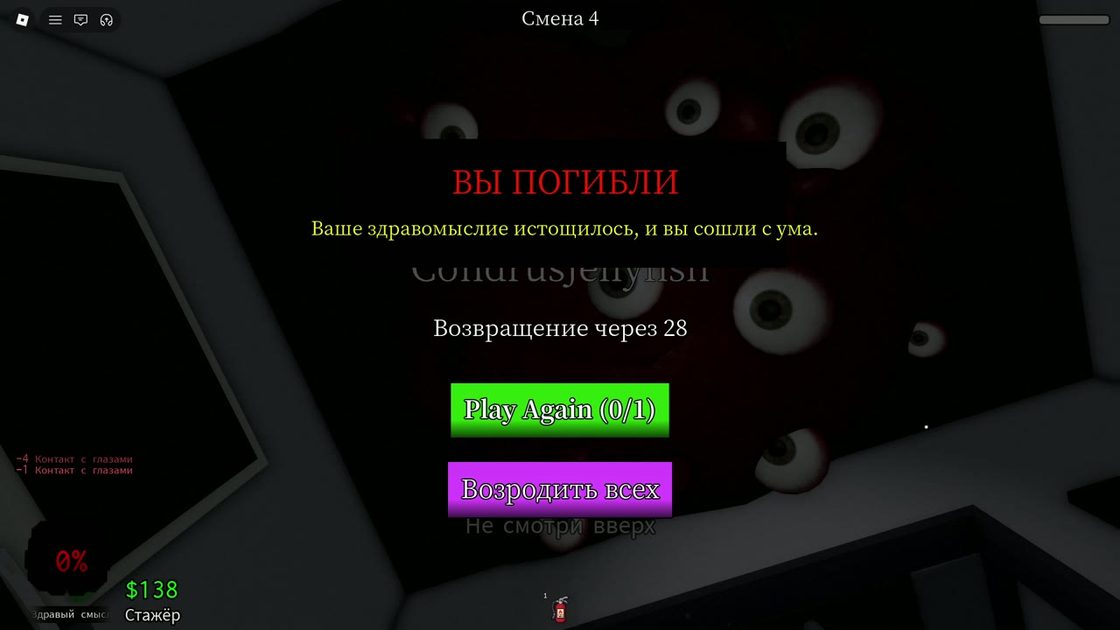
The cost of error is high and abrupt: wrong treatment or a missed anomaly = death, and sanity can collapse in a spiral all the way to the "YOU DIED" screen. In the recording the team reaches Shift 4 and loses: sanity drains from 25% to 0% on the Mass of Eyes. The horror leans heavily on jump scares (their effect fades with repetition), and between shifts there's routine running around between stations. Player’s voice: "And I got eaten. A monster under the bed… I’m left with 30% sanity. He had some anomaly — I just didn’t notice it."
What kind of game this really is
On the surface it's "heal the little animals," but by construction it's a co-op horror with a hidden role and three layers: workplace routine (admission, diagnosis, treatment), anomaly detection (three channels of clues + the admit/refuse decision) and survival (sanity, monsters, events) under a shared limit of 3 deaths.
Horror work-shift + a "friend or foe" detection game + co-op survival with a shared resource (sanity, 3 lives for the team, a shift report).
Game card
| Parameter | Value |
|---|---|
| Title | Animal Hospital ("Animal Anomaly") |
| Studio / author | Animal Anomaly · owner Roytt (verified) |
| Genre | Co-op horror · shifts · hidden role (anomaly detection) |
| Platform | Roblox · PC and mobile (landscape) |
| Like rating | 95% |
| Online (peak) | 633K |
| Visits | 296M+ |
| Server size | 30 players |
| Age rating | Minimal · voice chat supported |
| Created / updated | 05/10/2026 · update 07/01/2026 (frequent patches) |
Player journey: shift after shift
A full run through the recording of a live co-op session (~79 minutes) — what the player does, what they feel, and the design behind it. Each shift with an engagement and tension score. At the end of the part — the emotion map (see the "Pacing and fear peaks" section).
Five shifts of a single session (+ a co-op restart)
The recording is a solo entry with onboarding, then two-player co-op (Malvina201899 + CondrusJellyfish). The team reaches roughly Shift 4 and loses on the Mass of Eyes, after which it restarts. This is the early part of the game (the first four tutorial shifts); beyond that come Shifts 5–6, the "Ambulance" event every 5 shifts, and the full bestiary (see parts C–E). Below is how this particular stretch plays out.
The storefront and lobby sell a double fantasy
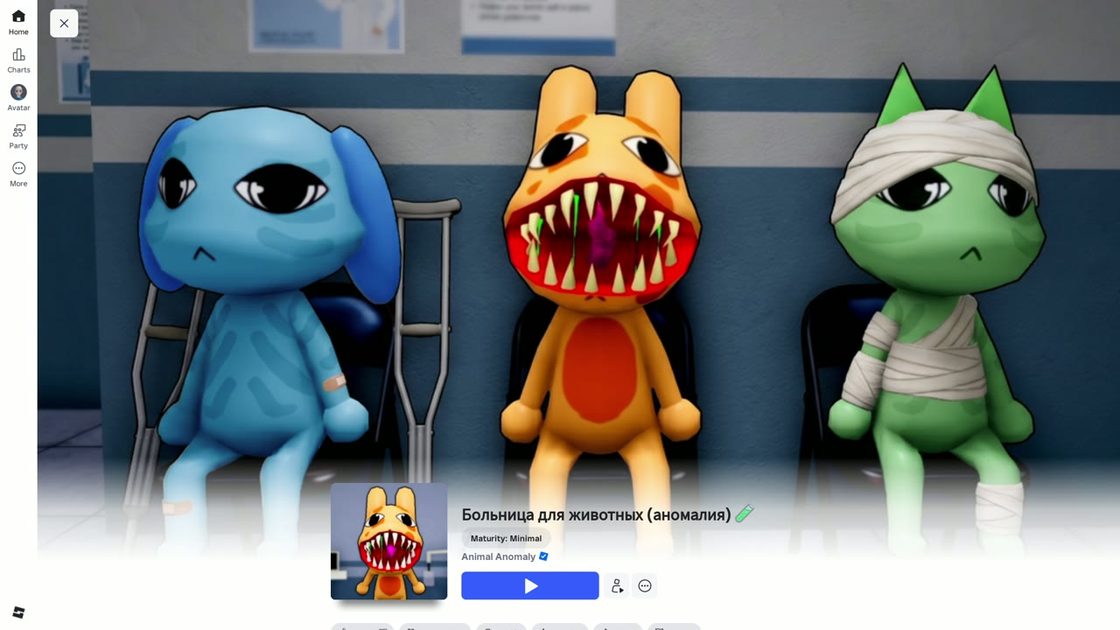
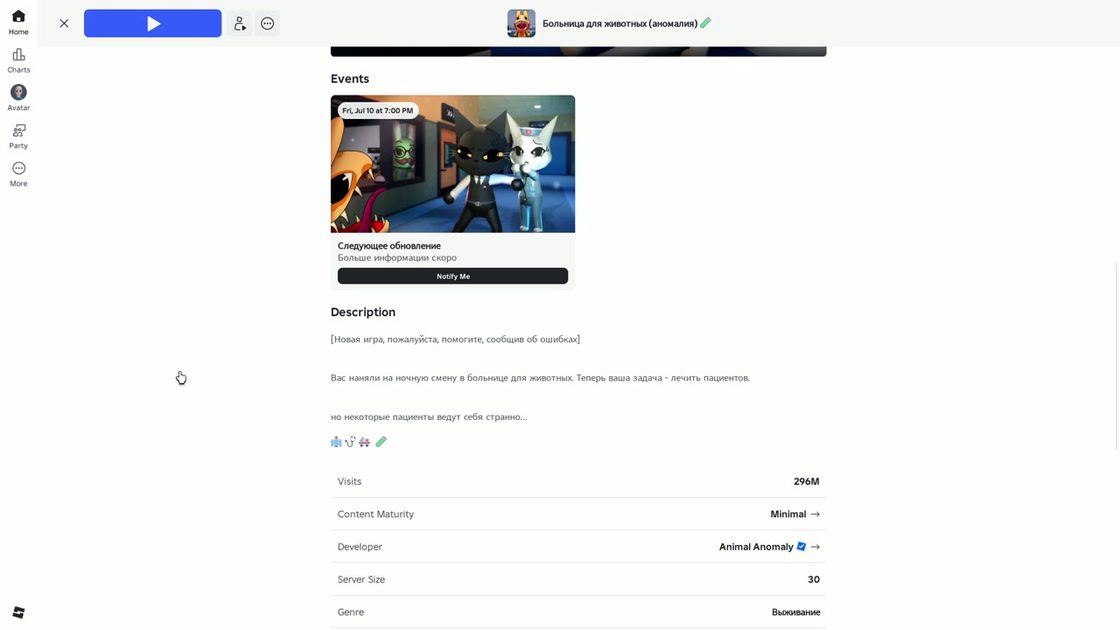
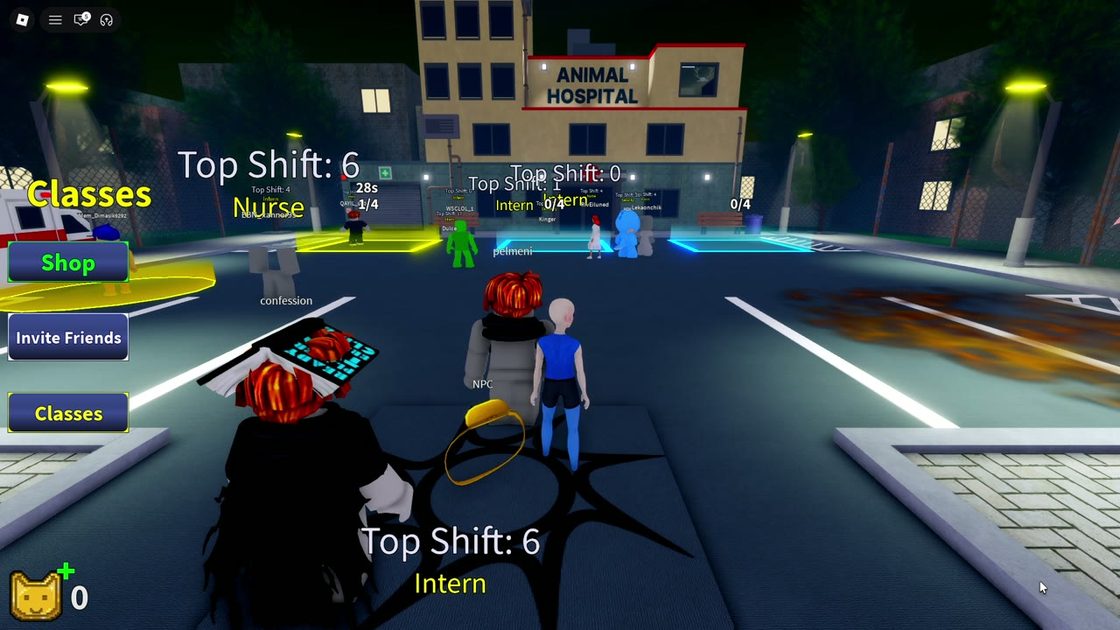
The game page: 95% likes, hundreds of thousands online, art of three "patients" where the central one is a fanged anomaly. The promise is double right away: the coziness of a vet clinic and a hidden threat. In the lobby the player browses the class shop (10 roles), reads prices in Animal Coins and Robux, and assembles a co-op team via the podiums with "Best Shift."
Design lens (hook): the cover honestly shows the genre — cute animals + one monster. The expectation ("someone will have to be figured out") matches what the game delivers. There's no gap of "promise ≠ product."
The first shift: admission, diagnosis, first treatment
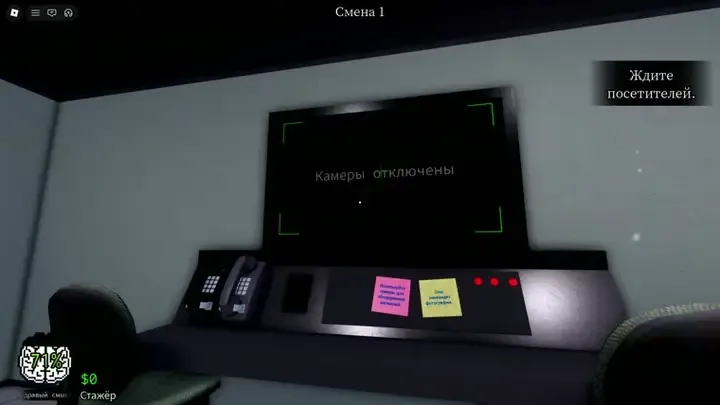
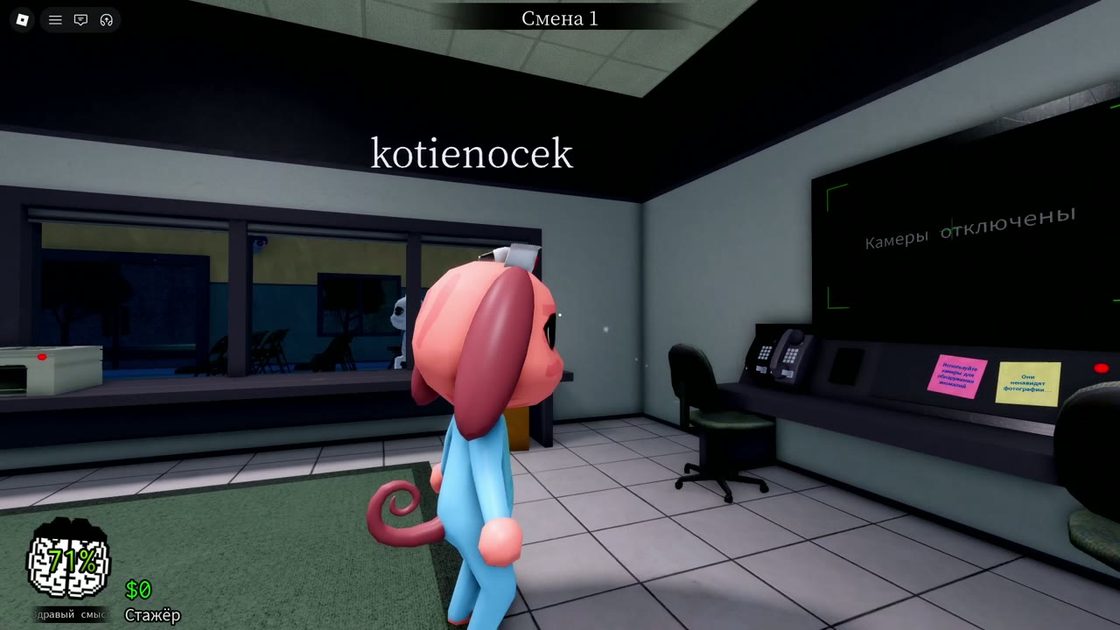
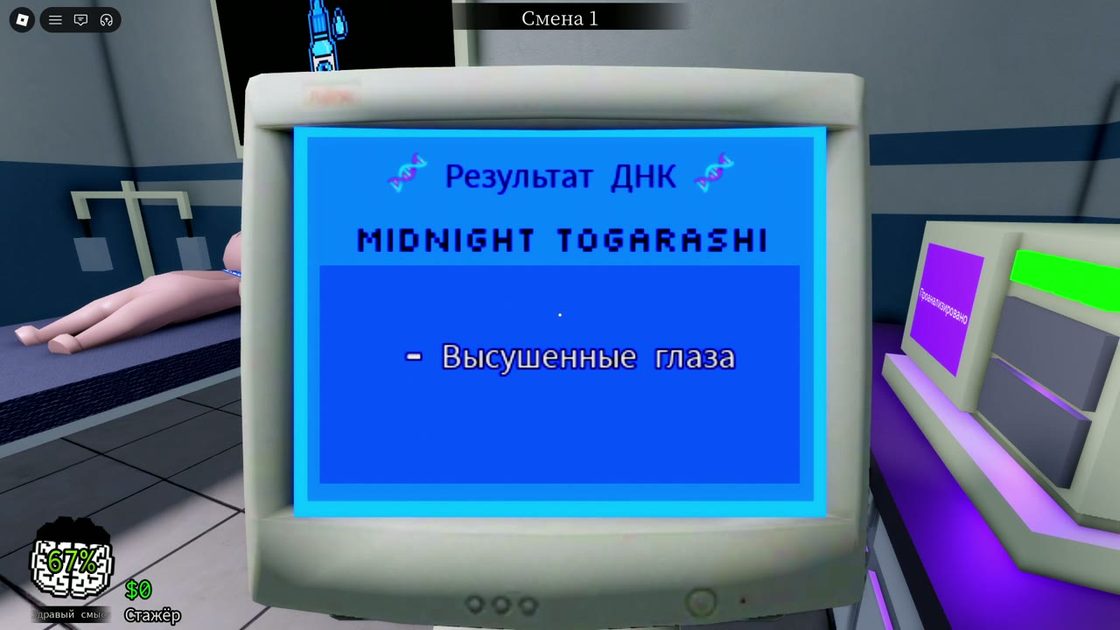
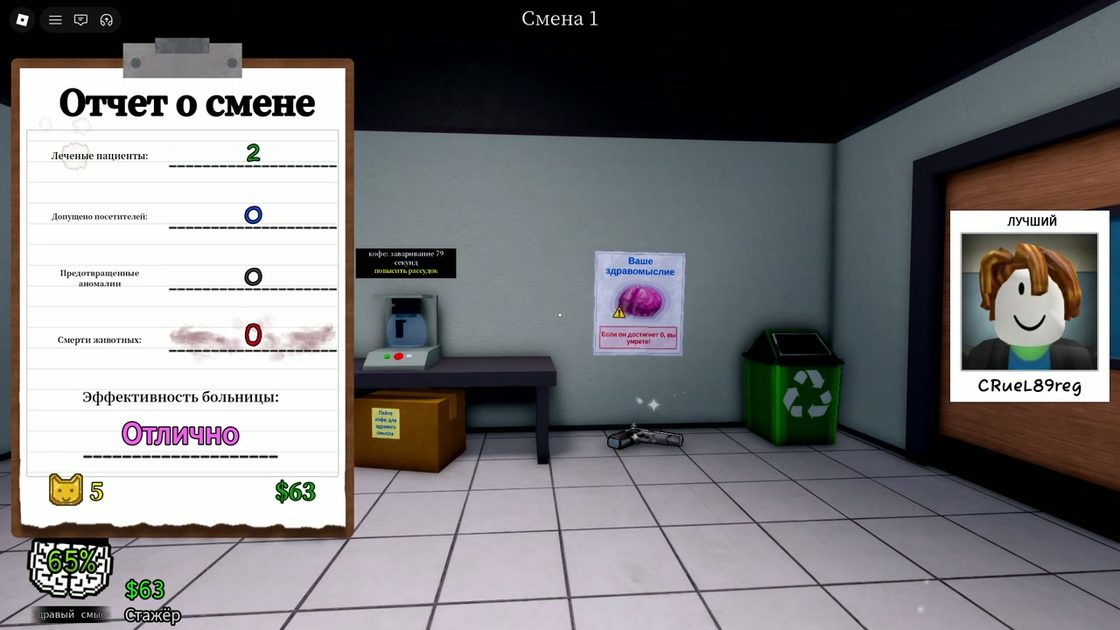
Starting with sanity at 71% (the Intern class), balance $0. Shift 1 is always the same: two scripted patients, guaranteed ordinary animals. The first arrives with a stomachache → Herbs, the second with dry eyes → Eyedrops. The game teaches without a single screen of text: yellow arrows and hints guide you through "Take a photo → Register on the PC → diagnosis → treatment." At the end, Dr. Harlow opens the shutters and the cameras, and always gives $63 if no one is killed.
Design lens (FTUE): the first shift is deliberately toothless — it sets the rhythm of the routine and muscle memory before introducing the threat. An "Excellent" report reinforces the correct behavior pattern.
Anomalies, shutters, cameras and the supplies shop appear
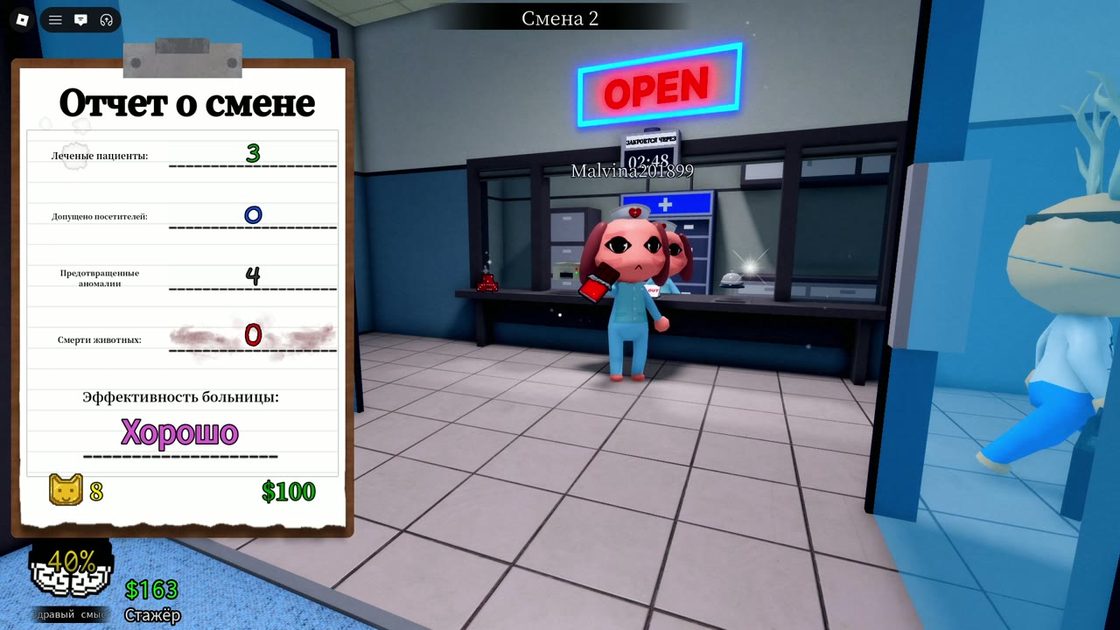
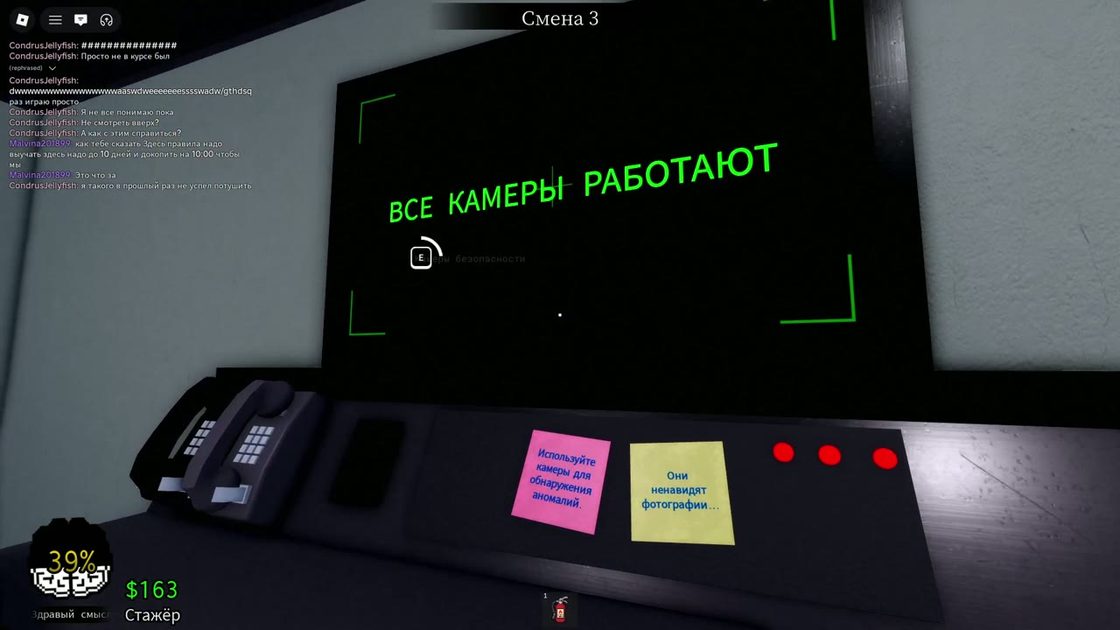
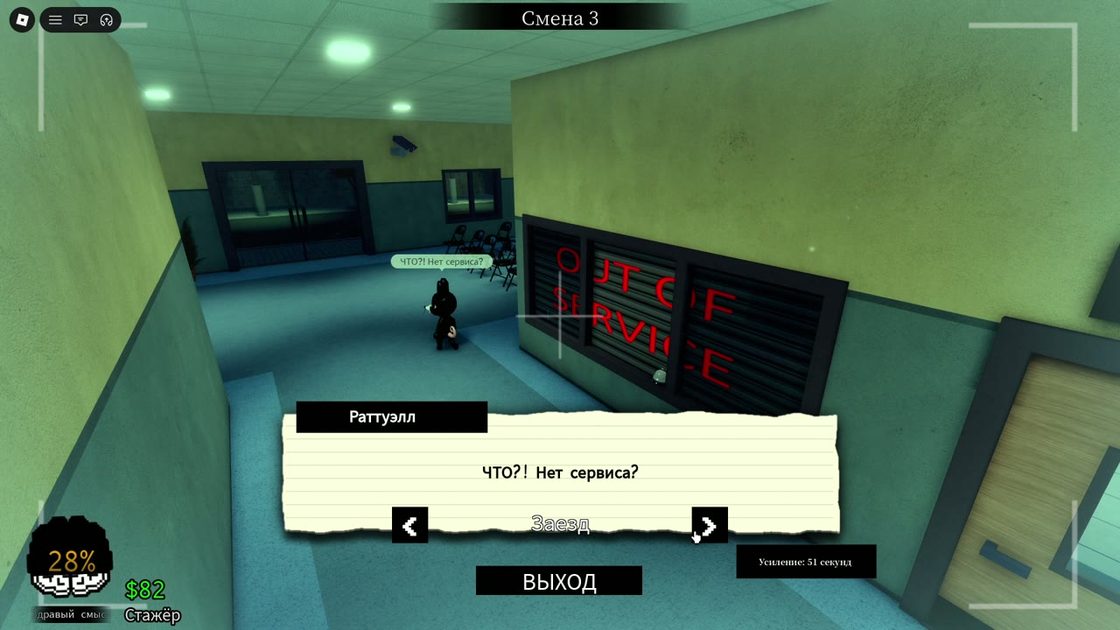
From Shift 2 on, you get ordinary patients, story characters (Barney, Ron from Accounting, Ratthew — these can be admitted) and anomalies. The player begins using the red "Shutters" button ("use the shutters to turn people away") and the surveillance cameras ("ALL CAMERAS OPERATIONAL"). At the end of the shift, Harlow opens the emergency wing (rooms 6–8) and the shop. Report: 3 patients, 4 anomalies prevented, 0 deaths — "Good," +$100.
Design lens (escalation): the threat is introduced exactly when the routine has been mastered. New tools (shutters, cameras, shop) arrive in a bundle — the shift feels like "the real work has begun."
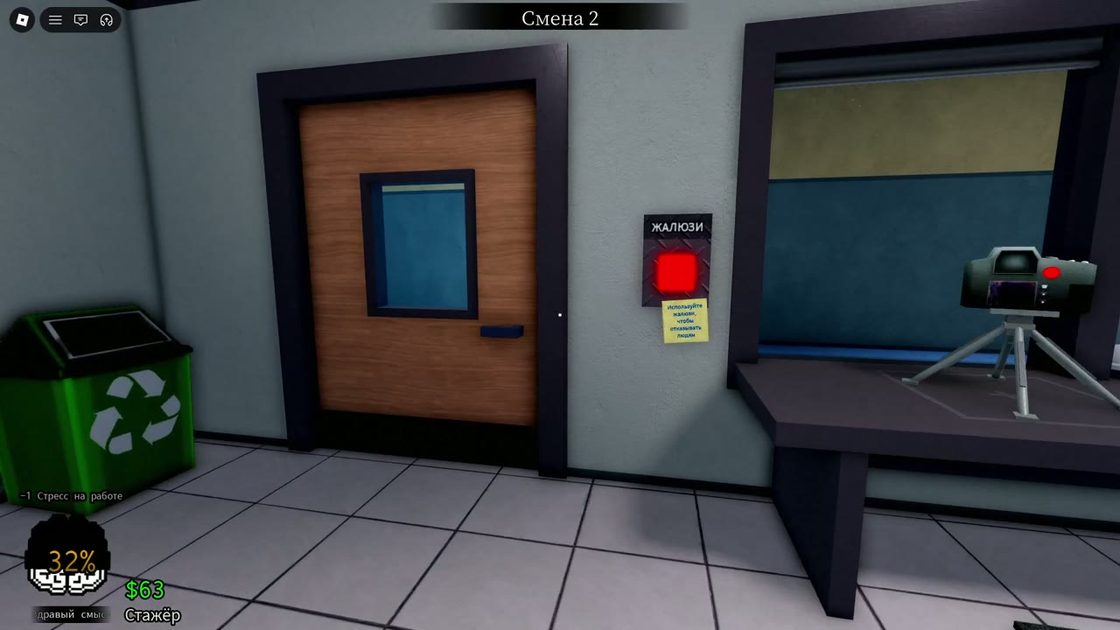
The emergency wing, the taser, the Tendril and the death ritual
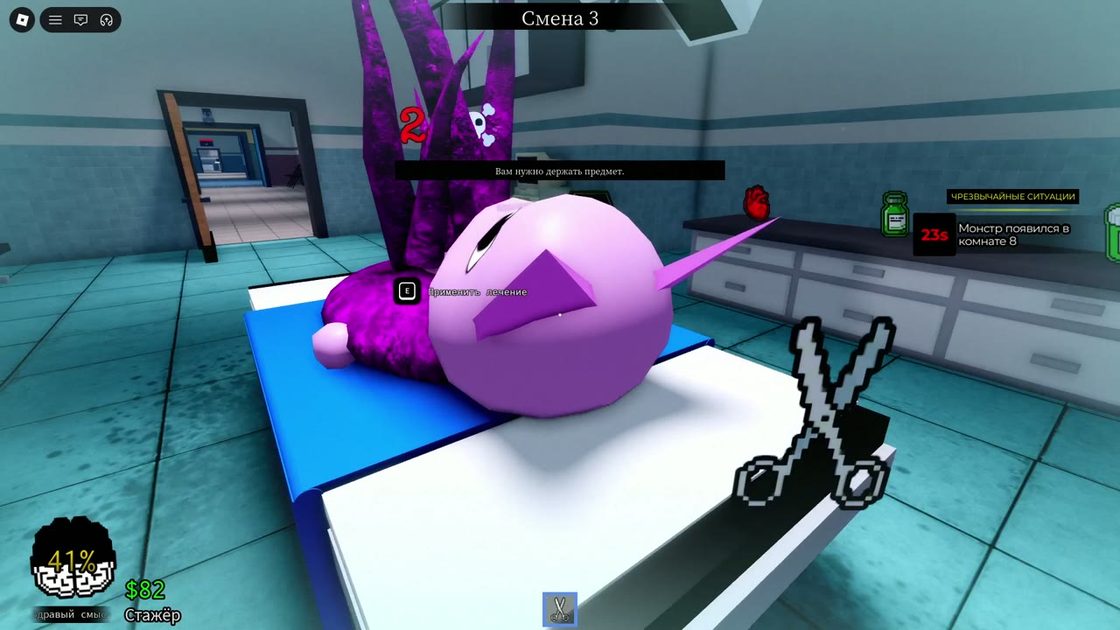
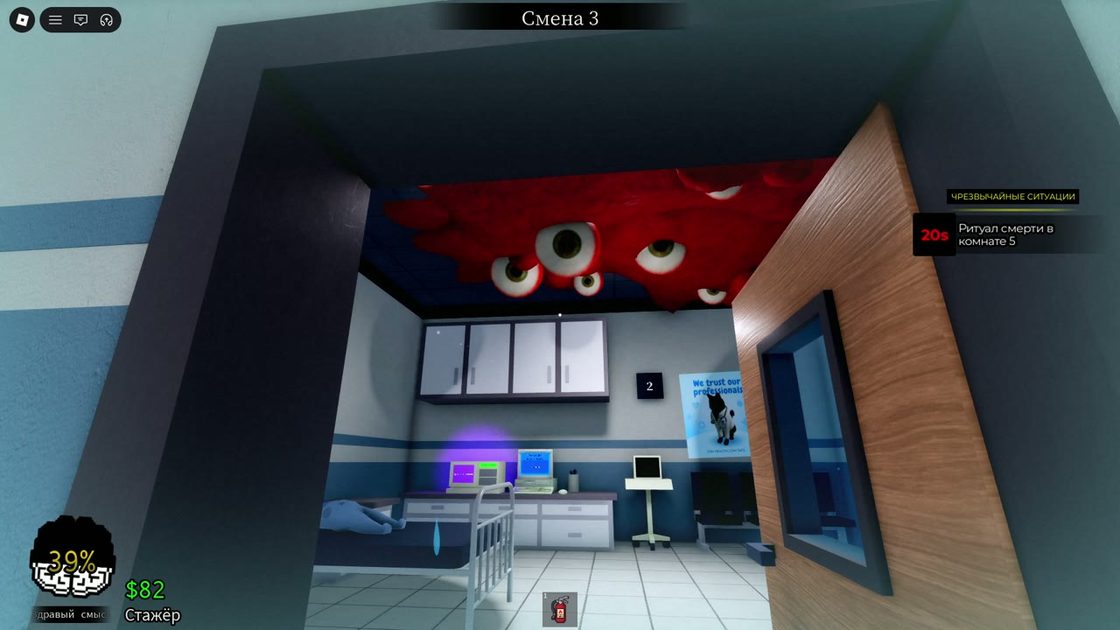
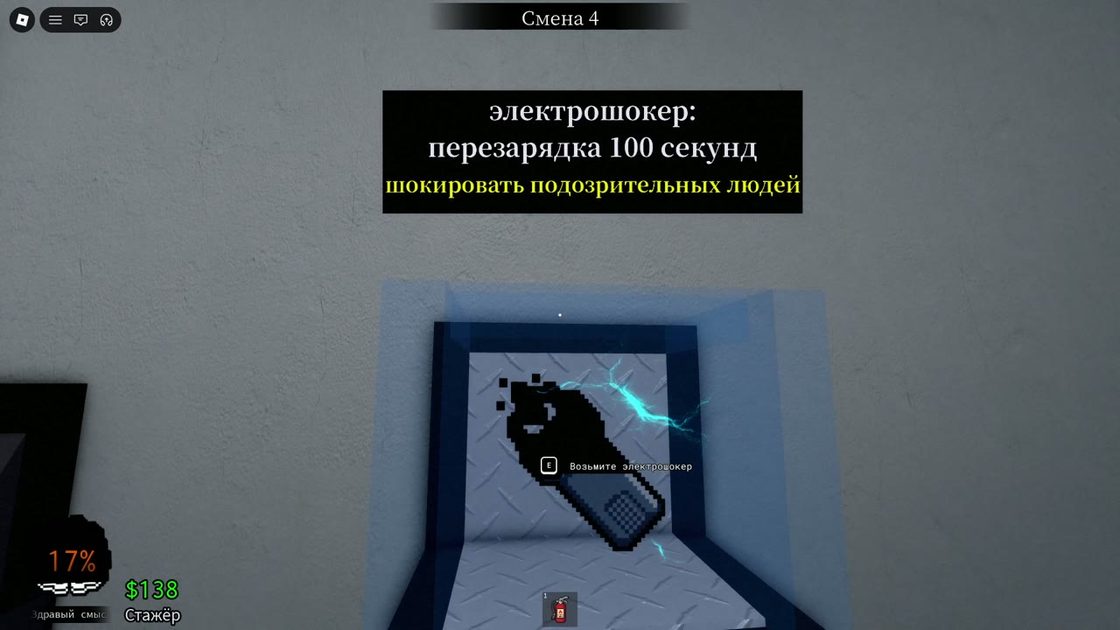
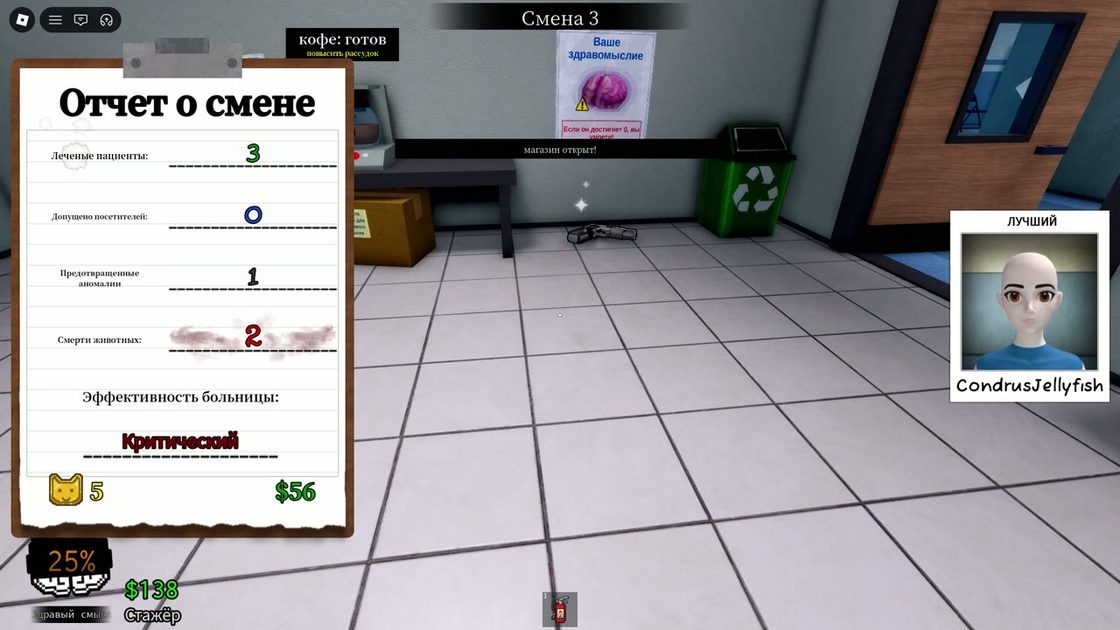
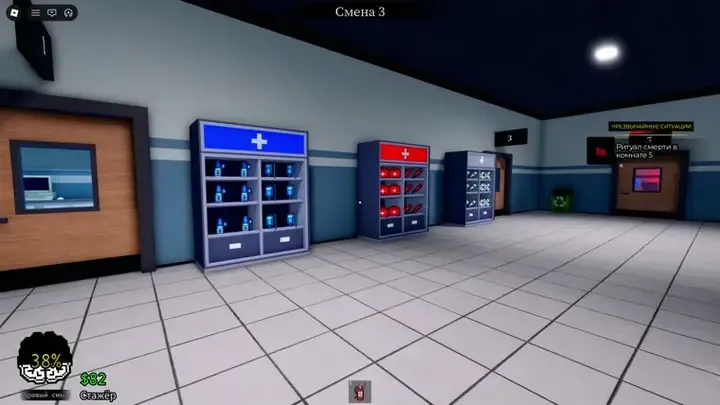
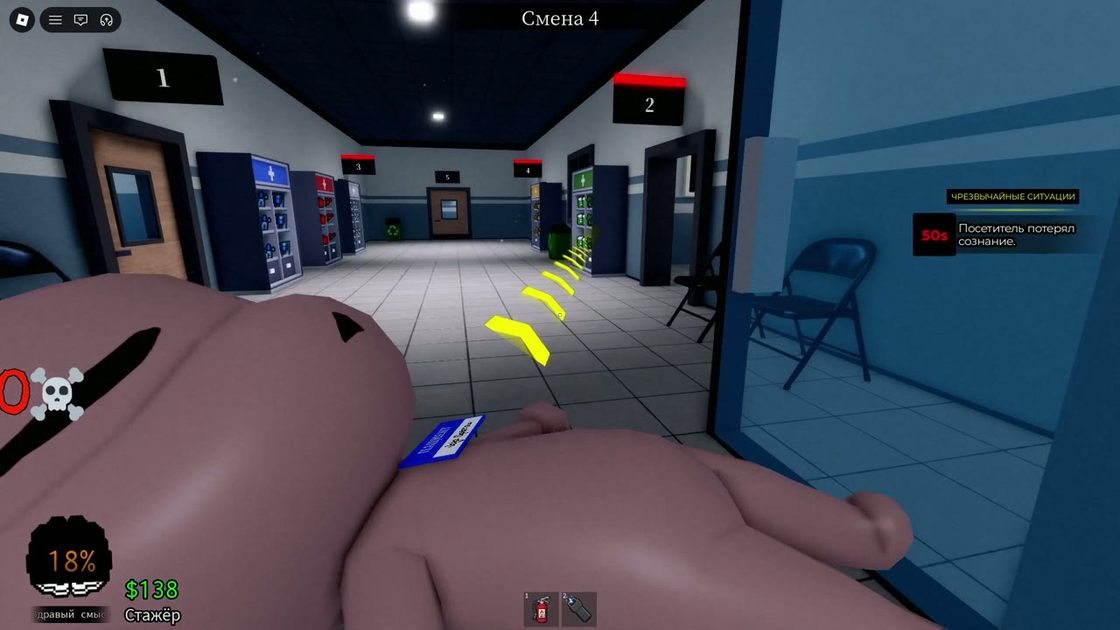
Shift 3 opens up the taser (free at the start, "shock suspicious people") and loads in the emergency wing: surgeries with the diagnosis "SURGERY: Antibiotics" and mini-games. Events arrive: "A death ritual in room 5" (40s) and the Tendril in room 8 (23s). This is also where the first patient deaths happen — the Shift 3 report: 3 patients, 1 anomaly, 2 animal deaths → a "Critical" rating, $56 in all.
Design lens (risk): the emergency wing sharply raises the difficulty — timers, patterns, monsters. A "Critical" report is honest but painful feedback: two mistakes, and failure is one step away.
Heavy anomalies, a sanity collapse and the "YOU DIED" screen
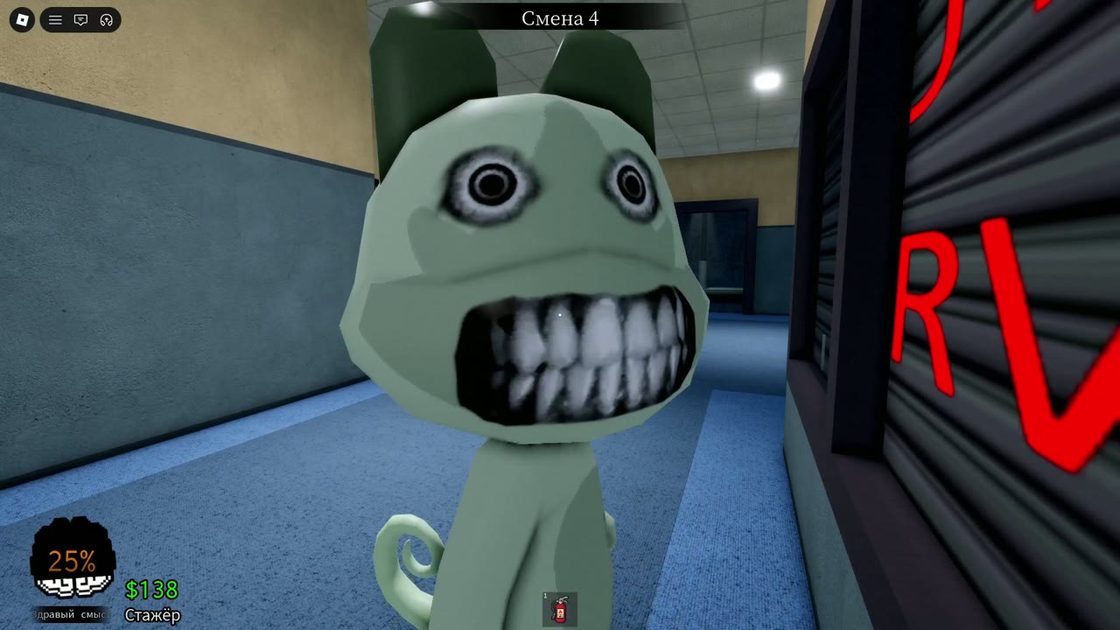
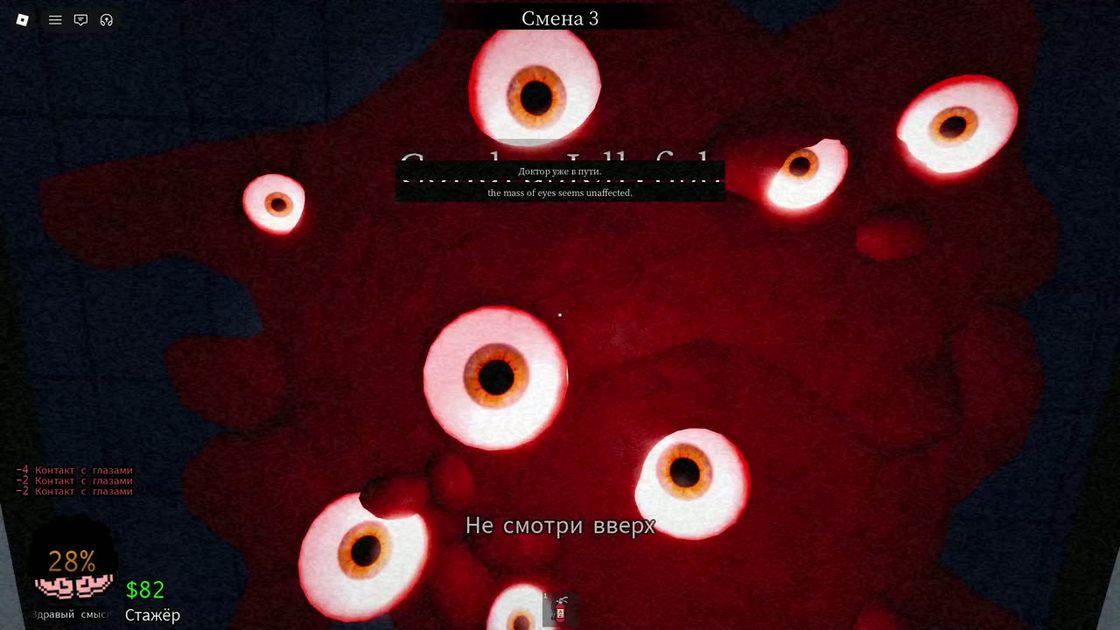
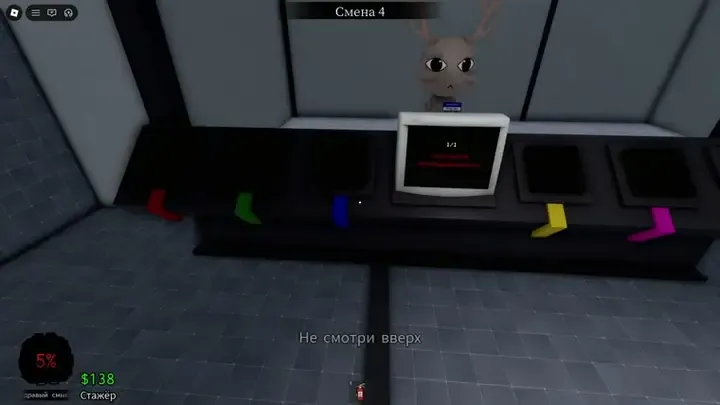
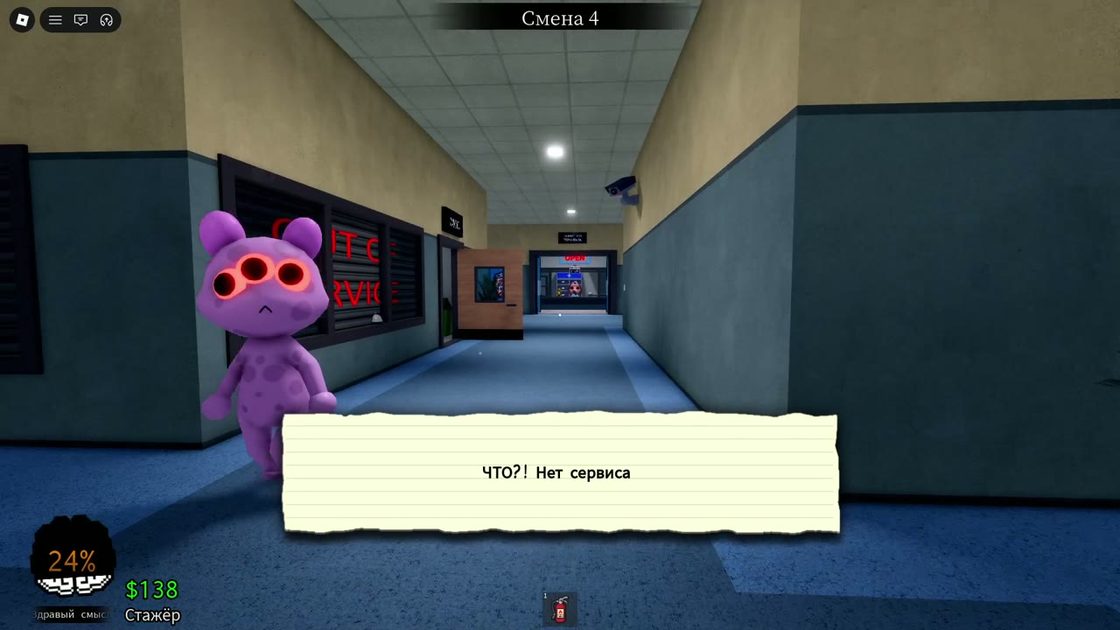
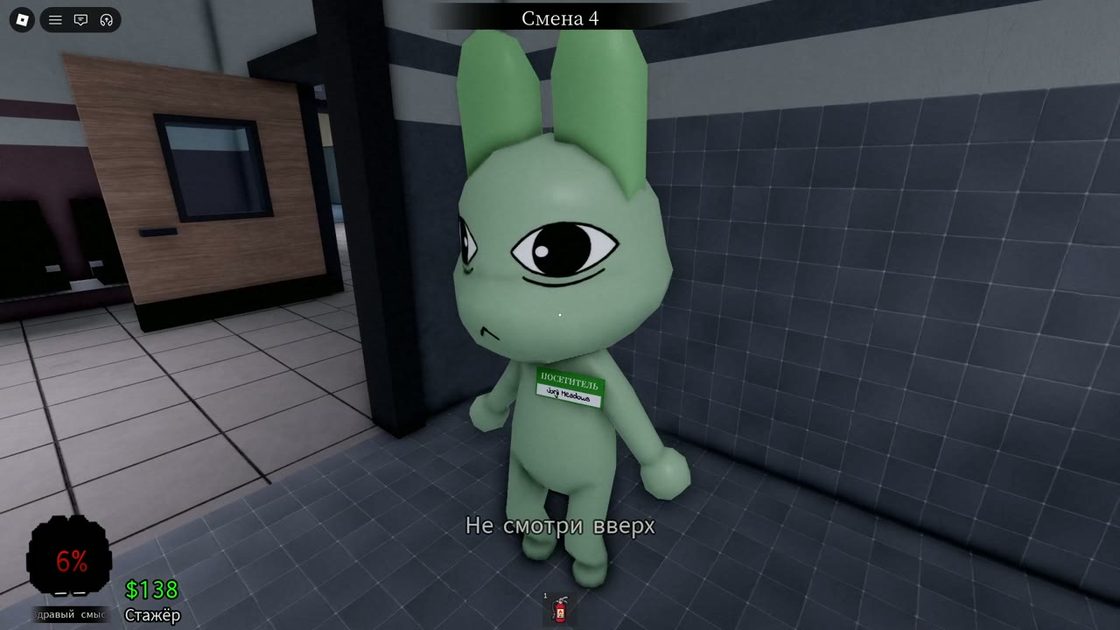
Shift 4 is the climax of the recording. More overt anomalies arrive (a purple bear with three eyes, a green cyclops rabbit "Jory Meadows"), the player picks up the taser (100s recharge). Sanity crumbles: 25 → 21 → 6 → 0%. On the Mass of Eyes from the ceiling ("Don't look up," −4 per contact) the team ends up on the "YOU DIED — your sanity ran out and you lost your mind" screen. Death is shared: "Revive All."
Design lens (failure): the sanity collapse is a spiral: the lower it goes, the harder it gets (the screen desaturates below 35%, the music slows down). The loss feels deserved but abrupt — a newcomer doesn't always understand what exactly killed them.
The player at that moment: "‘Don’t look up,’ they tell me. There’s someone above me… something in the room on the ceiling."
Back from the first shift again — now more confident, as a duo
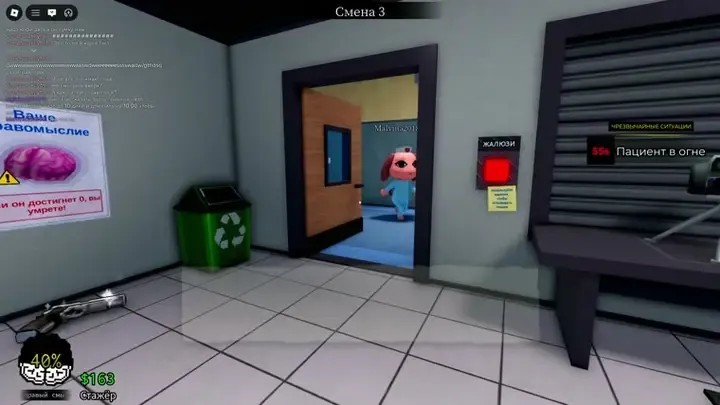
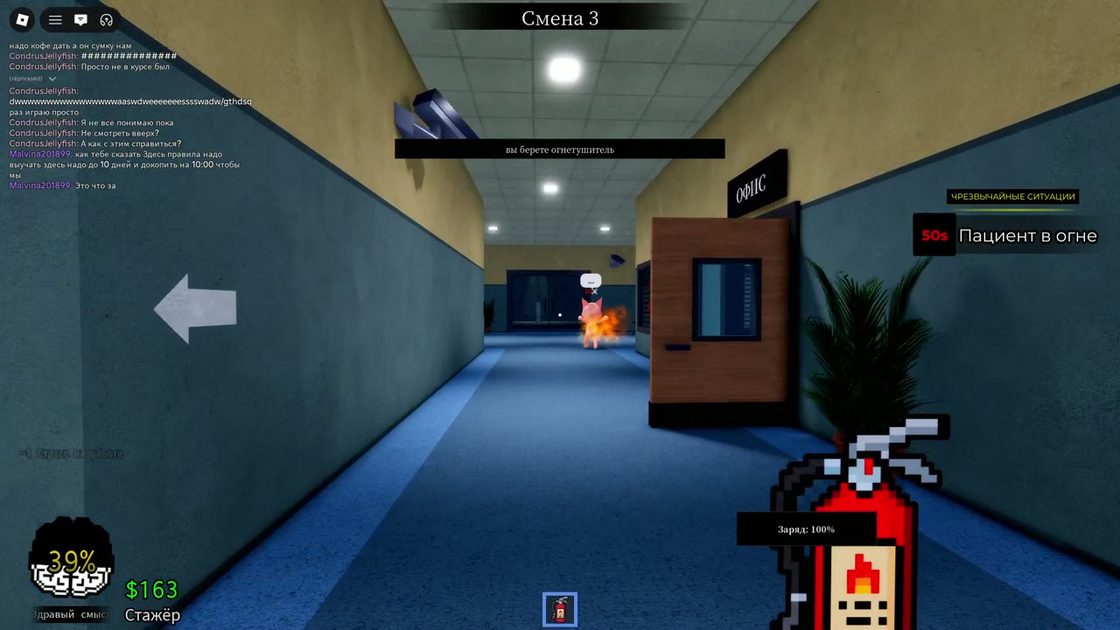
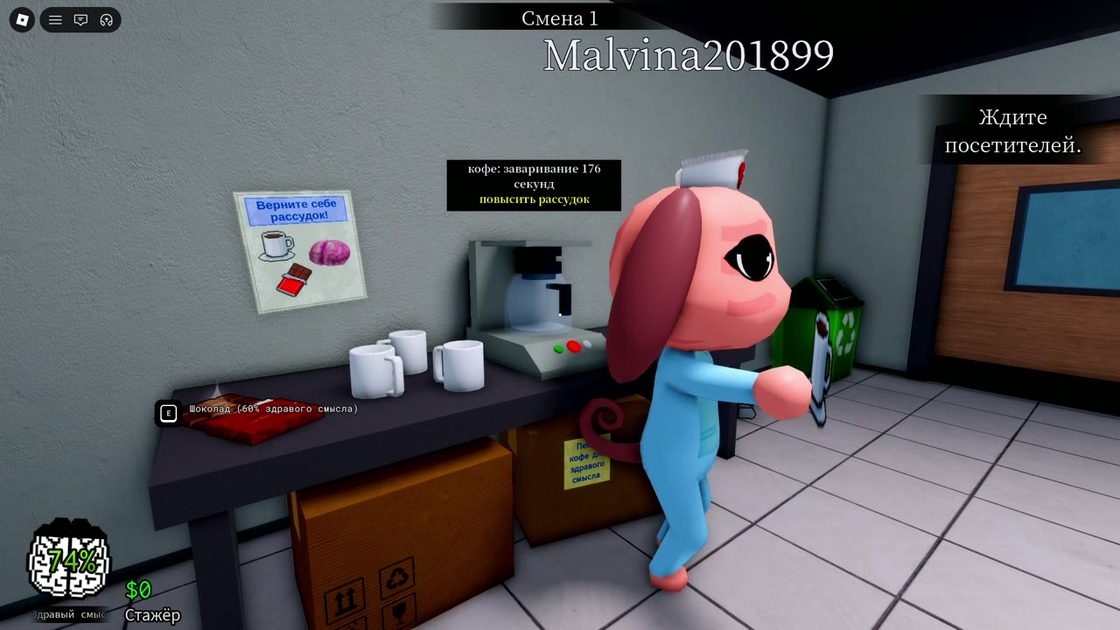
After the death — back to the lobby (the "Highest Shifts" leaderboard, a queue at the ambulance) and a new co-op run. The team clears the shifts more confidently: works the coffee station (sanity recovery), handles the "Patient on fire" event (50s, fire extinguisher "Charge 100%"), enters the X-ray room and the diagnosis mini-game "Copy the sequence." The session ends by exiting through the Roblox menu — with no final failure.
Design lens (mastery): the second run shows the learning curve: the same threats read faster, panic gives way to procedure. That's what replayability is — not new content, but growing competence.
Over ~79 minutes the team lived through the full emotional cycle of horror: calm tutorial (Shift 1) → mounting vigilance as anomalies and tools are introduced (Shifts 2–3) → a peak of panic and a deserved death on Shift 4 → a restart where fear gives way to procedure. The game is strongest in the moment of reading an anomaly and in co-op panic over shared lives; weaker in the abrupt, not always transparent cost of error and in the routine running around between stations. The full picture (Shifts 5–6, the "Ambulance" event, the entire bestiary and the class economy) — in parts C–E.
How the game looks
Art direction, the clinic layout, the anomaly gallery and the monster bestiary — everything the team that will rebuild this needs.
Coziness turned inside out into dread
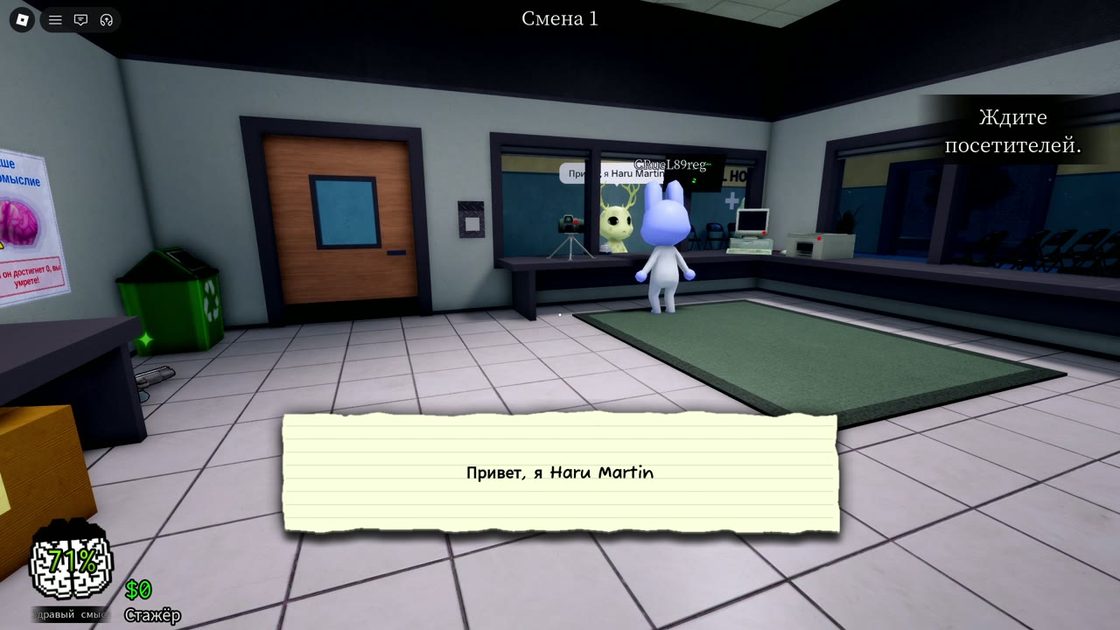
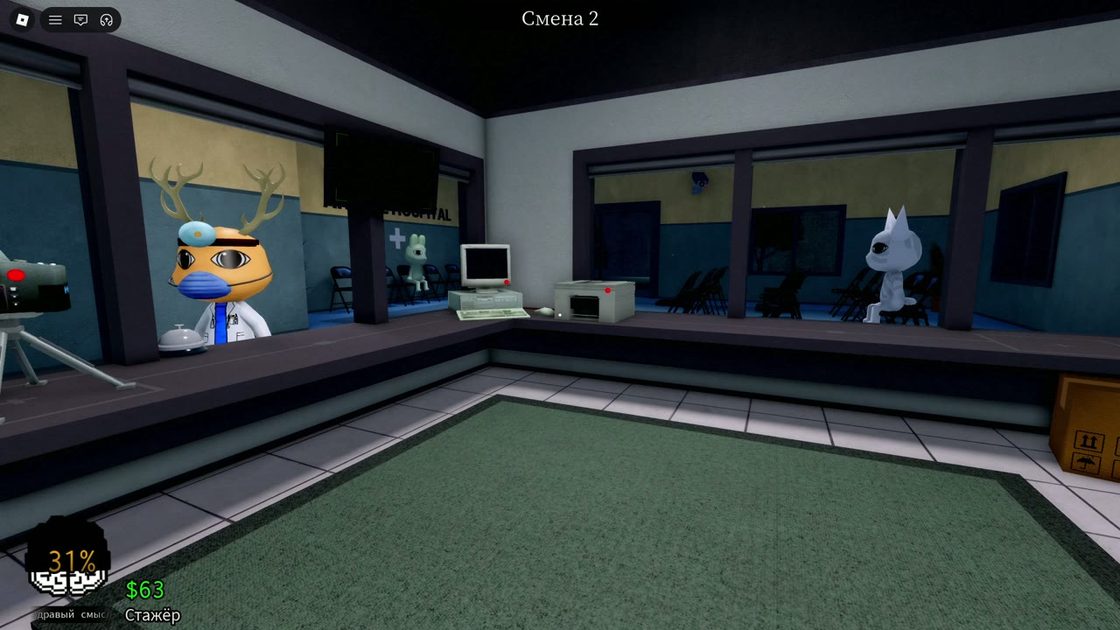
The game's visual trick is contrast. Soft claymation-style animals, the warm light of the reception area and a service bell sit next to deathly eyes, sharp teeth and fleshy monsters. The same cute character template becomes uncanny from a tiny shift (an extra eye, black eye sockets, static). The camera is first-person, the interface is large and legible.
How the space of a shift is arranged
The whole game takes place on a single hospital map with clear zones. The player constantly moves between the reception window, the office with the cameras, the two treatment wings and the shop. The distances between stations are part of the pressure: while you run for a medicine, somewhere a timer is ticking down.
Key zones and stations
| Zone | What's there | Unlocks |
|---|---|---|
| Reception window (Check-in) | Admitting visitors, photo camera, service bell, the red "Shutters" button | Shift 1 |
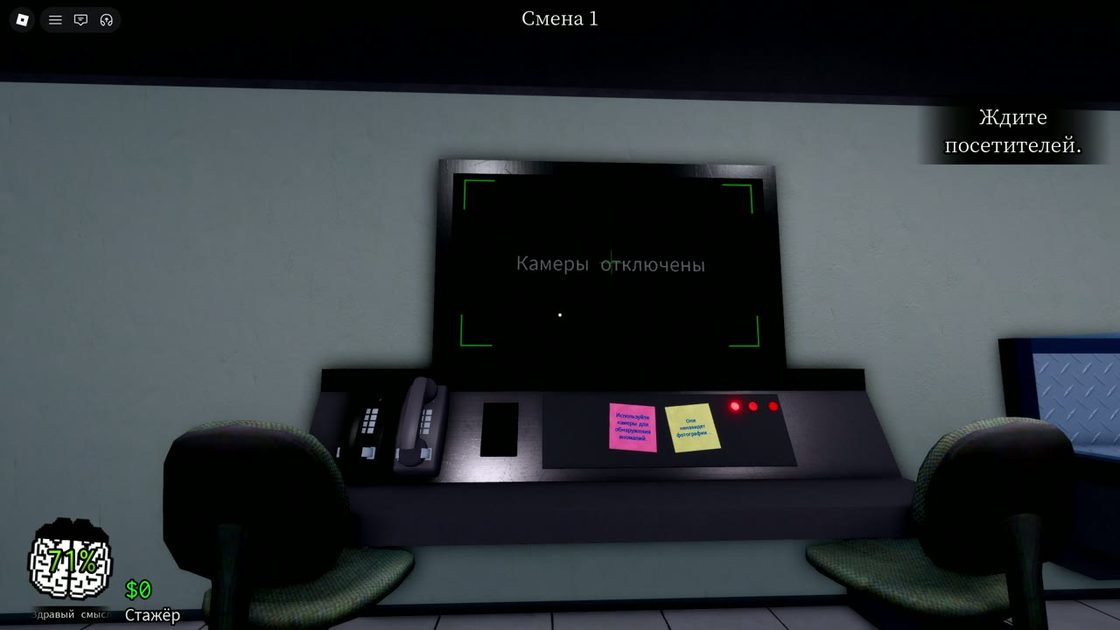
| Office / cameras | Surveillance TV (4 cameras), hint stickers, coffee station | cameras — end of Shift 1 |
| Medical wing (1–5) | Ordinary treatment: PC diagnosis, treatment screen, medicine shelves | Shift 1 |
| Emergency wing (6–8) | X-ray (room 6), heart scanner (room 7), operating room (room 8) | end of Shift 2 |
| Supplies Shop | 3 random items for $ + Animal Coins; reroll for 6 Robux | end of Shift 2 |
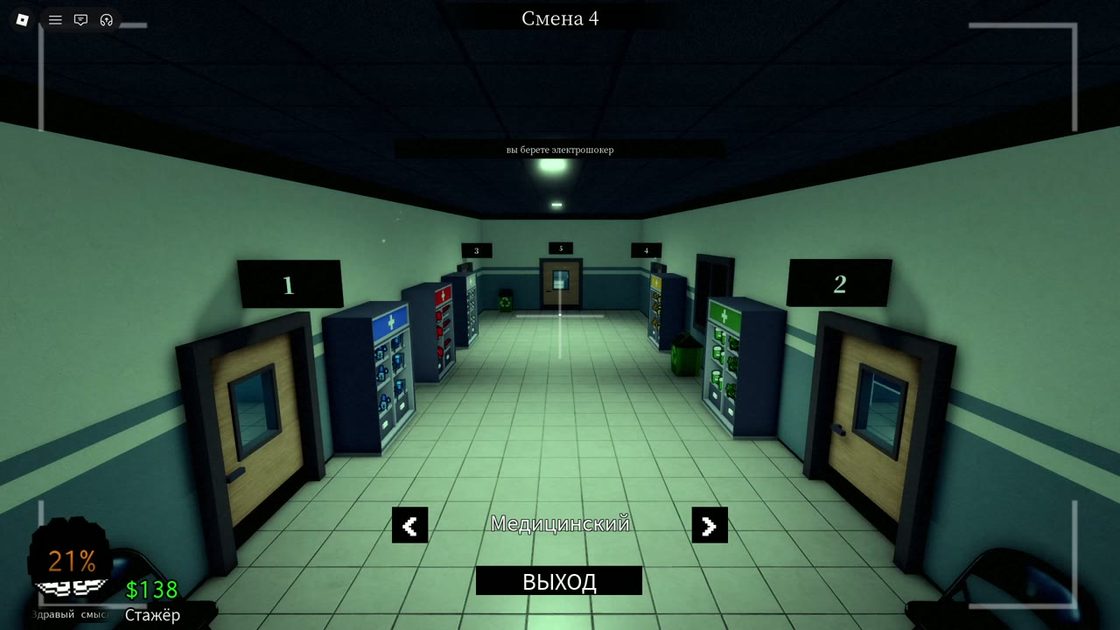
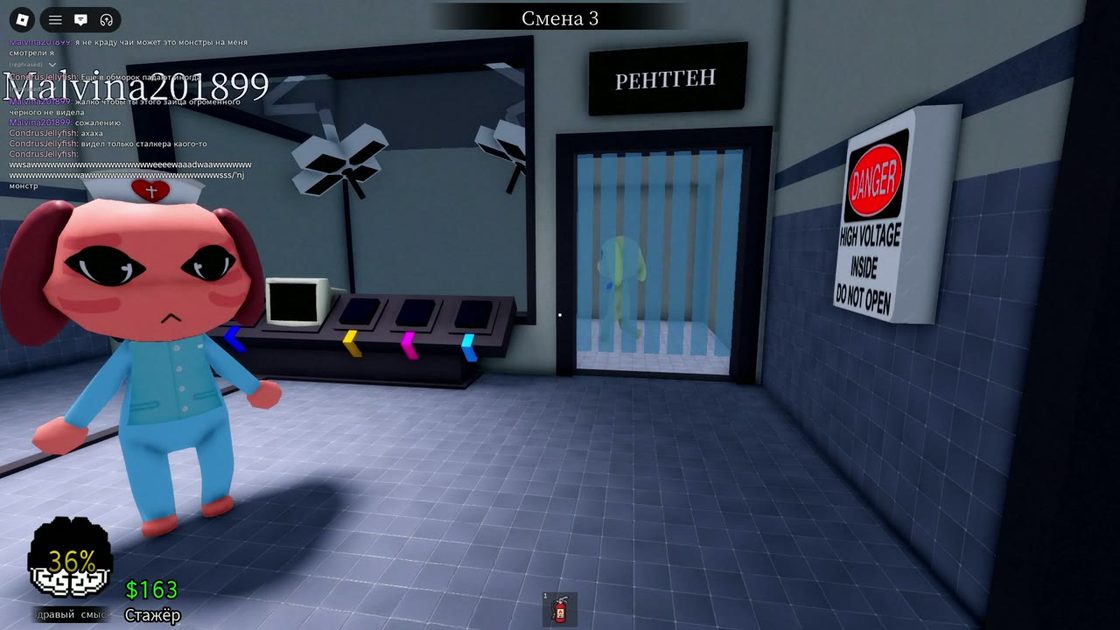
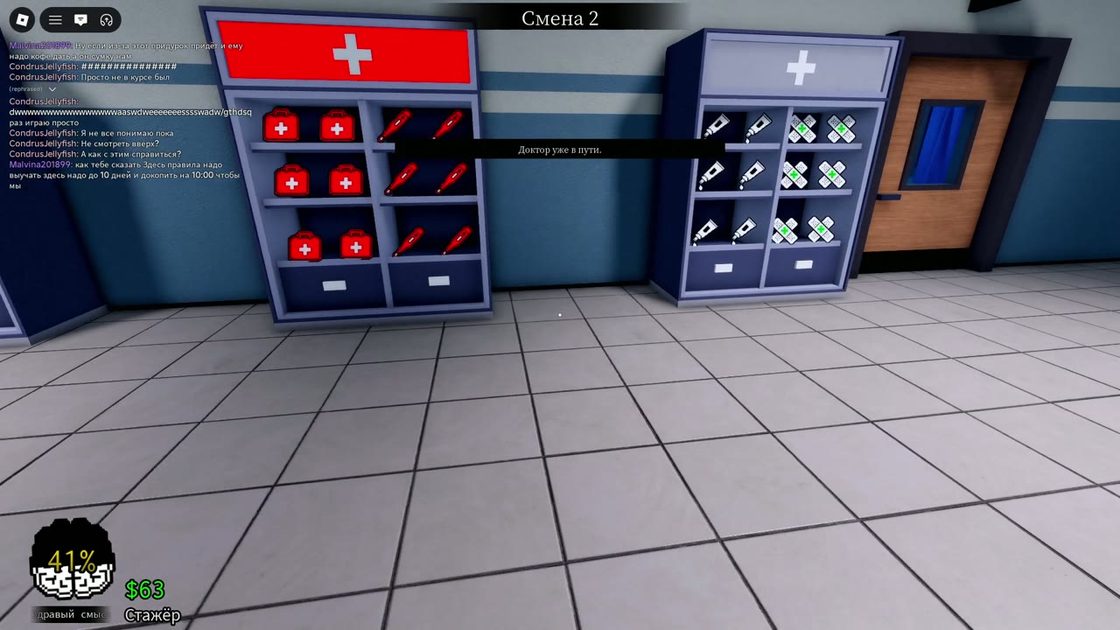
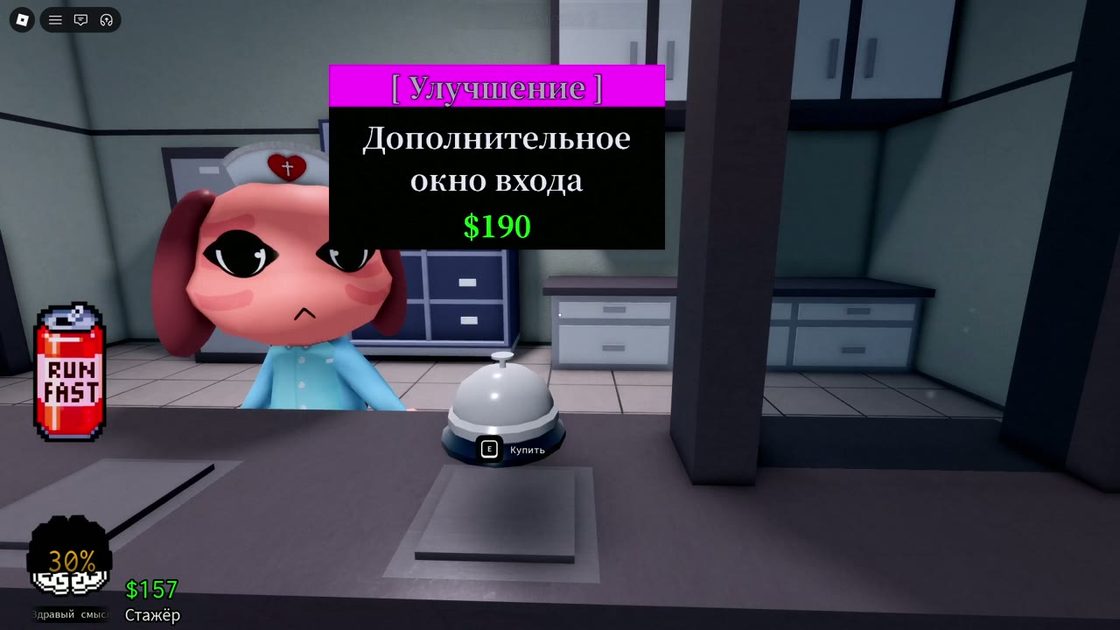
the core of the game — Three channels of clues and the "admit/refuse" decision
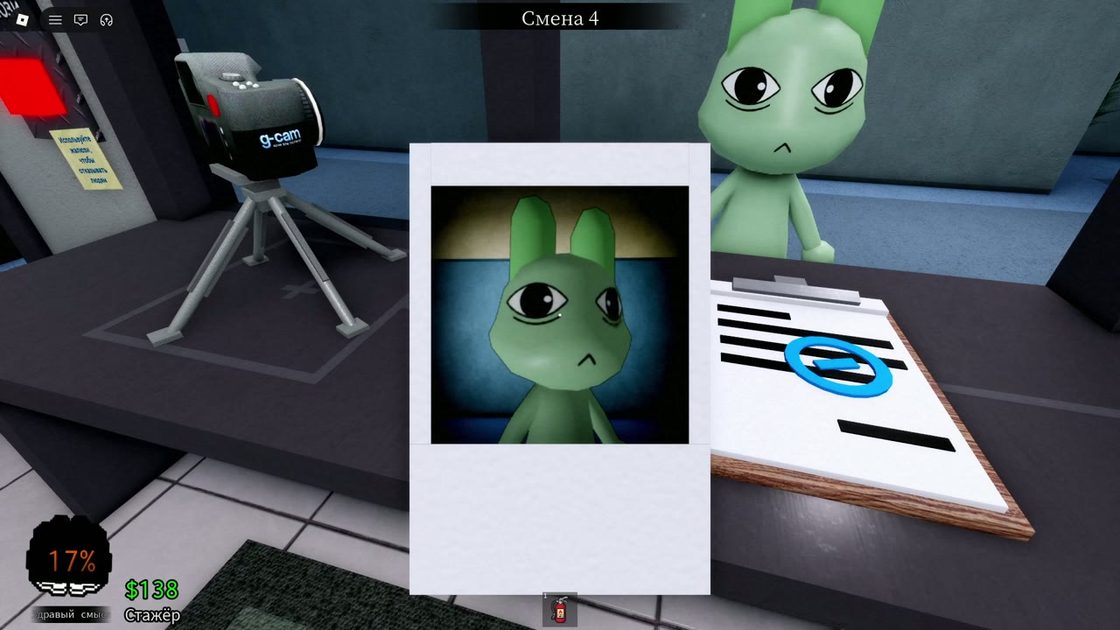
Anomalies are entities disguised as patients. They're given away by "tells" visible through three independent channels: live at the window, in a photo from the Polaroid camera, and on the surveillance cameras. A single patient can carry several signs at once. Admitting an anomaly means triggering an event (a death ritual, a monster) or getting a Shapeshifter that attacks. Refusal — the red "Shutters" button.
How to read a patient: three channels
| Channel | What it shows | Signs |
|---|---|---|
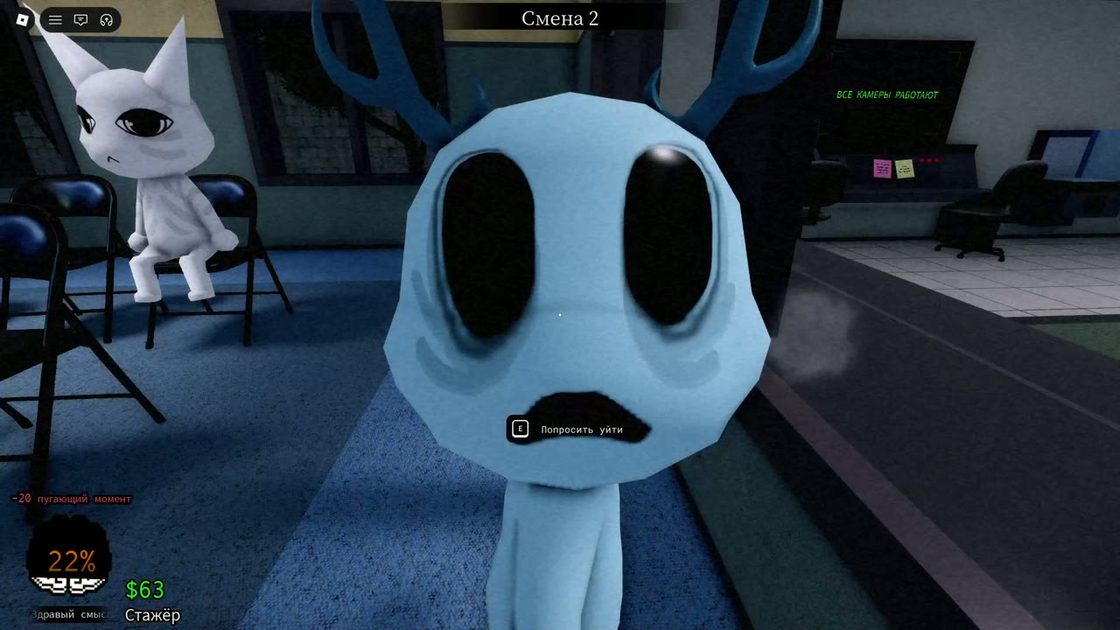
| Live (at the window) | Appearance and behavior | mismatched / extra eyes, sharp teeth, a hollow face, twitching, an elongated neck, a low distorted voice |
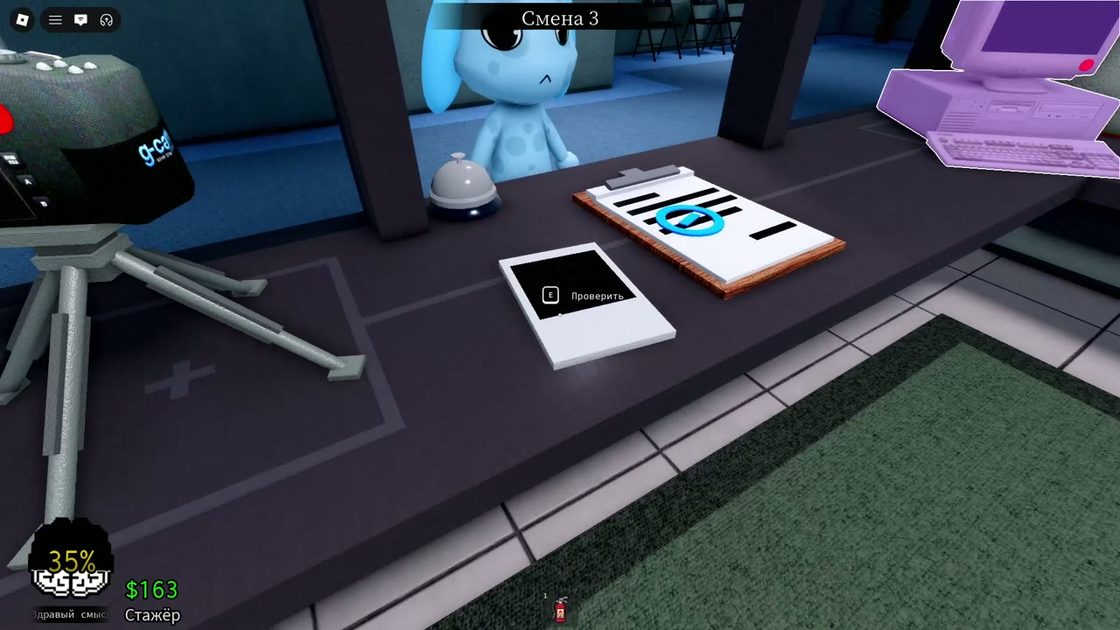
| Photo camera | Patient's Polaroid | different eyes/ears/mouth, "static" on the shot; a cursed photo = −10 sanity when looked at |
| Surveillance cameras | 4 cameras in the office | black eyes, a "boneless" stretched body, staring into the camera, total blackness — visible only on the feed |
Types of "tells" (reference)

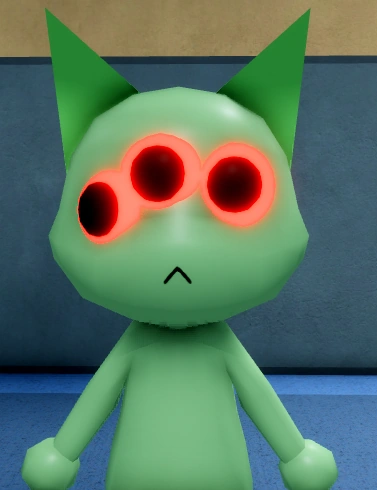

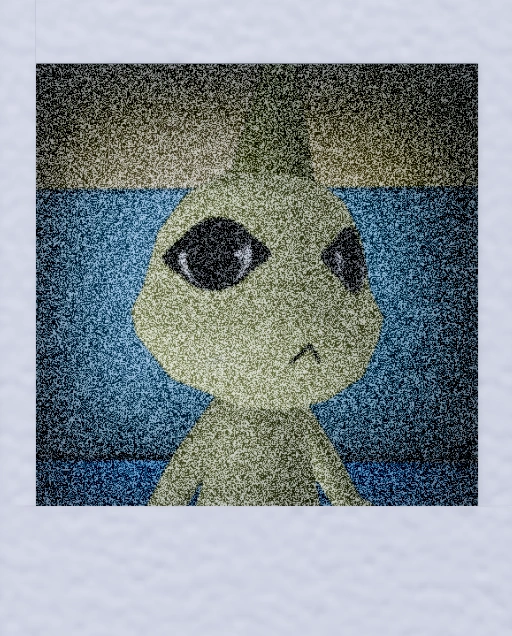
Player’s voice: "I didn’t like the way he was talking, so I’m going to patient #5"; "I shut the shutters because the lights flickered when he was coming in." That is exactly how detection intuition works — off small signals.
Caught anomalies — from the recording
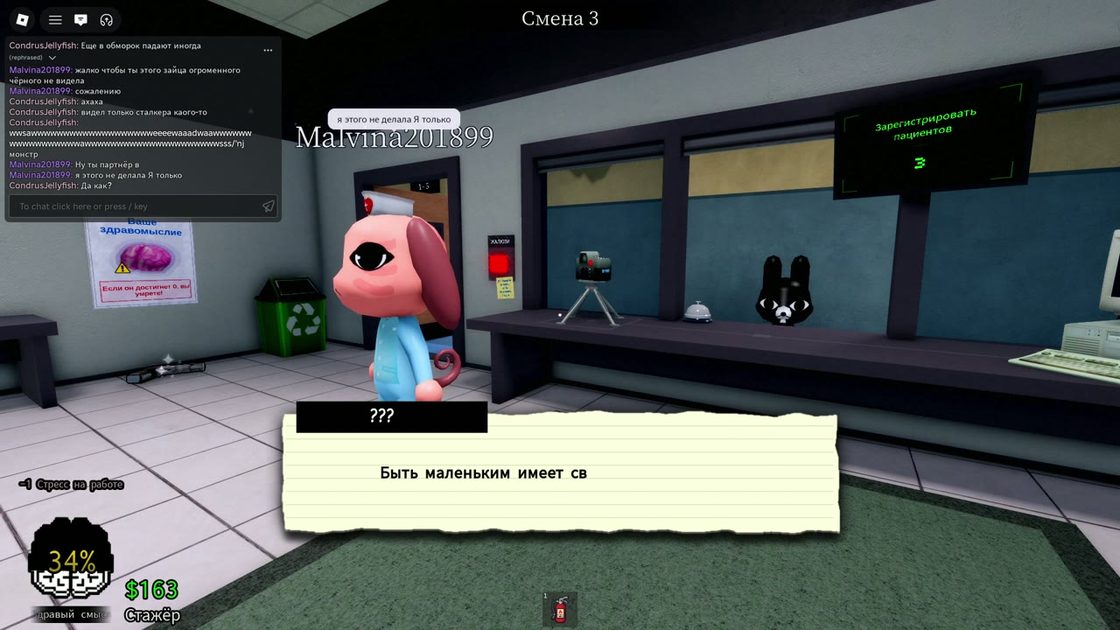
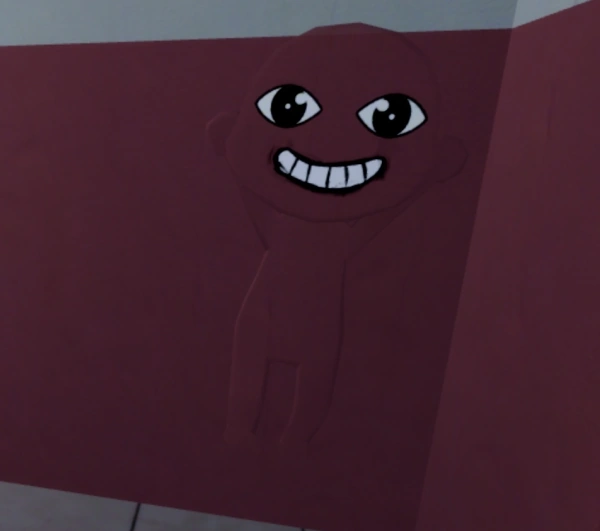
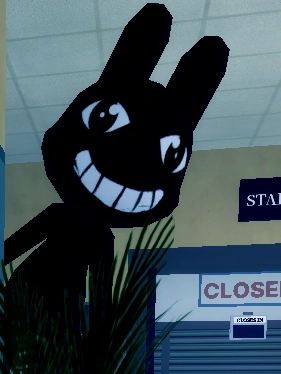
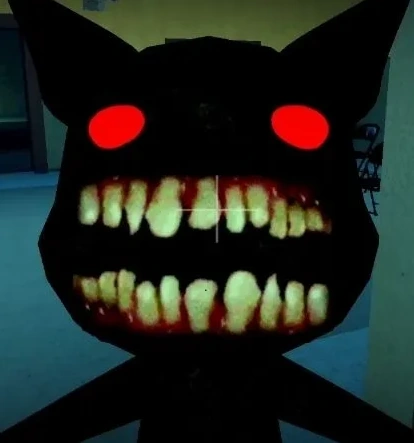
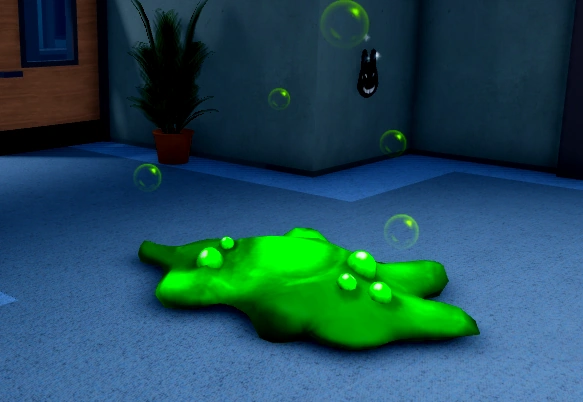
Monsters: how they look, how they hit, how to fend them off
If an anomaly is the riddle at the door, the monsters are the threat inside. Each has its own channel of appearance, its own sanity attack and its own counter-item. For a clone, this is the list of entities that need to be modeled and scripted. Damage values are from the official wiki.
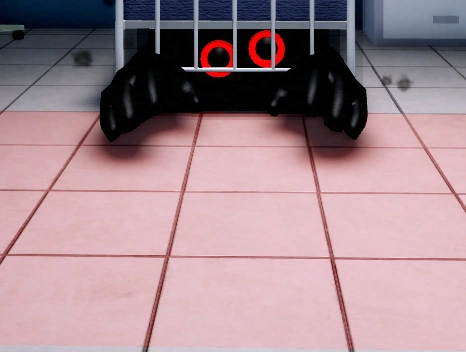
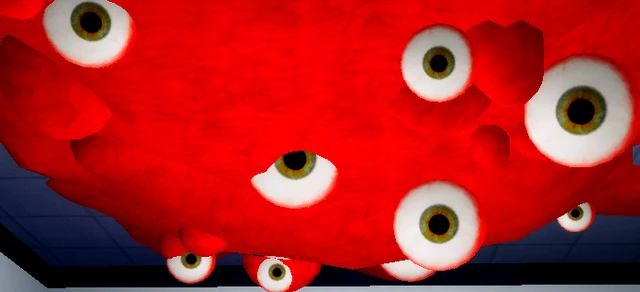

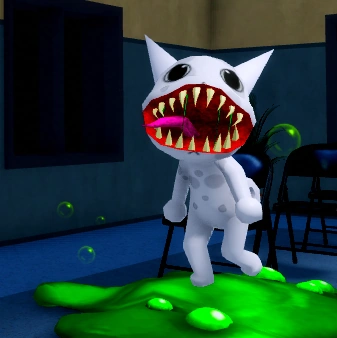

How it's played
The core loop, the treatment system, sanity, the shift-based tutorial ladder and the interface — how the game guides the player and keeps them on edge.
One loop that holds the whole shift together
The loop closes on the very first shift and doesn't change to the end — only the density of threats grows. This is exactly what's worth carrying into a prototype: a short "admit/refuse" decision plus a treatment procedure under the pressure of sanity.
Core loop:
The loop in motion — an early shift (GIF, click to enlarge)
The animation is assembled frame by frame from the recording: a patient walks up to the window, a photo camera and a bell nearby, the HUD shows sanity and class. This is the exact rhythm that repeats throughout the game.
Diagnosis, remedies and rooms 6–8
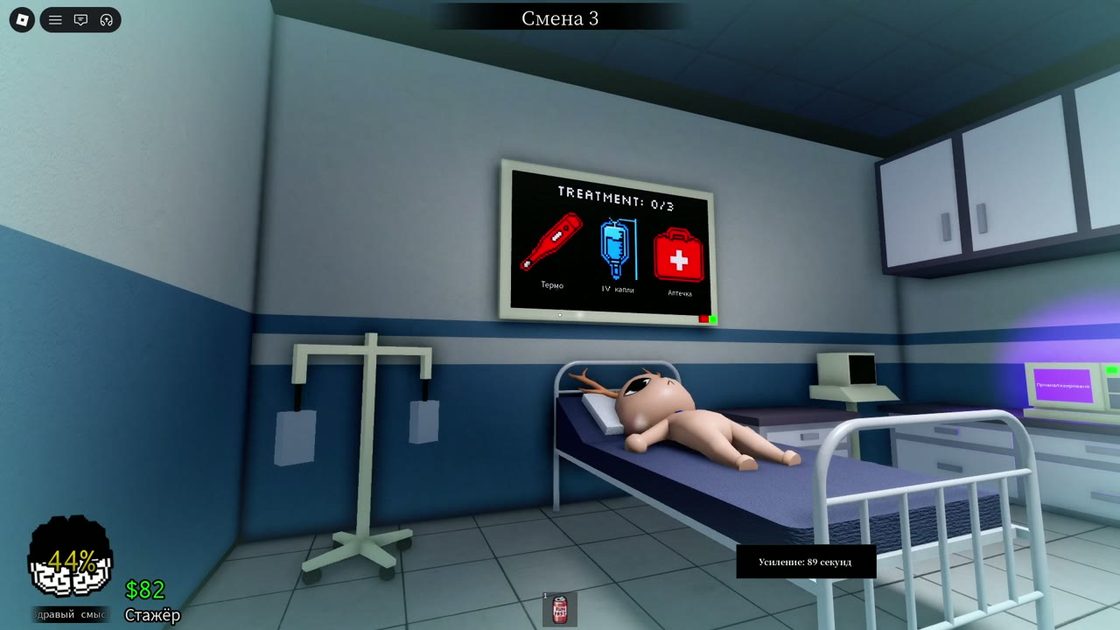
Treatment is the second most important mechanic after detection. Without upgrades, the cycle is: DNA analysis ~9s → diagnosis ~2s → recovery ~35s. The screen above the bed shows one to three remedies; a wrong one means the patient's death and a lost life (for an ordinary animal). The emergency wing adds mini-games.
Matching "illness → remedy"
| Illness | Remedy | Note |
|---|---|---|
| Stomachache | Herbs | basic (patient #1 on Shift 1) |
| Dry eyes | Eyedrops | they also calm the Mass of Eyes |
| Dehydration | IV Drops | also a surgery tool |
| Bruises | Medkit | also a surgery tool |
| Temperature | Thermometer (Thermo) | measures rather than "treats" |
| Rash / burns | Ointment | the only remedy at the admission stage |
| Bleeding | Bandages | the cross was recolored from red to green (06/23/26) |
| Headache | Medicine | also a surgery tool |
| Low sugar · "Canadian" | Maple Syrup | treats two illnesses; wards off the Bed Monster |
| Flu | Cough Syrup | also clears Slime faster |
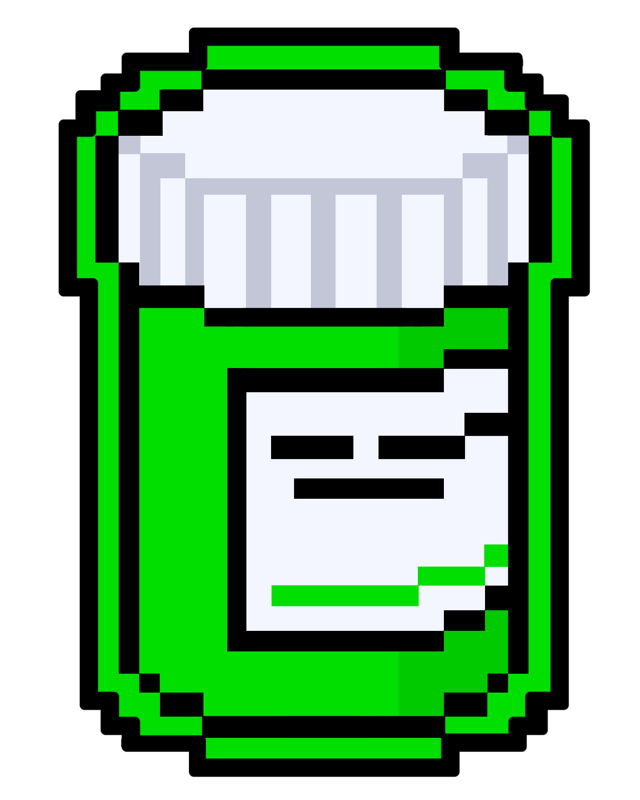
Remedy catalog (icon reference)














Emergency wing: rooms 6–8
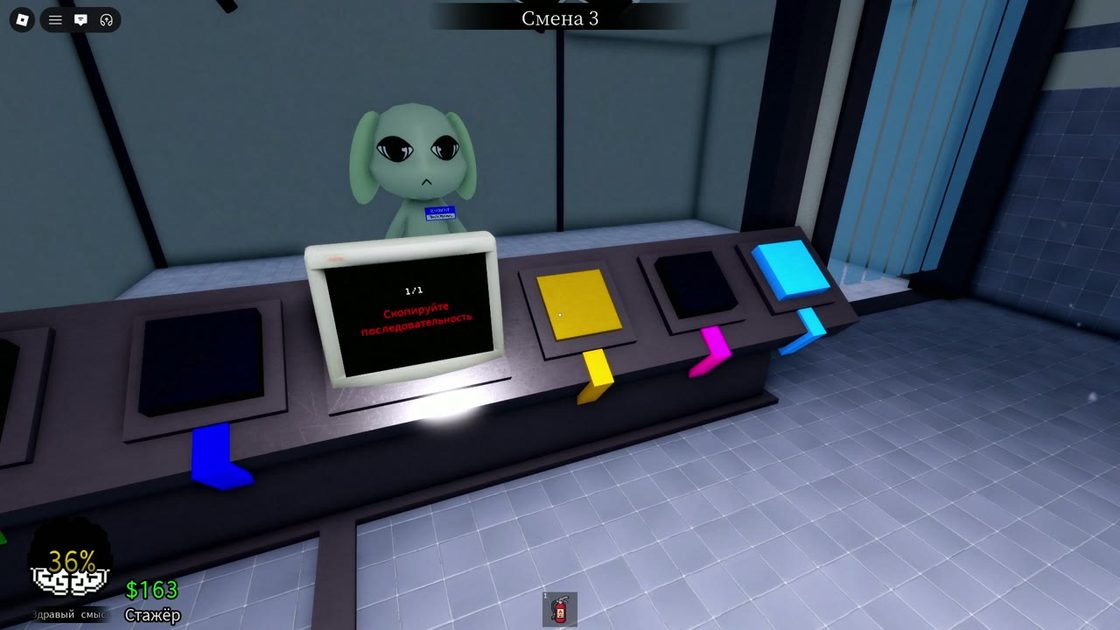
The "Copy the sequence" mini-game: memorize 4 colors (red/green/blue/yellow/pink/cyan). The machine prints the diagnosis.
You need to tap the icons as they appear; red skulls lower the scan percentage — don't tap those.
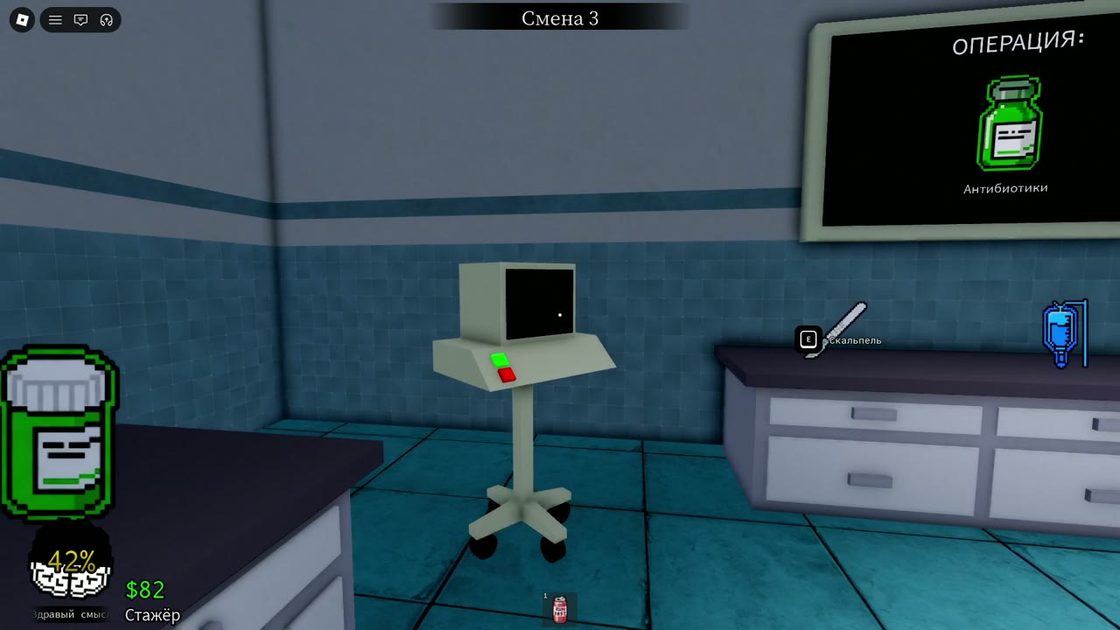
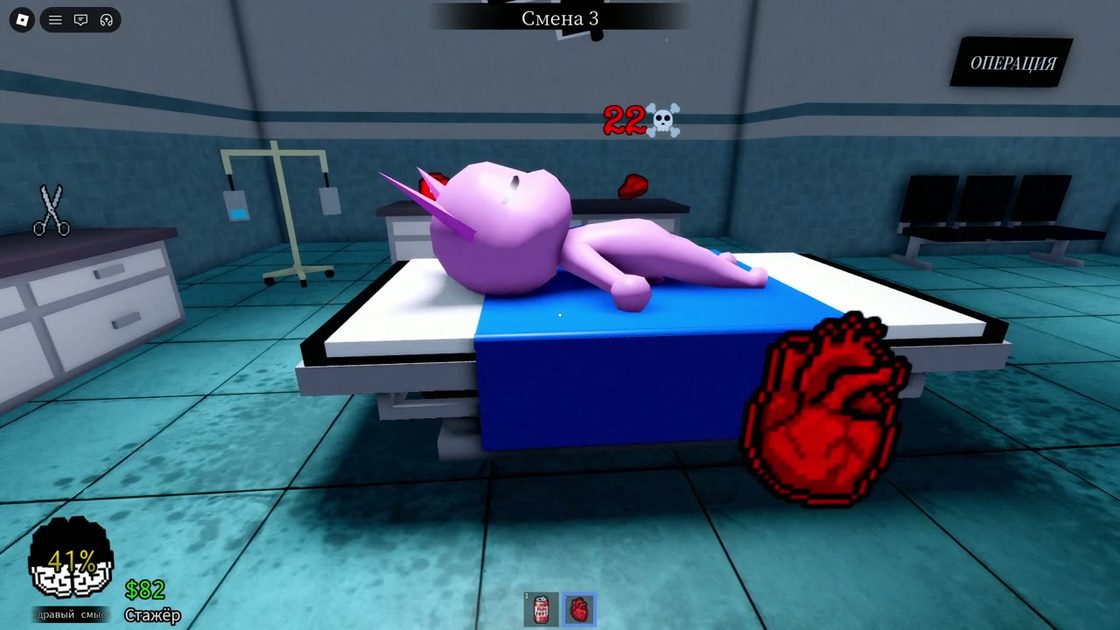
45 seconds to treat, and for success +1 sanity. Exclusive remedies: Antibiotics, Scalpel, Scissors, Organ, Transplant.
Sanity as a health bar
Sanity is the player's HP. It starts at 61–65% (higher for the Intern — 71%+). Below 35% the screen desaturates and the music slows down; at 0% — death. This makes the horror systemic: the scare comes not only from a script, but from a slowly draining bar.
There is no tutorial — you're dropped straight into a shift
An important correction to what's easy to mistake for "gentle teaching": there is no tutorial mode. You're dropped into Shift 1 with zero explanation — not a single text screen breaks down the loop "admit → photograph → diagnose → treat." You have to assemble the flow yourself: from yellow arrows, sticky notes on the walls, and trial and error.
It doesn't explain the sequence of actions, doesn't show where to get the treatments or how to run a diagnosis, and doesn't warn you about the cost of a mistake. The only concession is that the first shifts are structurally safe: the patients are scripted, there are no anomalies, there's no one to kill. This isn't a tutorial but a "quiet sandbox": failing is safe, but how to play is left unsaid. That is exactly what deserves to be called the "quiet tutorial" — teaching through safety, not through guidance.
The opaque onboarding hits co-op immediately: in this recording, the first teammates left the game while the player was still figuring out what to do at all. A newcomer with no mentor slows the team down — and the team loses them. So the "quiet sandbox" is at once a plus (you can learn on the fly without fear of killing a patient) and a minus (the first session is murky and lonely).
What actually "teaches" — the shift schedule
The teaching is hidden not in hints but in structure: mechanics and threats switch on one at a time by the end of each shift. That gives time to settle in — but only for those who figured out on their own what to do on the first shift.
The "Ambulance" event repeats every 5 shifts: Harlow panics, the News Bunny broadcasts on the TV, 6 patients rush in (some on fire / in critical condition), and there's a high chance anomalies slip in among them. For the first "Ambulance" — a bonus to the shift's pay.
How the money works
Two currencies, the supplies shop, ten classes with leveling and monetization — exact prices to reproduce.
Real prices: Animal Coins, dollars and supplies
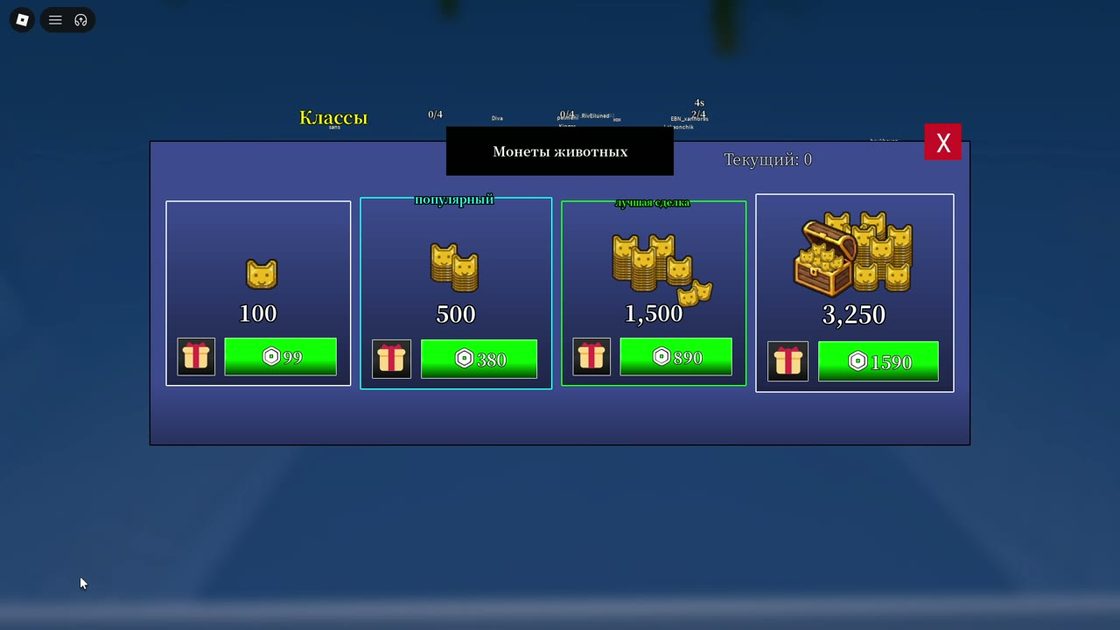
The game has two currencies. Dollars ($) are the shift's money: earned within a run and spent only in the supplies shop. Animal Coins are the persistent currency: accumulated between runs and spent on classes and skins, or bought for Robux. Below are the values, cross-checked with the official wiki and confirmed by frames from the recording.
Start at $0. Earned within the shift (treatment, work), spent only in the supplies shop. They can also buy 1–3 Animal Coins for $100 from the Shopkeeper Nurse. The shift report awards both dollars and coins: in the recording — Shift 1 "Excellent" +$63, Shift 2 "Good" +$100, Shift 3 "Critical" only +$56.
Accumulate: 2 coins per patient treated, ~0.5 per anomaly prevented, from the shift report, or for Robux. Spent on classes and skins; can be gifted to other players for Robux.
Supplies Shop — full price list (in $)
Open for a limited time each shift (from the end of Shift 2). Offers 3 random items, each bought once per run for the whole team; reroll of the assortment — 6 Robux.
| Item | Type | Price | Effect |
|---|---|---|---|
| Faster registration (quiet) | upgrade | $20 | Removes the "…" at the entrance, admission starts right away |
| +1 Carrying capacity | upgrade | $100 | Inventory 3 → 4 slots |
| +10% NPC speed | upgrade | $150 | Patients walk faster |
| +12% NPC speed | upgrade | $250 | Requires the +10% upgrade |
| Faster DNA analysis (−50%) | upgrade | $110 | 9s → 4.5s, stacks |
| Faster computers (−33%) | upgrade | $110 | Diagnosis in the rooms |
| Patients recover 25% faster | upgrade | $115 | ~35s → ~26s |
| Extra entry window | upgrade | $190 | Two patients at the entrance at once |
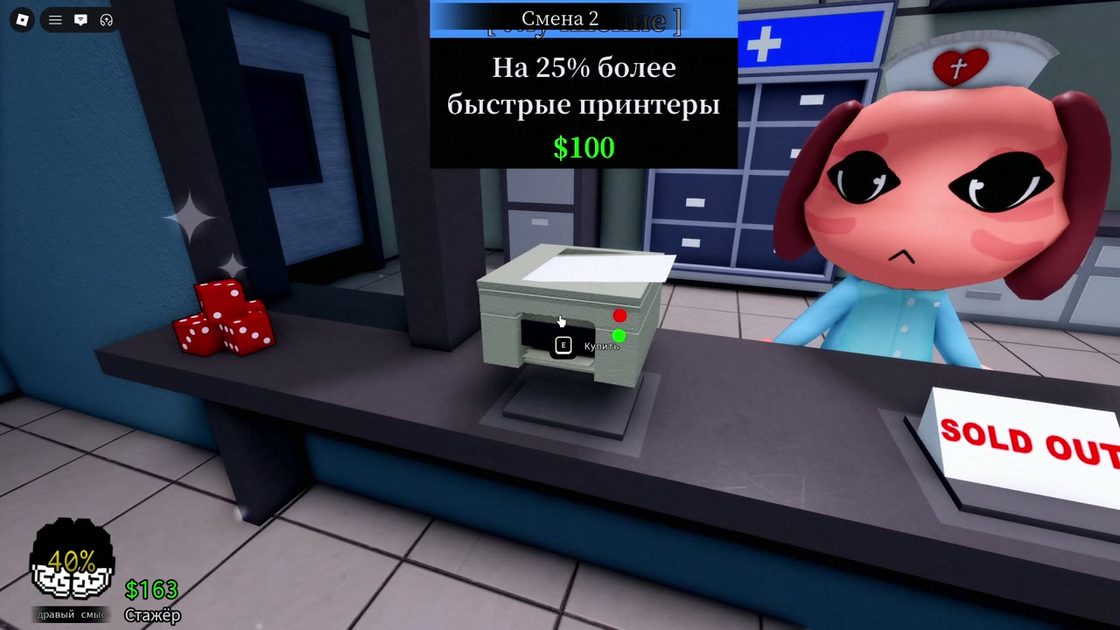
| 25% faster printers | upgrade | $100 | Speeds up printing forms/photos |
| Dispense medicine from inventory | upgrade | $450 | Treat without leaving the bed (risk of error) |
| Coffee (+15 sanity) | item | $55 | +5 per sip |
| Chocolate (+60 sanity) | item | $120 | +20 per bite |
| Speed-up (Run Fast Cola, 30s) | item | $75 | Temporary speed |
| Taser (1 use) | item | $150 | Add-on to the main taser |
| Taser (5 uses) | item | $250 | Reusable taser |
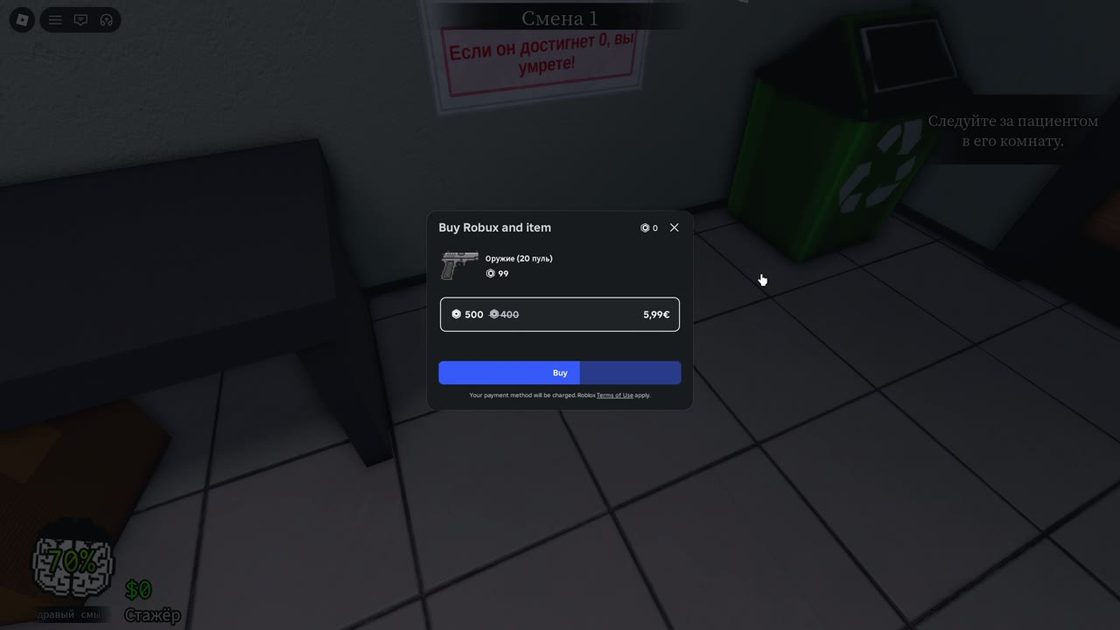
| Pistol (20 rounds) | item | $410 | Ranged; also wounds patients |
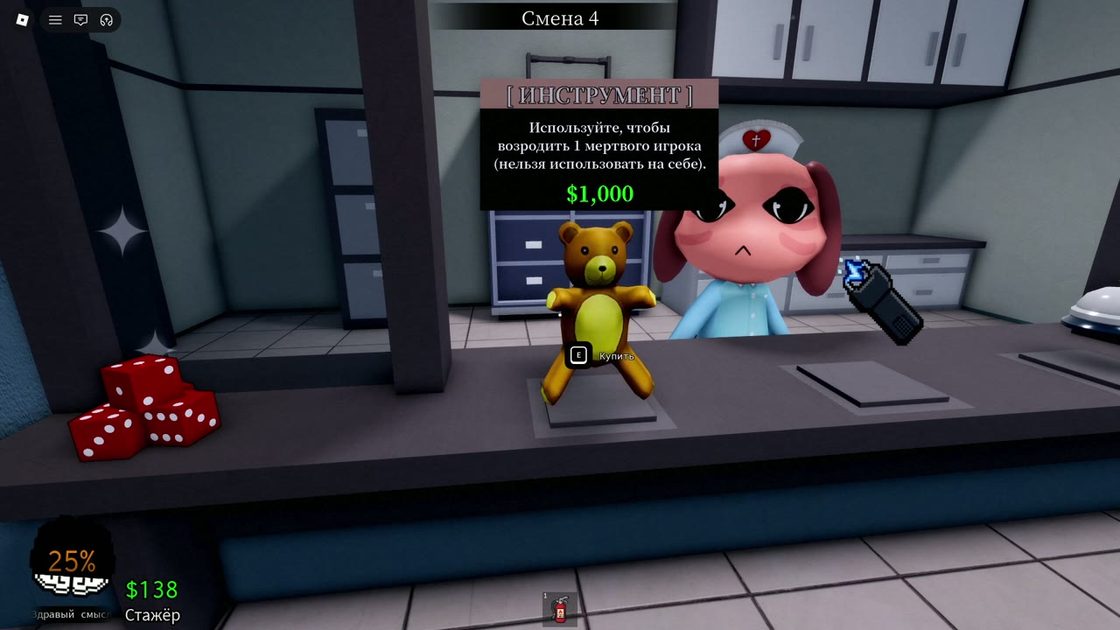
| Teddy bear (revive) | item | $1 000 | Revive 1 dead player (not yourself) |
| 1–3 Animal Coins | currency | $100 | A bit of persistent currency for the shift's money |
Ten roles and their leveling
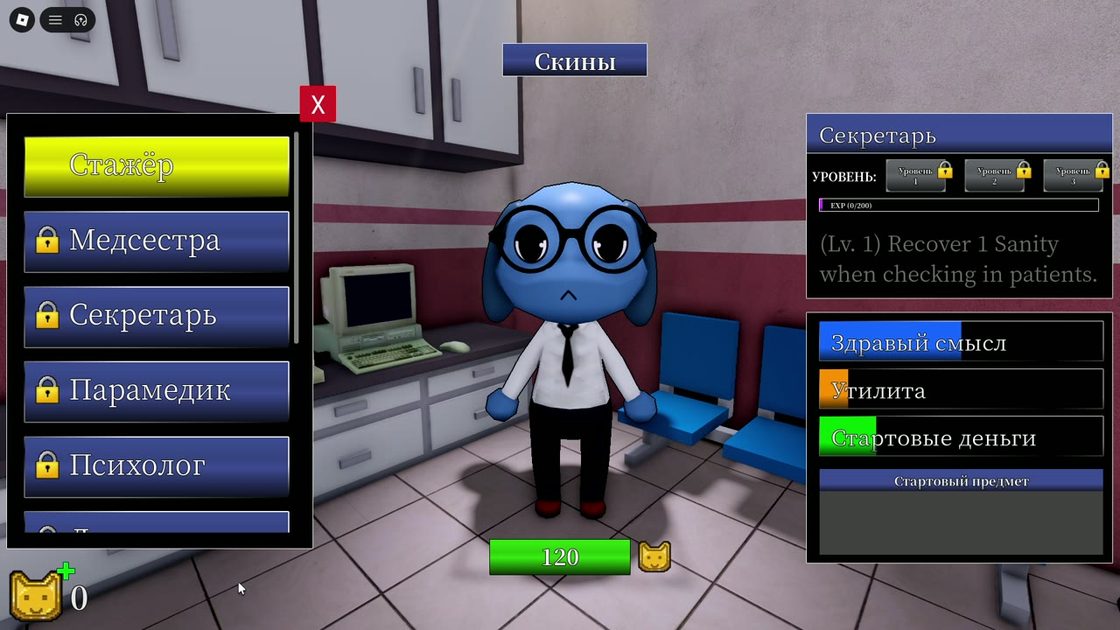
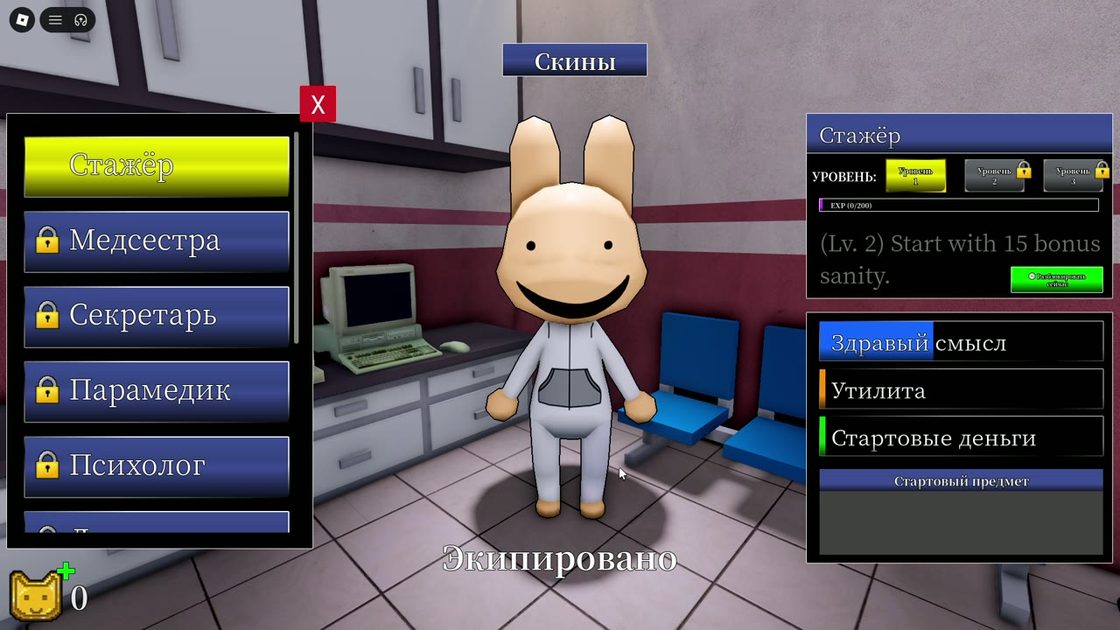
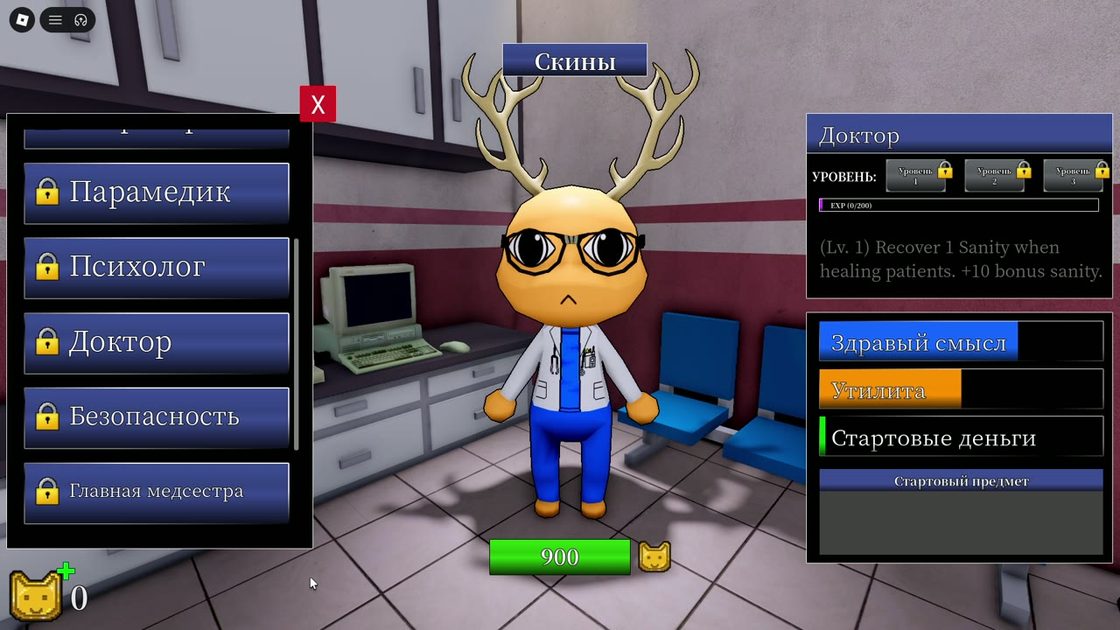
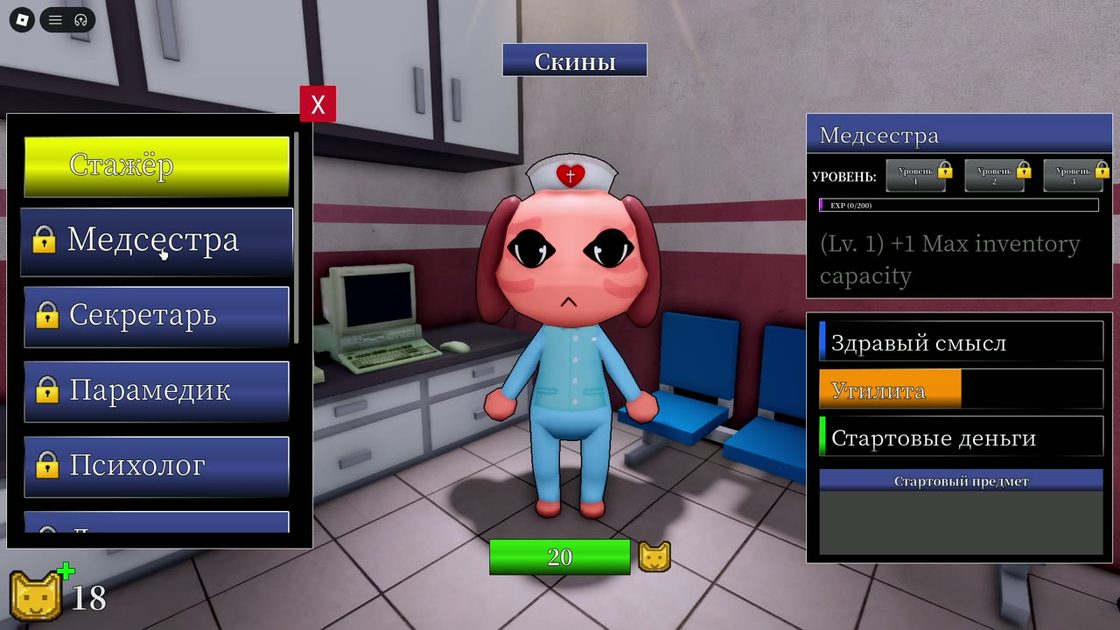
Classes are the main meta-progression and the primary sink for Animal Coins. There are 10; they're bought with coins or Robux in the lobby, and each levels up to level 3 (the "The Class Upd" update from 06.2026). A class changes starting sanity, inventory, starting item and starting money. Below are the full leveling ladders; click a class to expand.
*Intern* free — free · sanity · default start
| Level | Effect |
|---|---|
| Lv. 1 | +10 sanity → start 71% |
| Lv. 2 | +15 sanity → 76% |
| Lv. 3 | +20 sanity → 81% |
The only class with an individual fur color for each player.
*Nurse* 20 coins — 20 coins · utility · cheapest paid
| Level | Effect |
|---|---|
| Lv. 1 | +1 to inventory |
| Lv. 2 | +2 to inventory |
| Lv. 3 | +3 to inventory |
*Secretary* 120 coins — 120 coins · sanity per registration
| Level | Effect |
|---|---|
| Lv. 1 | +1 sanity for each patient registered |
| Lv. 2 | +1 per registration · +5 starting sanity |
| Lv. 3 | +1 per registration · +10 starting sanity |
*Paramedic* 250 coins — 250 coins · utility · starting speed-cola
| Level | Effect |
|---|---|
| Lv. 1 | Large Speed Cola — 6 uses |
| Lv. 2 | 9 uses |
| Lv. 3 | 9 + restore 1 per round |
*Psychologist* 500 coins — 500 coins · sanity · high risk
| Level | Effect |
|---|---|
| Lv. 1 | All sanity effects ×2 (both gains and losses); start 100% |
| Lv. 2 | ×2 · 7.5% chance to ignore a loss |
| Lv. 3 | ×2 · 15% chance to ignore a loss |
Doubles the damage too: −20 from the Head Banger becomes −40. A class for careful play.
*Doctor* 900 coins — 900 coins · sanity per treatment
| Level | Effect |
|---|---|
| Lv. 1 | +1 sanity per treatment · +10 starting |
| Lv. 2 | +1 per treatment · +15 starting |
| Lv. 3 | +1 per treatment · +20 starting |
*Security* 1 250 coins — 1 250 coins · utility · starting X-taser
| Level | Effect |
|---|---|
| Lv. 1 | X-taser — 5 uses |
| Lv. 2 | 6 uses |
| Lv. 3 | 6 + restore 1 per round |
*Head Nurse* 190 Robux — 190 Robux · utility · Robux only
| Level | Effect |
|---|---|
| Lv. 1 | +3 to inventory |
| Lv. 2 | +3 to inventory · +10 sanity |
| Lv. 3 | +3 · "Special technique": all remedies in inventory at the start of the round |
*Surgeon* 2 500 coins — 2 500 coins · most expensive for coins
| Level | Effect |
|---|---|
| Lv. 1 | Sanity + a short speed boost after treatment |
| Lv. 2 | Longer (8s) speed boost after treatment |
| Lv. 3 | ×2 sanity + boost · +10 starting |
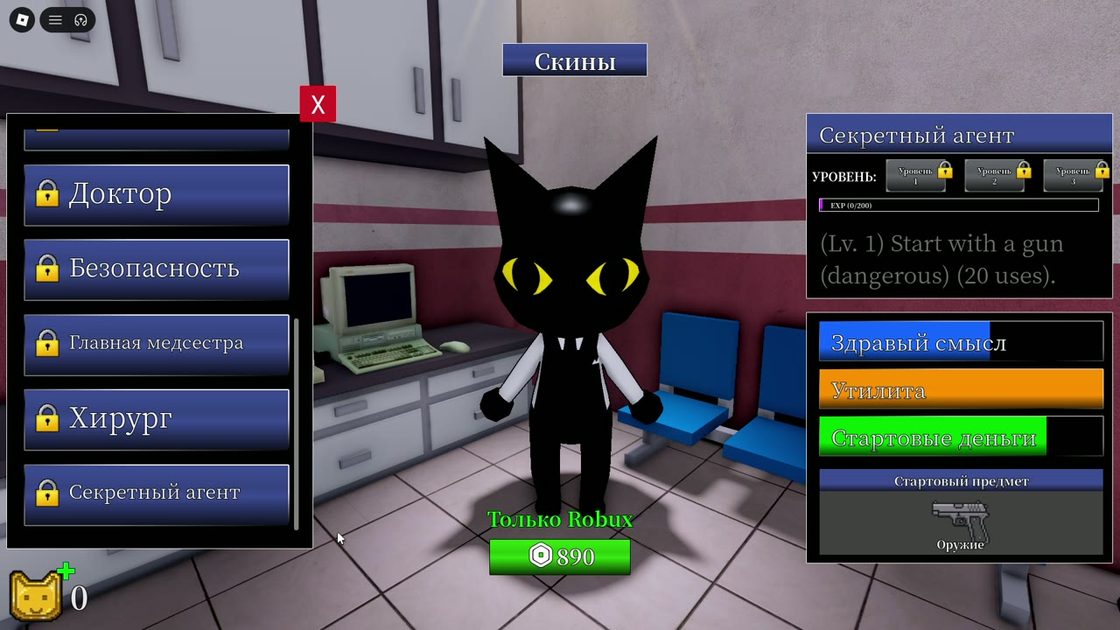
*Secret Agent* 890 Robux — 890 Robux · most expensive class · starting pistol
| Level | Effect |
|---|---|
| Lv. 1 | Pistol — 20 uses |
| Lv. 2 | 30 uses · +10 sanity |
| Lv. 3 | 30 · restore 1 per round · +20 sanity |
The price has changed: 06.2026 — 790 Robux, then raised to the current 890.
How the game holds and sells
The tension curve across a session, what brings the player back, and where desire turns into a purchase.
Where the tension is, and where it sags
The main UX-pacing takeaway. The game accelerates on "fear peaks" (the first anomaly, a monster, an event, death) and sags in two places: the toothless tutorial at the start and the disorientation after an abrupt death. Below is the engagement curve from the actual recording.
How to read the chart. Horizontally — minutes of the session (0→79, including the restart). Vertically — how interested and tense the player is right now. Peaks (green dots) are "moments of fear": the first anomaly, a monster, an event, death. Pits (red dots) are the toothless tutorial at the start and the disorientation after an abrupt death, when the player didn't understand what killed them. Below the dashed threshold the risk grows that the player gets bored or quits.
Three states of pacing: tension, lull, frustration
It's important to distinguish a lull (passive boredom, nothing to fear) from frustration (active irritation — an incomprehensible death). They're treated differently.
Fear peak When: the first anomaly, a monster in the room, an event (fire/ritual/ambulance), a sanity collapse toward death. Why it works: a threat, a timed decision and co-op panic all arrive at once — triple pressure. Feeling: "How do I deal with this?!", a shout into voice chat.
Nothing to fear When: the toothless Shift 1 and calm stretches with no anomalies or events. Why: the tutorial is deliberately safe, but dragging it out means losing the tension people came for. Feeling: routine admission with no stakes — "I'm just registering."
An incomprehensible death When: an abrupt sanity collapse to 0% and a failure the newcomer didn't understand the cause of. Why: the sanity spiral hits harder and harder, while the feedback on "what exactly killed you" is weak. Feeling: "why me?" — instead of "next time I'll do it differently." Player’s voice: "I want to quit, but how isn’t clear… to exit you have to leave the game itself, there’s no respawn here." It’s not just death that’s opaque — the way out is too.
The mechanism of the downturn: the sanity spiral
- Why it's easy to fail Sanity always drains — at least −1 every 50s from stress, plus damage from monsters and events. Recovery is limited (coffee +15, chocolate +60, and you still have to go get it). As soon as the bar drops below 35%, the world desaturates, the music thickens — and every next mistake costs more: it's harder both to treat and to run away. Two things amplify it: the shared team pool (someone else's panic sinks everyone) and the weak feedback** on the cause of sanity loss — a newcomer doesn't always see what's finishing them off.
Why the player comes back
Replayability rests not on new content every run, but on growing mastery, co-op sociality, the long class-leveling grind, the story backdrop and frequent updates.
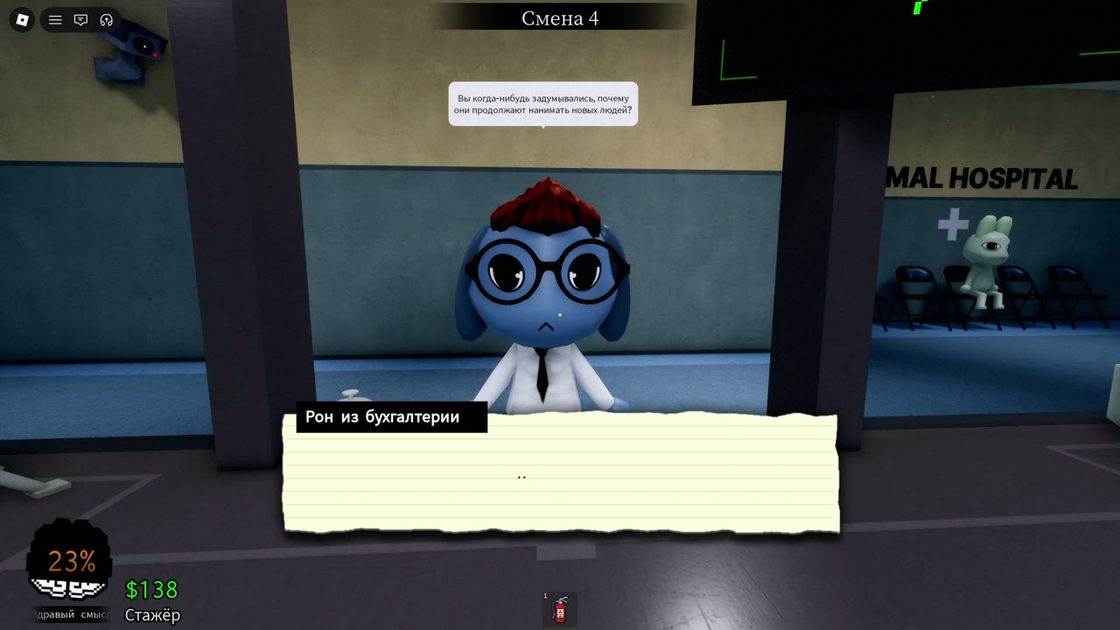
On top of the gameplay there's a quiet story: the clinic is owned by Animal Corporation, and patients aren't "sick" but "infected." Ron from Accounting lets slip: "Have you ever wondered why they keep hiring new people?". Ratthew warns "don't trust anyone here" and is searching for his missing sister Rattina. Barney is a polite killer who asks you to hide him from the police. The lore doesn't get in the way of the game, but gives a reason to come back to "finish reading" — and highlights which characters are safe to admit.
Where desire turns into a purchase
Monetization is soft and mostly for convenience/power: classes and coins for Robux, small in-game items for Robux within a run, a shop reroll. Harsh tactics (the troll "Jumpscare All" game pass) the studio removed after community backlash — a useful "what not to do" case.
A healthy sign: the studio rolled back a toxic purchase. The main income is on convenience and cosmetics, not on "pay-to-win."
What to take from this
The design analysis, the transfer plan, the risks and the final verdict — for the decision.
Mechanics → Dynamics → Aesthetics
Translating "scary / likable" into design language: which rules create which behavior and which emotion.
Rules: admission with the "admit/refuse" decision, three channels of clues (live/photo/cameras), diagnosis (DNA ~9s) and treatment with 1–3 remedies, sanity as HP, monsters with counter-items, events on timers, a shift report with 4 grades, 3 shared lives, 10 classes leveling to Lv.3. Sanity drains ≥1/50s; below 35% the world desaturates.
Behavior: the player assesses risk under a timer, learns the anomalies' "tells," distributes roles in co-op, conserves sanity and inventory slots, coordinates coffee, panics during events, saves coins for classes and strives for "Excellent." Peaks — reading an anomaly and co-op panic; pits — the quiet tutorial and the incomprehensible death.
Emotion: anxious vigilance, the thrill of "caught you!", the pleasure of a competent doctor, camaraderie and a shared shout in co-op, curiosity about the lore — and disorientation from an abrupt death. What's worth carrying over is the "detection + sanity-as-HP + co-op on shared lives" pairing, not the setting.
What we carry into our own clone
Not "make a similar horror," but assemble in the right order the systems and feelings the game rests on.
| Priority | System | Why | Minimum implementation | QA criterion |
|---|---|---|---|---|
| P0 | Decision loop | Test the fun | Patient at the window + 1 "tell" + admit/refuse buttons | The player catches an anomaly without explanations within a minute |
| P0 | Sanity-HP | Pressure | A bar, passive drain, 1 source of recovery | The player feels time ticking against them |
| P1 | Treatment | The second loop | Diagnosis → 1–3 remedies → the right set treats | A mistake is tangibly punished |
| P1 | Clue channels | Decision depth | Add photo and camera as a second/third channel | The player uses at least 2 channels |
| P1 | Shifts + report | Rhythm and goal | A shift with a timer, a report with a grade and a reward | There's a desire to "play for Excellent" |
| P2 | Co-op | Retention | Shared lives + voice chat for 2–4 players | One player's death is felt by everyone |
Problem → cause → solution
Where exactly the player experience breaks, why, and what minimal fix will test it. The points are confirmed by the recording and the wiki data.
| Problem | Why it's bad | Minimum fix | How to verify |
|---|---|---|---|
| Abrupt, opaque death | The newcomer didn't understand what killed them → "why me?" | A clear indicator of the sanity-damage source + a warning about the "spiral" | Share of players repeating the mistake |
| Reliance on jump scares | The effect fades with repetition | Diversify the threats, strengthen the systemic dread (sound, light, sanity) | Reactions on the 3rd and 10th run |
| No tutorial — dropped straight in | Newcomers don't know the flow; in this session the first teammates left because of it | A guided first shift (arrows + "do this next" prompts), keeping failure safe | First-session drop-off (solo and co-op) |
| Top-class grind | 2 500 coins at 2/patient — very slow | Raise the shift reward / add intermediate unlock goals | Time to the 1st paid class |
| Running around between stations | Routine friction between admission, shelves and rooms | Early convenience upgrades (carrying capacity, speed, extra window) | Meters traveled per shift |
| Too many "tell" types at once | It's hard for a newcomer to memorize all the signs | An in-game anomaly "codex" / a training shift | Refusal accuracy among newcomers |
Final score — for the decision
Animal Hospital is a strong co-op horror with a clear idea: turn a cozy job inside out into a detective game under the pressure of sanity. It has an excellent "inspect → decide → treat" pairing, systemic fear and healthy monetization. The main growth points are the transparency of death and the pacing at the edges (quiet start, class grind).
A mature co-op horror whose core is worth taking: the atomic "admit/refuse," three channels of clues, sanity-as-HP, the shift structure with a report, and co-op on shared lives.
- Build a P0 prototype: patient + one "tell" + admit/refuse in 1–2 days
- Add sanity-HP with a passive drain and one source of recovery
- Test the first session on 3–5 newcomers with no hints
- Measure time-to-first-catch and understanding of the cause of death
- Introduce the second and third channels of clues (photo, cameras) and the shift report
| Dimension | Score |
|---|---|
| Core Loop | 8/10 |
| Horror | 8/10 |
| Onboarding | 8/10 |
| Economy | 7/10 |
| Co-op / Retention | 8/10 |
| Transfer | 9/10 |
Next steps
Extended visual reference
Additional frames for the team: monsters, events, items and screens that didn't make it into the main sections.