▶ the verb
Driving is the catch
You spawn in a starter car with a one-brainrot trunk. Roblox's default movement is wrapped in a vehicle shell, so a young kid can pilot it instantly — zero learning curve, capacity as the first thing to want more of.
Drive for Brainrots is a collector you steer with a car. The pull isn't a reveal animation or a slow-motion kill like its siblings — it's the place itself: a world of escalating hazards you gamble your way into for richer brainrots, then floor it back home. Even the menus bounce like a car settling on its suspension.
The engine underneath is the genre standard — catch brainrots, place them on your plot, earn cash per second, rebirth for multipliers. What's swapped in is the verb: instead of walking or fishing, you drive a car out into the world, find a brainrot, and hold to collect it.
You spawn in a starter car with a one-brainrot trunk. Roblox's default movement is wrapped in a vehicle shell, so a young kid can pilot it instantly — zero learning curve, capacity as the first thing to want more of.
Goofy voxel characters in escalating rarities — Common up through Legendary, Secret, Cosmic, Celestial. Each one placed on a plot prints cash per second; rarer pulls reorder your whole economy.
Drive to a brainrot, hold the prompt, haul it back across your base line, drop it on a pad. Cash climbs, you upgrade the car's speed, and the numbers spiral from hundreds to billions.
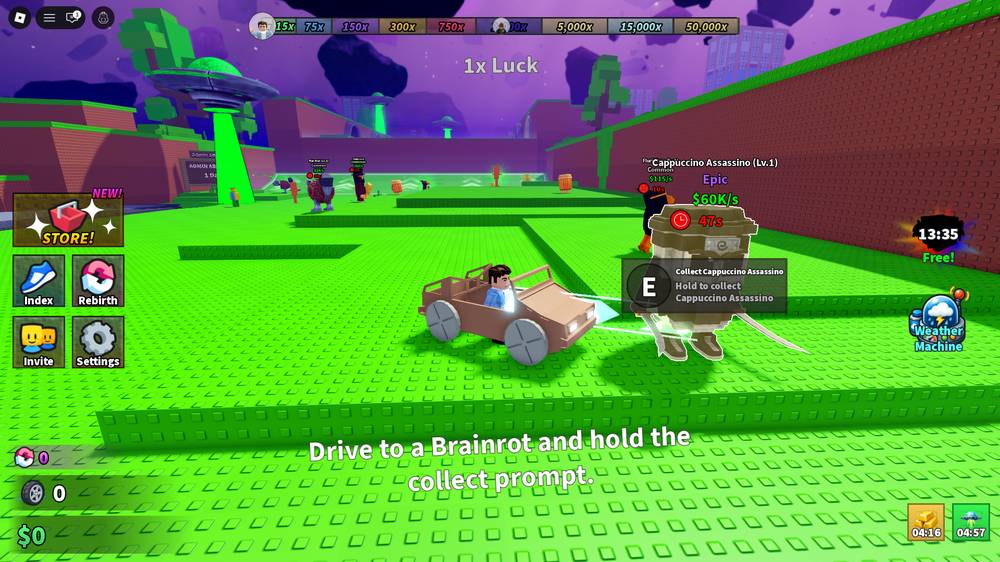
That's the surface. What makes the game memorable is everything stacked on top of this loop — and crucially, where the loop happens. The brainrots you actually want are scattered across far-off, dangerous biomes, and getting to them is the whole game.
This is the pillar that separates Drive from its siblings. There's no reveal animation doing the emotional work, no cinematic kill. The thrill is spatial: you can see high-value brainrots sitting in far, hostile biomes, and every trip out is a bet — is my speed and boost enough to grab the loot and escape before the world kills me?
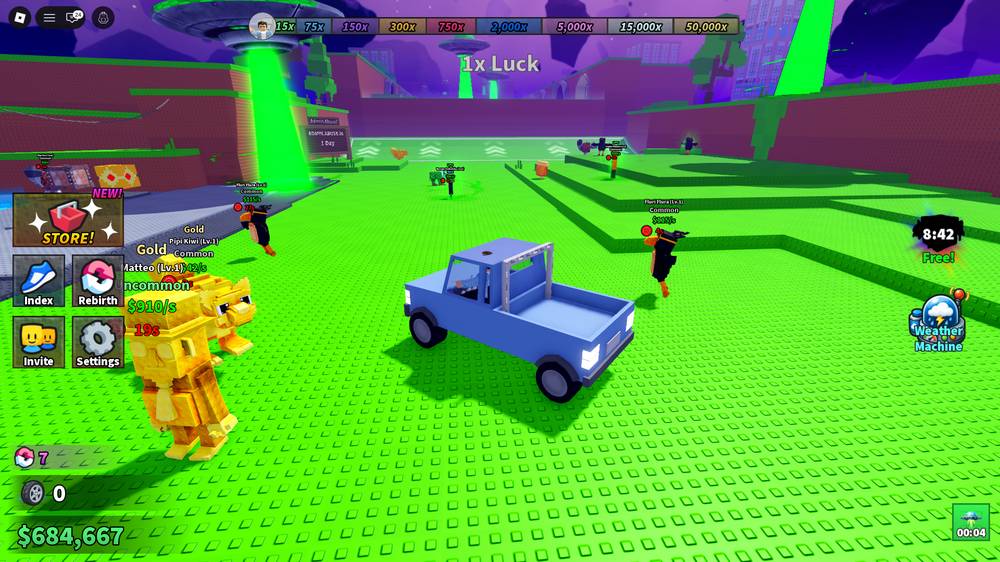
Each biome doesn't just change the scenery — it introduces a new kind of obstacle. The collection loop becomes a risk-gauntlet that keeps escalating, and the further out you push, the better the brainrots and the deadlier the trip.
Greed versus caution becomes the moment-to-moment tension. And the payoff is explicit: hauling a rare brainrot back to base feels good precisely because the risk was real — there are real death stakes out there.
Common brainrots, gentle income. The first lesson that the world is hostile: UFOs roam and abduct, roaming cars knock you around. Survivable, but it sets the tone.
Ground that slowly sinks you in, forcing fast pickups and careful crossings. Speed stats start to actually matter here.
Desert cannons line the ridges and fire on you mid-drive. The first biome where the player described it as combat, not just terrain.
Frost avalanches and water/bubble hazards. Wide-open and slippery — easy to overshoot a brainrot and slide into trouble.
Volcanic eruptions with a highland to retreat to. High-luck territory — you go here when your car can actually take the heat.
Ghosts chase and deal heavy damage — you need raw speed to juke them. A giant chasing boulder you dodge through wall crevices. The endgame "barely made it" thrills live here.
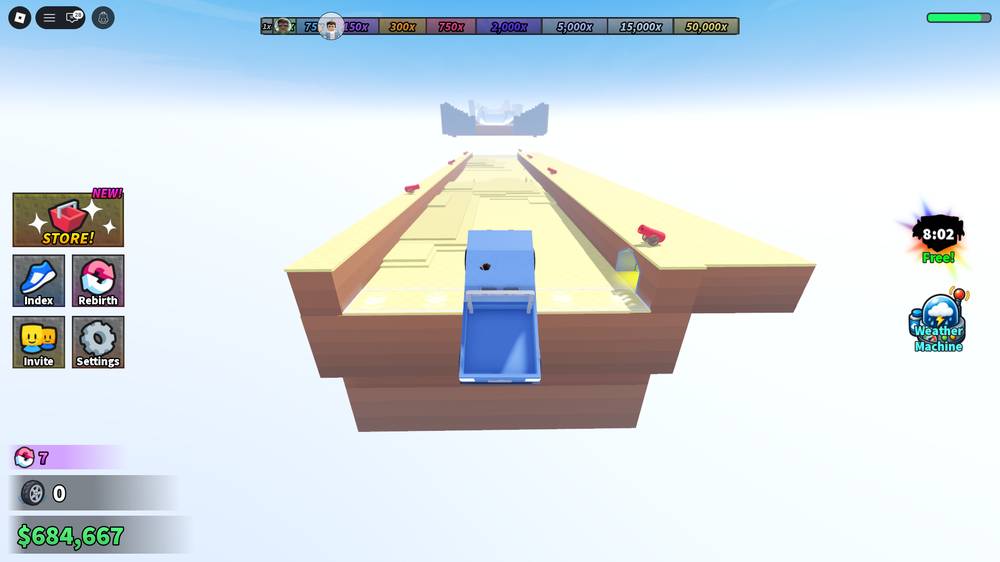
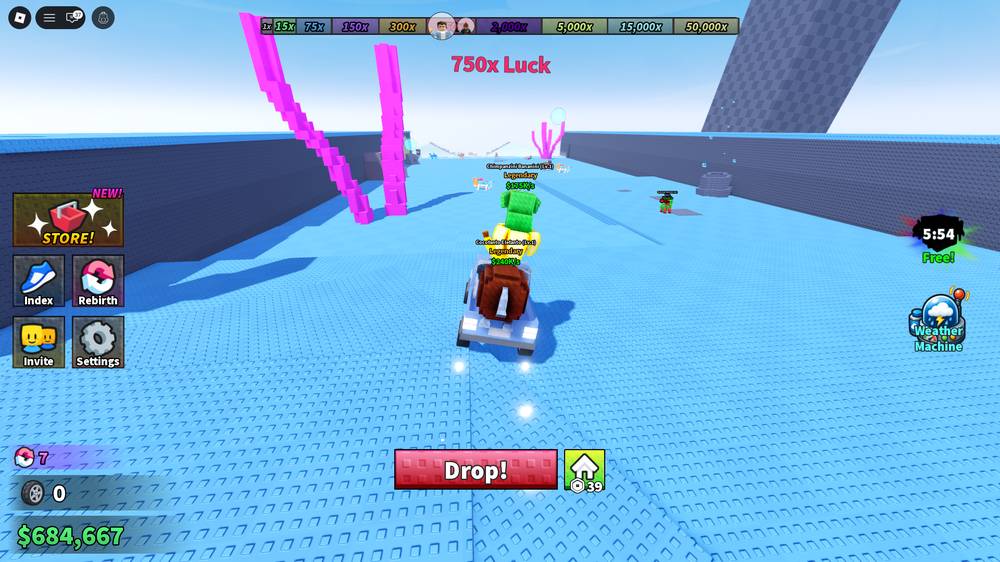
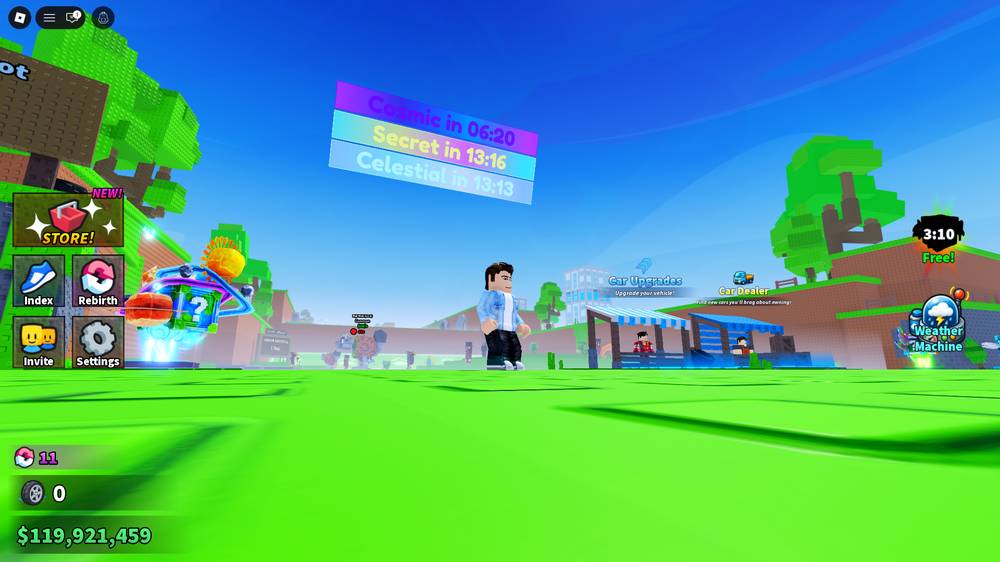
This is a genuinely sophisticated piece of game-feel work. Almost every interface element has spring physics — it overshoots and settles rather than just appearing. Cards bounce in, the car itself rides on a visible bouncing suspension and tilts to match the terrain under it, and even the floating billboard GUI up in the sky bobs gently. Nothing is static.
It's easy to underrate because it never announces itself, but it's doing real work: motion makes the entire game feel alive and physical even when you're just sitting in a menu. The driving inherits it too — the car squashes on its springs over bumps and rotates to hug slopes, so traversal reads as tactile rather than floaty.
The cards and headers on this very page bounce in on the same kind of spring curve — a small homage to how the game presents itself.
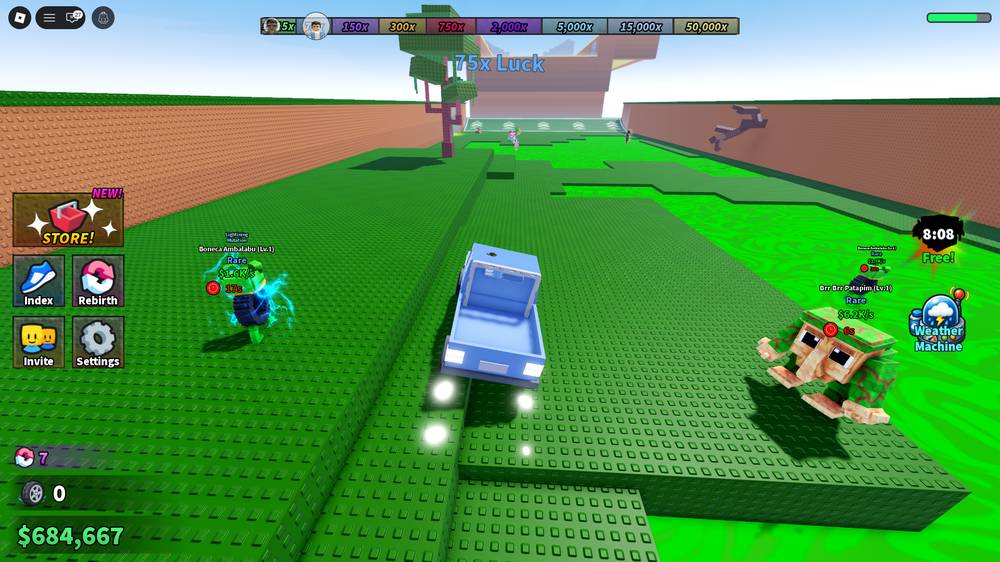
Panels don't snap open — they bounce slightly past their resting position and ease back, like weight dropping onto a shock absorber.
The car body bobs on its wheels and reflexively rotates to the surface angle, so every bump and ramp is felt, not just driven over.
The floating surface billboard high above the map drifts and bobs gently. The motion budget reaches the one element nobody would have blamed them for leaving still.
Rebirths come fast and cheap early; you blow straight past the first several, occasionally missing a milestone by a hair (a neat near-miss tease). Rebirth goals appear to double each time, which would normally stall a player — but exponential income outruns them anyway. That's intentional.
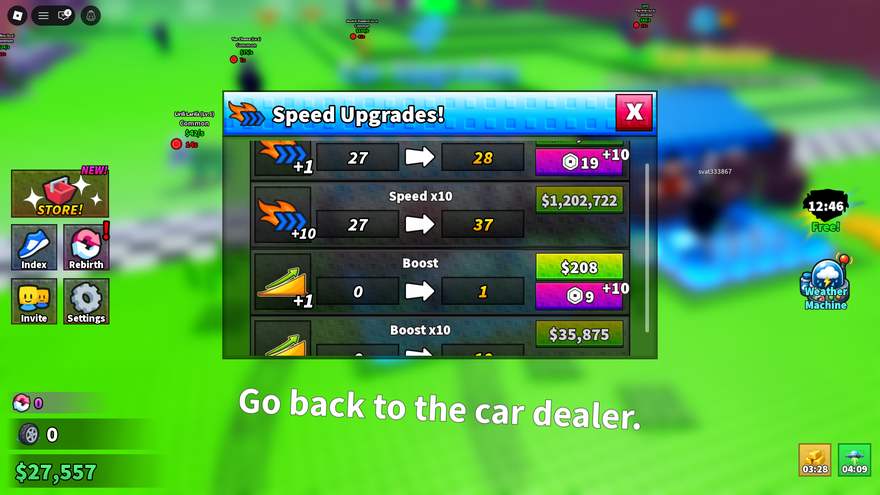
The constant "rebirth again!" drip is the reward. The genuinely expensive cars — pickup truck, then a mint coupe around 250M, then the next jump near 5B — are the real pacing brakes. So you feel rich and rewarded constantly, while the meaningful milestones stay aspirational and far off.
Each new car is a real power jump: more speed, more trunk capacity, access to deadlier biomes. And the brainrot upgrade curve itself is fair — rare and epic brainrots get solid but not absurd boosts, so investment matters without trivializing the game.
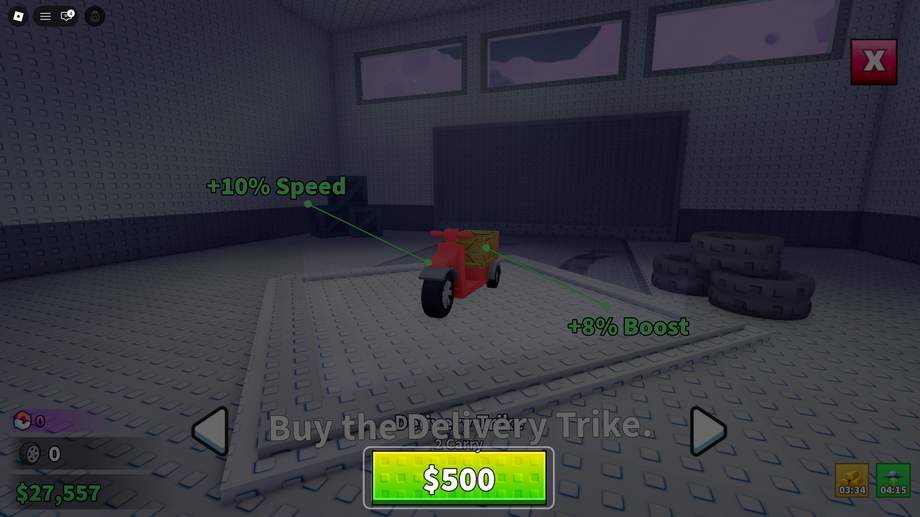
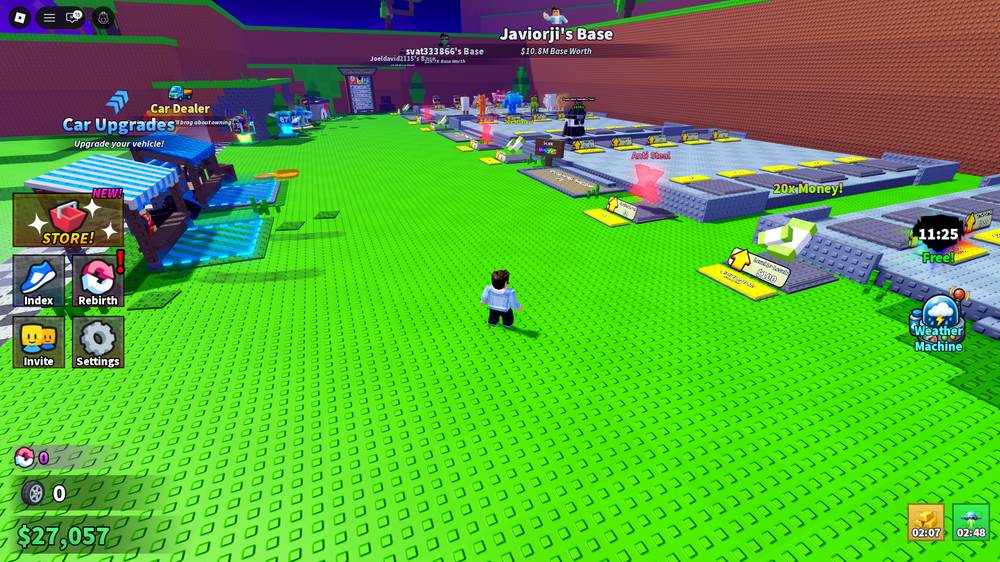
On top of drive-and-collect, the game stacks several side tracks — so there's always a different dot to chase. None is a deep economy on its own; together they keep the session from ever feeling one-note.
A special-currency sink: bank event currency (e.g. nine units) to spawn premium events like a diamond event. Rare player agency over when a boost window fires.
Equippable badges that attach to and buff individual brainrots — a light customization / optimization layer for players who want to tune output.
Clusters you crash into and explode "very satisfyingly" for currency. The purpose is almost beside the point — the act of smashing them is its own little reward.
Built-in bypasses between biomes for grinders who've already cleared a zone. Monetization that respects your time instead of taxing it.
A shiny "Free!" claim timer and play-for-a-minute bundle nudges — standard scaffolding, cleanly readable, never the main event.
An Exotic Luck Block with visible drop odds (75% / 25% / 1% / 0.1% / ??%) gives the familiar gacha "you got something" hit without dominating the loop.

On almost every craft axis, Drive is the stronger game. The driving feels great, the biome-hazard gauntlet is more original than a shooting range, the economy is the most honestly balanced of the three, and the springy physics UI is a level of polish its siblings don't attempt. By the numbers it should be winning.
The likely reason is the same thing that makes it special. All of Drive's distinctiveness lives in a stack of unique systems — driving, biomes, suspension feel, weather banking, relics, wheels. That richness can read as a one-trick-pony once the novelty of the world wears off: the trick is "explore the cool biomes," and once you've seen them, the underlying loop is still just collect-and-earn.
Brainrot Sniper, by contrast, is built on a simpler, tighter core verb — aim, shoot, slow-mo, collect — that's instantly legible, endlessly repeatable, and competitive (contested-airspace PvP). A simple mechanic with a high skill ceiling tends to retain harder than a wide spread of clever ones. Drive's breadth is its identity and, plausibly, its ceiling.
The lesson for a builder: originality and polish are necessary but not sufficient. A game can out-craft a competitor on every visible axis and still lose on retention if its core verb is broad-but-shallow rather than simple-but-deep.
The dopamine isn't in a single animation — it's distributed across the world, the feel of moving through it, and a smartly split reward structure.
Driving-as-walking means anyone can play in seconds, and boost panels plus satisfying crashes make pure movement rewarding even between objectives.
Not a reveal or a kill — escalating biome hazards and the greed-vs-survival loot-and-escape gamble, with real death stakes giving the risk weight.
Cheap, frequent rebirths for constant drip; genuinely expensive cars as the real gates; relics, weather events, and wheels as parallel tracks to dip into.