Sell Lemons
A Roblox economy simulator that grows from a $1 lemonade stand into a multi-storey factory with logistics, warehouses and automation. A full teardown for the client and, at the same time, a visual-economic reference for the team that will build its own version: object models, UI, currencies, prices, progression, pacing and grind "pits" — based on a ~72-minute recording of a live playthrough.
Core thesis: the game holds up not on the number of systems but on a crystal-clear first loop — "place an income source → the number grows → upgrade" — and on the endless feeling of "just one more upgrade." It's strongest in the moments of discovering new zones and haggling with buyers; weakest in fixed timers and long stretches of pure waiting in the late game.
Overview
What this product is, who it sells the fantasy to, and why it works.
What it is, why it works, and where the main risk lies
Sell Lemons is a mature, polished idle-tycoon with millions of players. This is not a raw prototype but a working product you can learn from: progression structure, feedback "juice," buyer haggling, and tasteful idle monetization of convenience.
"I start with a $1 stand and turn it into a lemon empire — and the number on my balance never stops growing." The emotion is growth and control: greed for the next zero on the balance and the satisfaction of the business starting to run itself.
Fixed timers and an exponential economy create "pits" of pure waiting. In the recording, the player himself flatly calls waiting on second-long timers "the biggest problem there could be," and sums up the late game as "nothing changed here." Between big purchases there's often nothing to buy, and the manual pleasure (picking lemons) gets displaced by autofarm.
What this game really is
On the surface it's "sell lemons"; by construction it's a classic idle-tycoon with three layers: a fast clicker income at the start, a multi-tier progression of sources, buildings, warehouse and logistics, and a social-trading loop on top (buyer offers, other players' bases, co-op help, ratings, community).
Tycoon simulator + idle economy with automation + a trading-social hook (buyer offers, co-op, badges, abilities).
Game card
| Parameter | Value |
|---|---|
| Title | Sell Lemons |
| Studio / author | BloxByte Games (goro7) · verified |
| Genre | Idle / Tycoon economy sim |
| Platform | Roblox · mobile (landscape) |
| Like rating | 95% |
| Players online | 91.9K+ |
| Visits | 253M+ |
| Server size | 10 players |
| Voice chat / camera | Supported |
| Community | 1.1M members · +10% luck for joining |

Player journey: stage by stage
A full pass through a live-session recording — what the player does, what they feel, and the design behind it. Each stage scored for engagement and pacing. At the end of the part — an emotion map (see section 12, "Pacing & pits").
Seven stages of one session (+ a second login)
The recording is ~62 minutes of the first login and ~10 minutes of the second. The player reached roughly the third income source (Lemon Depot) — that's the early-to-mid game; the full economy and "rebirths" come later (see parts D and E). Below is how exactly this stretch is lived through.
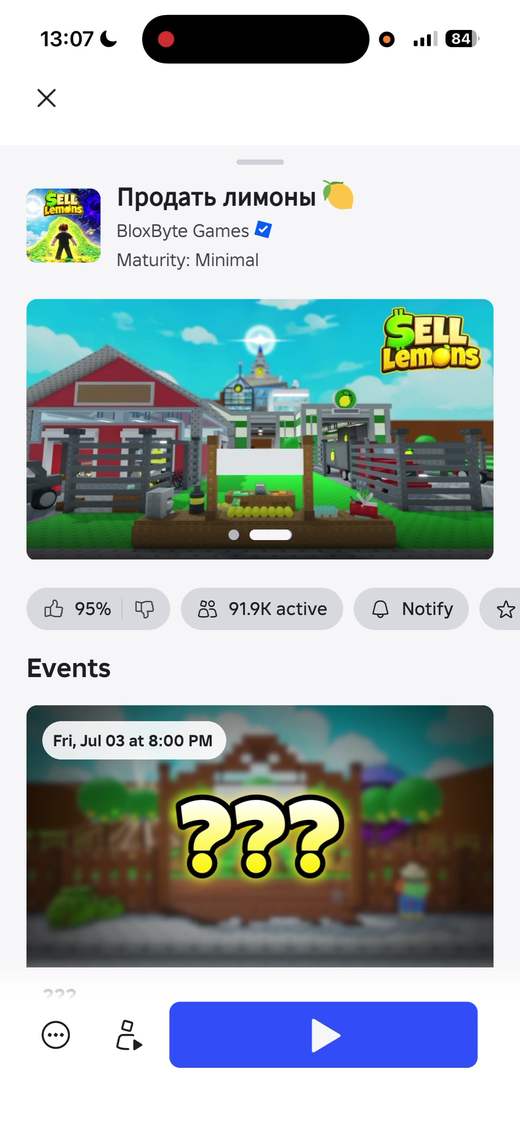
The storefront sells the fantasy
The game page: 95% likes, 91.9K online, lemon-factory art, the promise to "earn a lot, unlock abilities, 100% income offline." The player voices his expectation even before logging in — the promise will match what he gets.
Design lens (hook): the cover + social proof (online/likes) set the expectation for exactly the core loop the game delivers. There's no "promise ≠ product" gap.
First login: $1, the first loop, the first automation
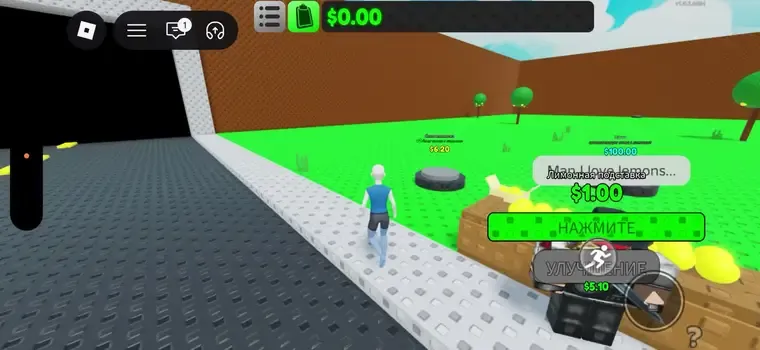
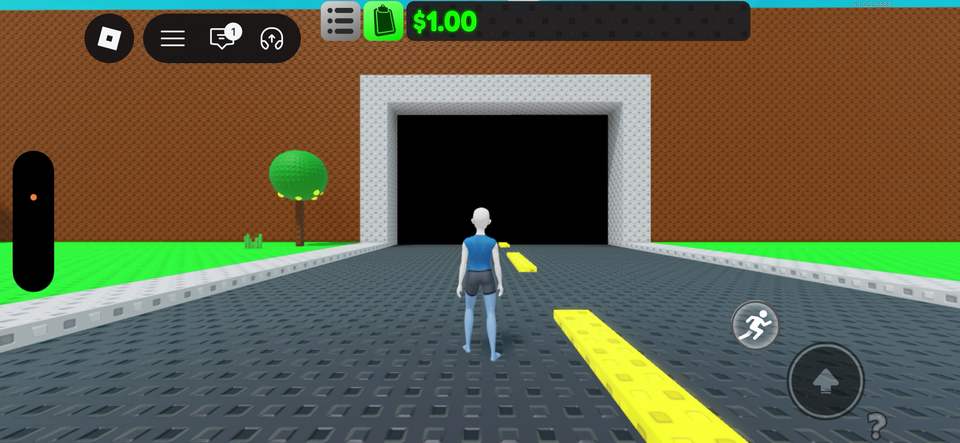
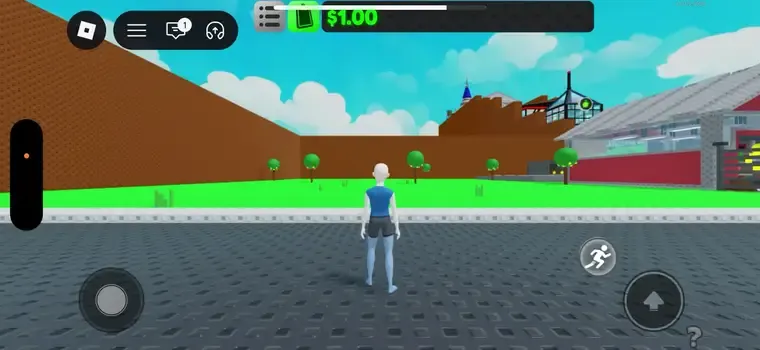
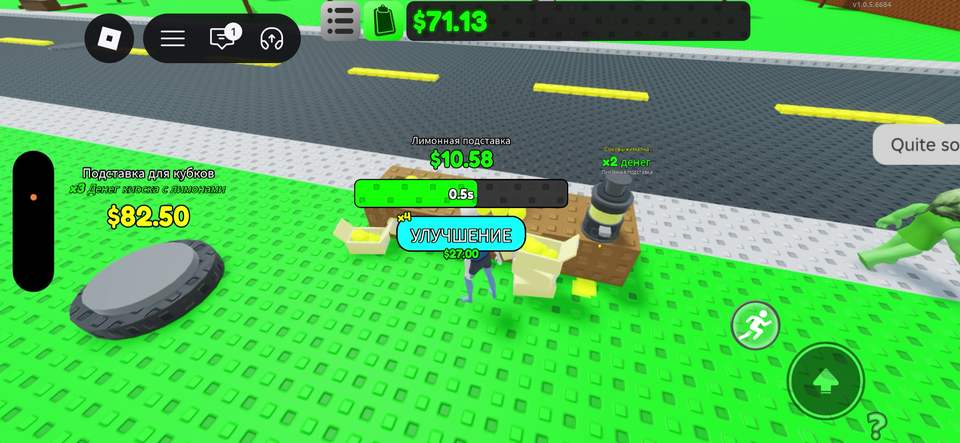
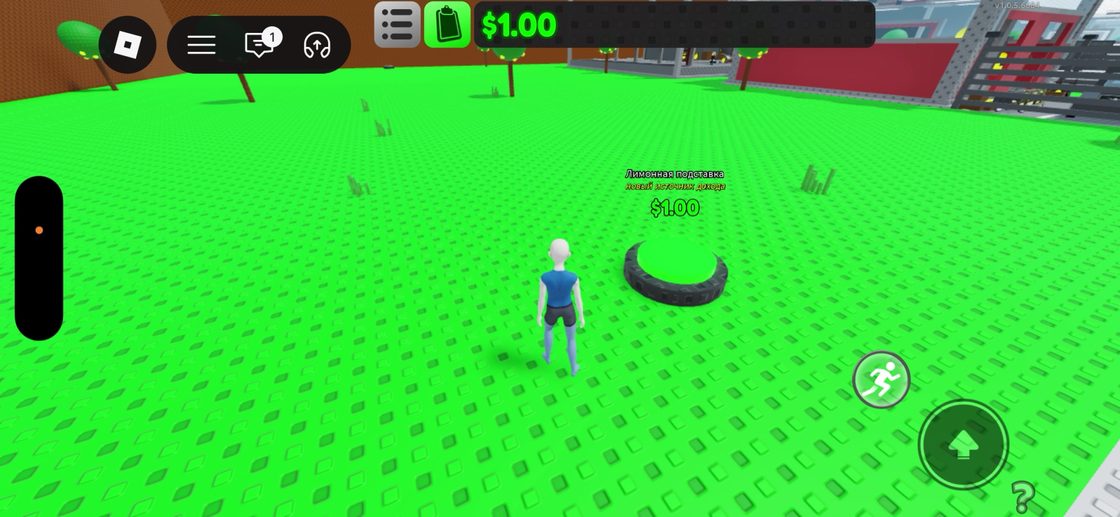
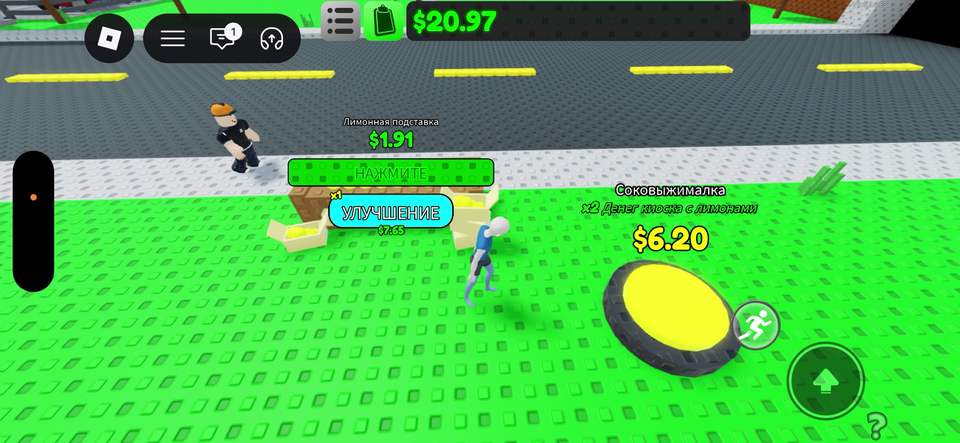
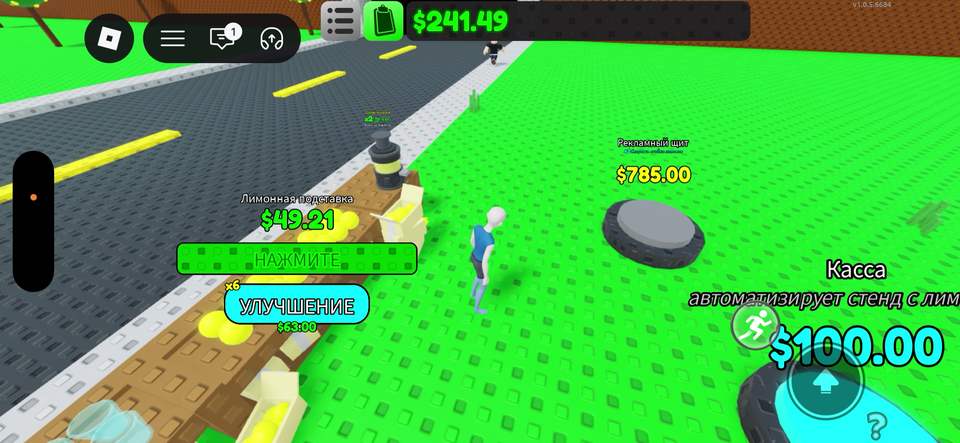
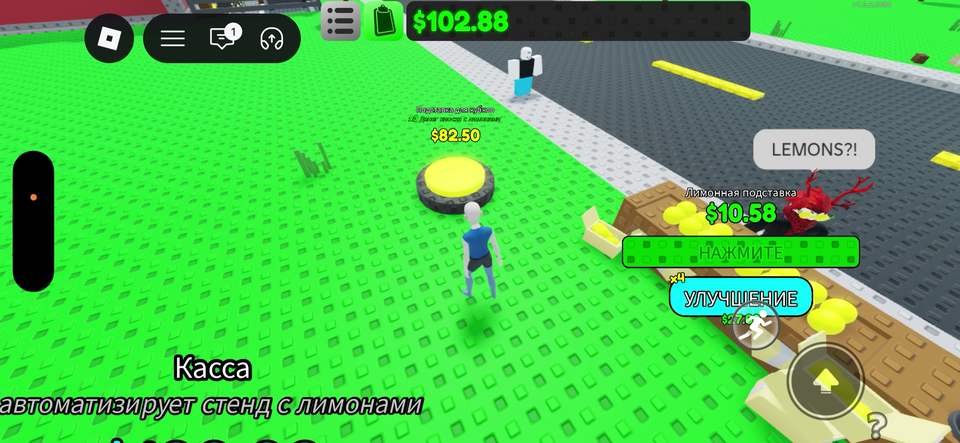
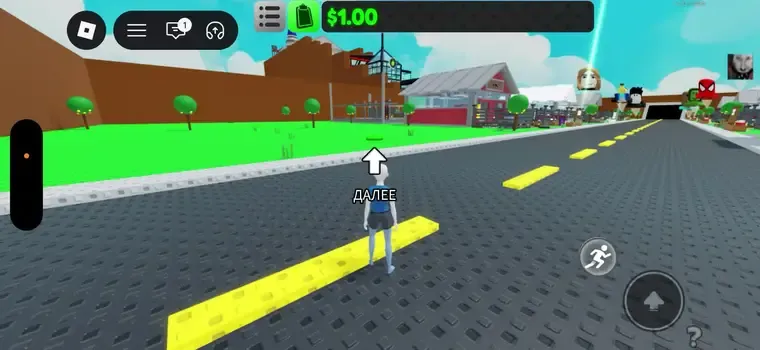
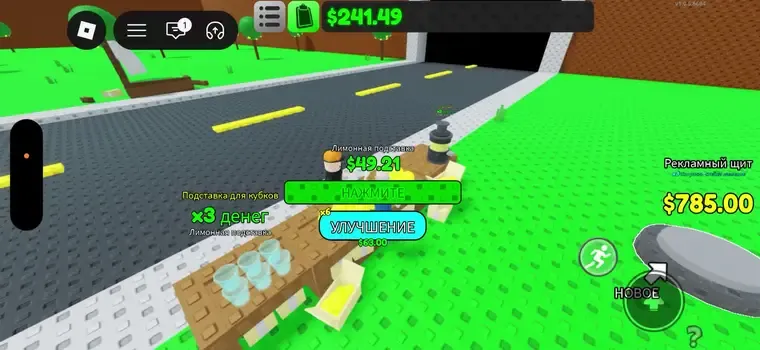
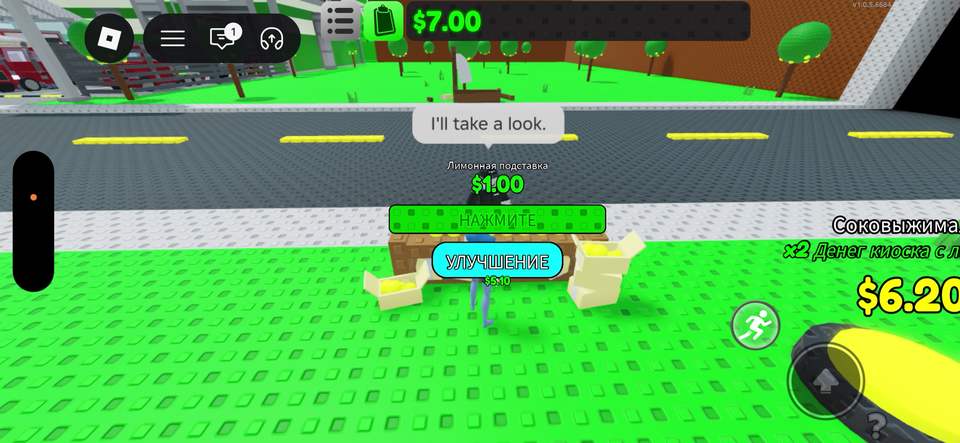
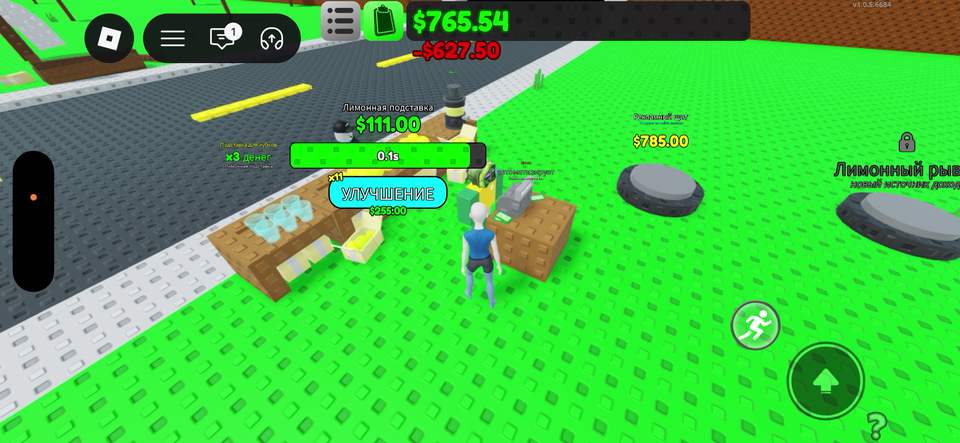
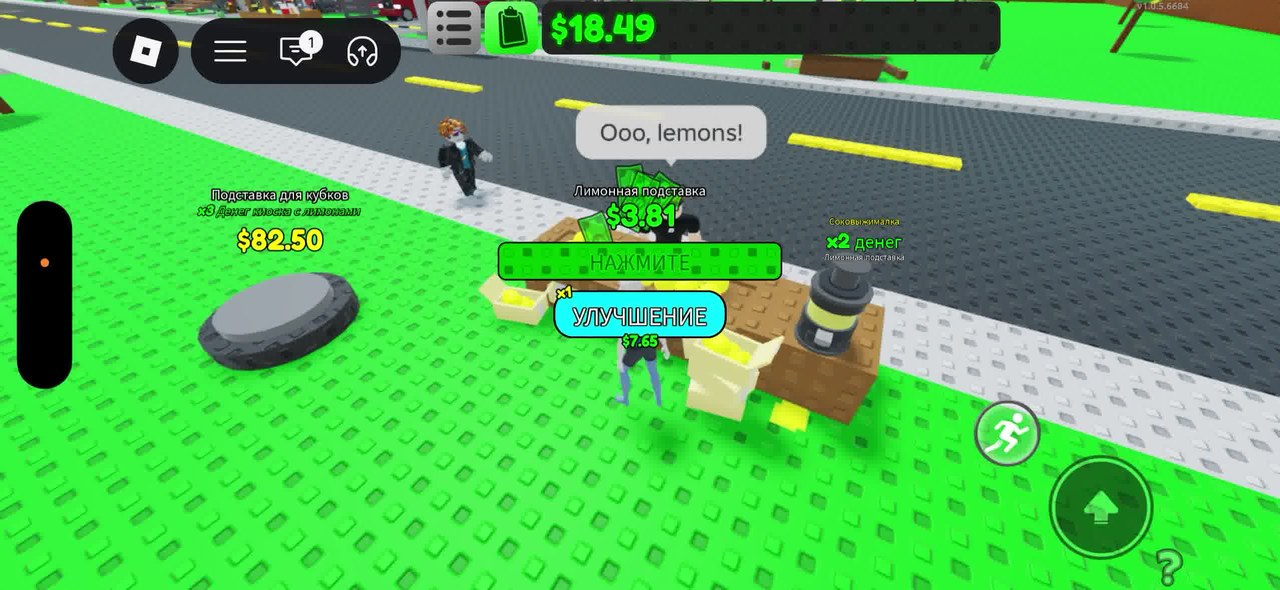
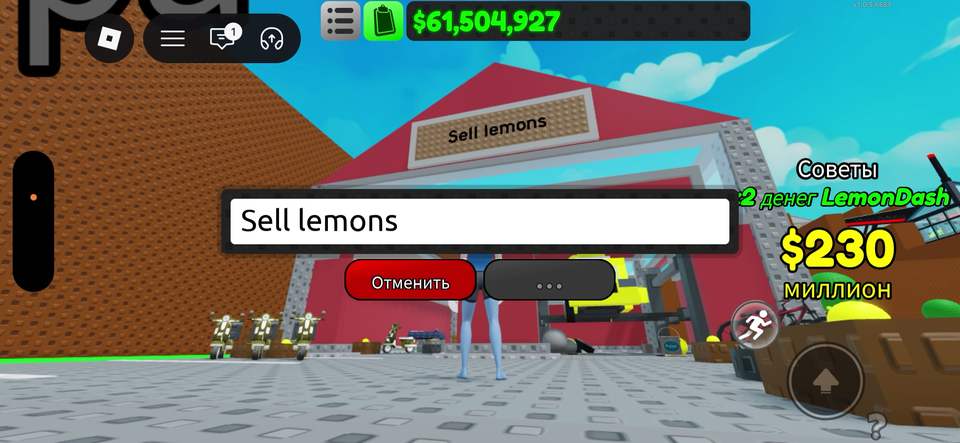
Spawn with a balance of $1.00; the "Lemon Stand" pad is highlighted for $1.00 — the first success is guaranteed. NPCs buy, "Upgrade" appears, income grows ($1.91/click → $58 → $102). The player takes the Juicer $6.20 (×2), then a Cashier: "it automates — that's useful." Onboarding has not a single screen of text; it's all done through highlighting and arrows.
Design lens (FTUE): goal = budget, the reward is double (income↑ + interval↓), the first automation already by minute 9. Friction: the distances between stations — "sometimes you have to run."
LemonDash, the first offer, the first million, a manager
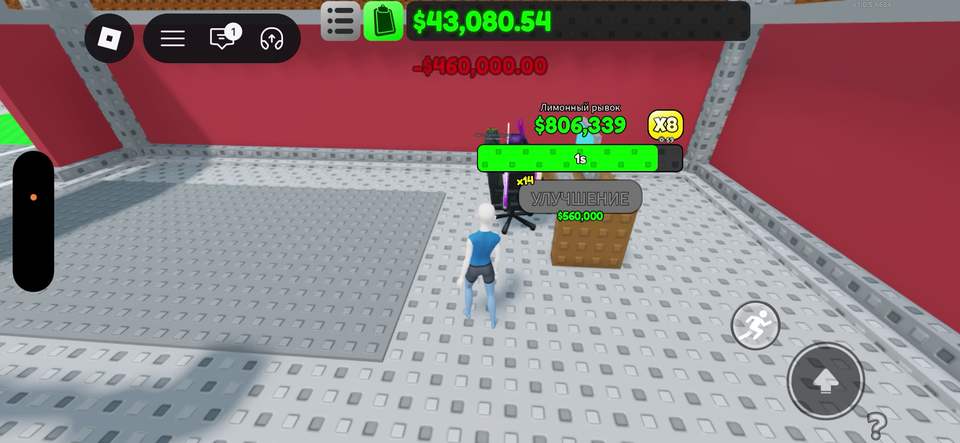
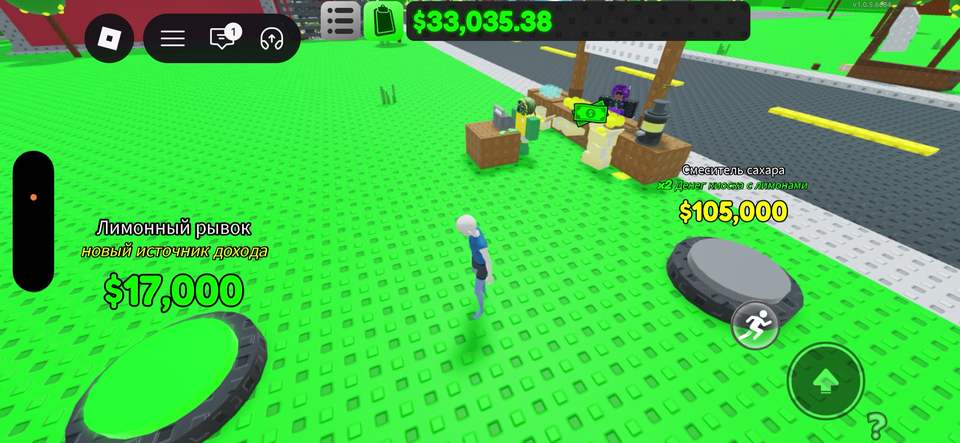
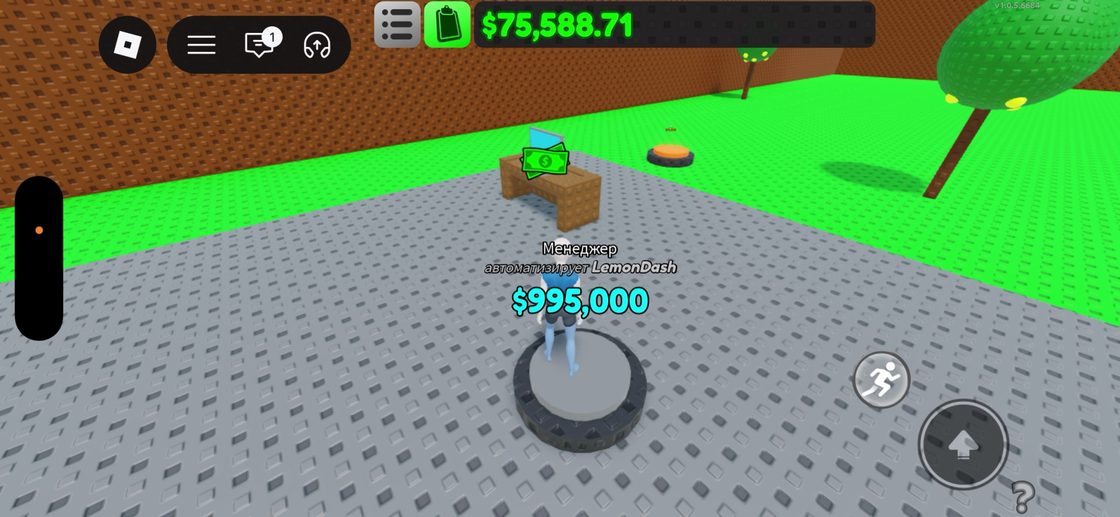
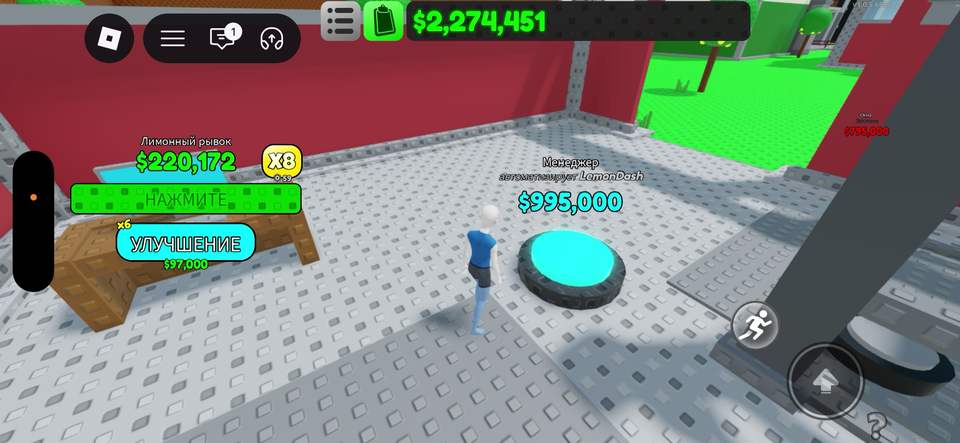
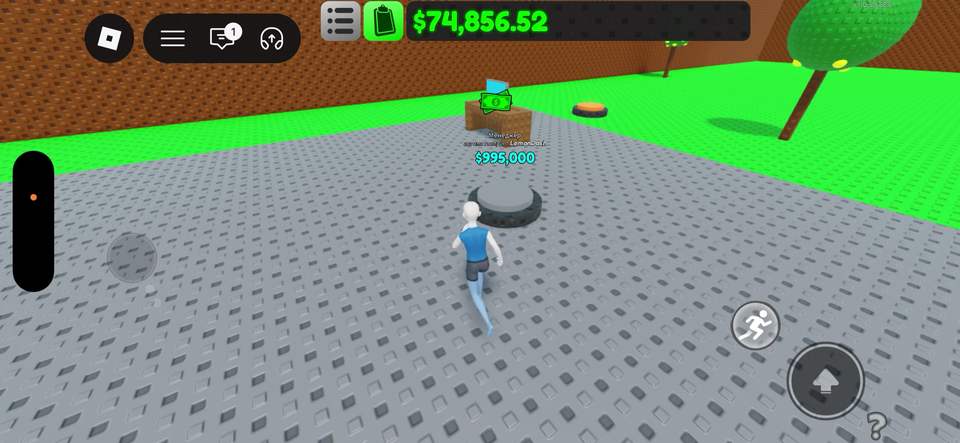
The second source opens — LemonDash $17,000: "a whole lot opened up at once." The first buyer offer (+$11,000) comes in. By ~minute 18 — the first million and a badge. The stage climaxes with the Manager $995,000, which automates LemonDash: "I won't have to click anymore." The game turns from a clicker into idle.
Design lens (progression): a new source = both an income jump and a fresh goal. The Manager is the pivotal purchase, removing the grind right when it starts to be felt.
Multiplier stacks, a teleport, the Void Event ×4.2
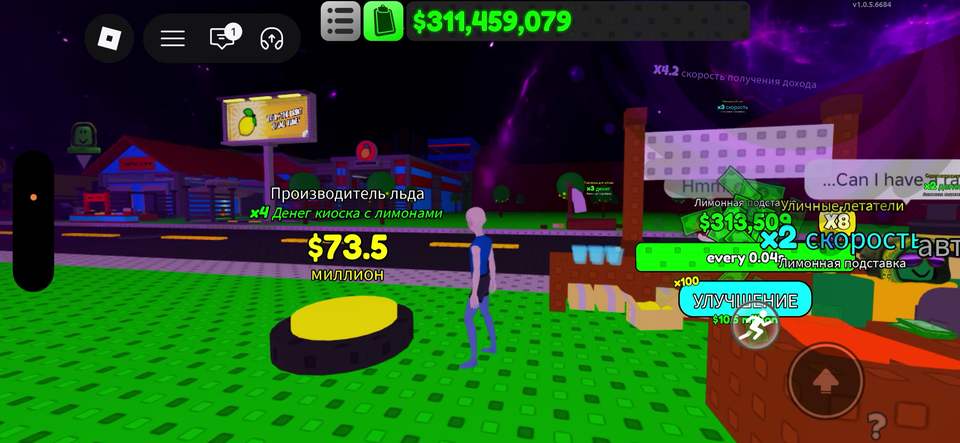
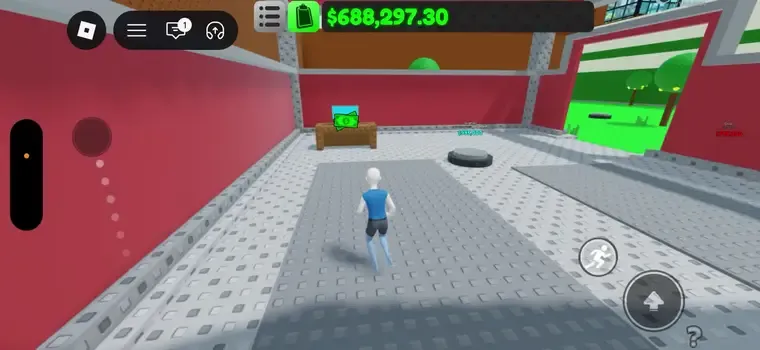
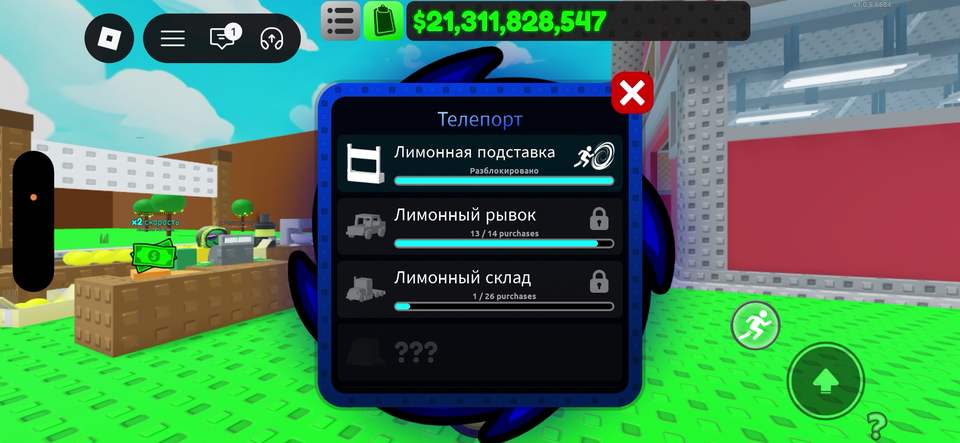
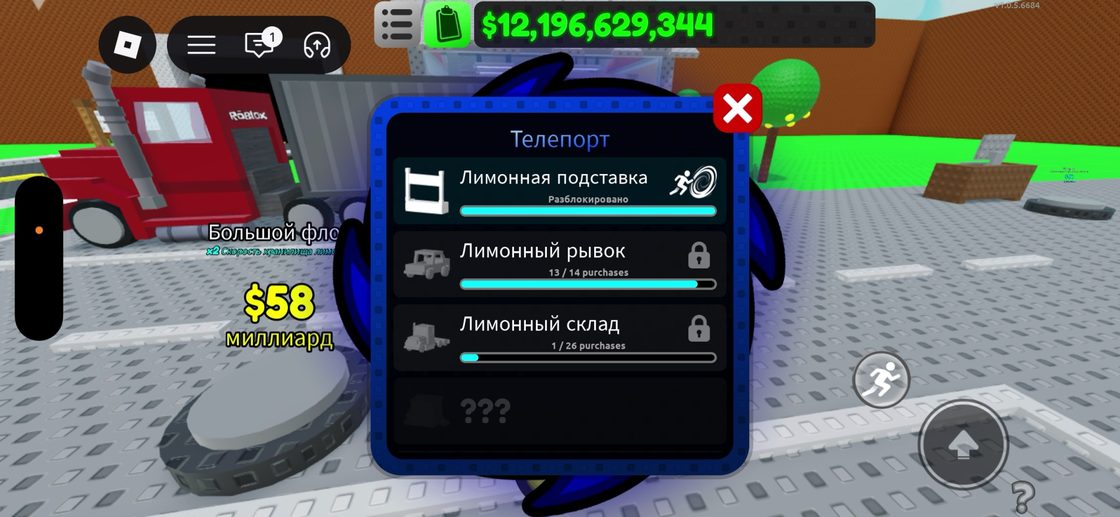
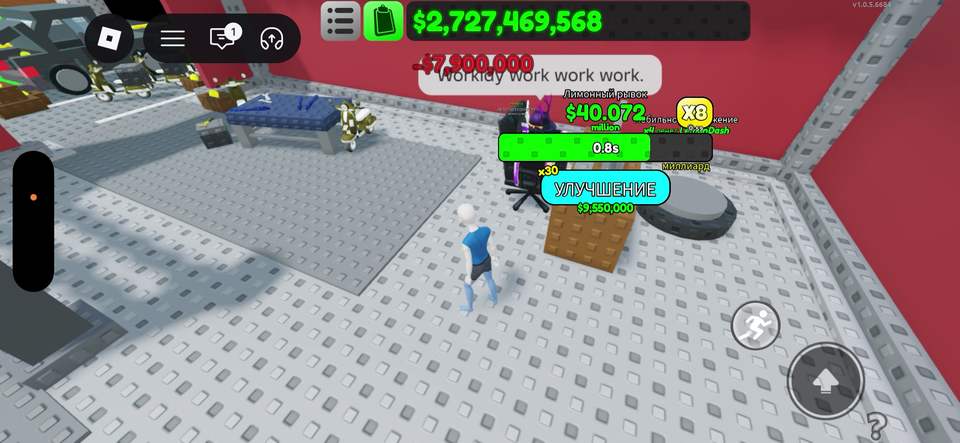
The player stacks the high-value ×2 LemonDash upgrades ($3.25M / $11.5M / $230M) — "the most worth it." At ~minute 24 a Void Event ×4.2 triggers (the sky "glitches" into a galaxy for 3 minutes). At ~minute 29 — a teleport opens (after buying Lemon Depot): "the yellow button is blinking." The first hint of fatigue (~22:54): "no point watching every upgrade."
Design lens: the ×4.2 event and the teleport are "novelty injections" against monotony. But manually grinding through levels is already starting to tire — a harbinger of the "pit."
Lemon Depot (warehouse) and a long accumulation
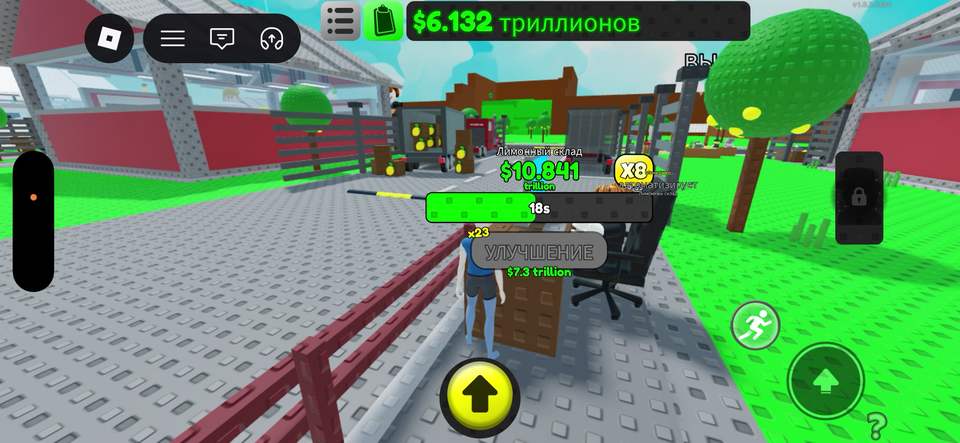
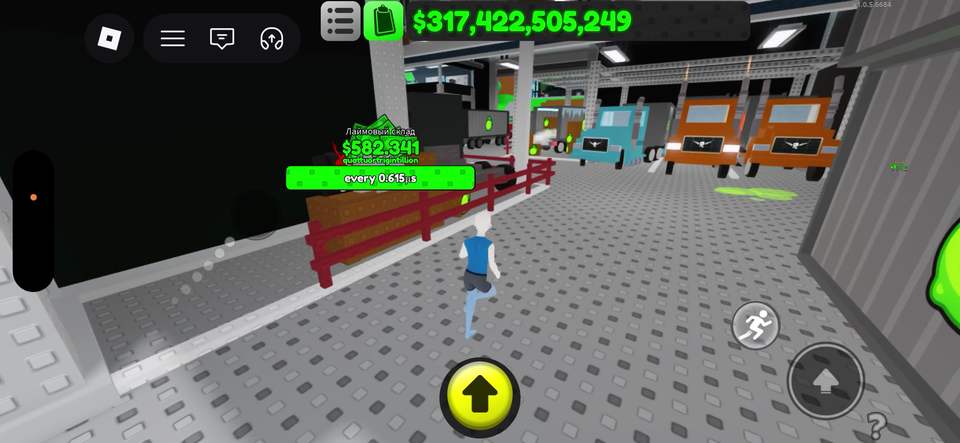
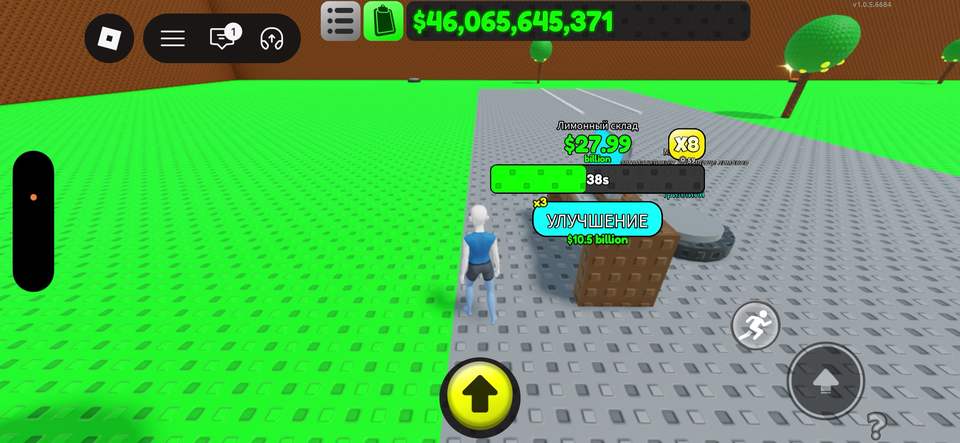
The player opens Lemon Depot (the "warehouse" in the voice-over) as a new main source and levels it up: Bigger Fleet, refrigerated trucks. But between the big tiers there's nothing to buy — at ~minute 31: "nothing left to upgrade… just waiting." At ~minute 42: "until I have a manager it's a bit hard to play" — the warehouse has to be click-farmed by hand.
Design lens (risk): the exponential curve creates "walls" of pure waiting; manual clicking without a manager amplifies the frustration. This is the weakest stretch for pacing.
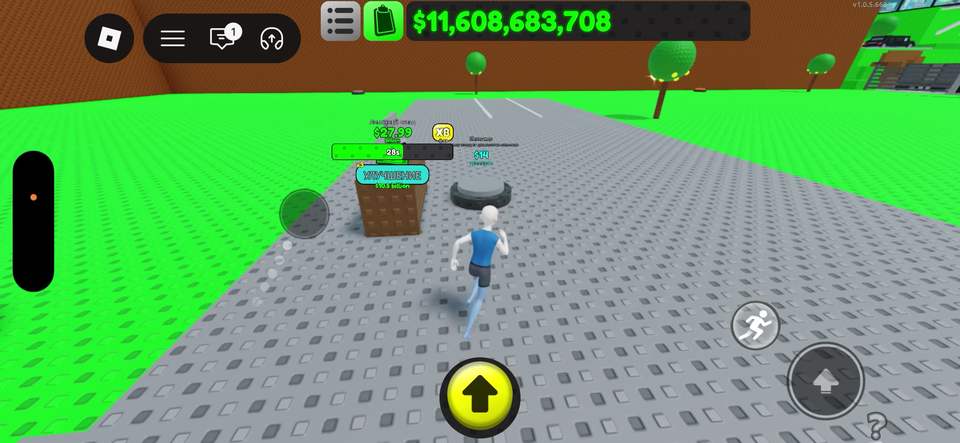
Picking from trees, a golden lemon, other bases and haggling
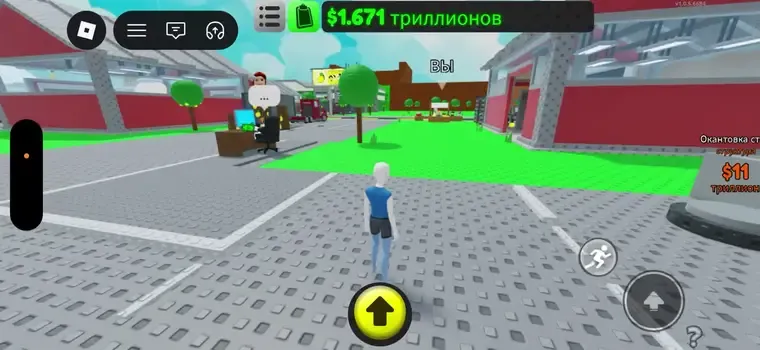
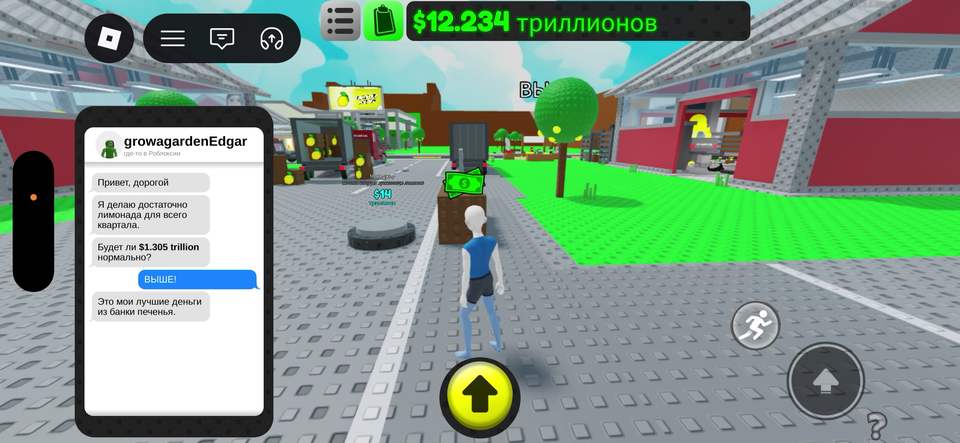
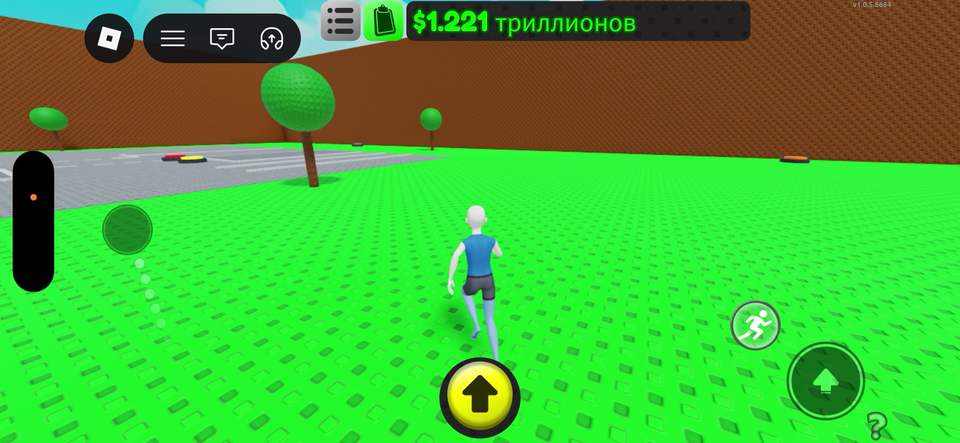
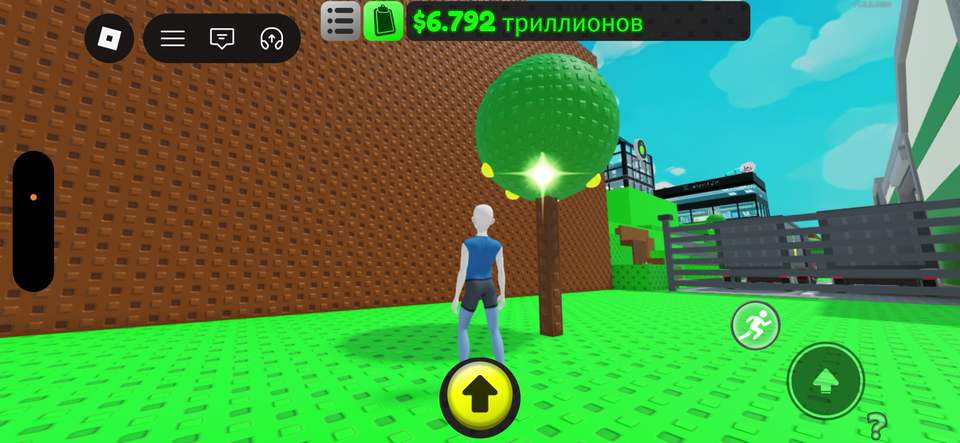
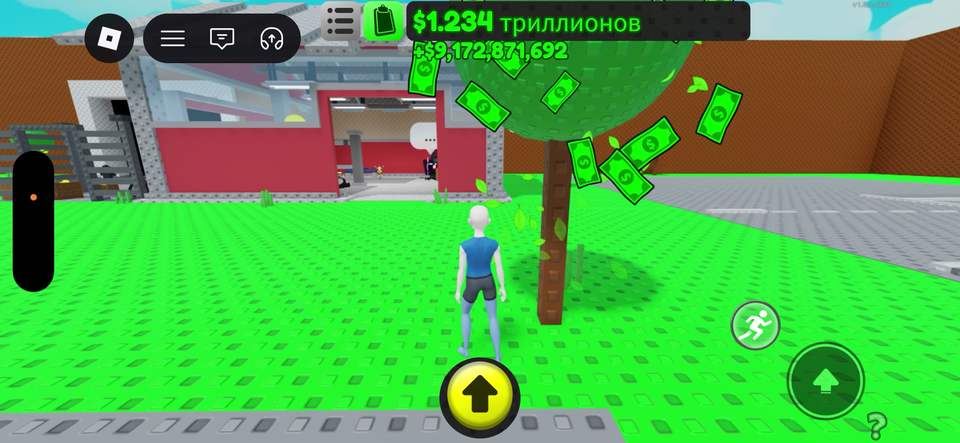
The player discovers picking from trees: "you actually can! I tap a lemon — it gives 4 billion" ($45B, then $94B). A golden lemon ×10 turns up. He goes to look at other bases (quadrillions, flying saucers), tries co-op help for a newcomer. He haggles with buyers: Gordon raises his offer to $1.88T. The player: "picking is more fun than tapping a button."
Design lens: active picking + haggling restore engagement after the "pit." But the game hints at the trees too late (found only by minute 46) — a missed early hook.
The long-awaited warehouse manager and the base going vertical
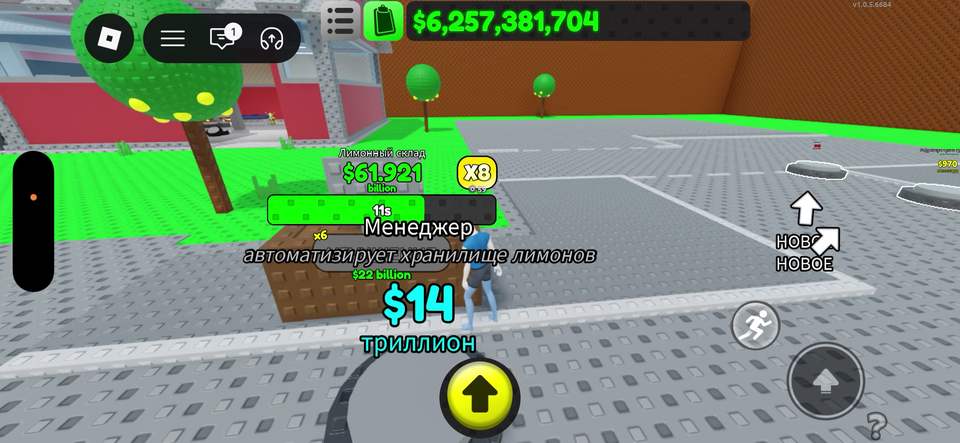
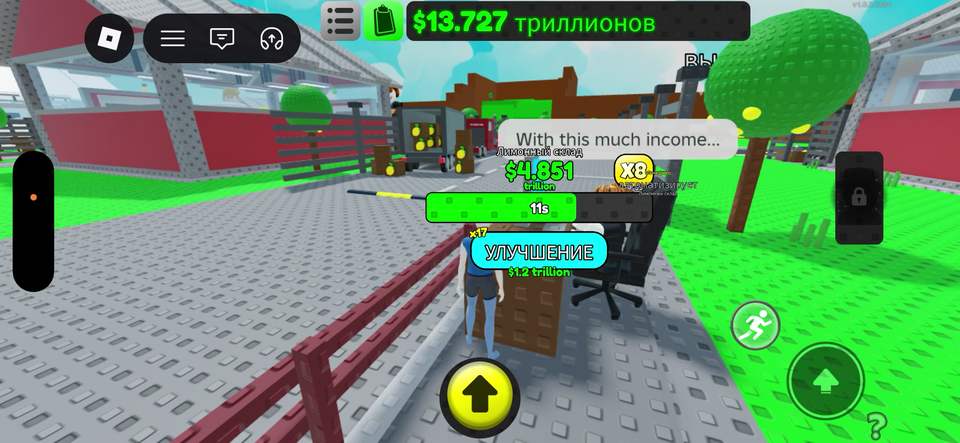
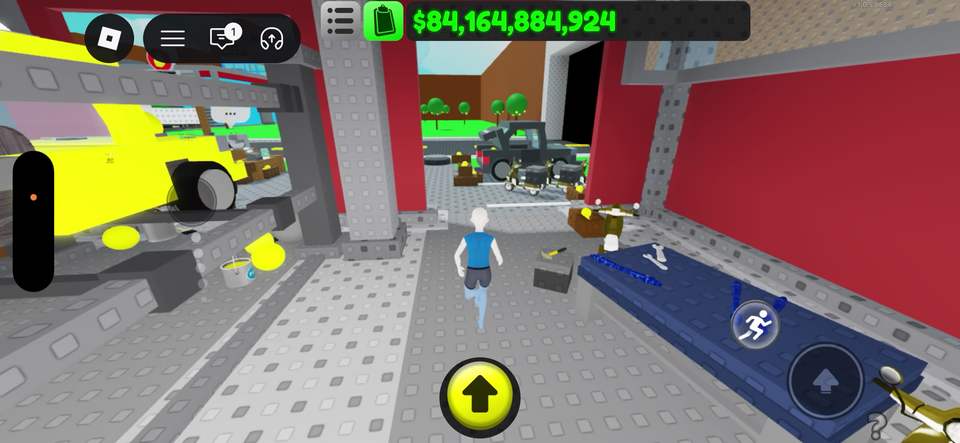
Having saved up on Gordon's offer, the player buys the warehouse manager (~$14T): "now I'm much calmer" — the end of manual clicking. The base grows upward: balconies/floors open. This is the emotional peak of the first session: the frustration of stage 4 is lifted by a purchase.
Design lens: the classic "pain → a paid (in-game) solution." The long savings grind for the manager makes its purchase a meaningful event rather than a chore.
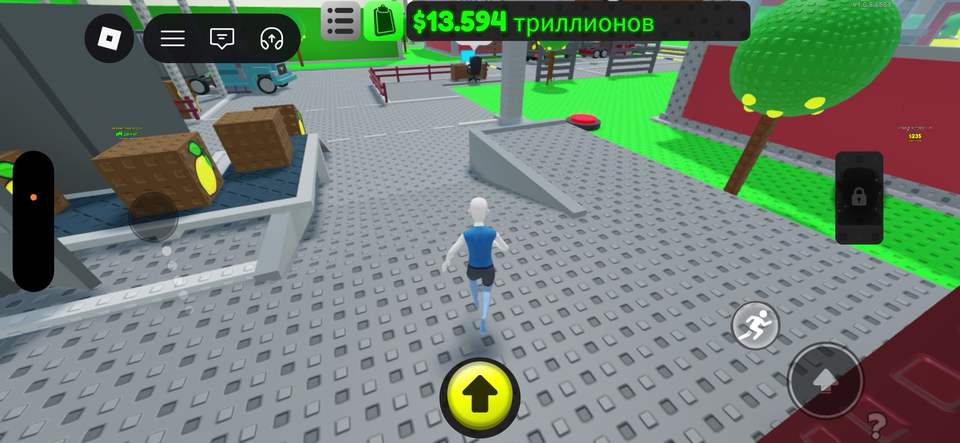
Offline return, logistics, and "nothing changed here"
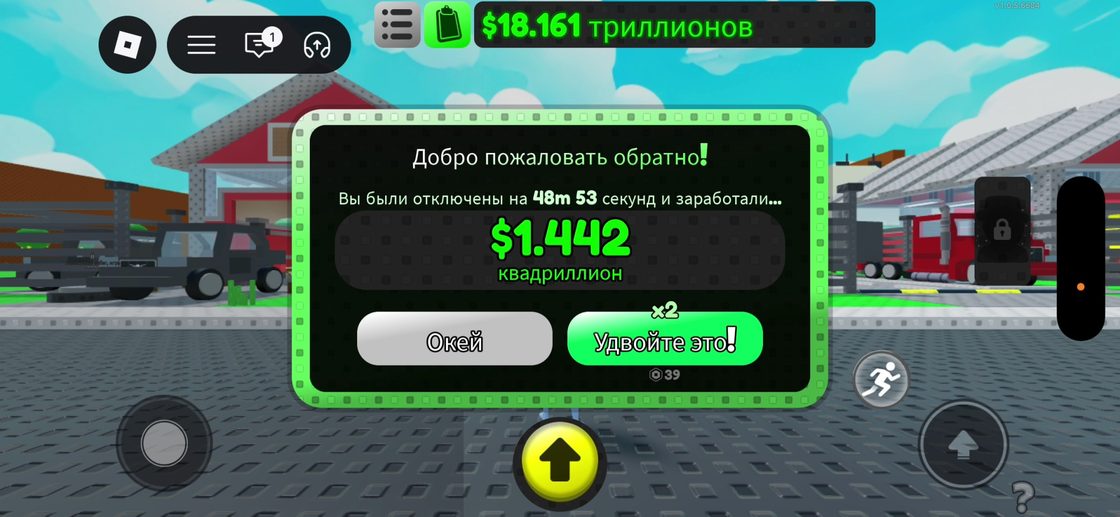
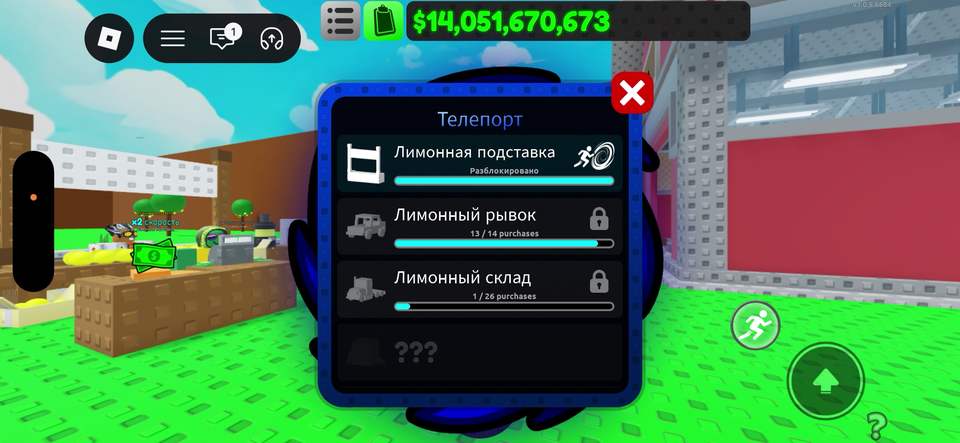
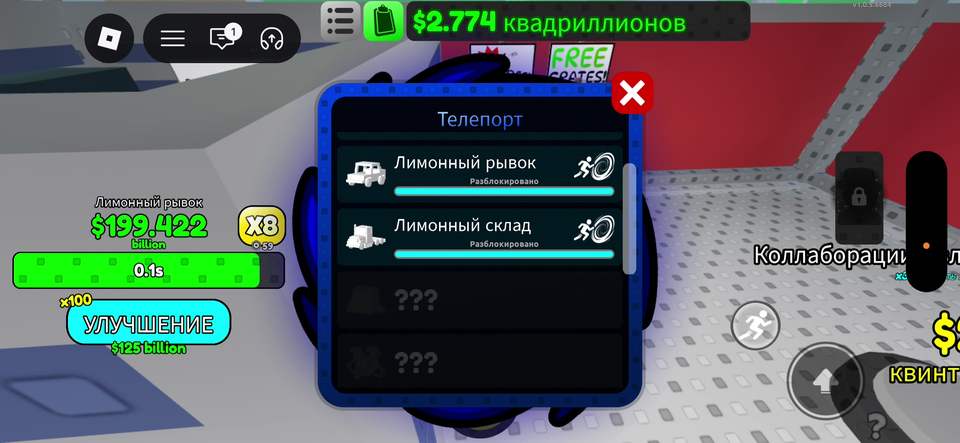
Returning after offline: a "Welcome back!" screen with the accumulated sum and a "Double it! ×2" button — the main D1/D7 hook. The player buys warehouse logistics for $62.5T (speeds up output) and picks up the station teleports. But emotionally the late game is flat — the closing line: "nothing changed here."
Design lens: the offline return brings the player back beautifully, but without a new "territory" the late game runs into a plateau — exactly the place where you need intermediate mini-goals.
Over 72 minutes the player traveled the "$1 → trillions" path across the first three sources. The emotional curve: a powerful start → ramp-up on new sources → a drop into the "pit" of waiting (31–42 min) → revival via trees/haggling/neighbors → relief from the manager → a flat plateau on the second login. The game is strongest in moments of new territory and haggling; weakest in fixed timers and accumulating between tiers. The full progression picture (5 more sources + three "rebirths" with an alien meta-game) is in parts D and E.
What the game looks like
The world, base evolution, other players' bases, the object catalog and special content — what the team that will rebuild this needs.
Art direction and the scene
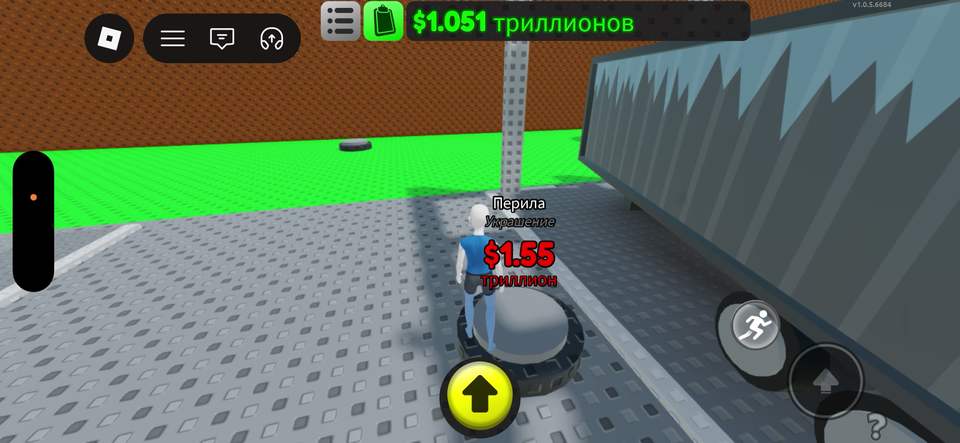
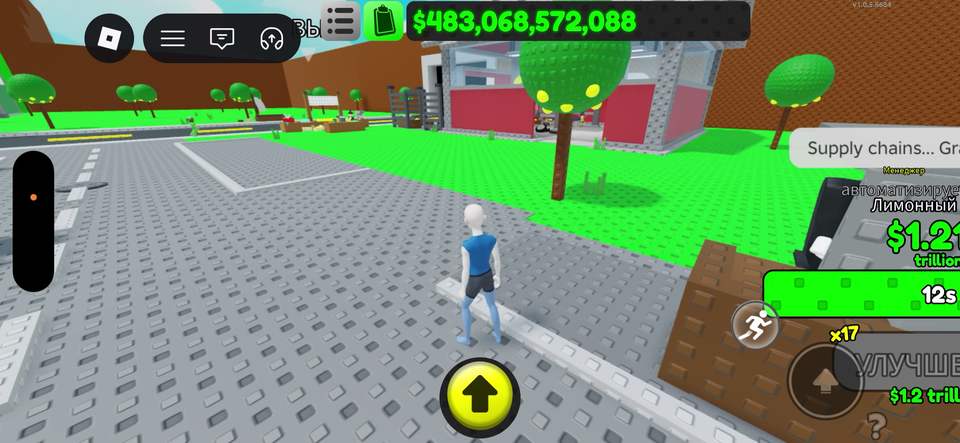
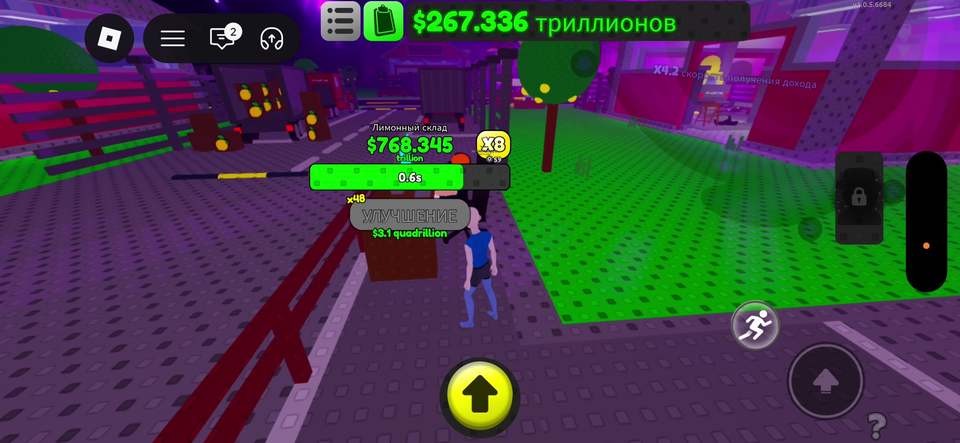
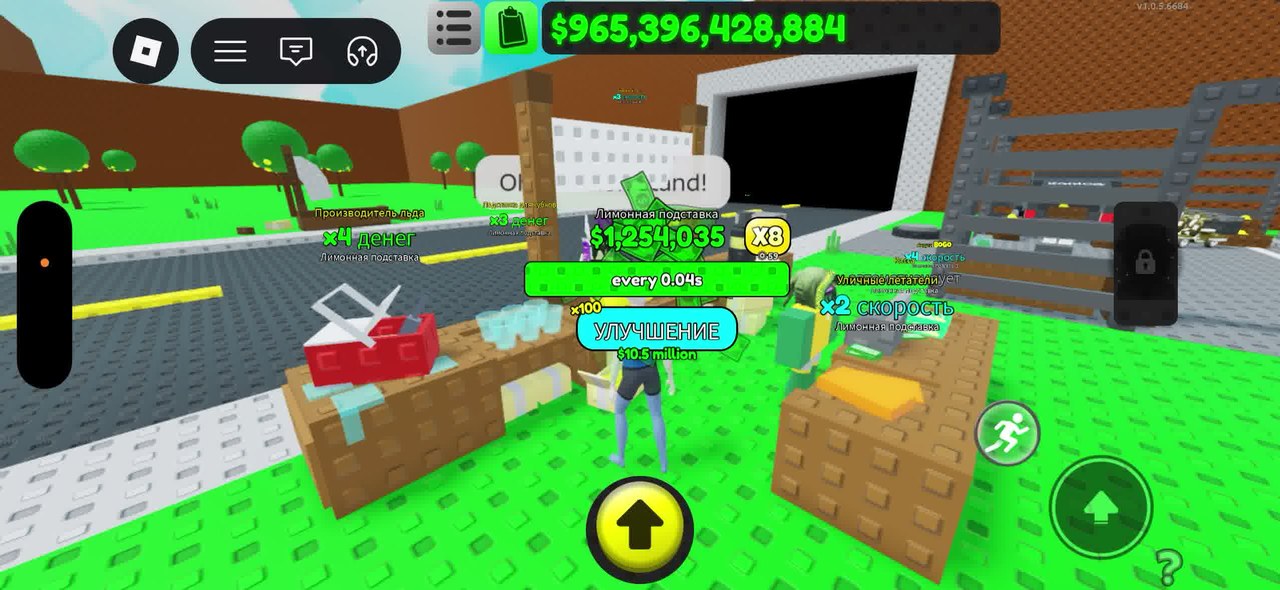
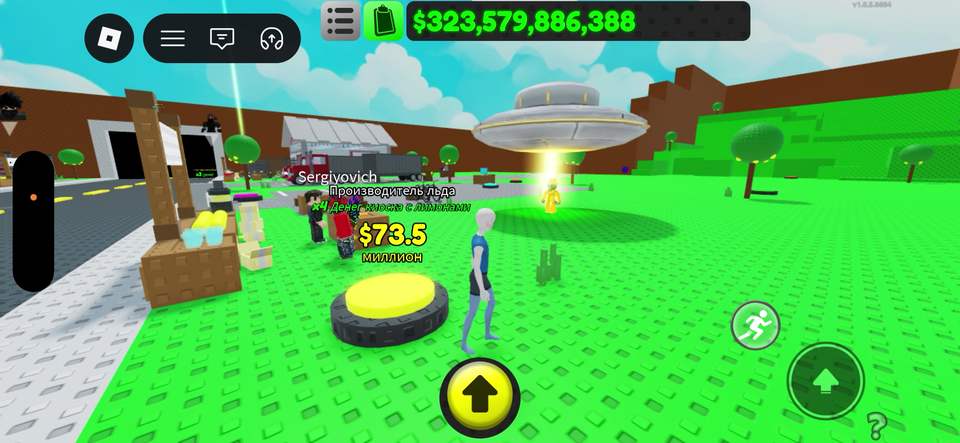
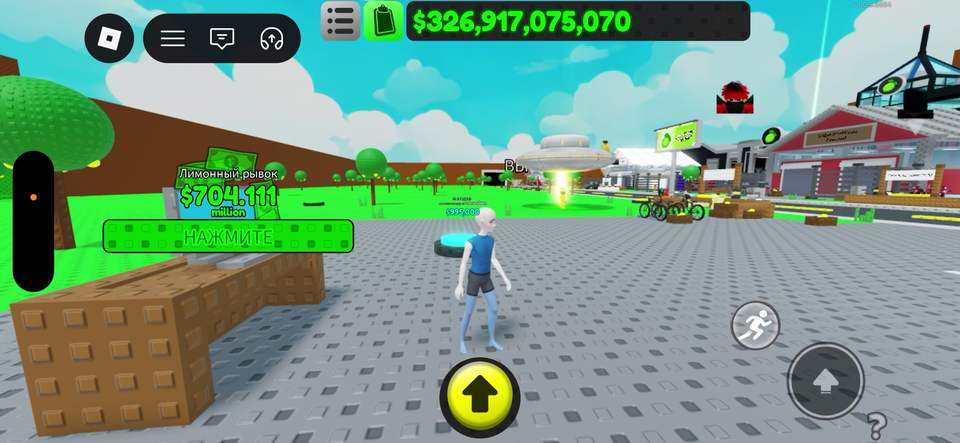
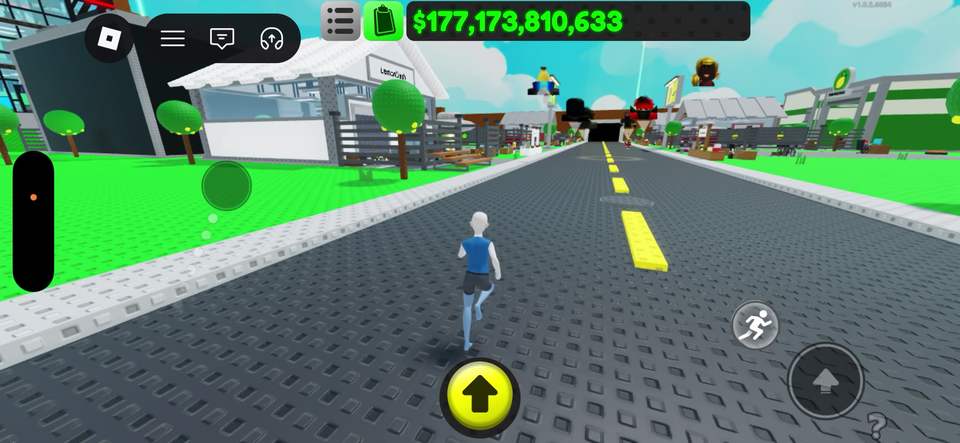
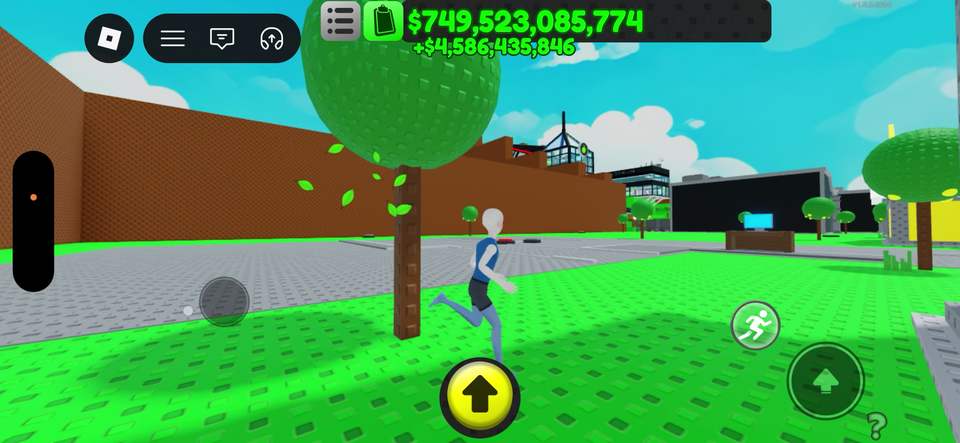
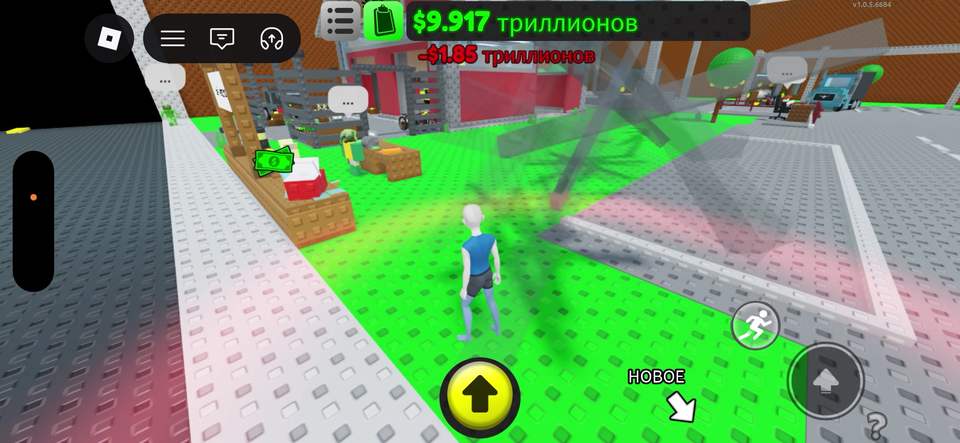
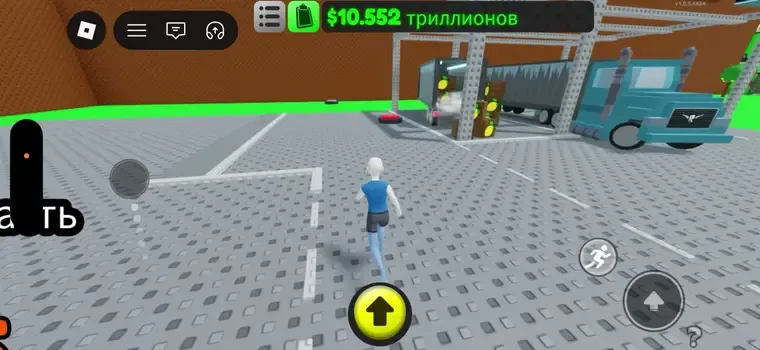
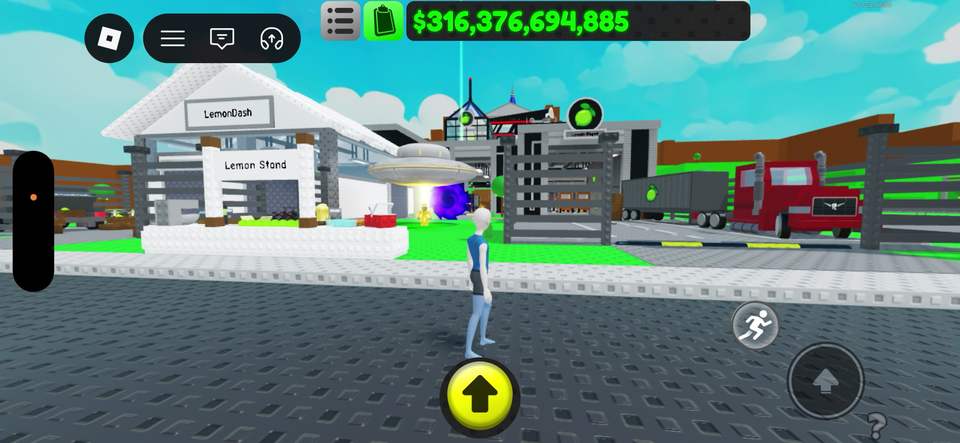
A bright "LEGO-cartoon" Roblox style: a green grassy plot, a lemon-yellow palette, large readable objects, and floating green income numbers. The camera is third-person behind the character; controls are a mobile joystick + an action button.
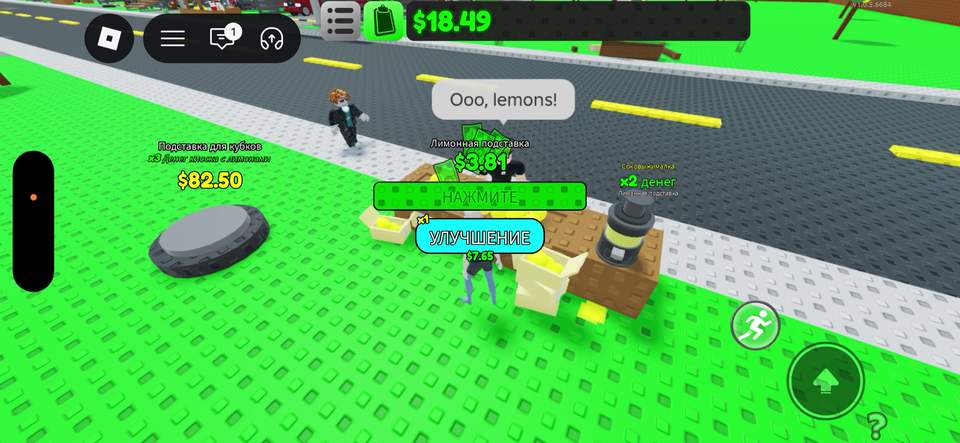
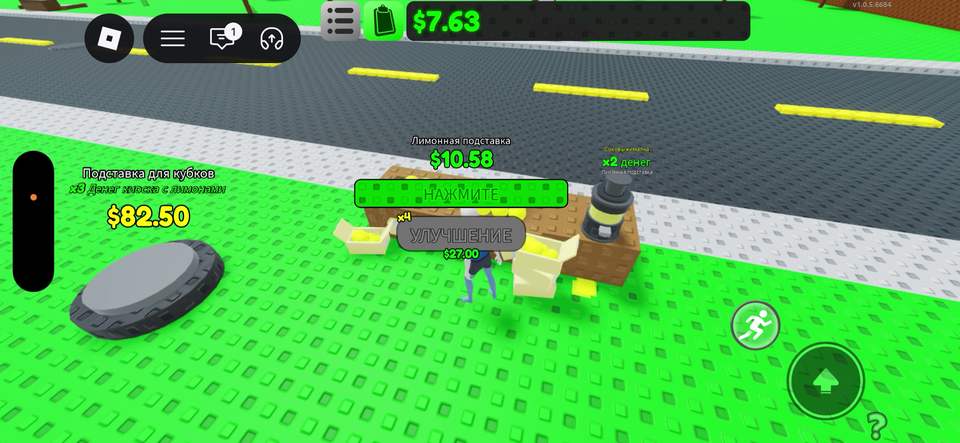
The base: start → mid → finale
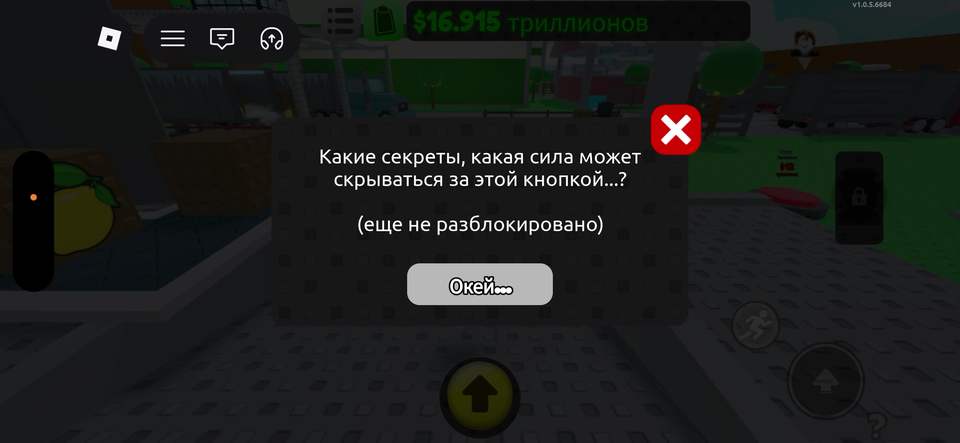
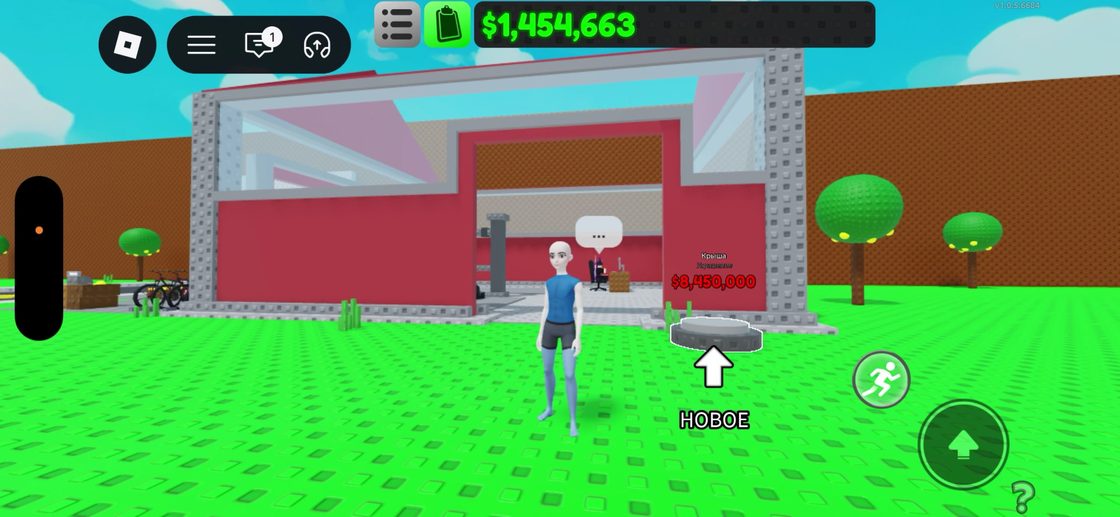
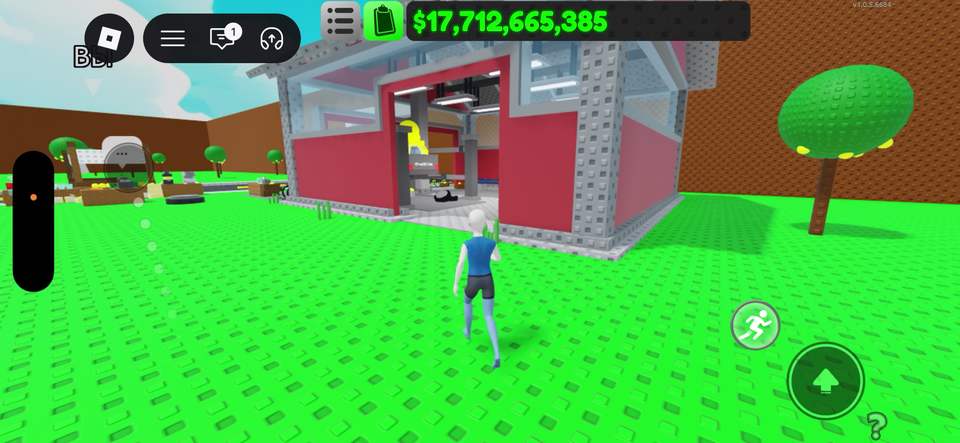
The game's main visual story — how an empty $1 plot turns into a multi-storey factory with trucks, a warehouse and logistics. Every big purchase visibly reshapes the base: that's the "before/after" sense of progress.
Neighbors: social scale and co-op
A 10-player server, and other players' bases are visible and open to inspection. This works as social proof ("people already have quadrillions") and as light co-op — you can visit a newcomer's base and help them.
Key stands and structures
A reference model of the main objects the player unlocks through progression: what it is, what it does, and how much it costs. For a clone, this is the list of what needs to be modeled and scripted first.
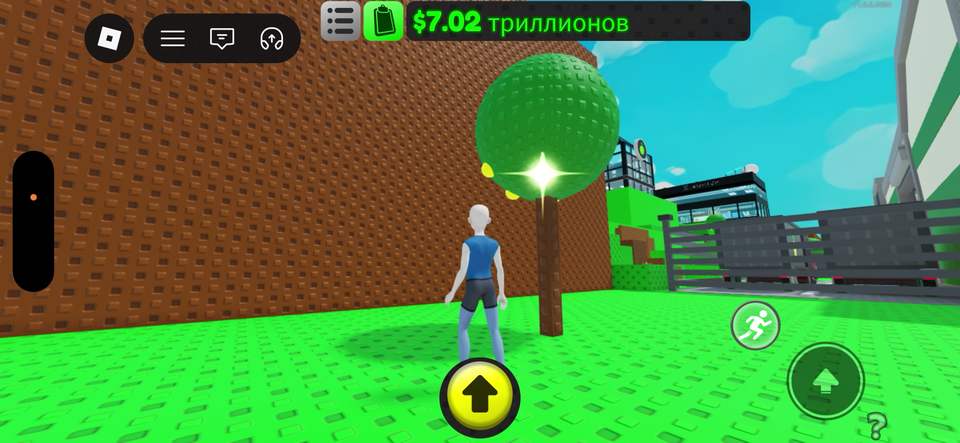
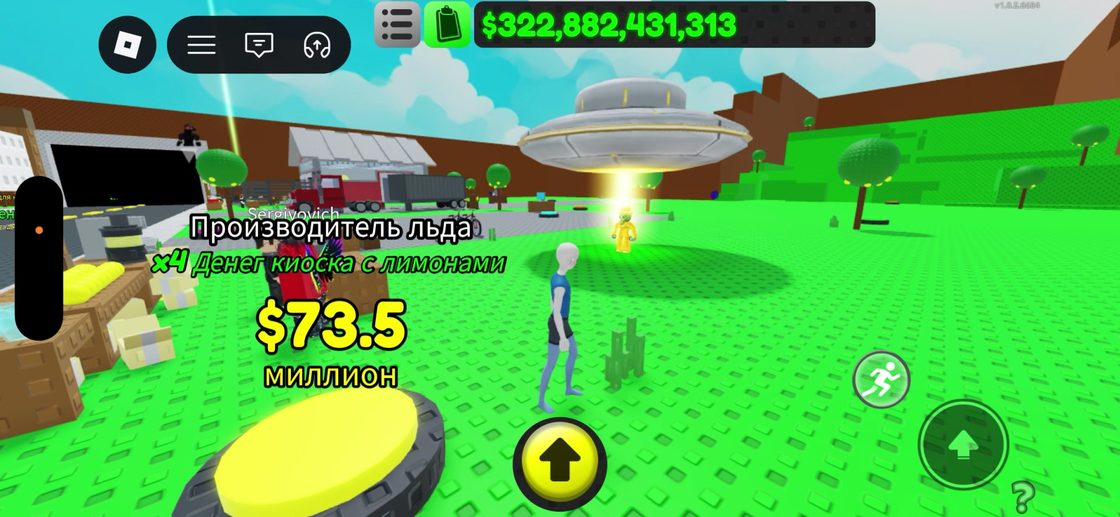
Lemons on trees, the golden lemon, and aliens
On top of the idle core there's active picking: lemons can be picked by hand from trees for large one-off sums, and occasionally a golden lemon ×10 turns up. And yes — aliens are a real meta-game mechanic here: the first "rebirth" is done at Joe the Alien's UFO (you need ~77 sextillion — the player didn't reach it in the recording). And the flying saucers he saw on neighbors' maxed bases are status decorations of that same alien layer. The full meta-game is broken down in the "Meta-progression" section.
How it's played
The core loop, the first minutes and the interface — how the game leads the player by the hand.
One loop that holds the whole game together
The loop closes within the first minute and stays unchanged across all 70+ minutes — only the scale of the numbers and the degree of automation change. This is the first thing worth carrying into a prototype.
Core loop:
The loop in motion — early gameplay (GIF, click to enlarge)
Animations assembled frame-by-frame from the playthrough: the "first $1", the sell cycle itself, and the first automation. Click any one to view it large.
The first minutes: where the game wins the player over
The start is built almost flawlessly: the storefront sells the fantasy, the spawn gives exactly $1, the first purchase and upgrade are guided by highlighting and arrows. There's one weak spot — navigation: in dense zones several prompts compete with each other.
- Onboarding quality** What to improve: keep one clear "next goal" at a time; explicitly hint at active tree picking (the player found it only by minute 46, even though it's "more fun than tapping a button").
The interface guides, but is noisy in places
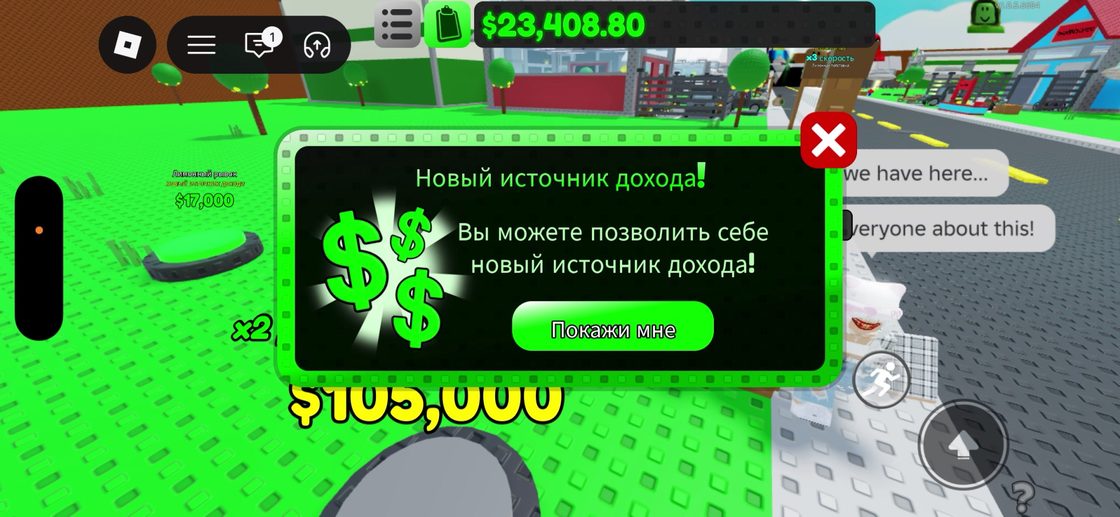
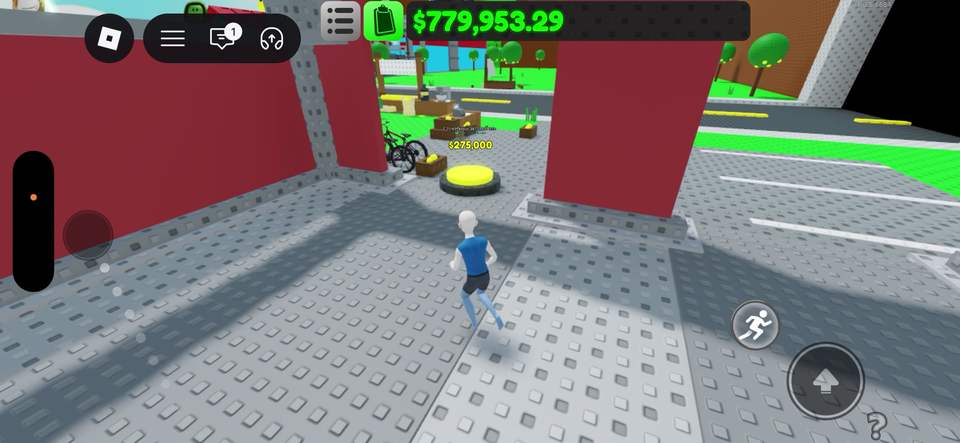
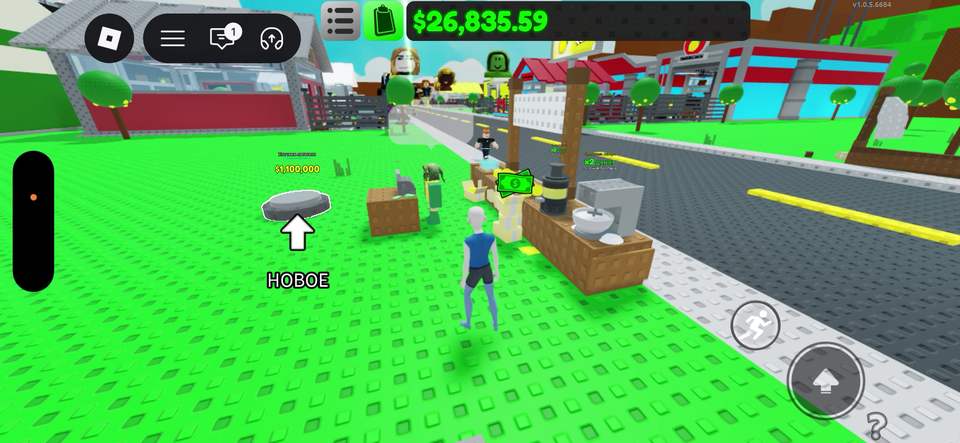
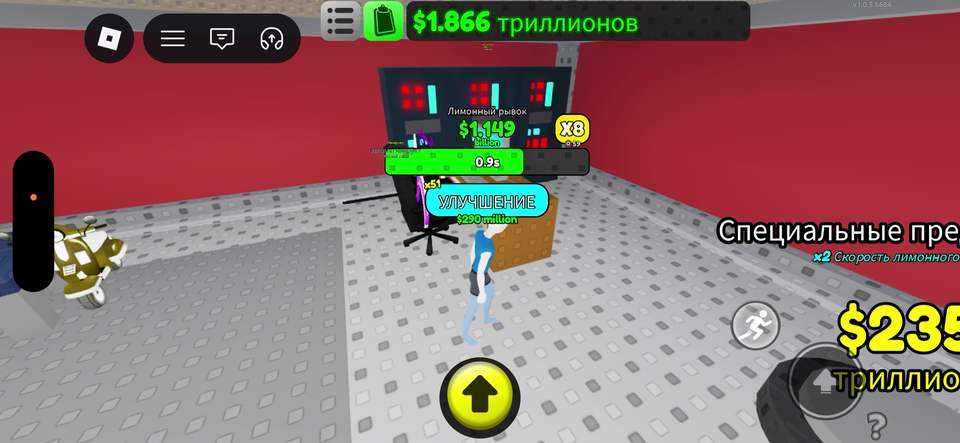
Strong feedback and clear prompts are the main plus and the "juice" benchmark. The downsides are localized: partial localization (English text + Russian buttons), the density of floating UI in busy zones, and big distances between stations early on.
- The main screen clearly asks "buy / upgrade"; in dense zones the focus blurs.
- Large numbers read well, but partial localization and floating labels get in the way.
- Purchase animations, flying $, sound, a growing balance — benchmark "juice."
- Running between stations early on; removed by teleport and gamepasses.
- What's done well**
- Where the friction is**
How the money works
Currencies, real prices, desire tuning, and the pacing curve — the core of the spec for a clone.
What you pay with and where the money comes from
There's one main currency — dollars ($) — which grows from dollars to quadrillions and beyond in a single session. Robux is Roblox's external premium currency. Multipliers (×) are tied to objects, events and the rare golden lemon.
Currencies
| Currency | What it's spent on | Notes |
|---|---|---|
| Dollars ($) | Sources, structures, warehouse, logistics, upgrades | The main progression currency; $ → K → M → B → T → quadrillions+ |
| Robux (R$) | Gamepasses, profit packs, boosts, private server | Roblox's external currency |
| Multipliers (×) | Tied to objects, events, the golden lemon | ×2 · ×3 · ×4 · ×8 · ×10 · ×100 |
Real prices, timings and multipliers
An exponential economy: each next tier is an order of magnitude more expensive than the last, while the timers compress at the same time. Below are values cross-checked against the official wiki — enough to reproduce the progression ladder.
Full income-source ladder (8 of them)
Data cross-checked against the game's official wiki. In the recording the player reached roughly the 3rd source (Lemon Depot); beyond that — 5 more sources with exponentially rising price tags all the way to the cosmic theme of LemonX.
Inside each source — a tree of ~7–14 upgrades alternating Cash (×2/×3/×4/×7 to money) and Speed (×2/×3/×4/×7 to tick speed), plus cross-source Global Upgrades (up to ×42 to global income). Each tier is about an order of magnitude more expensive than the previous one.
Source and automation chain (from the recording)
| Object | Price | Effect | Stage |
|---|---|---|---|
| Lemon Stand | $1.00 | The first income source | Start |
| Stand upgrade | $5 → $10 → … | Income/click ↑ ($1.91 → $58 → $164…) | Start |
| Juicer | $6.20 | ×2 money | Early |
| Cashier | early | Auto-click the stand | Early |
| Billboard | $785 | Business naming | Early |
| Lemon Dash | $17,000 | The second income source | Early |
| Higher Fees (Lemon Dash) | $39,500 | ×3 money | Mid |
| Service vehicle | $275,000 | ×2 Lemon Dash speed | Mid |
| Manager | $995,000 | Automates Lemon Dash | Mid |
| Lemon Dash upgrades | $3.25M · $11.5M · $230M | ×2 money (the best value) | Mid |
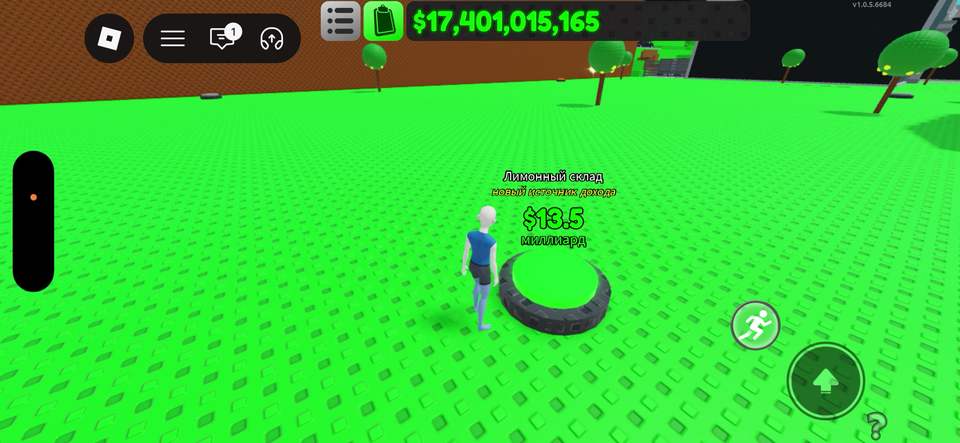
| Lemon Warehouse | $13.5B | New main source (tick 30s) | Late |
| Teleport network | with warehouse purchase | Unlocks teleports between stations (there is no separate "Fund" building) | Late |
| Mobile App (Lemon Dash) | $270B | ×4 Lemon Dash cash | Late |
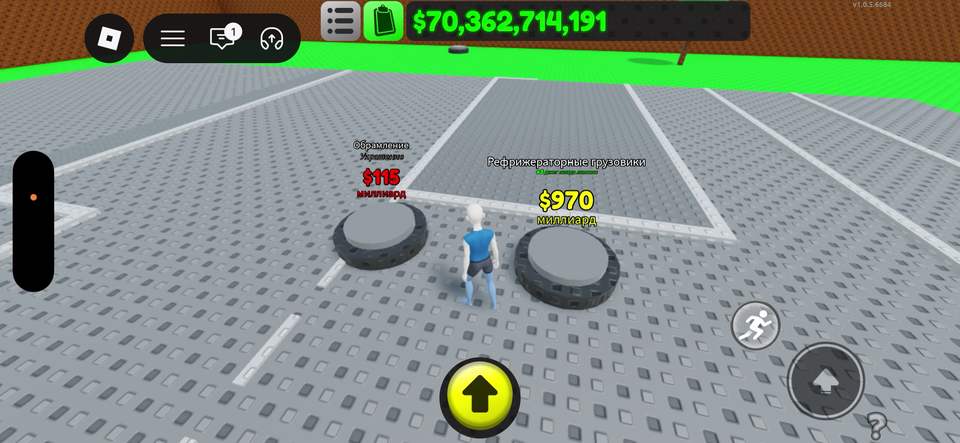
| Refrigerated trucks | $970B | ×3 warehouse logistics | Late |
| Warehouse manager | ≈ $14T | Automates the warehouse (end of manual clicking) | Late game |
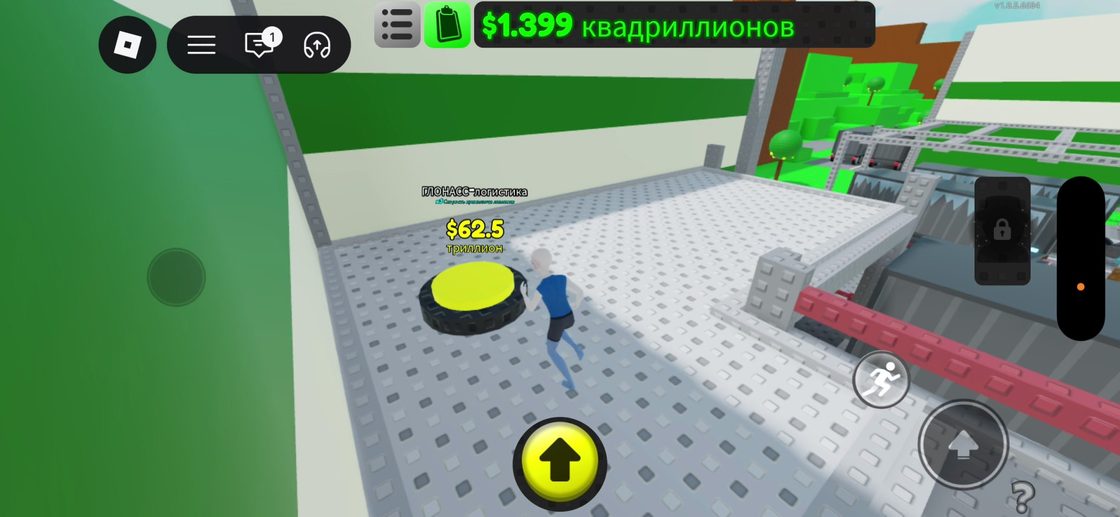
| Logistics (GLONASS/GPS) | $62.5T | ×2 storage speed | Late / 2nd session |
Multipliers, timings and haggling
| System | Values | Timer / tick | Multipliers |
|---|---|---|---|
| Lemon Stand | $1 → upgrades $1.91…$52 | 0.6s → 0.2s → 0.04s | ×2 · ×3 |
| Lemon Dash | $17K → $39.5K → $3.25M → $230M | /3s | ×2 · ×3 · event ×4.2 |
| Lemon Warehouse | $13.5B → … → tens of T/30s | 30s (down to <1µs for top players) | ×3 trucks · ×3 logistics |
| Picking from trees | $4B · $45B · $94B per lemon | by hand | golden ×10 · gamepass ×2 |
| Buyer offers | $11K · $1.09M · 1.35→1.88T | by event | haggle ±% |
Full upgrade trees for all 8 income sources (expandable)
Exact values from the official wiki — the complete economy "ladder" for reproduction. Click a source to expand its upgrades. ×N cash multiplies income, ×N speed shortens the tick. In the recording the player reached the 3rd source (Lemon Depot); sources 4–8 are future and endgame content. The number scale is the short scale (Billion=10⁹, Trillion=10¹², Quadrillion=10¹⁵ …).
*1 · Lemon Stand* start · $1 — start · $1 · 7 upgrades · clicker start
| Upgrade | Effect | Cost |
|---|---|---|
| Juicer | ×2 cash | $6.20 |
| Cup Stand | ×3 cash | $82.50 |
| Billboard | ×3 speed | $785 |
| Sugar Mixer | ×2 cash | $105,000 |
| Street Fliers | ×2 speed | $1.1M |
| Ice Maker | ×4 cash | $73.5M |
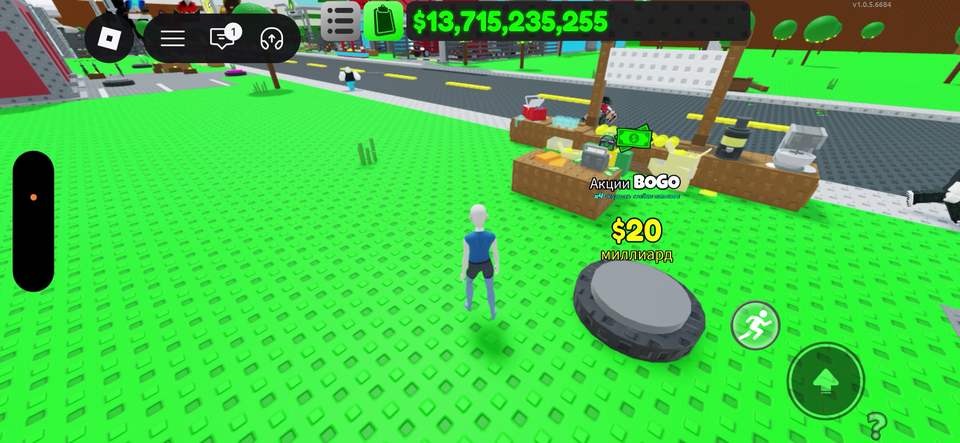
| Bogo Deals | ×4 speed | $20B |
*2 · LemonDash* $17K · delivery — $17K · delivery · 11 upgrades · up to $5.35 Sext.
| Upgrade | Effect | Cost |
|---|---|---|
| Higher Fees | ×3 cash | $39,500 |
| Company Vehicle | ×2 speed | $275,000 |
| LemonDash+ | ×2 cash | $3.25M |
| Exterior Sign | ×2 cash | $11.5M |
| Tips | ×2 cash | $230M |
| Express Delivery | ×3 speed | $810M |
| Mobile App | ×4 cash | $270B |
| Special Deals | ×2 speed | $235T |
| Reward Points | ×3 cash | $1.25Q |
| Influencer Collabs | ×3 speed | $21 Quint. |
| Drone Delivery | ×7 cash | $5.35 Sext. |
*3 · Lemon Depot* $13.5B · 'warehouse' — $13.5B · 'warehouse' · 14 upgrades · as far as the player got
| Upgrade | Effect | Cost |
|---|---|---|
| Bigger Fleet | ×2 speed | $58B |
| Refrigerated Trucks | ×3 cash | $970B |
| Automated Loading | ×4 cash | $3.65T |
| Automated Boxing | ×2 cash | $19.5T |
| GPS Logistics | ×3 speed | $62.5T |
| Toll Evasion | ×2 cash | $385T |
| Delivery Insurance | ×2 cash | $3.6Q |
| Even Bigger Fleet | ×3 speed | $11.5Q |
| Wholesale Pricing | ×3 cash | $370Q |
| Exterior Sign | ×2 speed | $40 Quint. |
| Truck Branding | ×4 speed | $735 Quint. |
| Turbochargers | ×4 speed | $1.65 Oct. |
| Self-Driving Trucks | ×7 cash | $130 Non. |
| Citrus Fuel Lines | ×3 cash | $18 Dec. |
*4 · Lemon Trading* trading floor — trading floor · 13 upgrades · future content
| Upgrade | Effect | Cost |
|---|---|---|
| Expert Brokers | ×2 speed | $120Q |
| Obfuscated Finances | ×3 cash | $1.9 Quint. |
| Lemon NFTs | ×2 cash | $6.15 Quint. |
| Crypto Miners | ×3 speed | $135 Quint. |
| Offshore Banking | ×4 cash | $20.5 Sext. |
| Faster Terminals | ×3 speed | $41 Sext. |
| Hype Generators | ×2 cash | $210 Sext. |
| Celebrity Pumpers | ×4 speed | $3.75 Undec. |
| Exterior Displays | ×4 cash | $4.7 Duodec. |
| More Displays | ×2 speed | $1.2 Quattuordec. |
| Trading Bots | ×3 cash | $5.5 Sexdec. |
| 24-Hour Trading | ×7 cash | $9.65 Septendec. |
| Big Exterior Sign | ×2 speed | $130 Novemdec. |
Extra mechanic: the "Lemon Trading, the Game" mini-game.
*5 · Lemon Labs* science — science · 12 upgrades · endgame
| Upgrade | Effect | Cost |
|---|---|---|
| Government Funding | ×3 cash | $220 Sept. |
| Lemon-Based Computing | ×3 speed | $29.5 Oct. |
| AI Researchers | ×2 cash | $165 Oct. |
| Gene Splicing | ×3 speed | $3.7 Dec. |
| Genetic Patents | ×3 cash | $225 Dec. |
| Citrus-Based Fuel | ×2 cash | $630 Dec. |
| Nano Tech | ×3 cash | $350 Duodec. |
| Fuel Deliveries | ×2 speed | $445 Tredec. |
| Experimental Testing | ×7 cash | $65 Quindec. |
| Exterior Sign | ×2 speed | $470 Novemdec. |
| Lemon Reactor | ×4 cash | $7 Unvig. |
| Lemon Accelerator | ×7 speed | $1.45 Tresvig. |
*6 · Lemon Robotics* robots — robots · 12 upgrades · endgame
| Upgrade | Effect | Cost |
|---|---|---|
| Giga-Lemon Factory | ×3 cash | $1.7 Tredec. |
| Citrus Lubricant | ×2 speed | $16.5 Tredec. |
| Nanobot Farm | ×2 cash | $115 Tredec. |
| Efficient Assembly | ×3 speed | $870 Quattuordec. |
| Military Contracts | ×4 cash | $595 Quindec. |
| Overseas Production | ×7 cash | $325 Sexdec. |
| Cyber-Lemons | ×7 speed | $19.5 Duovig. |
| Growable Batteries | ×2 cash | $14 Tresvig. |
| Sun Exposure | ×3 cash | $8.05 Quinvig. |
| Exterior Signs | ×2 speed | $415 Quinvig. |
| Robot Overclocking | ×3 speed | $130 Sexvig. |
| Regenerative Robots | ×4 cash | $935 Septenvig. |
*7 · Lemon Republic* state — state · 13 upgrades · endgame
| Upgrade | Effect | Cost |
|---|---|---|
| Central Bank | ×2 cash | $285 Octodec. |
| Lemon Subsidies | ×2 speed | $25.5 Novemdec. |
| Bank Expansion | ×3 cash | $1.75 Vig. |
| Automatic Voting | ×3 speed | $33.5 Unvig. |
| Public Citrus Works | ×2 speed | $1.1 Duovig. |
| Lifelong Terms | ×3 cash | $6.25 Tresvig. |
| Lemon Propaganda | ×7 speed | $970 Quattuorvig. |
| Lemon Tariffs | ×3 cash | $2.7 Sexvig. |
| Corporate Lobbying | ×4 cash | $925 Octovig. |
| Personal Aides | ×3 speed | $180 Untrig. |
| Exterior Signs | ×2 speed | $21 Novemtrig. |
| Lemon Tourism | ×7 cash | $3.9 Duoquadrag. |
| Reduced Regulation | ×3 speed | $14.5 Sexquadrag. |
*8 · LemonX* 🛸 space / aliens — space / aliens · 9 upgrades · final source
| Upgrade | Effect | Cost |
|---|---|---|
| Alien Negotiators | ×2 speed | $925 Sexvig. |
| Lemon Cryo-Storage | ×4 cash | $8.8 Septenvig. |
| Lemon Teleportation | ×4 speed | $17 Octovig. |
| Lemon Space Port | ×4 cash | $235 Novemvig. |
| Space Agriculture | ×3 speed | $19 Untrig. |
| Rocket Reuse | ×3 cash | $2.1 Duotrig. |
| Holographic Signs | ×2 speed | $6.2 Duotrig. |
| Agriculture Expansion | ×2 cash | $250 Quadrag. |
| Lemon Singularity | ×4 speed | $5.05 Novemsexag. |
The cosmic-alien theme: this is home to Alien Negotiators and Lemon Teleportation — the finale of the source progression.
*Global Upgrades* cross-source — cross-source · 21 · up to ×42 income
| Upgrade | Effect | Cost | Location |
|---|---|---|---|
| Lemon Commercials | ×2 global cash | $2.05 Sept. | Lemon Depot |
| Lemon Monopoly | ×4 global cash | $4.35 Non. | Lemon Trading |
| LemonAI | ×3 global speed | $52 Undec. | Lemon Labs |
| Climate Control | ×2 global cash | $11 Octodec. | Lemon Labs |
| National Monument | ×2 global cash | $15 Vig. | Lemon Republic |
| Go Public | ×2 global cash | $100 Vig. | Lemon Trading |
| Lemon Cloning | ×2 global cash | $120 Tresvig. | Lemon Labs |
| Vertical Integration | ×2 global cash | $785 Tresvig. | Lemon Robotics |
| Centralized Power | ×2 global speed | $3.95 Quattuorvig. | Lemon Republic |
| Robot Employees | ×4 global speed | $30.5 Quattuordec. | Lemon Robotics |
| Lemon Domination | ×4 global cash | $3.7 Trig. | Lemon Robotics |
| Intergalactic Lemon Trade | ×4 global cash | $460 Trig. | LemonX |
| Lemon Tax | ×3 global cash | $5.55 Trestrig. | Lemon Republic |
| Warp-Speed Shipping | ×4 global speed | $77.5 Duotrig. | LemonX |
| Galactic Empire | ×16 global cash | $58 Unquinquag. | LemonX |
| Quantum Lemon Tech | ×4 global speed | $52 Septenquinquag. | LemonX |
| Interdimensional Markets | ×7 global cash | $350 Septentrig. | LemonX |
| Lemon Supremacy Act | ×7 global cash | $75 Duoquinquag. | Lemon Republic |
| Citrus Thrusters | ×2 global speed | $205 Quattuorquadrag. | LemonX |
| Sentient Lemons | ×16 global cash | $305 Tressexag. | LemonX |
| Wormhole Development | ×42 global cash | $79 Quinseptuag. | LemonX |
Global Upgrades multiply income/speed across all sources at once — the main endgame multiplier (peaking at Wormhole Development ×42).
Where it's fast and where the waiting starts
The main takeaway on UX pacing. The game ramps up beautifully on new "territories" (opening sources, zones, teleports, trees) and sags into "pits" of pure waiting between big tiers. Below — the pacing curve from the real recording with exact player quotes.
How to read the chart. The horizontal axis is the minutes of one session (0→72, including the second visit P2). The vertical axis is how interested the player is and whether there's something to do right now. Peaks (green dots) are "new territory" moments: opening a source, zone, teleport or trees — each gives both an income jump and a fresh goal. Dips (red dots) are when there's nothing to buy or friction gets in the way; below the dashed "boredom threshold" the risk of quitting climbs. The lowest point is minute 42: the warehouse with no manager, which has to be click-farmed by hand.
Three pacing states: growth, pit, frustration
It matters to separate two kinds of dip: a pit is passive boredom (nothing to do), while frustration is active irritation (friction gets in the way). They are cured differently.
New territory When: opening a new source/zone/teleport, the first manager, trees and the golden lemon, the ×4.2 event. Why it works: an income jump, a fresh goal and new visuals all arrive at once — triple reinforcement. Feeling: "a whole lot opened up at once," "now I'm much calmer."
Nothing to buy When: minute 31 and the plateau in the second visit — saving between big tiers takes long, with no small goals. Why: the next tier's price grows exponentially and outruns income → a long stretch of pure accumulation. Feeling: "nothing left to upgrade… just waiting," "nothing changed here."
Friction gets in the way When: minute 42 (warehouse with no manager — clicking by hand) and the late game with fixed second-long timers. Why: the game demands a routine action or simply "serving out" a timer, offering no decision. Feeling: "until I have a manager it's hard to play," "waiting on these seconds is the biggest problem."
Why the pit happens: cost outruns income
- Exponential vs linear Each next tier costs roughly an order of magnitude more than the last, while income grows far more slowly. Early on, "saving up" is a couple of ticks (seconds) and the pit isn't felt. In the late game the same arithmetic turns into minutes of empty waiting: the gap between the red and green line is the "pit." Two things make it worse: no manager (income has to be clicked out by hand) and the warehouse's fixed timers** (30s and so on), which can't be sped up by a decision — only waited out.
Minute-by-minute pacing map
| Time | What happens | State | Why |
|---|---|---|---|
| 00–09 | $1 start → first loop → cashier | Growth | First win guaranteed; an upgrade = income↑ and tick↓ |
| 11 | Lemon Dash opens | Growth | A new source = income jump + fresh goal |
| 18–20 | First million, badge, manager $995K | Growth | A milestone threshold and the "clicker → idle" shift |
| 24–29 | ×4.2 event, teleport opens | Growth | Novelty injections against monotony |
| 31–41 | Saving for the warehouse, nothing to buy | Pit | The tier's price outruns income → a waiting pause |
| 42–54 | Warehouse with no manager — clicking by hand | Frustration | A routine action with no decision — the low point |
| 46–50 | Trees, golden ×10, haggling, neighbors | Growth | Active picking and haggling bring engagement back |
| 55 | Warehouse manager ≈ $14T | Growth | Manual clicking removed — an emotional peak |
| 61 | Waiting on fixed timers | Frustration | "Waiting on these seconds is the biggest problem" |
| P2 | Logistics, warehouse upgrades, plateau | Pit | No new territory → "nothing changed here" |
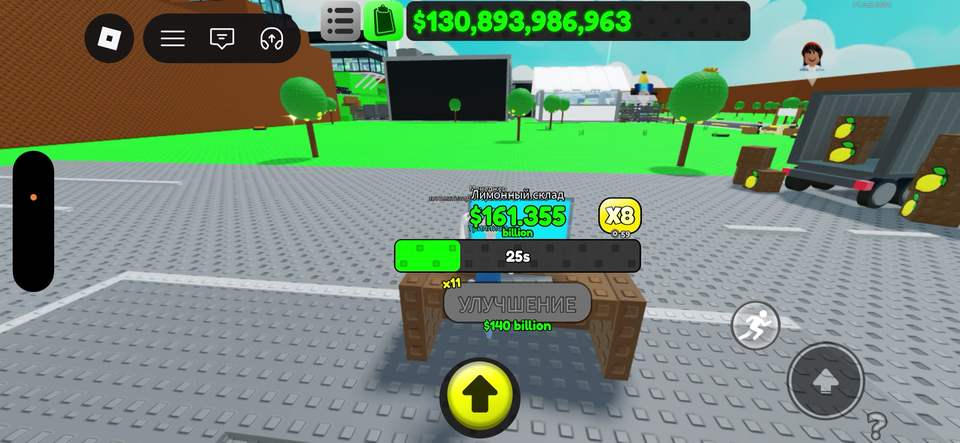
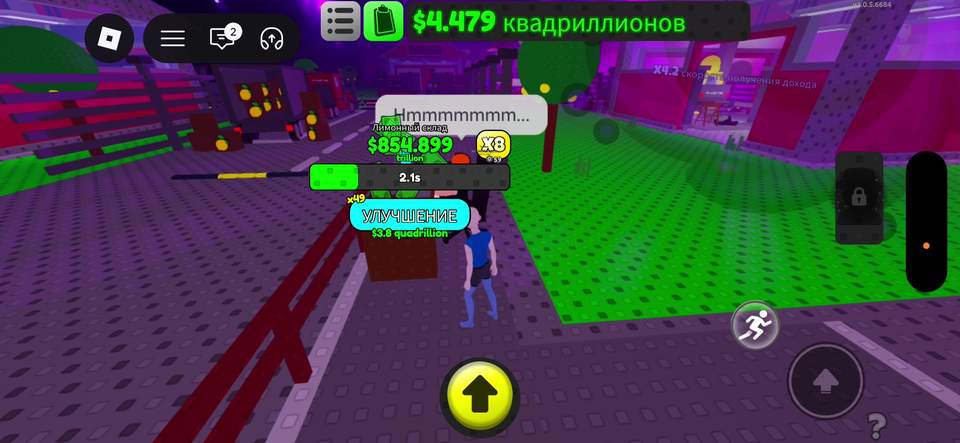
Diagnosis. Pacing rides on "new territory": while there's something to open, the game flies. It sags in two different places, and each is treated differently.
Why the player wants to buy exactly this
The economy is tuned so that at every moment there are one or two "almost affordable" goals, and the choice between them is meaningful. The recording shows how the player reasons — and that logic is worth reproducing.
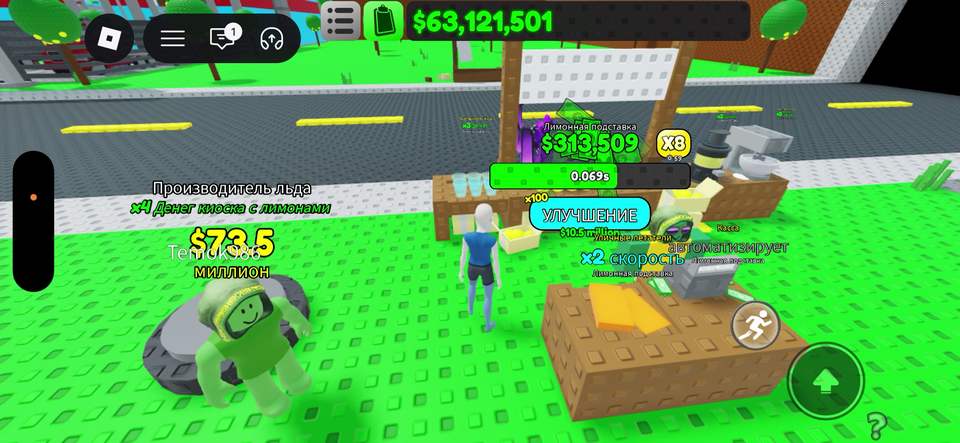
Verdict on key purchases (from the recording)
Every notable acquisition — what it gives, how it changes the game, and whether its value logic is worth copying. The verdicts rest on the player's real decisions and lines.
| Purchase | Price | What it gives | Verdict |
|---|---|---|---|
| Juicer | $6.20 | The first ×2 cash multiplier | essential — pays for itself instantly |
| Cashier | $100 | Auto-clicks the stand | take before the billboard — "it automates, that's useful" |
| Billboard | $785 | ×3 speed + naming | neutral — nice, but not urgent |
| Lemon Dash (source) | $17,000 | A second, more powerful source | an income jump and a fresh goal |
| Manager | $995,000 | Automates Lemon Dash | pivotal — the clicker becomes idle |
| ×2 Lemon Dash stack | $3.25M · $11.5M · $230M | Income multipliers | "the best value" — multiplier > flat |
| "Stocks" / God Stocks | $20B | ×4 stand speed | skip — "feels weak, speed is already colossal" |
| Lemon Depot (warehouse) | $13.5B | A new main source | the new top earner — buy it |
| Refrigerated trucks | $970B | ×3 warehouse cash | a strong logistics multiplier |
| Warehouse manager | ≈ $14T | Automates the warehouse | removes manual clicking — the emotional peak |
| Logistics (GLONASS/GPS) | $62.5T | ×2 warehouse speed | needed, but the late game is already flat |
The long game: rebirths and aliens
What lies beyond the horizon of the 72-minute recording: three layers of progress reset, the prestige currency "Investors," and a cosmic-alien meta-theme. This is the "depth" that keeps players around for weeks.
Three "rebirths" and aliens (the answer to the UFO question)
After enough accumulation, the game offers to reset progress for a multiplier — classic prestige. There are three layers, nested inside one another. This is where the "aliens" live: the first rebirth is done at Joe the Alien's UFO, and the prestige currency is called "Investors" (Alien Investors).
Unlocked at ~77 sextillion $. Reset cash and sources → "Investors" (+1% income each; +2% for the Alien Key quest in The Sewers). Robux purchases are kept.
From 501.2 quadrillion "Investors." Reset Powers/Investors → ×42 to global speed (stacks). 10 fruits (Lemon → … → Purity → loops with +1). Trees change appearance to match the fruit.
After buying all buttons and completing The Staircase. Reset everything (including evolutions) → a permanent ×7.77 to money (net ×2.33 per ascension) and endgame perks.
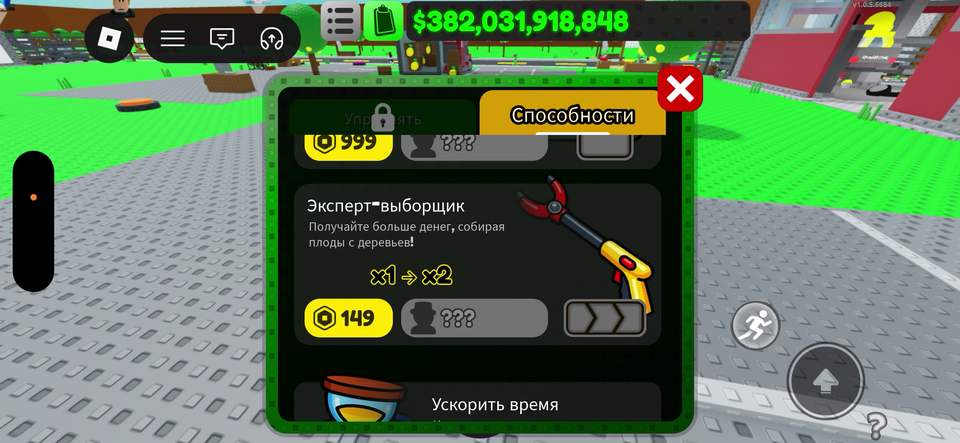
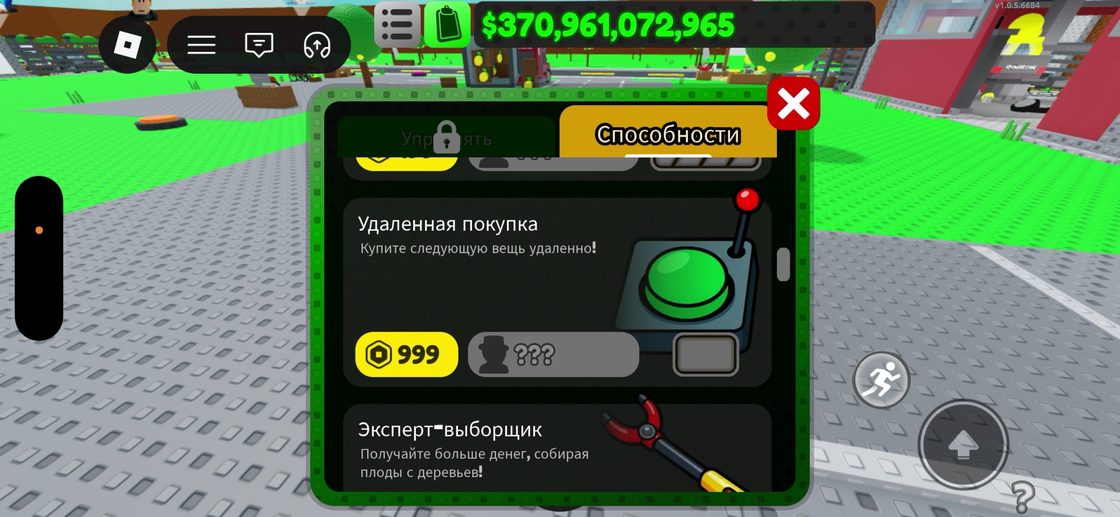
A rebirth grants Investors (more the bigger the balance was). They're spent in the Powers shop on permanent upgrades (e.g. Expert Picker for 1 quadrillion Investors — ×8 to tree picking). Powers survive a rebirth but reset on Evolution/Ascension.
In the recording the player saw the saucers but didn't reach a rebirth (you need ~77 sextillion, he was at trillions). For a clone, this is the main "long-term engine."
What dilutes the waiting
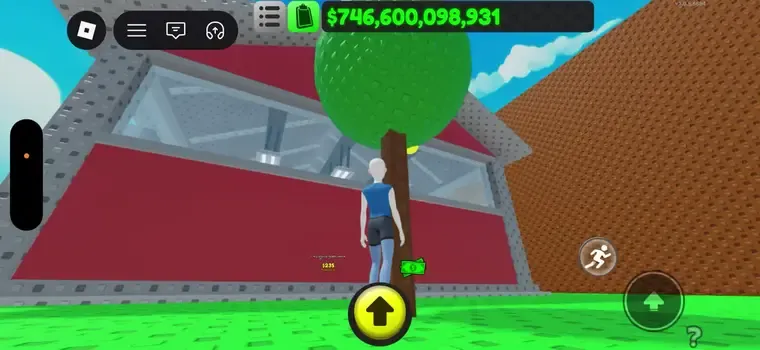
Against the "pits" of the idle core, the game sets active actions and events: five ways to earn active income, two mini-games, a server-wide Void Event, and a friend bonus. These are exactly what's worth copying so the late game doesn't turn into pure timer-waiting.
Trees (tap a fruit → cash from current income, ×8 with Expert Picker), Cosmic Cash Vine (once every 4 hours — 30 min of income), Cashbags, Phone, mini-games. They give more "by hand" than simple waiting.
Lemon Dash, the Game — bet on 1 of 4 "racers," and you can "root" for yours. Lemon Trading, the Game. 5-min cooldown, reward based on income/sec. A micro-breather between upgrades.
Void Event (~once every 50 min, 3 min, ×4.2, sky-galaxy). Friend Bonus — ×2 cash while a friend is on the server. Badges for sources/balance/progress. No codes in the game (officially).
What brings players back and what it sells
Retention hooks, the social-trading loop, and tasteful idle monetization.
Why the player comes back
Retention is built on three horizons: "one more minute" inside the session, "come back tomorrow" via 100% offline income, and "play for weeks" via badges, abilities, other players' bases and the community.
One more minute Almost enough for the next source; the upgrade timer is about to shorten; a buyer offer blinks nearby. The constant "just a little short" keeps you in the moment.
Come back tomorrow 100% of income accrues offline; on login — a "Welcome back" screen with the accumulated sum and a "Double ×2" button. A direct reason to log in.
Play for weeks Badges and quest tiers (millionaire → billionaire → …), full unlocking of abilities, base expansions, other players' bases for comparison, a community with promo codes and +10% luck.

Where desire turns into a purchase
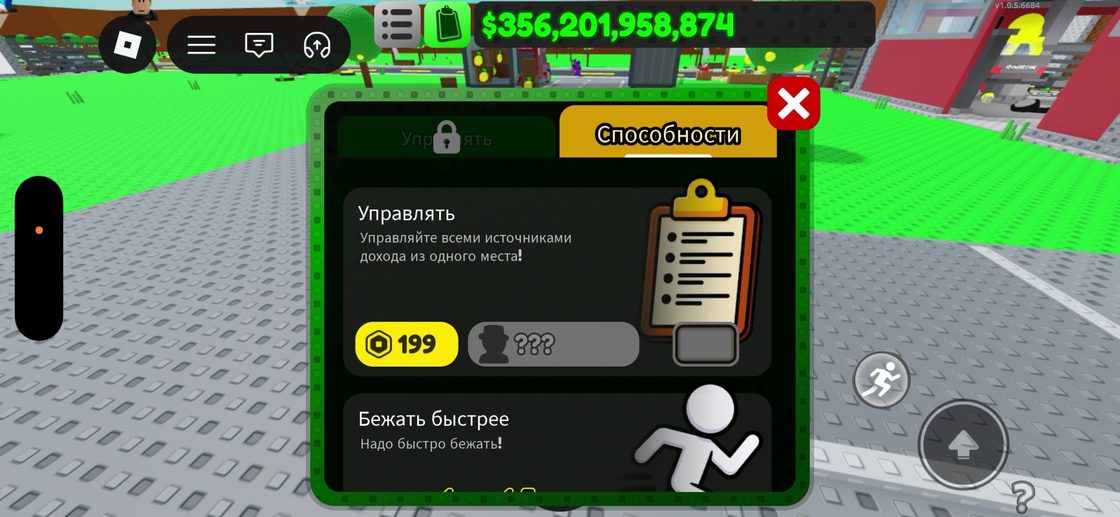
The monetization is "idle-fair": it sells convenience, speed and automation rather than blocking progress. The player himself approves: "they made interesting monetization — to save time." Most offers remove a grind the player has already felt.
Gamepasses (permanent)
| Gamepass | Price | What it gives |
|---|---|---|
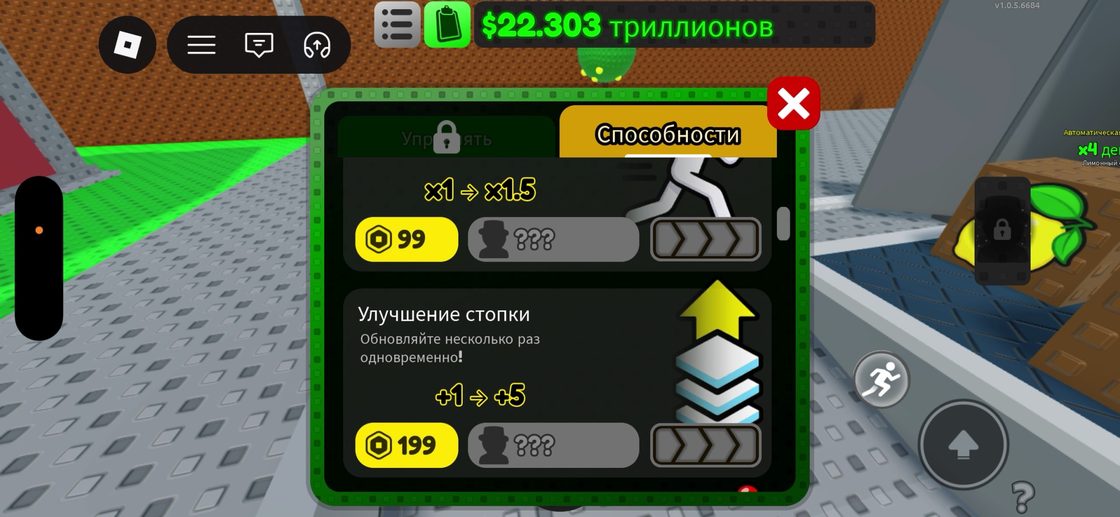
| Run faster | 99 R$ | Movement speed ×1 → ×1.5 |
| Expert Picker | 149 R$ | ×2 money for picking fruit from trees |
| Manage | 199 R$ | Control all sources from one place |
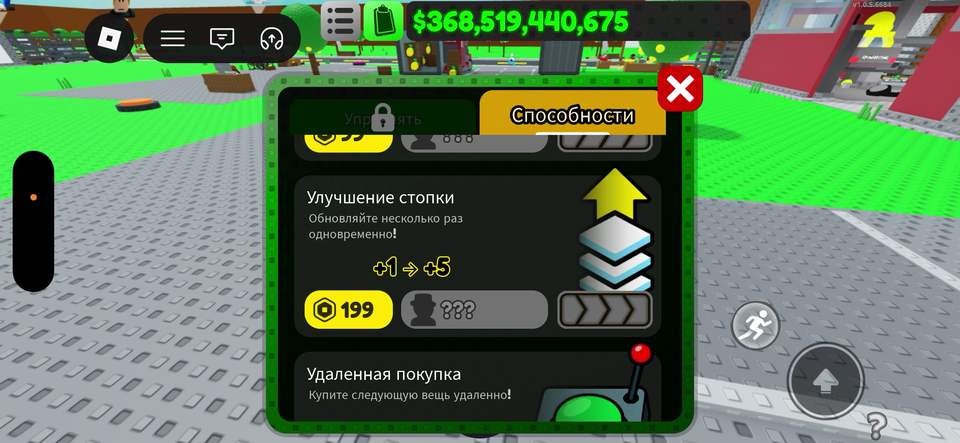
| Stack upgrade | 199 R$ | Multiple upgrades at once (+1 → +5) |
| Speed up time | 599 R$ | Income speed in all areas ×2, forever |
| Remote purchase | 999 R$ | Buy the next item from a distance |
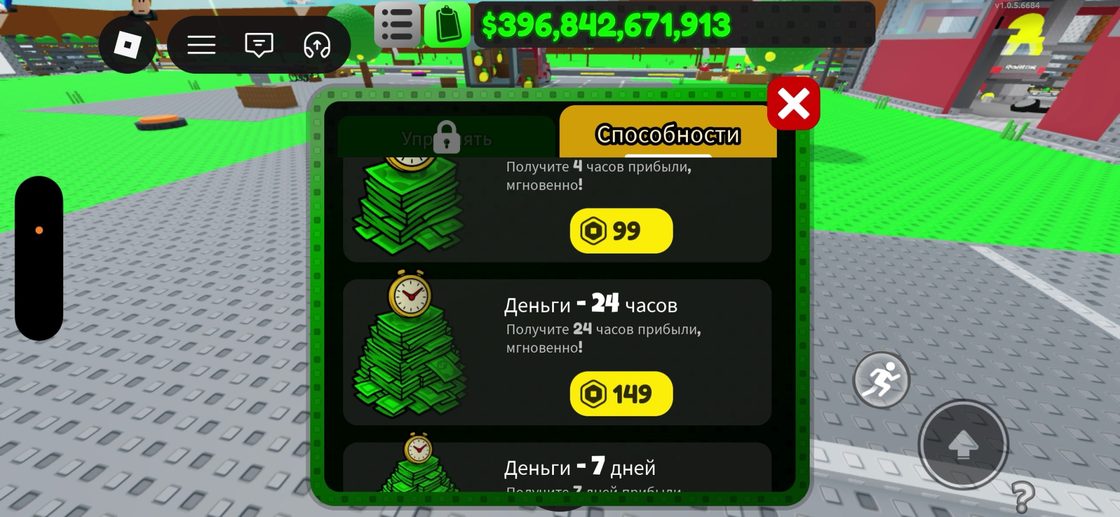
"Money" packs and boosts
| Offer | Price | What it gives |
|---|---|---|
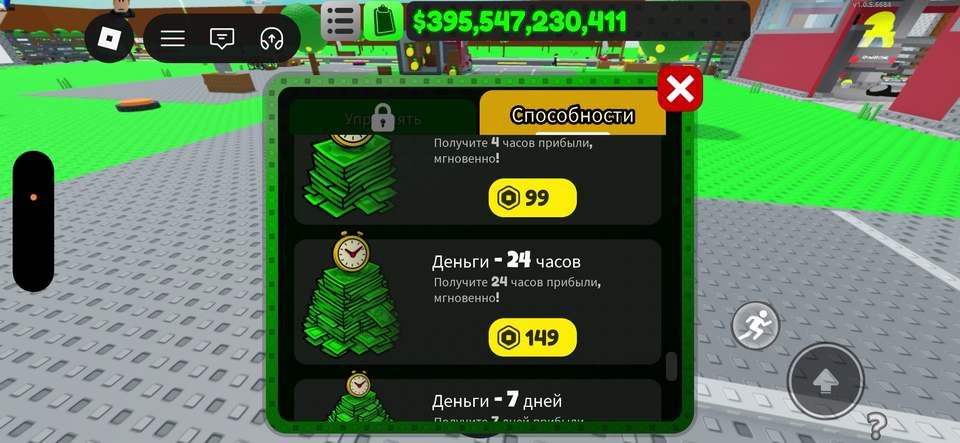
| Money — 5 minutes | 19 R$ | 5 minutes of profit instantly |
| Money — 30 minutes | 49 R$ | 30 minutes of profit instantly |
| Money — 4 hours | 99 R$ | 4 hours of profit instantly |
| Money — 24 hours | 149 R$ | 24 hours of profit instantly |
| Money — 7 days | 199 R$ | 7 days of profit instantly |
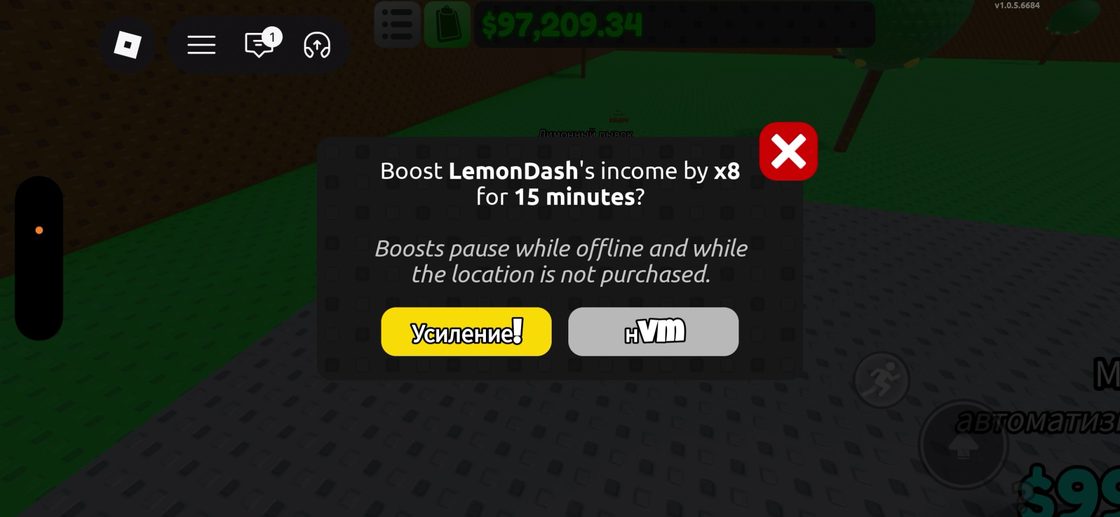
| Lemon Dash boost ×8 / 15 min | 59 R$ | A temporary income boost (paused while offline — honestly stated) |
| Private server | 29 R$/mo | Play with friends (Roblox subscription) |
A weak spot in the presentation: the profit packs don't show the resulting amount in dollars. The player flat-out complains: "I don't even know how much I'll get" — lost clarity and conversion.
What to take from this
The design lens, transfer to a prototype, risks, and the final verdict.
Mechanics → Dynamics → Aesthetics
Translating "like / dislike" into design language: which rules create which behavior and which emotion.
Rules: buying sources, NPC auto-sales, upgrades (price×, interval↓), Cashier and managers (automation), multipliers ×2…×100, picking lemons from trees (golden ×10), buyer offers with haggling, teleport gating, 100% offline income, co-op help, badges, abilities. The tick compresses from 0.6s to 0.04s; each tier is an order of magnitude more expensive.
Behavior: the player optimizes the order of upgrades (multipliers > flat), saves up for automation, haggles for a better price, collects golden lemons, returns for the offline payout, compares his base with others', sometimes just waits on a timer. Engagement peaks — opening zones and haggling; troughs — waiting on timers.
Emotion: greed for the growing number, the pleasure of control and automation, the thrill of haggling and the golden lemon, pride in a sprawling base — and boredom/frustration in the "pits" of waiting. What's worth carrying over is the bundle "growth + automation + haggling + visible scale," not the setting.
What we carry over into our clone
Not "make something similar," but assemble in the right order the systems, screens and feelings the game rests on.
| Priority | System | Why | Minimal implementation | QA criterion |
|---|---|---|---|---|
| P0 | Core loop | Validate the fun | 1 source, 1 resource, 1 upgrade (income↑ + interval↓) | The player gets it without explanation in 30 sec |
| P1 | Progression | Give a goal | 3 source tiers + manager automation | There's a desire to open the next source |
| P1 | Offline income | D1 retention | Offline accumulation + a return screen with ×2 | The player comes back for the payout |
| P1 | Offers with haggling | Enliven idle | An NPC sends an offer, buttons "take / ask for more" | The player haggles at least once |
| P2 | Active picking | Anti-boredom | Trees with a one-off payout + a rare golden ×10 | Picking is more noticeable than simple waiting |
| P2 | Convenience monetization | Revenue without P2W | 1–2 gamepasses (auto/speed) + a profit pack with a preview | The offer doesn't block progress |
Problem → cause → solution
Concrete critique: where exactly the player's experience breaks, why, and the minimal fix that would validate it. Most points are confirmed by the player's direct quotes.
| Problem | Why it's bad | Minimal fix | How to validate |
|---|---|---|---|
| Fixed second-long timers in the late game | Player: "waiting on these seconds is the biggest problem" | A progress bar to the next goal + upgrades that compress the wait | Late-game session length, D7 |
| "Pits": nothing to buy, just waiting | The pace drops, the player quits | Intermediate mini-goals between big tiers | Time between two purchases |
| Late game = pure autofarm | The manual pleasure disappears | Picking/bonus events on all tiers (trees everywhere) | D7 retention among late players |
| Profit packs with no amount | Opacity lowers trust and conversion | Show "≈ $X" from current income next to the price | A/B the pack's conversion |
| Partial localization | An English-Russian mix breaks the sense of quality | A single native translation of offers and prompts | Test offer comprehension on newcomers |
| Active picking is poorly hinted at | A strong mechanic found only by minute 46 | An early tutorial hook for picking from a tree | Share of players who picked a lemon in session 1 |
Final score — for a decision
Sell Lemons is an exemplary idle-tycoon: a clean loop, outstanding feedback, underrated buyer haggling, deep progression and honest convenience monetization. The main growth areas are pacing on the "pits" and clarity (localization + pack preview).
A mature idle-tycoon whose core is worth taking: a budget-matched starting goal, the "income↑ + interval↓" upgrade, automation, buyer haggling, and an offline return with doubling.
- Build a P0 prototype of the core loop (1 source, 1 upgrade) in 1 day
- Test the first session on 3–5 newcomers with no hints
- Measure time-to-first-reward and time-to-second-goal
- Add buyer offers with haggling and an offline return with ×2
- Smooth out the "pits": mini-goals and a progress bar to the next big purchase
| Dimension | Score |
|---|---|
| Core Loop | 9/10 |
| Onboarding | 8/10 |
| Economy | 7/10 |
| UX | 6/10 |
| Retention | 8/10 |
| Transfer | 9/10 |
Next steps
Extended visual reference
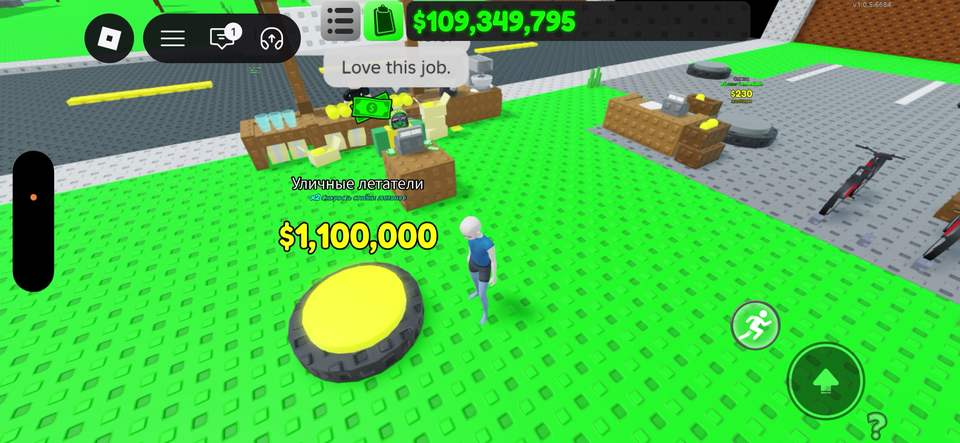
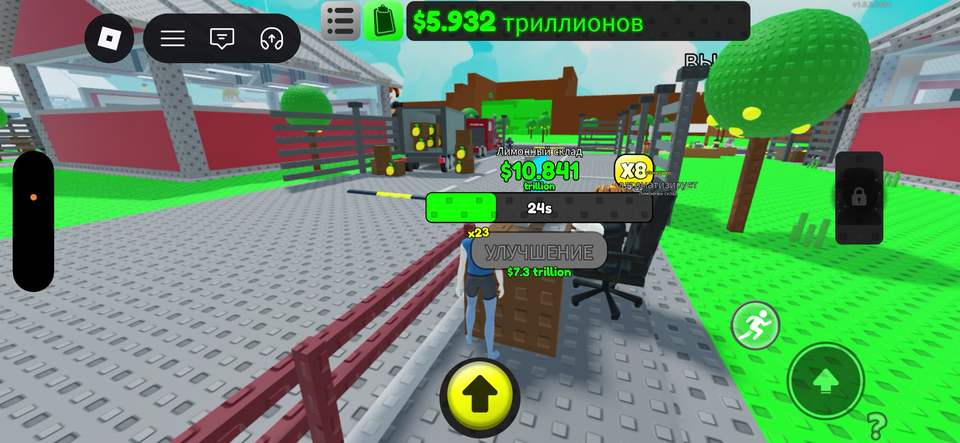
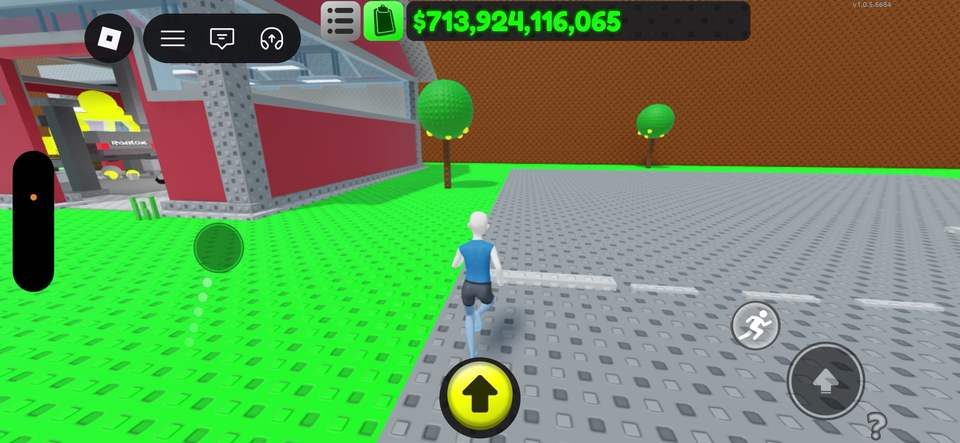
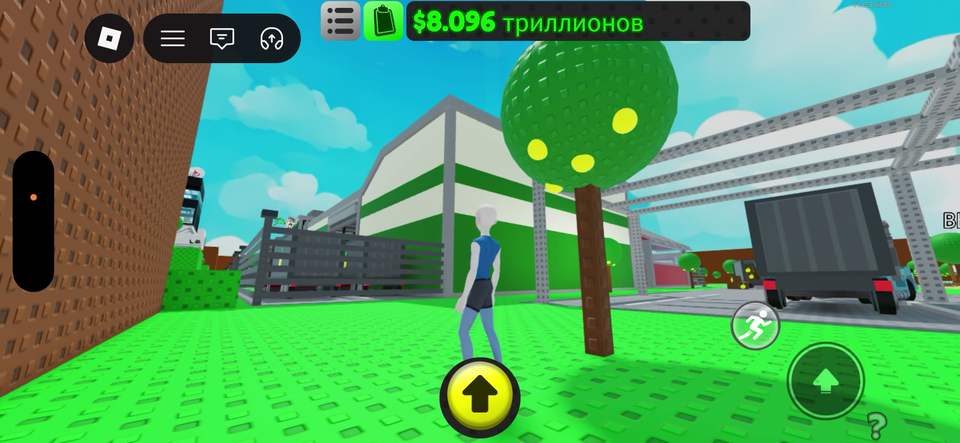
Additional frames for the team that will rebuild the game: intermediate base states, economy and shop screens, zones and UI details that didn't make it into the main sections.
Buyer offers, haggling and co-op
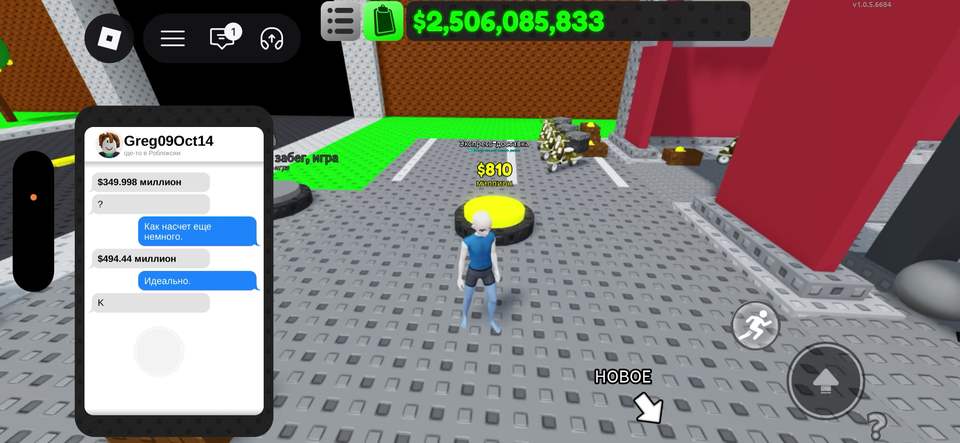
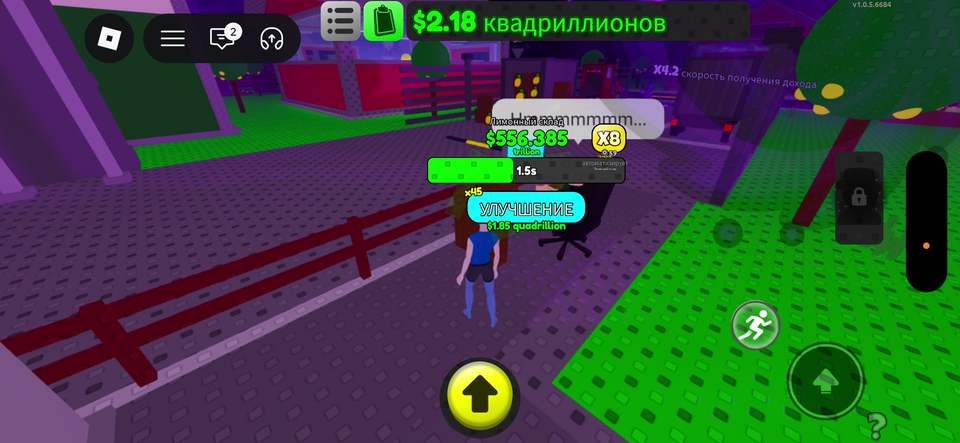
The game's most underrated system: buyers send the player messages offering to buy a batch of lemons — and you can haggle with them. This turns passive idle into a negotiation mini-game. Plus co-op help on other players' bases.
An NPC/player buyer sends an offer ("Hi… how about $8,985?"). You can accept or ask for more. Sometimes they give in and pay higher; sometimes — if you get greedy — the offer is withdrawn. A real decision and a slight risk appear.