Spin a Soccer Card
Pixellar Studios' idle card-collector (the "RSC" brand) runs the familiar buy‑pack → reveal → place‑card → print‑cash loop, then stacks it with a 17‑tier rebirth‑prestige engine, ten stacking mutations, weather events, crafting, wishing, a spin wheel, four leaderboards, and real‑money card stealing.
An objective design teardown, pulled in as a football‑genre competitor reference for the World Cup RNG project. It reads Spin a Soccer Card as the upper bound of how many systems one idle loop can carry — not as a template to clone wholesale.
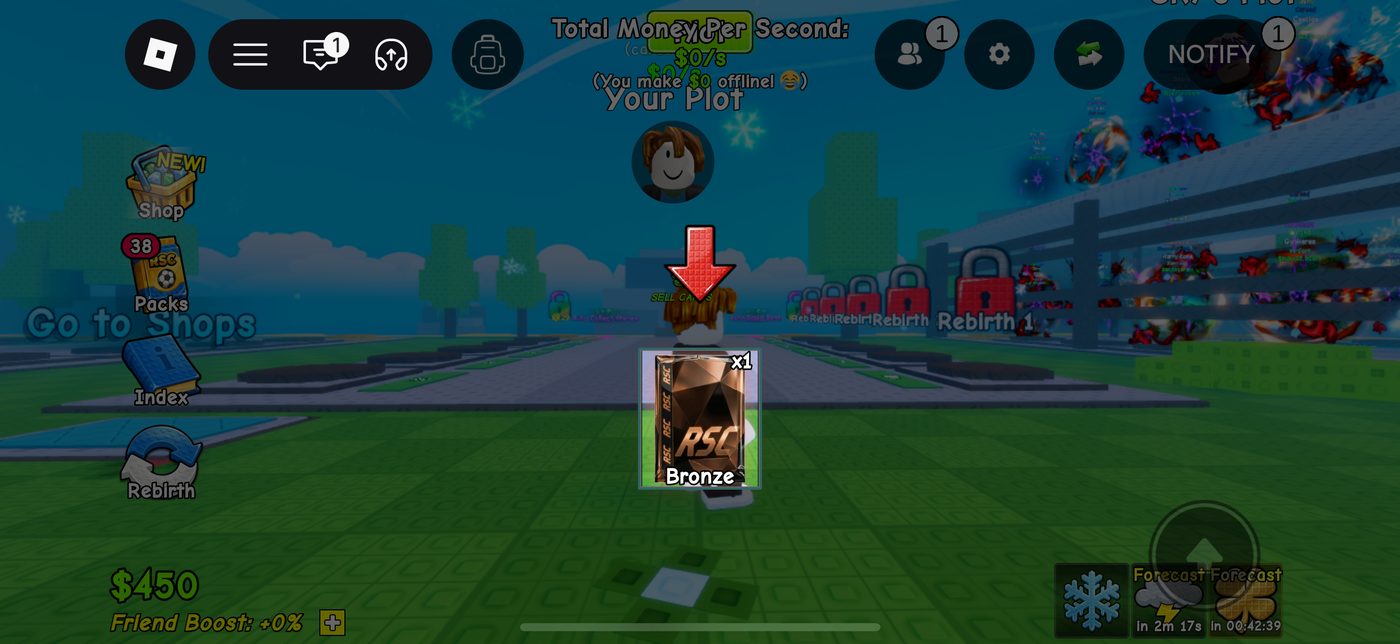
Why this game is the genre benchmark
Spin a Soccer Card isn't the benchmark for taste or restraint — it's the benchmark for scale: the game that proves how many systems one idle loop can be made to carry before it becomes a different kind of product. It sits at the maximal pole of the idle-collector spectrum the World Cup RNG project is mapping (World Cup Album sits at moderate; Build a Soccer Squad is lean score-chase).
What to copy first
17 tiers, each gating a new pack bracket, converting a flat idle curve into a ladder where every reset is a step up rather than a grind-back. Bloom's current config only has a cash-only x1.25 rebirth; this is the deeper version to build toward.
unlocked at Rebirth 2, it preserves your best cards across a reset (one slot at R2, full access by R5). It's the single best retention fix in the game and the direct answer to "my grind got deleted."
ten mutation types stack multiplicatively on a card, and a rotating weather forecast temporarily boosts specific mutation odds, giving players a clock-based reason to keep opening packs rather than a pure-RNG chase.
The maximal idle-collector, with pay-to-steal
Buy a pack → tap to reveal a footballer card (rarity, FIFA-style rating, a $/s value) → place it on a plot slot where it prints cash → reinvest into bigger packs → rebirth to multiply it all. That's the same idle heartbeat as World Cup Album — everything downstream of it is heavier: a deep rebirth-prestige engine, ten stacking mutations, weather events, crafting, wishing, a spin wheel, four leaderboards, and real-money stealing.
Dossier
| Parameter | Value |
|---|---|
| Title | Spin a Soccer Card |
| Brand | "RSC" |
| Studio | Pixellar Studios |
| Genre | Idle card-collector |
| Platform | Roblox · mobile / desktop / console |
| Scale (observed) | ~30k CCU · millions of visits |
| Launched | February 2026 |
| Corpus role | Coverage of stealing, rebirth, crafting, and a card bank — bricks the corpus didn't otherwise have |
Loop, first session, world/arena and feel
The loop closes in under 20 seconds and never fundamentally changes; what changes is the scale of the numbers and the depth of systems layered on top.
Pack → reveal → place → reinvest → rebirth
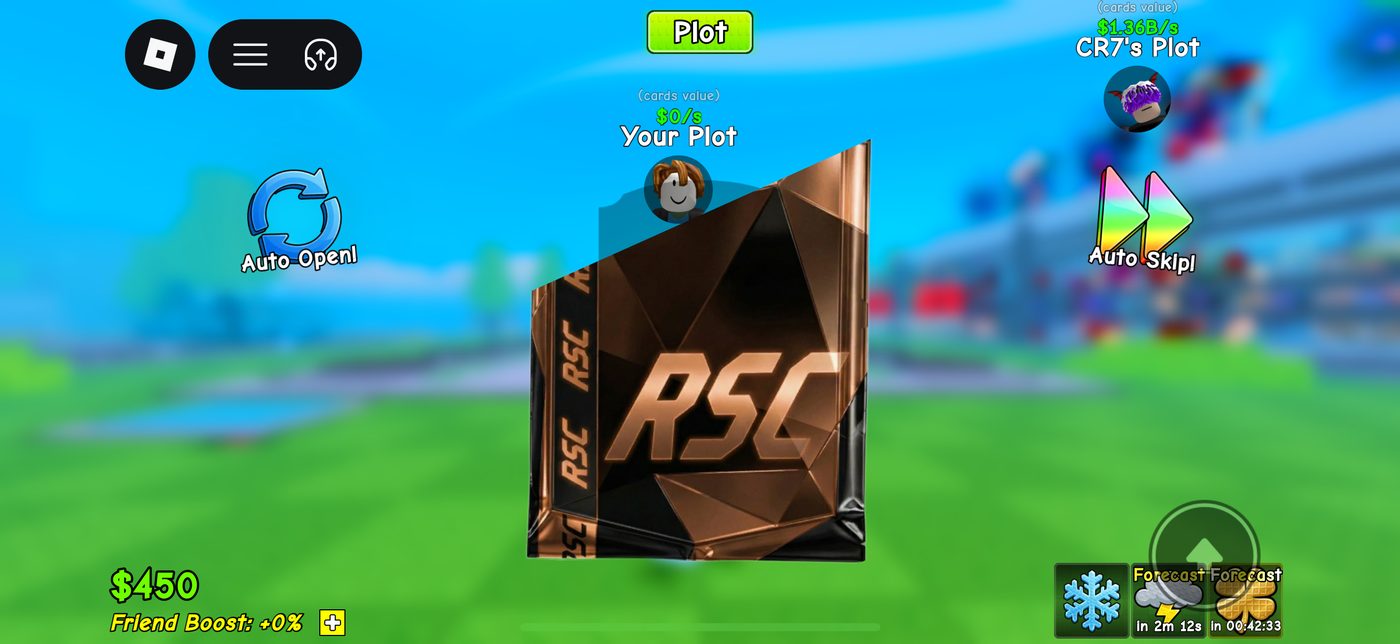
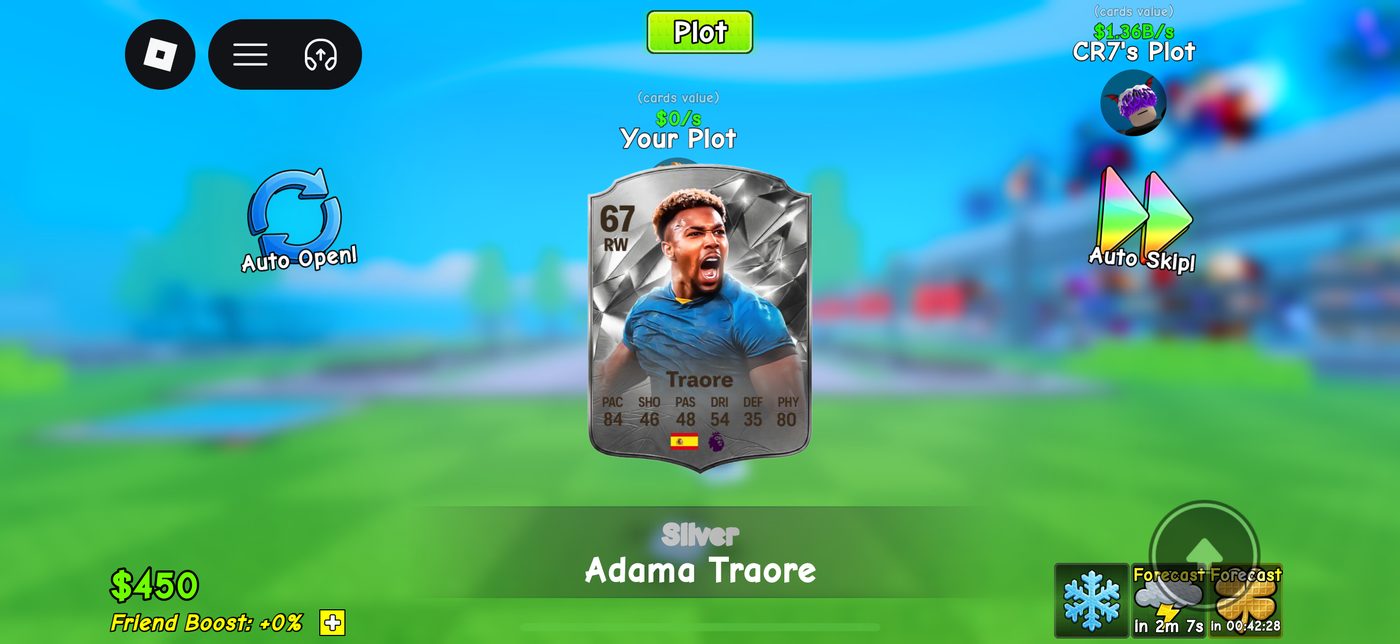
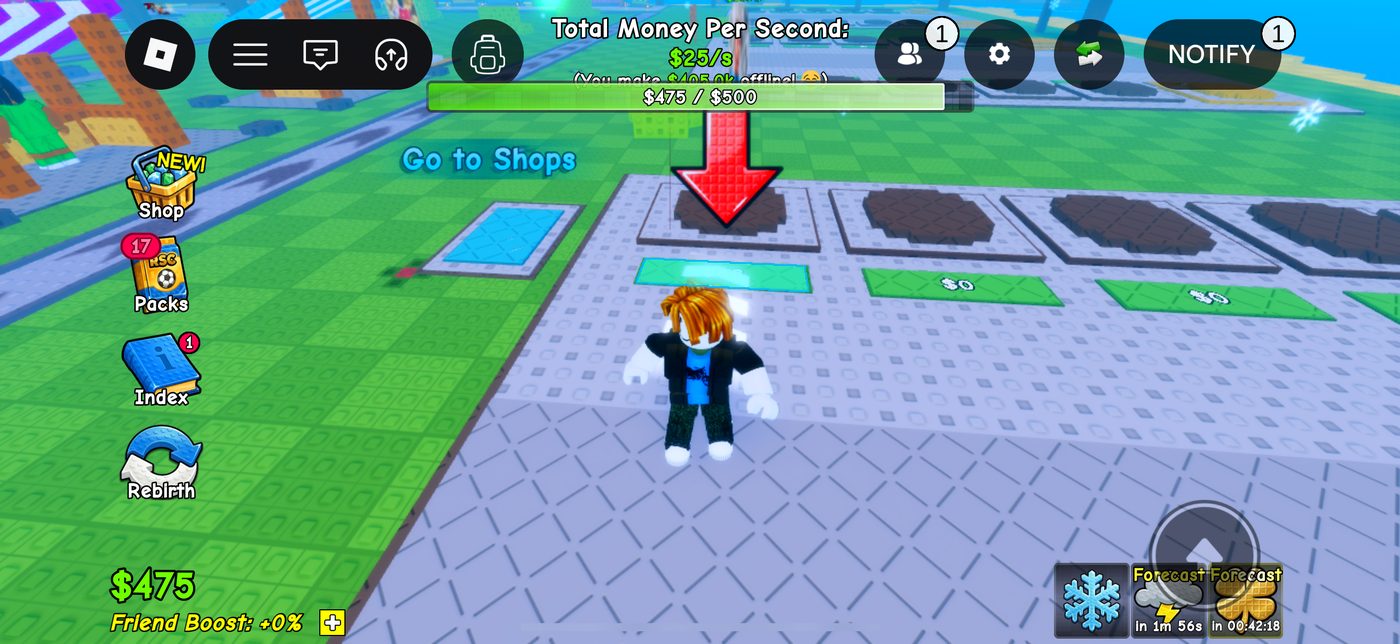
A 20-second onboarding cycle
Onboarding hands the player a free pack and walks them through one full cycle — buy, reveal, place — in under 20 seconds, then releases them to play at their own pace. The reveal itself can later be automated with the Auto Open and Auto Skip gamepasses, turning the manual "cut" into a background process once a player is willing to pay for it.
The reveal is still a flat two-tap cut
The core moment-to-moment feel is the reveal: a two-tap "cut" that surfaces rarity, rating, and $/s value. It works, but it's flat — the same spectacle gap the rest of the football-genre corpus shares. Nothing about the reveal itself (no build-up animation, no escalating tension) distinguishes it once you've seen it a few dozen times; the game compensates by making everything downstream of the reveal (mutations, rebirth, weather) deep rather than making the reveal itself more spectacular.
Not yet observed
The capture was a voice walkthrough of individual systems, not a timestamped full-session recording, so no minute-by-minute engagement curve can be honestly charted here. Flagged as a gap rather than guessed at.
The game's mechanical systems
Sixteen distinct systems stack on top of the base idle loop — more than any other title in the corpus. The value of this teardown is largely this catalog: it's the maximal reference for what's recombinable.
The engine that governs everything
Progression isn't "buy bigger packs," it's rebirth. When cash crosses a threshold, the player resets all cash and placed cards in exchange for a permanent income multiplier and access to the next bracket of packs. There are 17 rebirth tiers, and the apex packs are walled behind them — converting a flat idle curve into a prestige ladder where every reset is a real step up, not a grind-back.
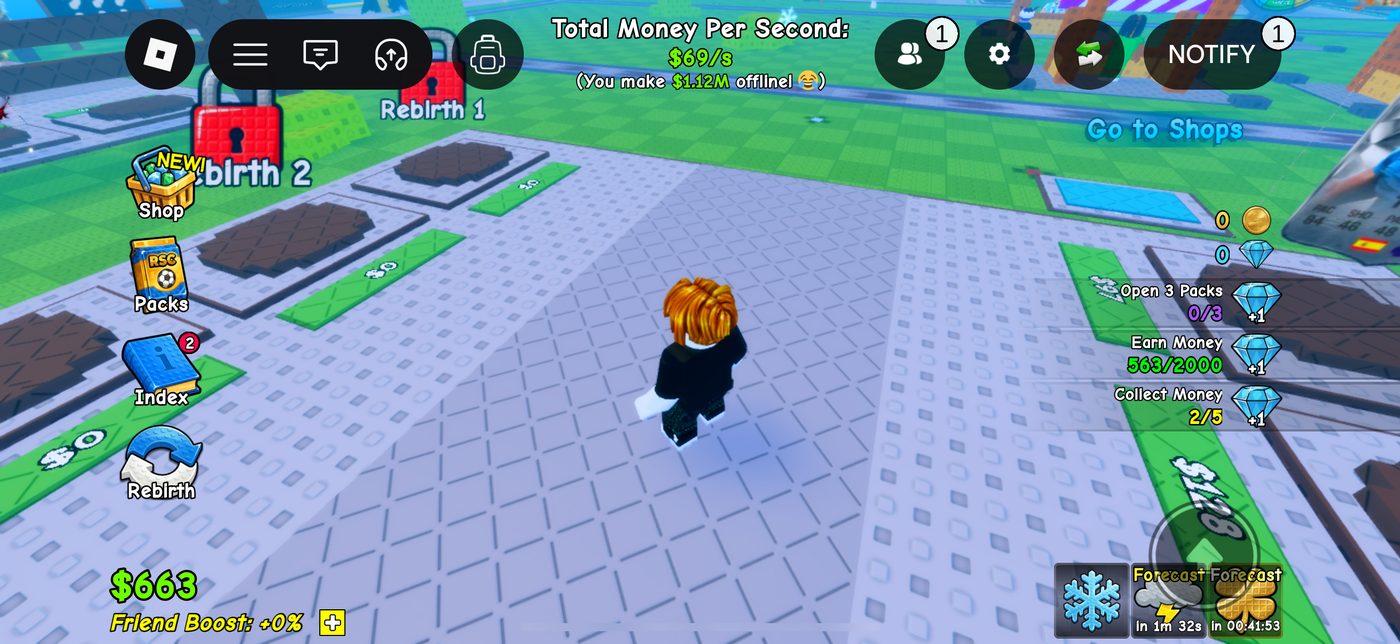
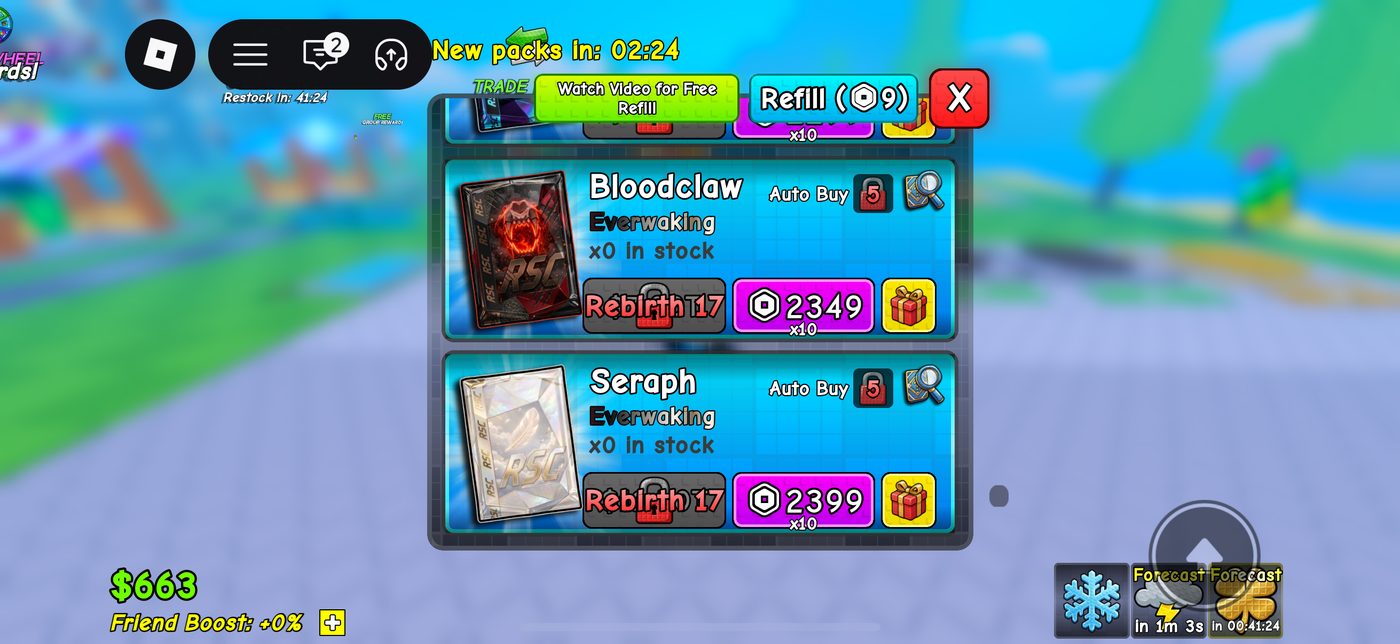
The wipe has an elegant counter: the Bank, unlocked at Rebirth 2, preserves the player's best cards across a reset (one slot at R2, full access by R5). It's the answer to the prestige genre's worst feeling — "my grind got deleted" — and it's the reason players push rebirths instead of dreading them.
The depth lives in stacking
Base rarity (Bronze → Silver → Gold → … → Divine → Mythical → Omega) is only one axis, backed by a 3,682-entry card index. Ten mutations — Shiny, Frozen, Electrified, Venomous, Rainbow, Divine, Blessed, Bonded, Cursed, Misprint — can roll on any card, and they stack multiplicatively. A max-mutation apex card prints hundreds of thousands per second. The endgame isn't "pull the best player," it's "stack the most mutations on a high-tier card."
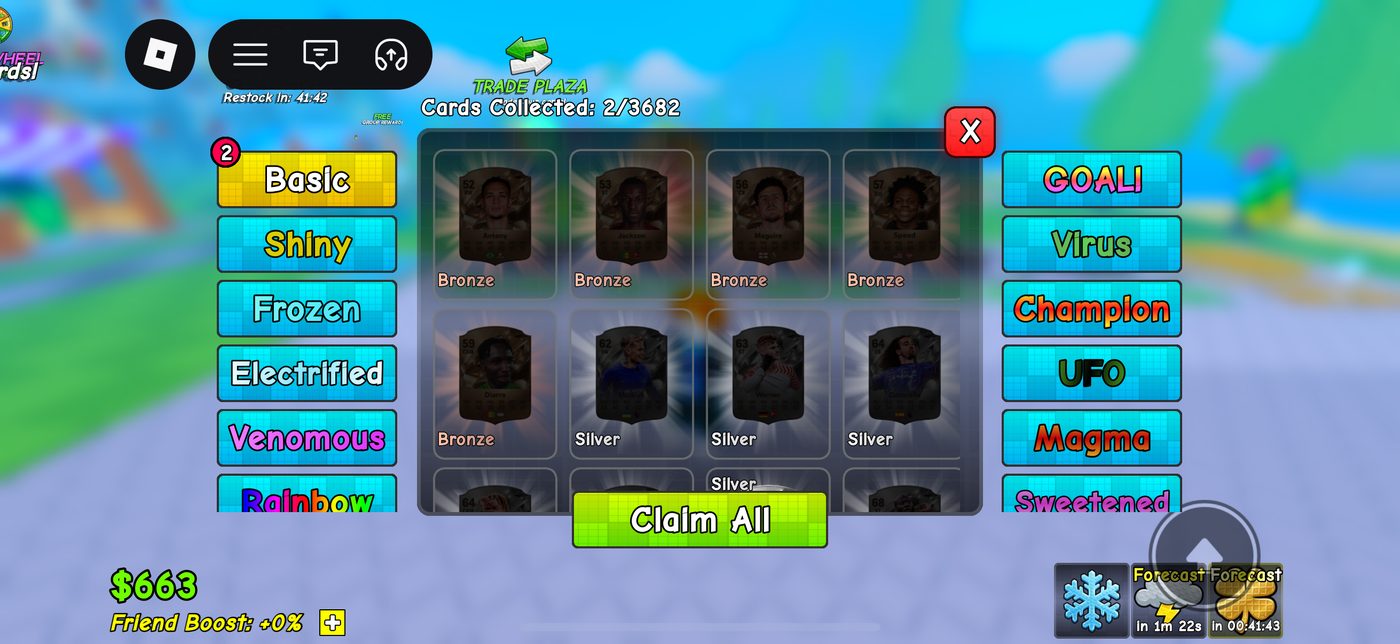
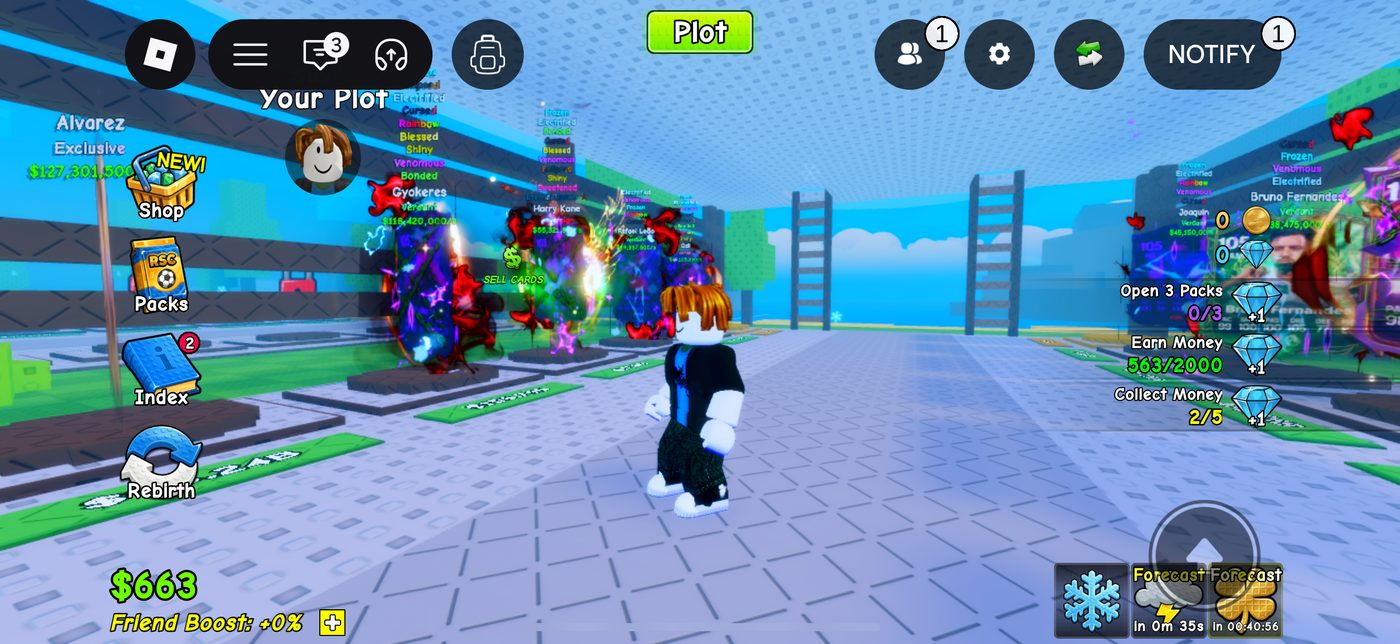
What makes the mutation chase a live loop rather than pure RNG is weather. A rotating forecast (Snowstorm, Thunderstorm…) temporarily boosts a specific mutation's odds, so players time their pack-opening to the weather, and a Forecast widget tells them what's coming.
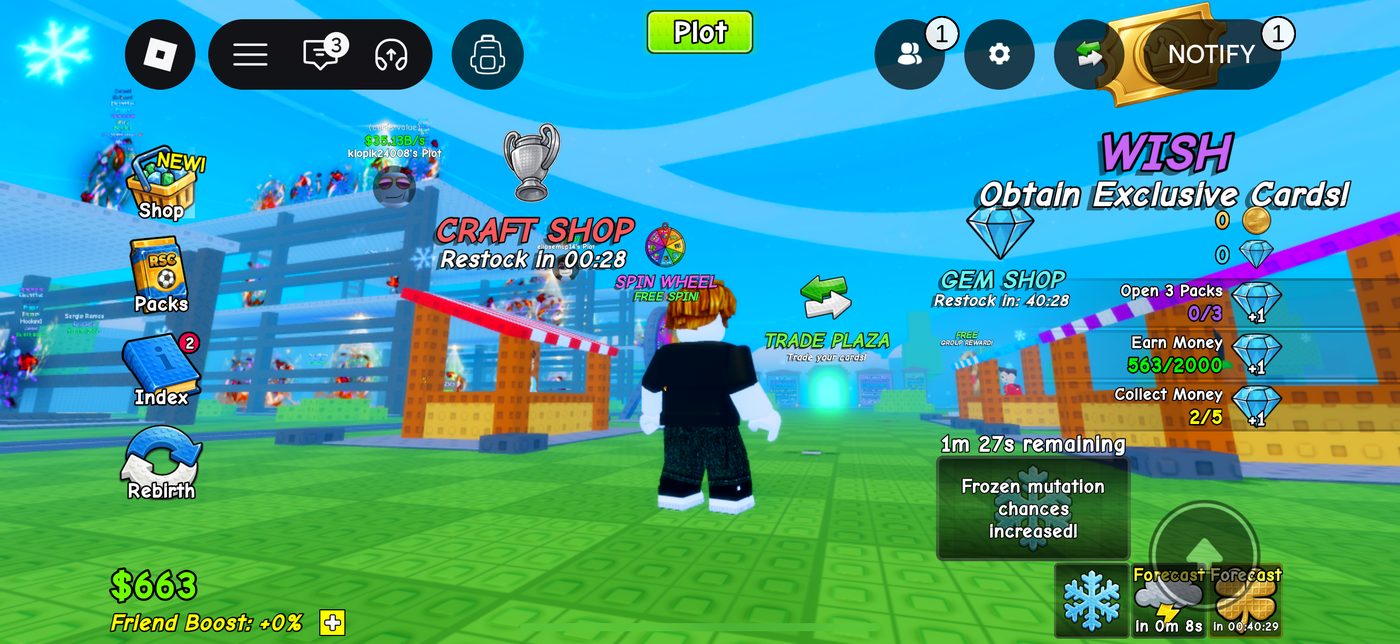
Nearly the complete brick catalog
No other game in the corpus stacks this many systems on one loop. This is the maximal reference for what's recombinable.
System catalog — sixteen bricks on one idle loop
| System | Tags | Description |
|---|---|---|
| Idle income plots | idle-income, offline-earnings, collect-tap | Placed cards print $/s by rarity × mutations; accrues offline. The economic spine — same as World Cup Album, but scaling to billions/s. |
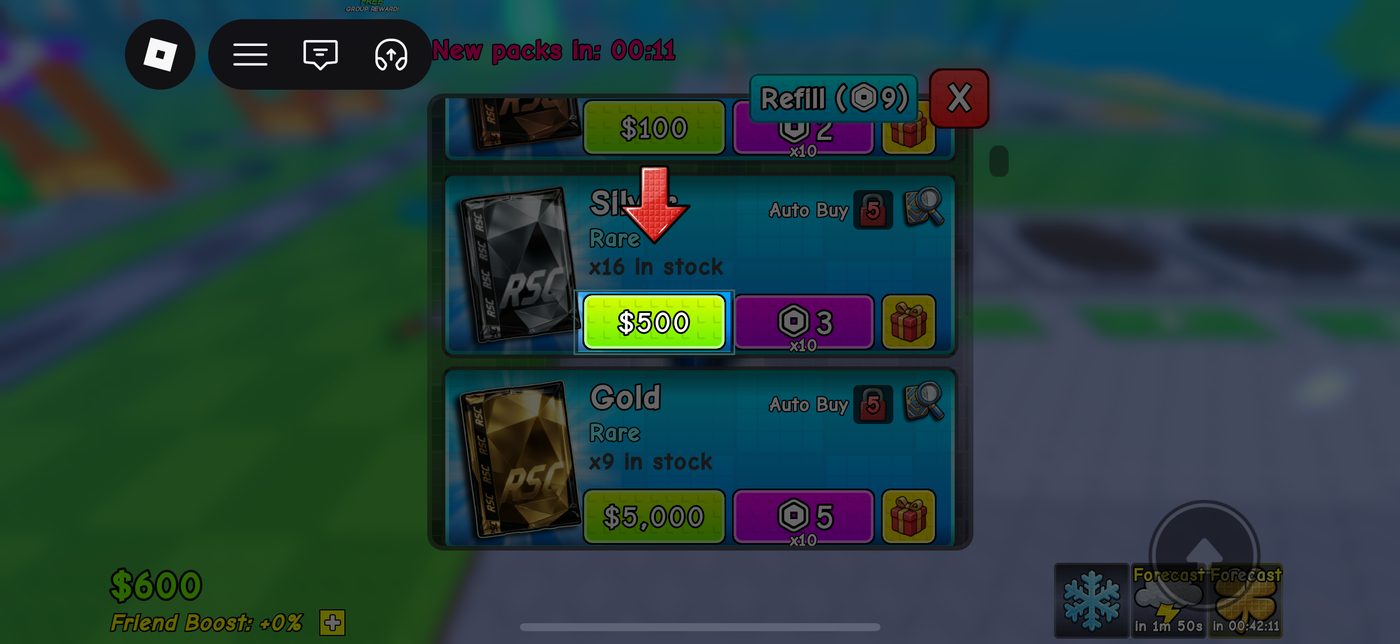
| Pack opening | pack-opening, restock-scarcity | Two-tap "cut" reveal; packs by tier with limited stock + restock timers + paid/ad refills + bulk buy + auto-buy. |
| Rebirth prestige | prestige-rebirth | 17 tiers. Reset cash + cards for a permanent multiplier and the next pack bracket. The progression spine. |
| Card bank | prestige-protect | Preserves best cards across a rebirth (1 slot R2 → full R5). The counter to prestige-wipe regret. Elegant. |
| Stacking mutations | variant-mutations | 10 types, multiplicative. The real endgame — stack mutations on a high-tier card for $100M+/s. |
| Weather events | weather-events, forecast | Rotating storms boost specific mutation odds; a forecast widget previews them. Times the open-loop to a clock. |
| Index / dex | dex-album | 3,682 entries; discovering new cards is itself the gem source. Collection doubles as a currency faucet. |
| Crafting → trophies | crafting | Craft Trophies from cards for a cash/gem boost (with a "stars" system). One-way — removing a trophy destroys the card. |
| Wish | wish-gacha | Spend Wish Tickets for a chance at exclusive cards unobtainable from packs. A gacha inside the gacha. |
| Spin wheel | wheel-spin | Free spin ~every 30 min, paid spins for gems. Prizes include cash, packs, gems, bonus spins, and limited exclusive cards. |
| Trading | trading | Player-to-player at the Trade Plaza, plus a Trade Token currency for exclusive cards. |
| Stealing | stealing, iap-pvp | Pay Robux to steal a specific card off another player's plot (~1,999R for a Void-tier). The corpus's only stealing — in its most aggressive form. |
| Automation gamepasses | iap-boosters, auto-roll | Auto Open, Auto Skip, Auto Buy, Auto Equip Best, Extra Bank Slots — sold for gems/Robux. Automation as monetization. |
| Quests | milestones | Open 3 Packs / Earn Money / Collect Money → gems. The early-game gem faucet and direction. |
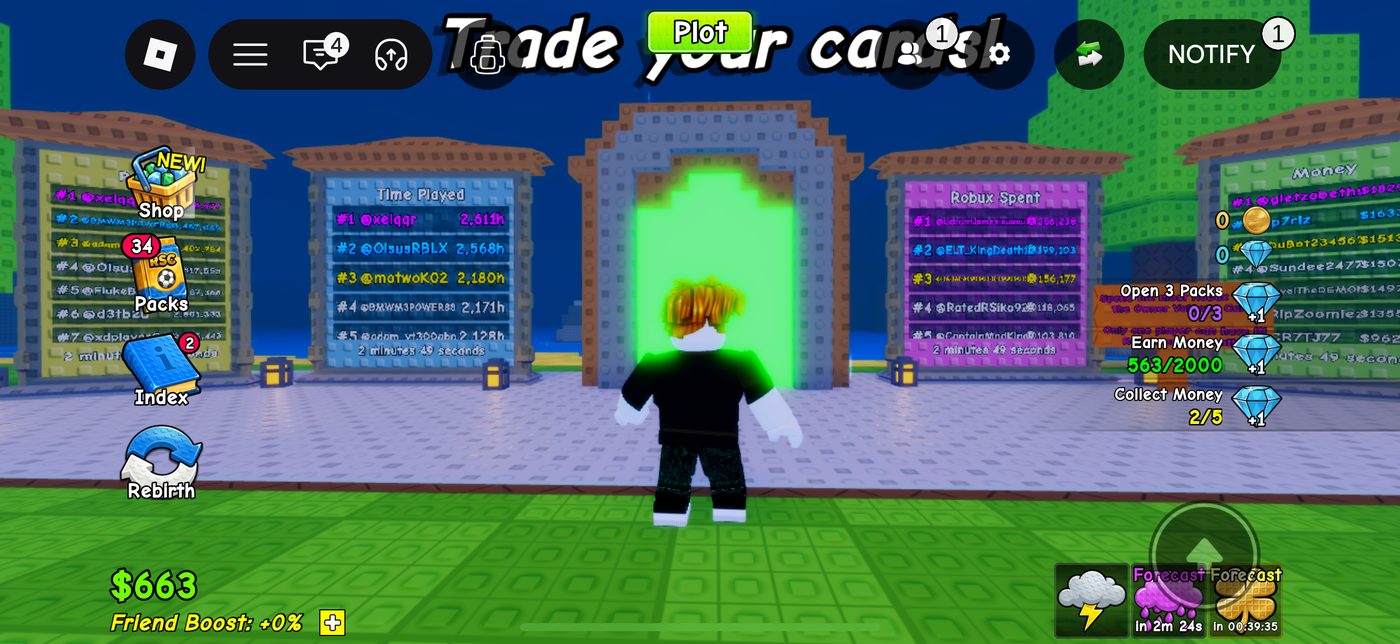
| Multi-axis leaderboards | leaderboard | Four boards — card value, Time Played (top ~2,600h), Robux Spent (top ~199k), Money. Openly ranks whales. |
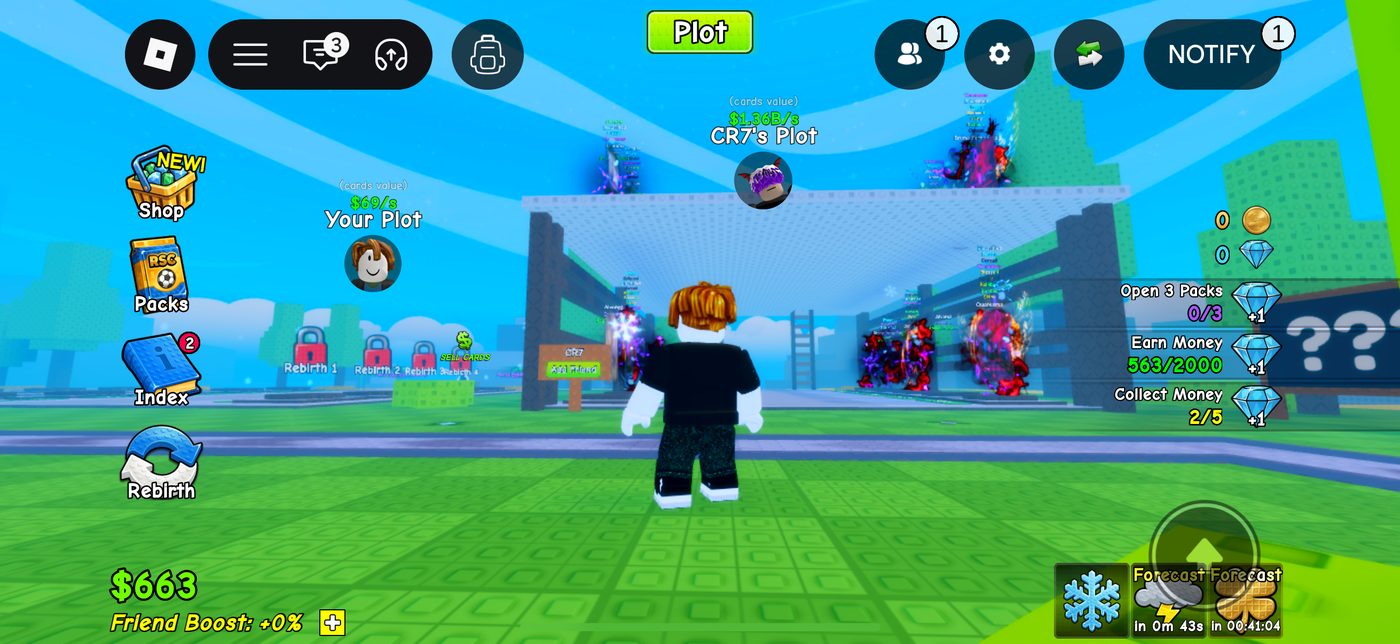
| Neighbor plots | neighbor-plots, lobby-flex | Walk others' plots showing billions/s and walls of mutated cards. The aspirational pull and the flex. |
Four gem sinks wearing different costumes
Craft, Wish, and the Spin Wheel are each a separate chase — and each a reason to convert cash into gems.
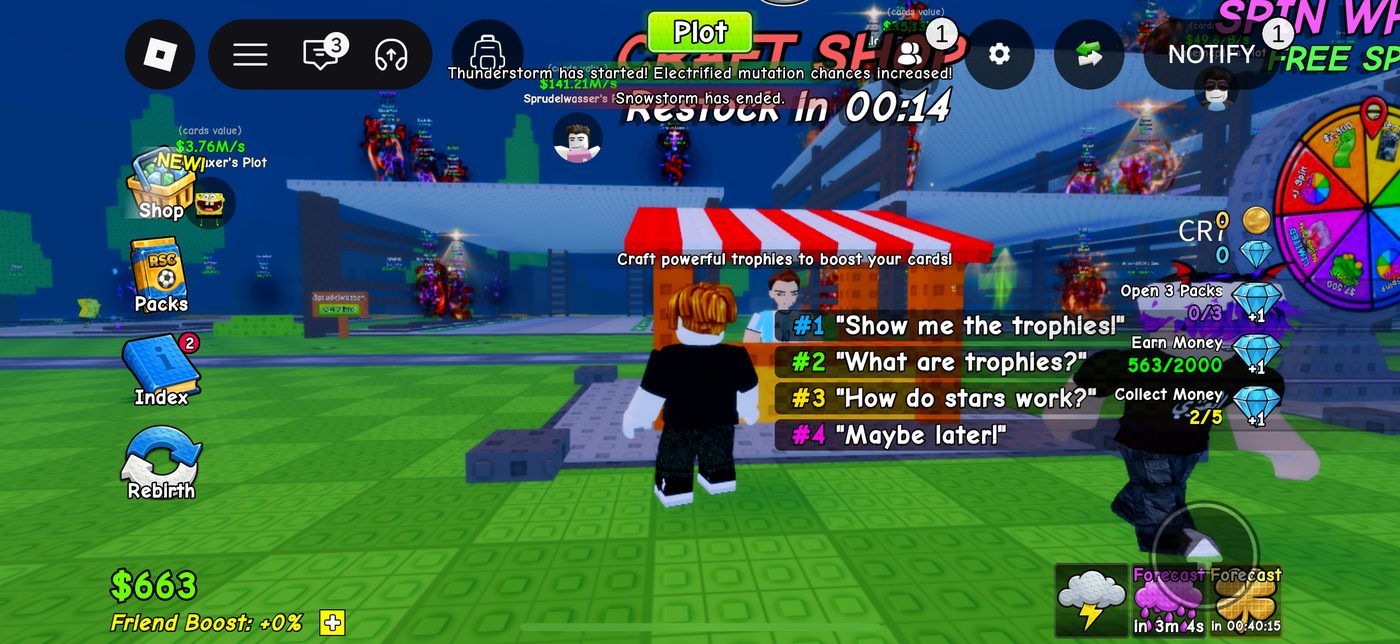
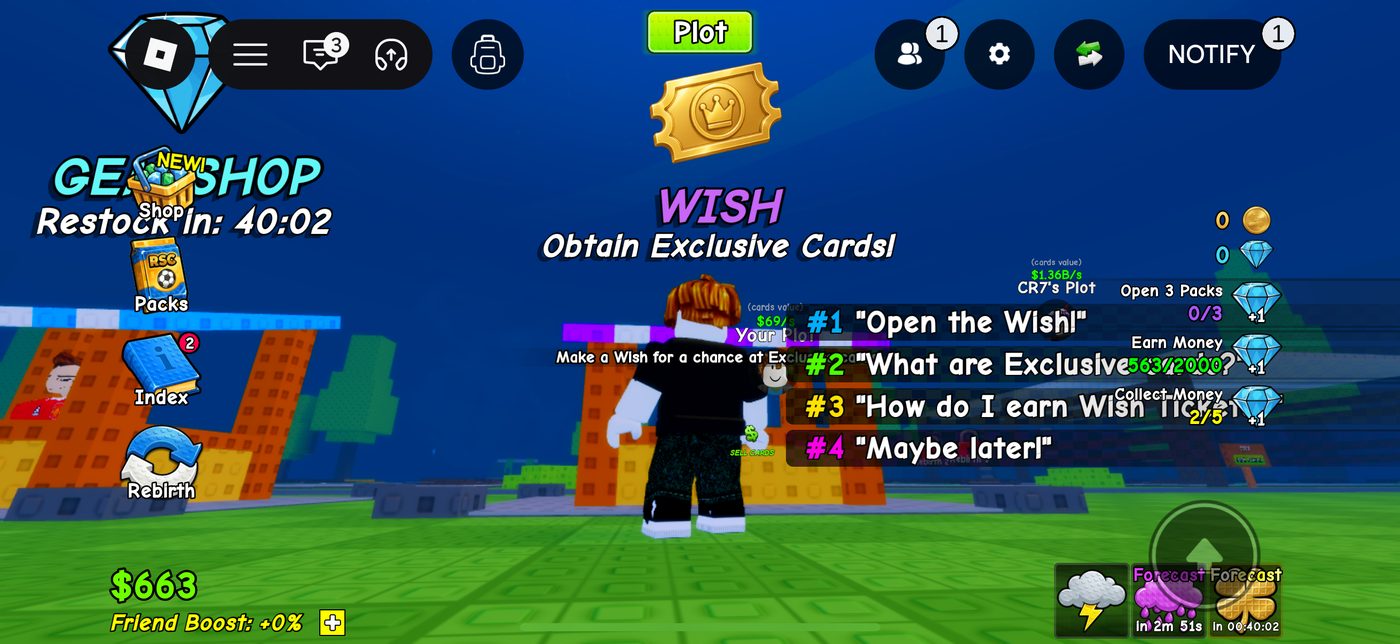
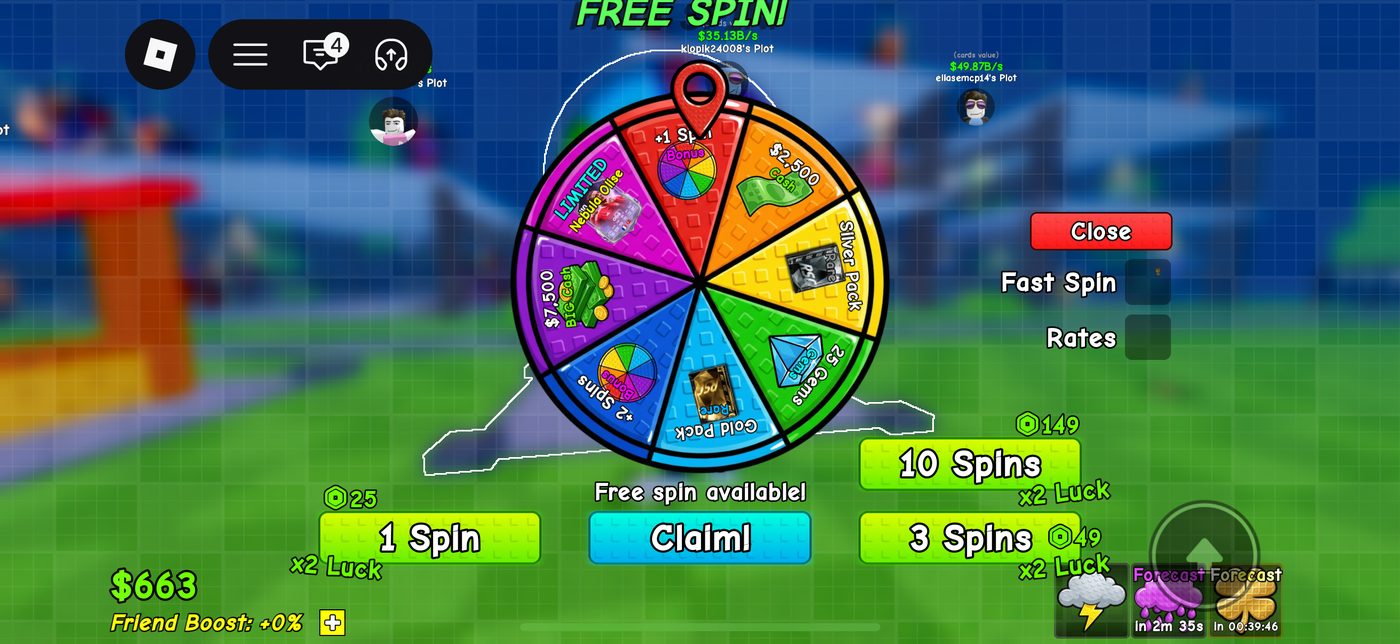
Crafting's one-way destruction (removing a trophy destroys the source card) is the sharpest edge of the three — a punishing, opaque trap for players who haven't learned the rule yet.
Economy, monetization and retention
Five currencies, a rotating gem shop, and the corpus's only pay-to-steal mechanic — the aggressive end of the genre, worth studying as much for the cautionary lines as the steal-worthy ones.
Five currencies, three monetization channels
Currencies
| Currency | What it's for | Notes |
|---|---|---|
| Cash | Idle income; buys packs | The base progression currency, reset (with cards) on rebirth |
| Gems | Premium currency | Earned from the card index (discovery) or bought with Robux; buys the pricier packs, the Gem Shop, and automation gamepasses |
| Trade Tokens | Exclusive cards | Earned via the Trade Plaza |
| Wish Tickets | Exclusive cards via Wish | A gacha-inside-the-gacha currency |
| Coins | Listed as a fifth currency in the economy lattice; specific use not detailed in the captured material | — |
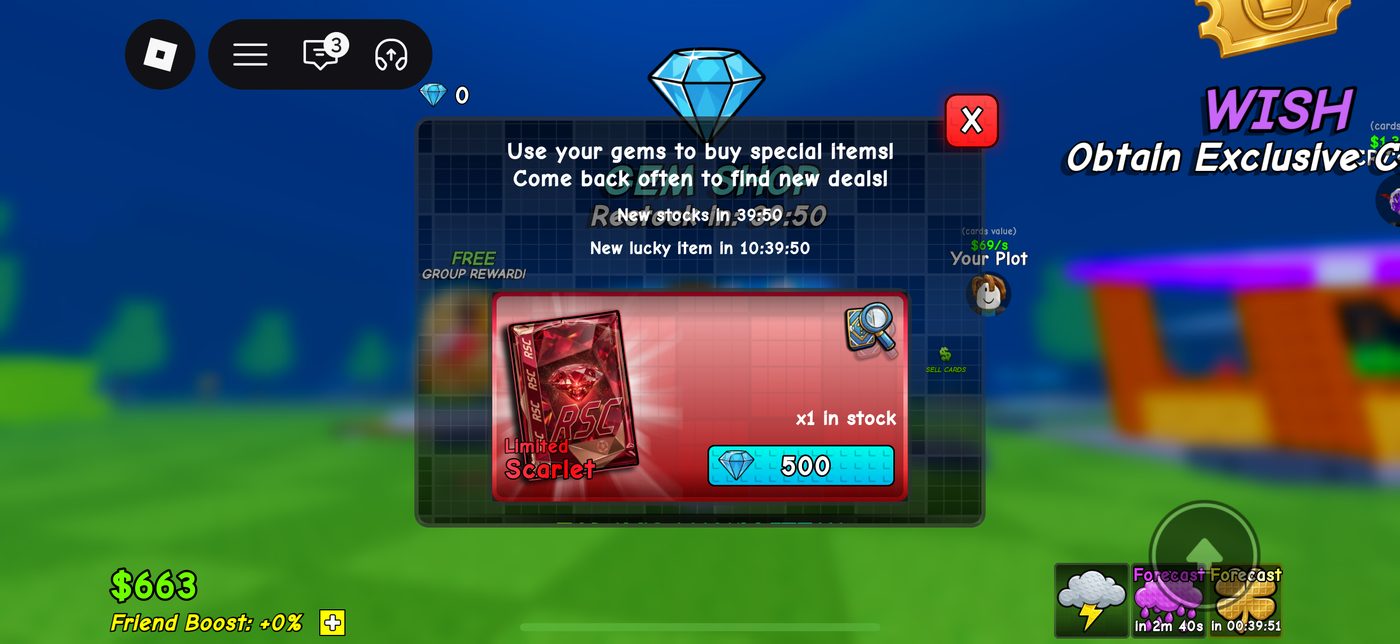
Packs take cash or gems; the Gem Shop rotates limited premium packs and sells the automation gamepasses; rewarded ads grant free refills.
Where pay-to-steal crosses the line
The line the rest of the corpus doesn't cross: stealing is a Robux purchase. Players pay real money to take a specific high-rarity card off another player's plot. Paired with a public Robux Spent leaderboard, the game doesn't just allow whaling — it gamifies it.
"Steal [Void]!" — ◊1,999 Robux (~€25). A real-money PvP take. Effective monetization, but an aggressive posture — and a brand decision, not a default.
Per-purchase verdict
| Purchase | Price | What it gives | Verdict |
|---|---|---|---|
| Steal [Void-tier card] | ◊1,999 Robux (~€25) | Take a specific high-rarity card off another player's plot | Effective monetization, but an aggressive posture — a brand decision, not a default |
| Automation gamepasses (Auto Open, Auto Skip, Auto Buy, Auto Equip Best, Extra Bank Slots) | Gems / Robux | Removes manual grind at every stage of the loop | Real money-makers that also genuinely reduce friction — automation sold, not given |
| Limited "Scarlet" pack | ◊500 gems, x1 in stock | Rotating premium pack | Rotating stock + a lucky-item timer manufacture "come back often" FOMO |
| Spin Wheel paid spins | ◊25 / ◊49 / ◊149 (x2 luck on bulk) | A shot at cash, packs, gems, bonus spins, or a limited exclusive card | The jackpot wedge is the wheel's only route to certain cards |
Leaderboards, weather cadence, and neighbor flex
No changelog or update-cadence material was captured for this game, so no live-ops timeline is presented here. What the captured material does show is three return hooks operating without a dated schedule:
Four boards — card value, Time Played, Robux Spent, Money — openly rank the top of the playerbase and give returning players a number to chase.
The rotating mutation-odds forecast (see 08 · Mutations) gives players a clock-based reason to return at a specific moment, not just "whenever."
Walking another player's base surfaces the entire mid-to-late game gap in one frame.
Readability vs a five-currency lattice
The base loop reads clearly (buy, reveal, place), but the systems stacked on top strain readability:
Cash / gems / trade tokens / wish tickets / coins — most players never grasp the full lattice.
Removing a trophy destroys the source card, and that rule isn't obvious until a player has already lost a card to it.
What to transfer, what to build, and the final call
Patterns worth adapting, softened
| Pattern | How to adapt it |
|---|---|
| Stealing | Now covered as a concept, but soften it: make it timing/skill-based rather than pay-Robux-to-take. A gentler PvP fits the brand better than a direct real-money take. |
| Crafting | Keep the cash/gem boost mechanic, drop the card-destruction trap. |
| Wish / wheel as gem sinks | Worth having, but pick one or two — not all three chases (craft, wish, wheel) at once. |
What to build first
17 tiers, content-gating — far past our current cash-only x1.25.
protect cards across a prestige reset.
we already have mutations; add the stacking depth and the weather clock.
make discovery itself pay currency.
sell Auto Open / Auto Skip / Auto Equip as convenience, not as a progression gate.
Not yet observed
No numeric per-dimension scores (e.g. Core Loop: N/10) were captured in the source material — only the qualitative Steal/Adapt/Skip judgments in 15 · Transfer and the verdict below. A scored dimension grid would need a dedicated scoring pass against a rubric, not an inference from this capture.
Maximal reference, not a template to clone whole
Maximal reference. Spin a Soccer Card is the upper bound of how many systems one idle loop can carry — the maximal pole of the idle-collector spectrum (World Cup Album sits at moderate; Build a Soccer Squad is lean score-chase). The lesson for a "vibe-code cheap loops" design principle isn't to copy the whole stack — it's to read which 3–4 bricks are load-bearing (idle income + rebirth-prestige + mutation-stacking + one chase) and which are bloat the game succeeds despite.
- Rebirth spine (17 tiers, content-gated) — build this
- The Bank (prestige-wipe protection) — build this
- Stealing — adapt, soften to skill/timing-based
- Crafting — adapt, drop the destruction trap
- Five-currency lattice — skip, collapse to two or three
- Public Robux-spent leaderboard — skip, gamified whaling, brand risk
- Flat two-tap reveal — skip copying as-is; spectacle is our wedge instead
Sources and data confidence
Sources. In-game screens from a single captured playthrough (voice walkthrough + screenshots) of Spin a Soccer Card by Pixellar Studios; 17 of the captured screenshots are carried into this document as figures. No store-page, tracker, or changelog data was cross-checked — CCU/visit figures in the Dossier are the capture session's own observation, not an independent tracker pull, and no live-ops/update-cadence data was available (see 13 · Retention).
Spin a Soccer Card · design teardown & reference for the World Cup RNG project · 2026