Survive Zombie Arena
A co-op wave-survival arena: up to 25 players drop from a spaceship onto one shared arena, fight escalating waves of zombies, and between waves spend earned Credits on weapons, upgrades and defensive builds. This is the mass-hit archetype of Roblox's zombie niche — the highest concurrent peak among zombie games and the cleanest example of a co-op loop assembled with modern live-ops.
An objective design teardown of the game's systems — how the loop, economy, monetization and retention are built — and a practical reference: what to copy, what to adapt, and what to avoid when building your own co-op survival game. Every number is read off in-game screens and cross-checked against public trackers; contested values are flagged.
Why this game is the genre benchmark
The three takeaways that drive everything else, and the promise the game sells itself with in a single line.
What to copy first
Success rests not on graphics or brand, but on three design decisions that together deliver a sense of power, protect loyalty, and manufacture a reason to return.
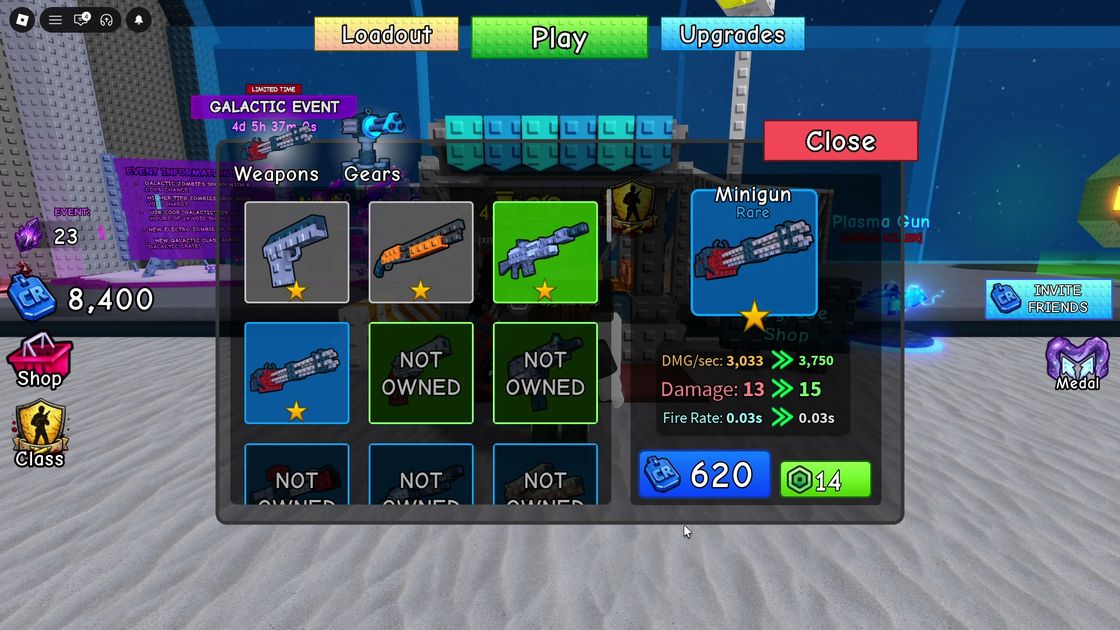
The default roster ships a free Minigun (3,033 DMG/sec, S-tier), and the Credit weapon ladder is short and steep. Players feel strong within one ~13-minute run — not after cross-session grinding.
There are only two gamepasses — VIP and Double Credits — and both merely accelerate earning, stacking with each other. None of the core content is locked behind Robux. That is what keeps 95.6% positive at this scale.
The Galactic Event is not a reskin but a content drop: its own map (Atlantis), currency (Void Shards), crate gacha, event weapons and an exclusive class. This live-ops discipline is the moat the 9–10-year-old zombie archetypes lack.
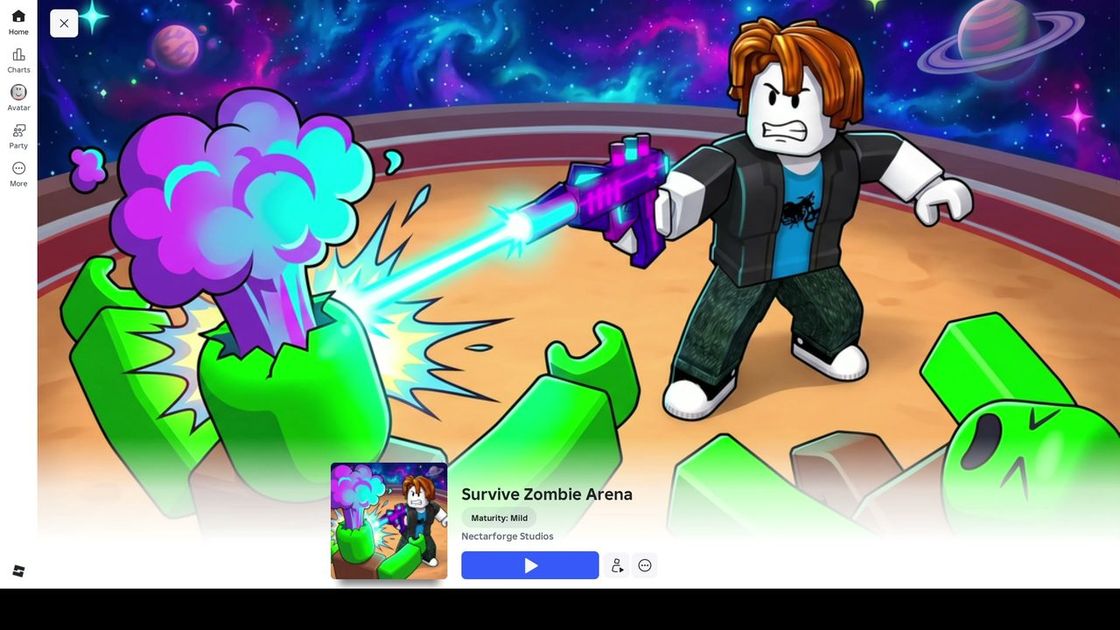
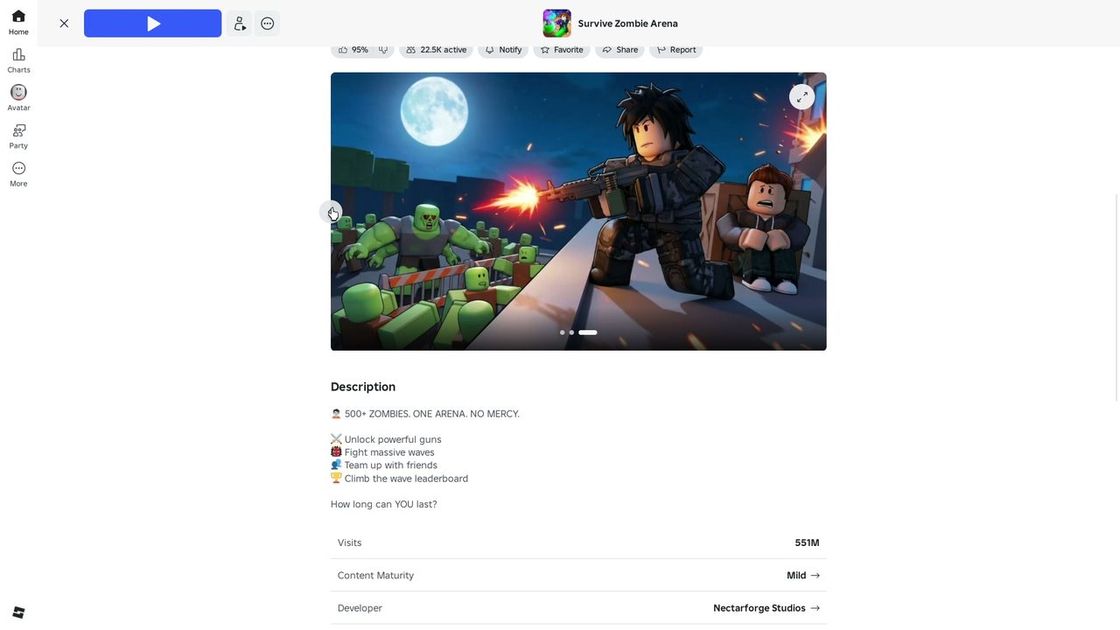
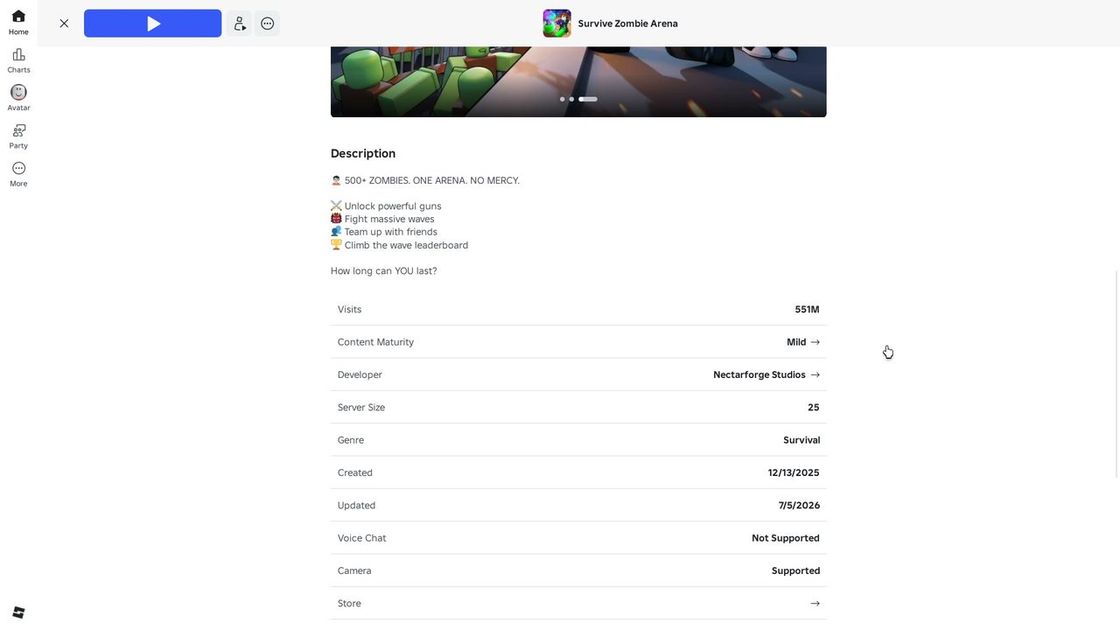
"500+ zombies, one arena, no mercy"
The store promise is the whole pitch, and it reads in a second. No filler, no mechanics to explain: genre, scale and mood register instantly — which is what drives the click-through.
Dossier
Loop, first session, arena and game feel
The mechanical core: a tight compounding loop, an instant entry, one contained arena, and shooting that stays readable under chaos.
Kill → Credits → upgrade → harder wave
A compounding cycle packed into a ~13-minute run. The key beat is the between-wave buy phase: that is where you decide what to invest earnings in, and it is what turns shooting into a game about economy.
Core loop:
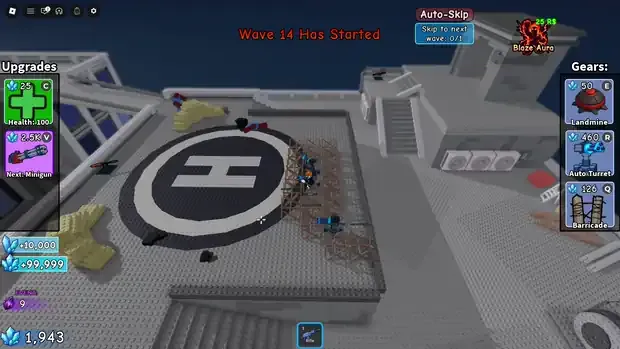
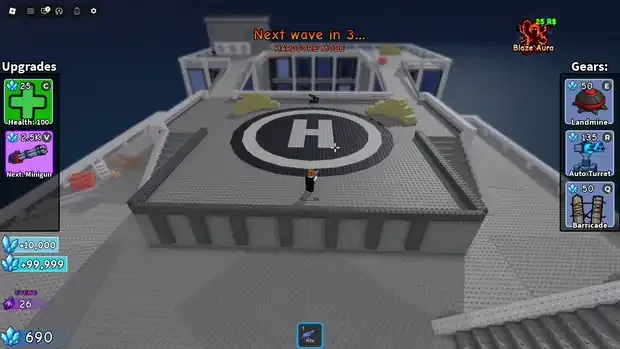
The game explains why to stay in seconds
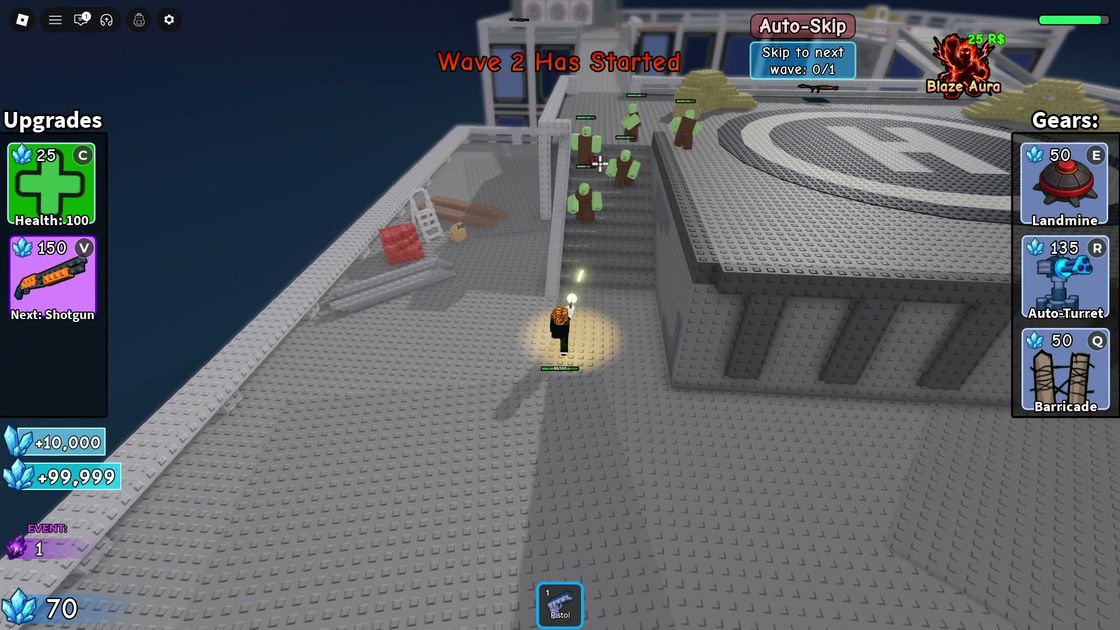
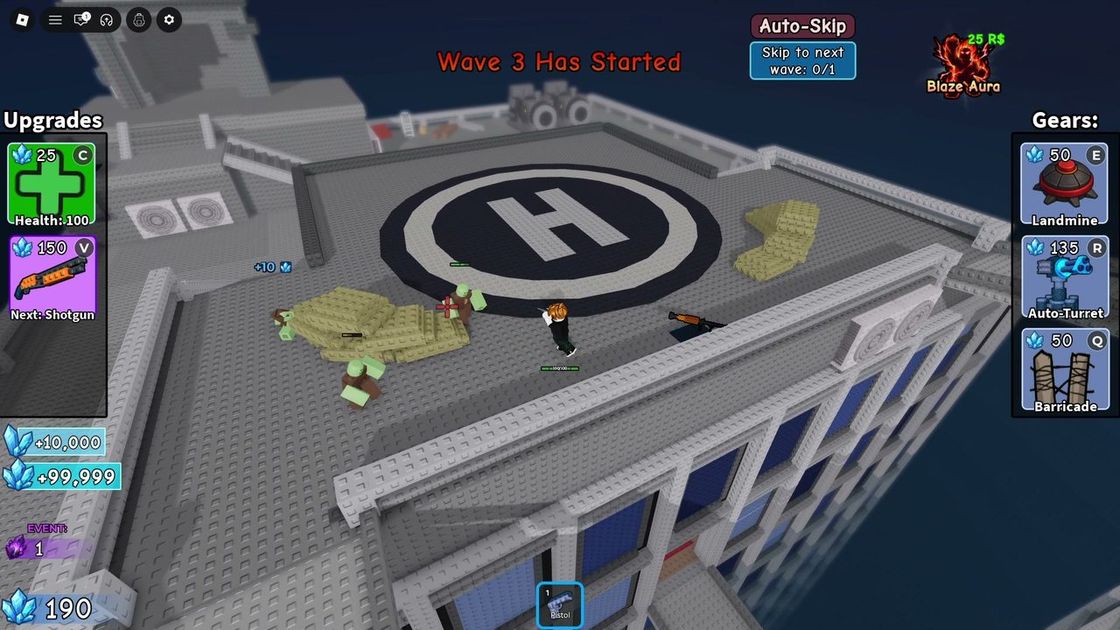
Zero setup: a handgun in your hands immediately, the economy learned in combat. There is almost no tutorial — and none is needed, because the action ("shoot zombies") matches the store promise exactly.
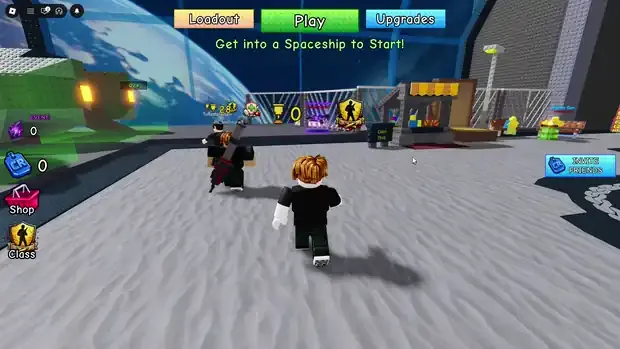
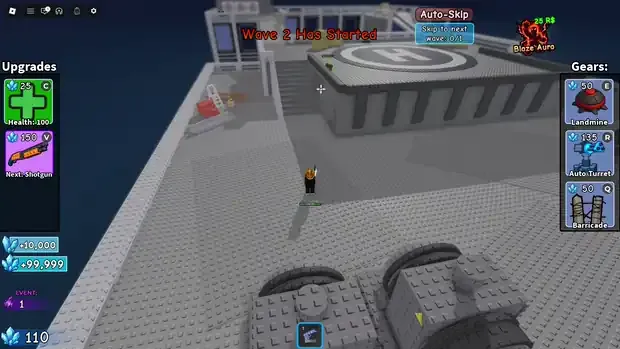
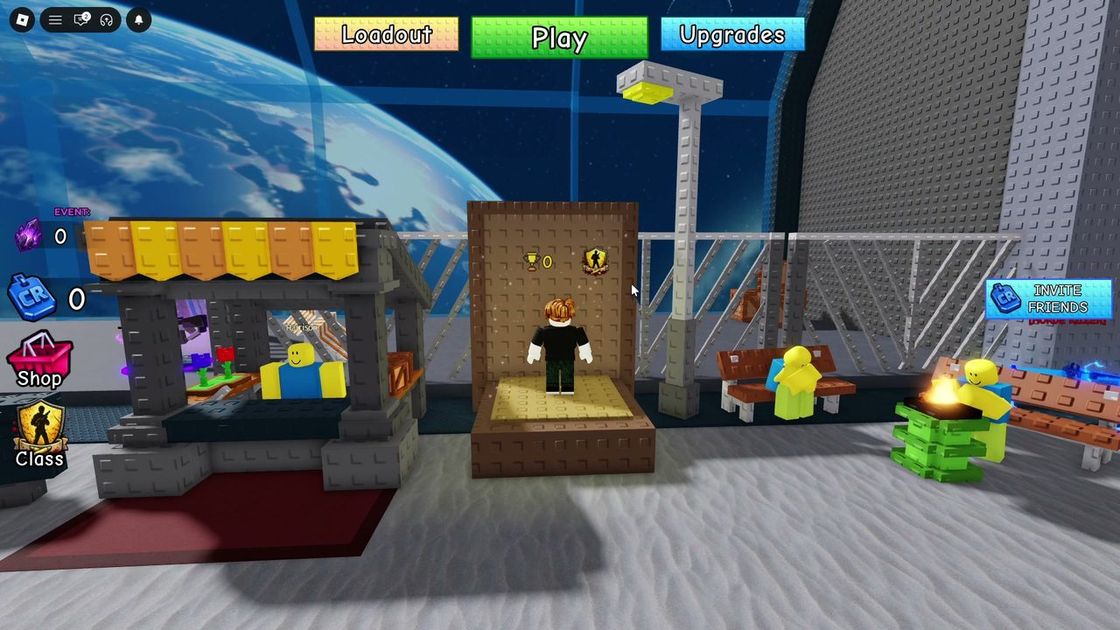
Instant readability of the idea, combat without a tutorial, the free Minigun in the roster (immediate power fantasy), 25-player co-op and a referral for inviting a friend. The first reward — Credits from the opening wave itself.
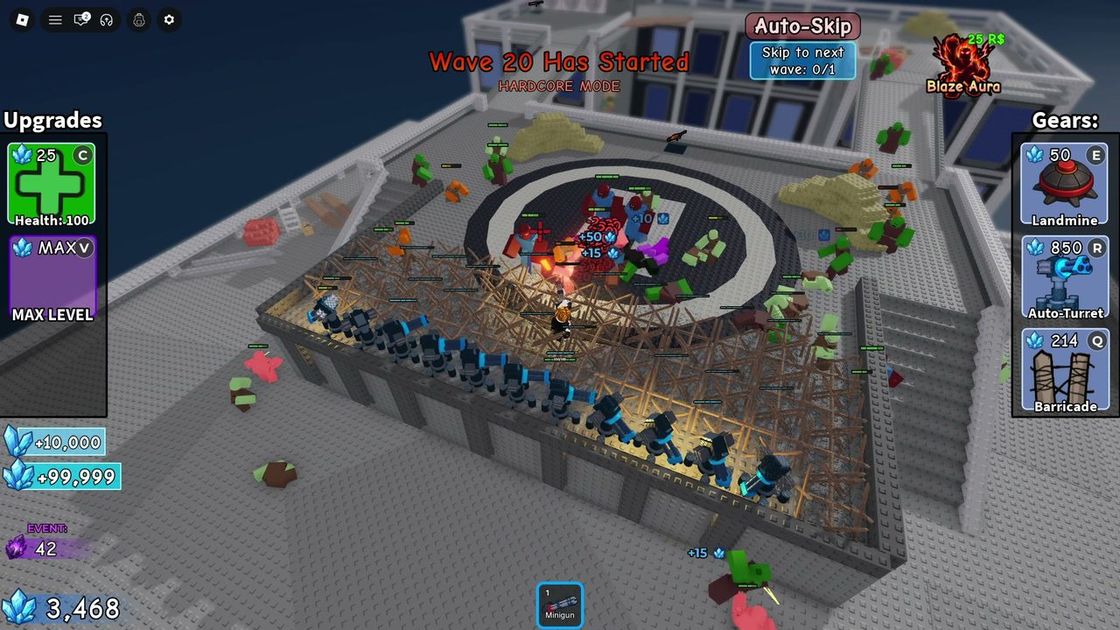
The density of the buy menu (weapons + gear + classes at once) and the visual noise of large waves. On mobile this must stay readable, or a newcomer gets lost in the very first buy phase.
One contained arena for 25 players
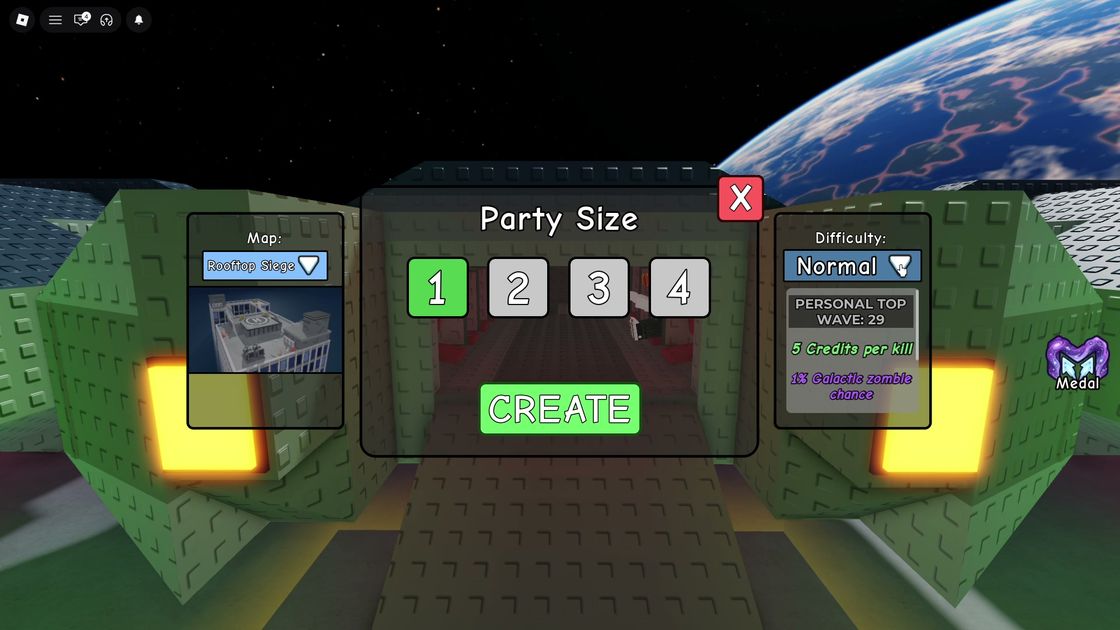
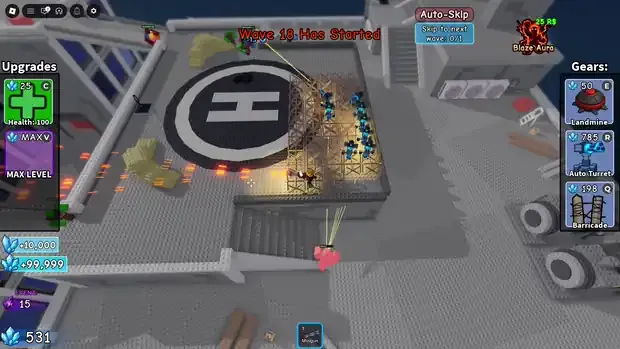
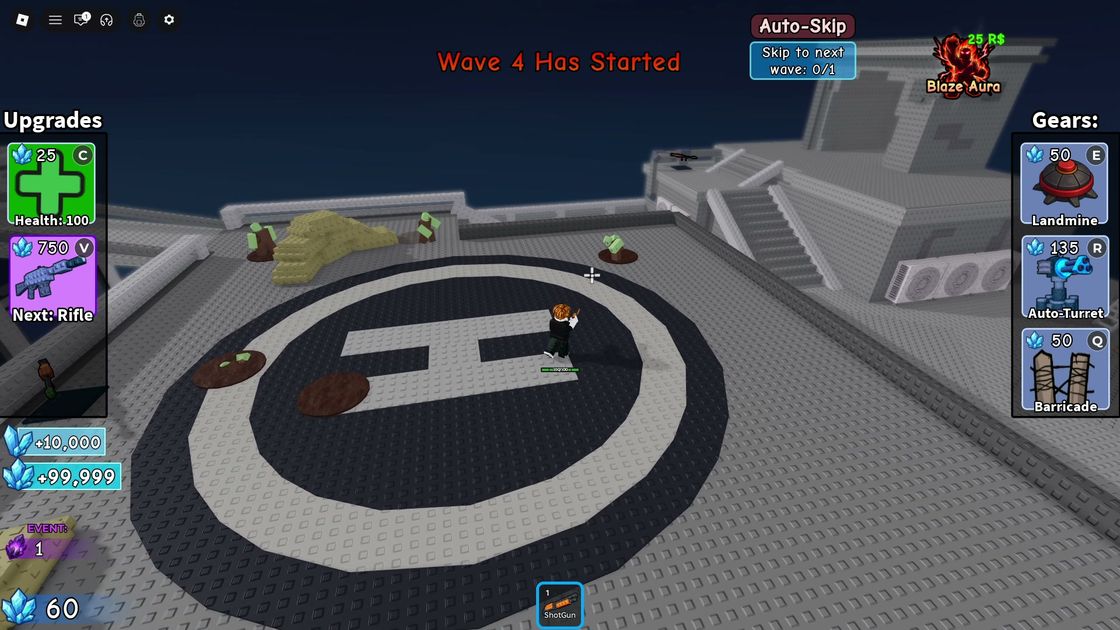
Not defensive lanes and not an objective to protect, but one shared open area the team reads tactically: high ground, chokepoints, defensible corners. The default arena is Rooftop Siege with an "H" helipad.
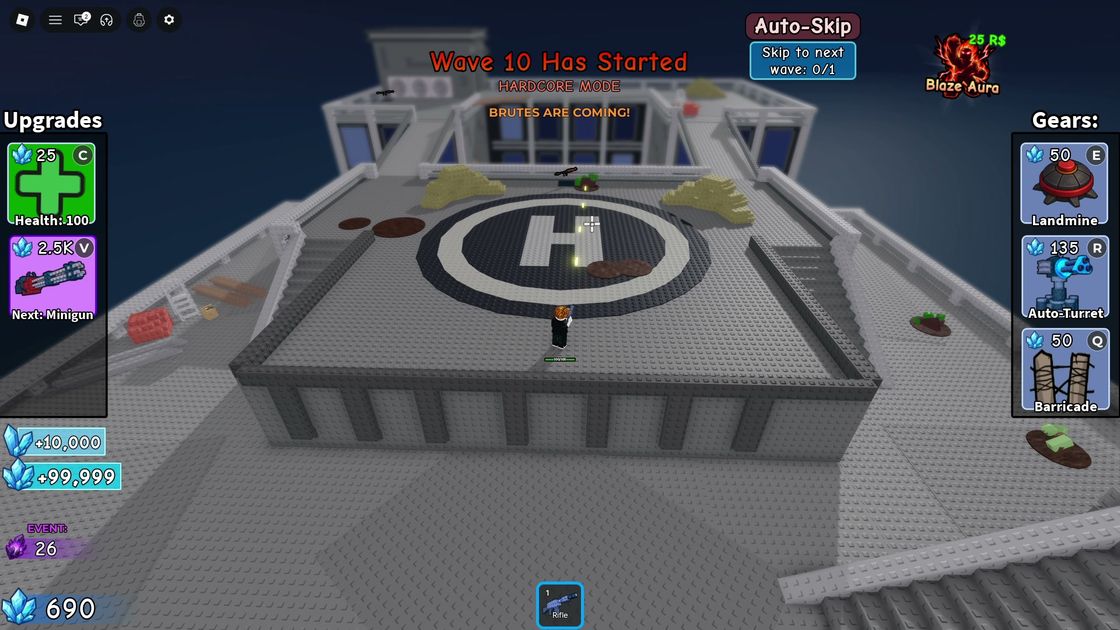
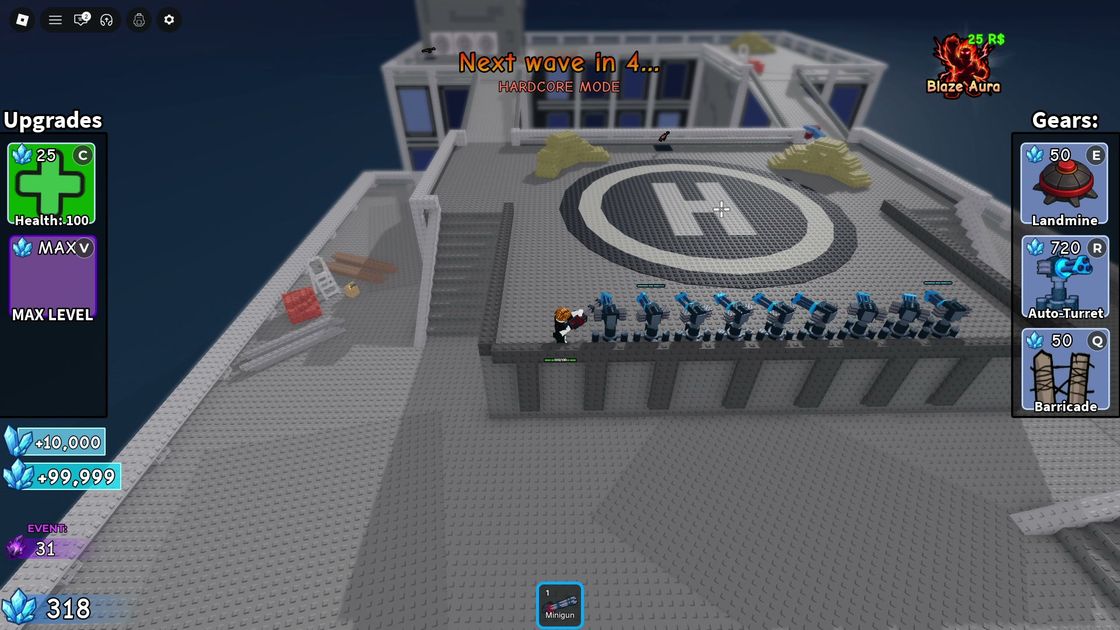
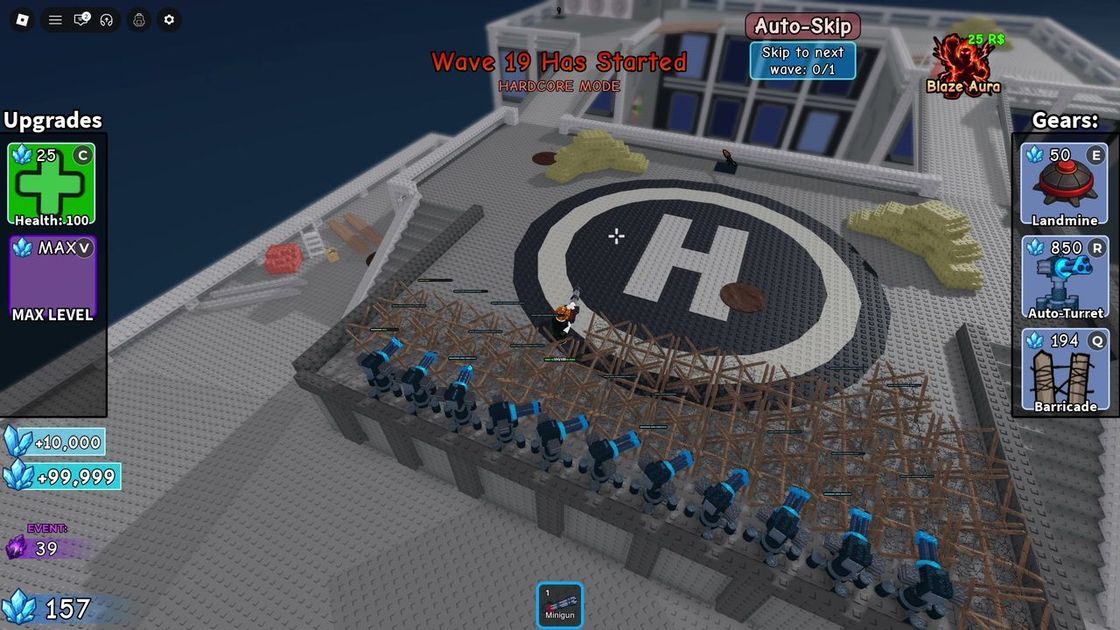
Chaotic, from all sides. Builds block spawns on their own tile — this opens a "wall off the corner" tactic, but also creates the AFK-farm risk on pathfinding-bug ledges.
A second floor, stairs, an "electrical box" as high ground. Elevation gives respite, but narrow passages sometimes trap zombies in place — a movement bug, not a mechanic.
Shipped with the Galactic Event: an underwater-ancient motif, a central staircase to an upper tier, water hazards and safe farming corners. A separate map, not decoration.
Kite-and-shoot; the "juice" is damage numbers and a falling crowd
A top-down / twin-stick shooter: WASD to move, Space to jump, 1–4 for four weapon slots, LMB to fire, Q/R/E to deploy gear. The style is kite-and-swap: a fast gun for open lanes, a heavy gun for dense clusters.
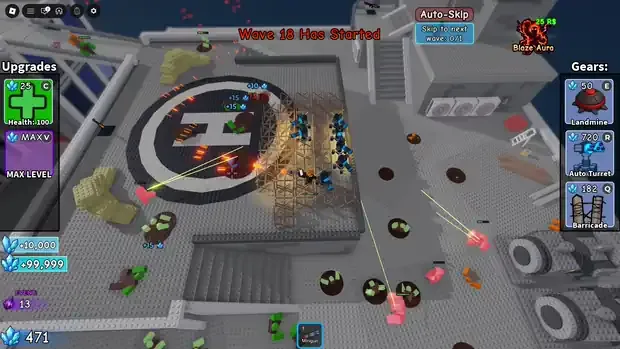
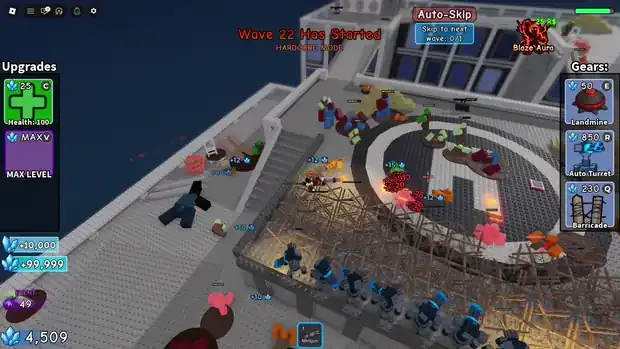
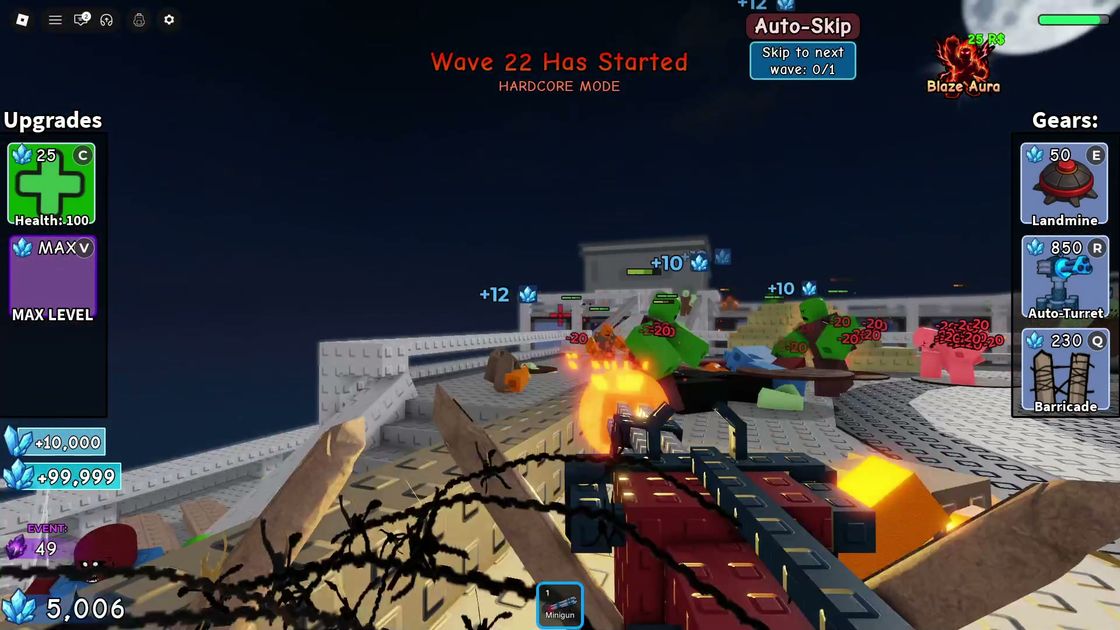
Instant response, line-piercing shots, HP auto-regen out of damage, infinite ammo, readable floating damage numbers, fire-sound falloff as the camera pulls away.
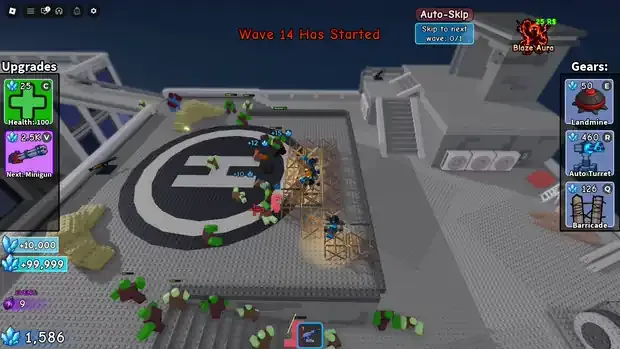
Auto-Turret (its own HP, auto-targeting), Barricade (blocks path and spawns), Landmine (blast on step). Placed on Q/R/E, price rises with each purchase in the run.
Reloading is a real vulnerability window (guides call "standing still to reload" a typical mistake). The fine "juice" is functional rather than cinematic: the core feedback is floating damage numbers and a falling crowd, without pronounced hitmarkers, screenshake or ragdolls. Enough for a casual co-op loop, but on shot "weight" the game trails the shooter benchmarks.
Where a run holds and where it sags
An engagement diagram for one session — not a measurement but a design model assembled from the observable wave structure. It shows a strong hook, an early power spike, and the main risk: a repetition plateau in the middle of a long run.
How to read it. The hook is high from the first second (drop-in + instant combat), the curve rises quickly to a peak at the power spike (~minute 3), then in the middle of a long run the wave content repeats and engagement slides toward the "boredom line" — that is the content-depth ceiling. Boss waves (~30 and beyond) act as re-hooks, and the high-wave chase plus leaderboard pull the tail. The main risk — and the growth point for a clone — is wave variety in mid-session.
Enemies, weapons, classes and economy
The game's balance backbone. Every value below is read off in-game cards; where a source is a fan wiki or the community, it is marked.
Color-coded threats that grow by wave
Types are introduced as waves progress and difficulty scales exponentially. Threat reads by color and silhouette — a deliberate design choice for readability under chaos. There is no public bestiary with HP: those values exist only in-game.
| Enemy | Role | Marker | Appears | Note |
|---|---|---|---|---|
| Standard Zombie | grunt | — | wave 1 | slow, low HP; deadly in numbers |
| Runner | fast flanker | orange | early | fast, flanks; kill mobility first |
| Ashwalker | very fast | fire | mid | extreme speed; countered by barbwire / Molotov |
| Decayed | durable swarmer | dark green | mid | presses with mass and durability |
| Elite Zombie | breaks defenses | — | ~wave 11 | high HP, quickly smashes barricades — first difficulty spike |
| Shade | elite | large silhouette | mid-late | big, standout silhouette, high threat |
| Howler | herald / support | — | before bosses | buffs nearby zombies; signals a boss wave |
| Brute ("Big Purple Guy") | tank / mini-boss | red-purple | ~wave 30 | sinks damage; needs focused turret + minigun fire |
| White Zombie ("Yeti") | late tank | white | waves 60+ | huge damage resistance; countered by Death Nova / Plasma Gun |
| Galactic Zombie (event) | special drop | purple + orb | ~1.00% spawn | drops Void Shards; higher tier = more shards |
| Electro (event) | variant | electric | added | arrived with the Galactic Event; little detail |
"Big Purple Guy" and "Yeti" are community nicknames, not official names. The VOLATILE enemy was shown in dev previews (Feb 2026) but is not yet in the game. The developer doesn't disclose exact enemy HP — those values exist only in-game; in practice threat reads by color, silhouette size and spawn wave, which is the block's core design device.
Wave curve and difficulty modes
| Waves | Composition | New threat | Phase meaning |
|---|---|---|---|
| 1–10 | light spawns, no elites | setup | warm-up, learn the economy |
| 11–20 | elites appear, denser packs | Elite / Shade / Brute | first difficulty spike |
| 21–30 | multi-angle spawns | tank mini-boss ~30 | stability test for the defense |
| 31–50 | density jumps sharply | true scaling | under-prepared teams wipe |
| 51–70 | pressure without respite | white "Yetis" in the 60s | endurance wall |
| 70+ | exponential density | kit management dominates | endless; ranked by max wave |
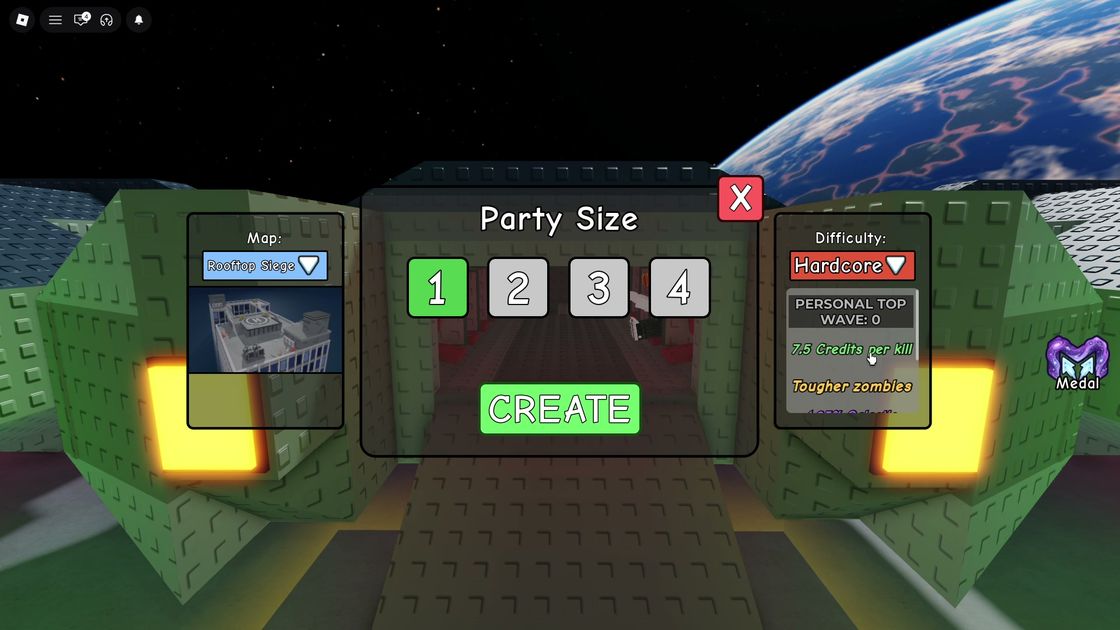
4 slots, each with its own ladder to endgame
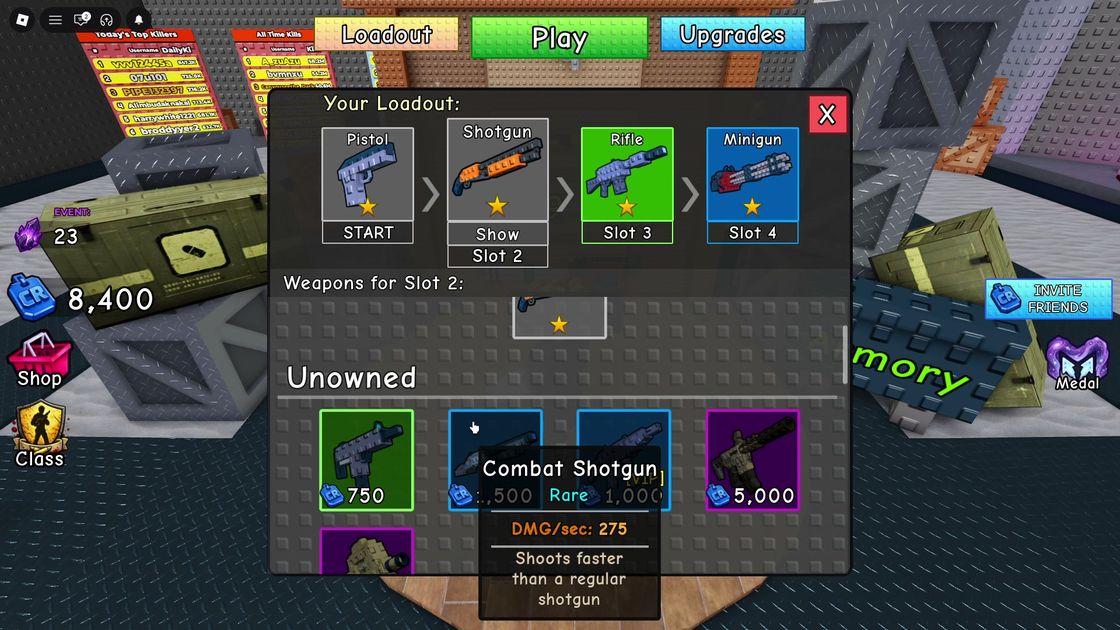
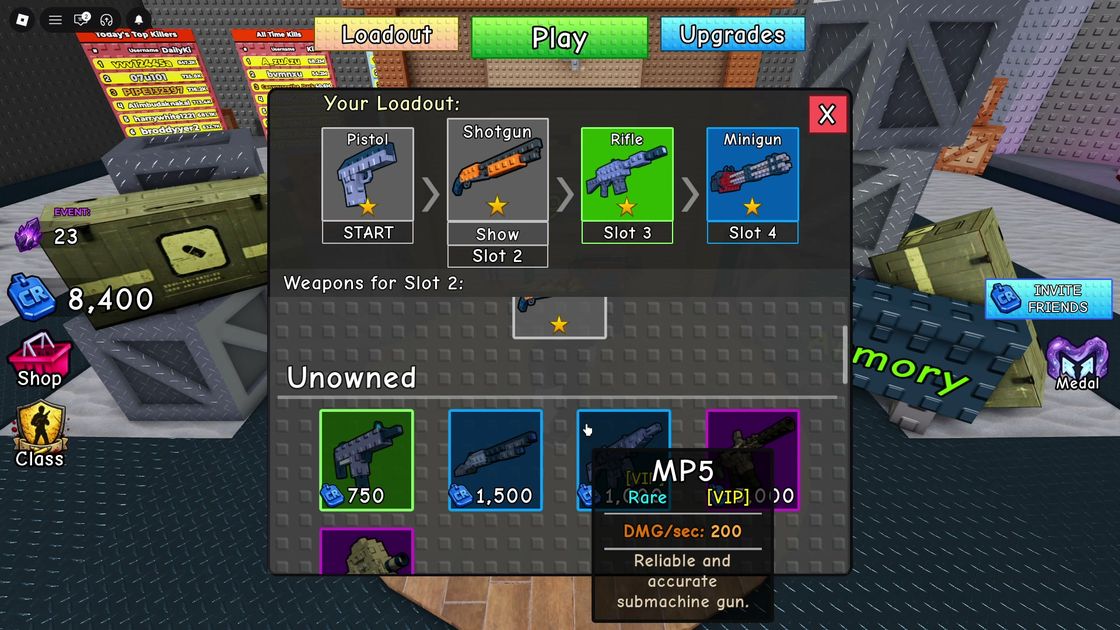
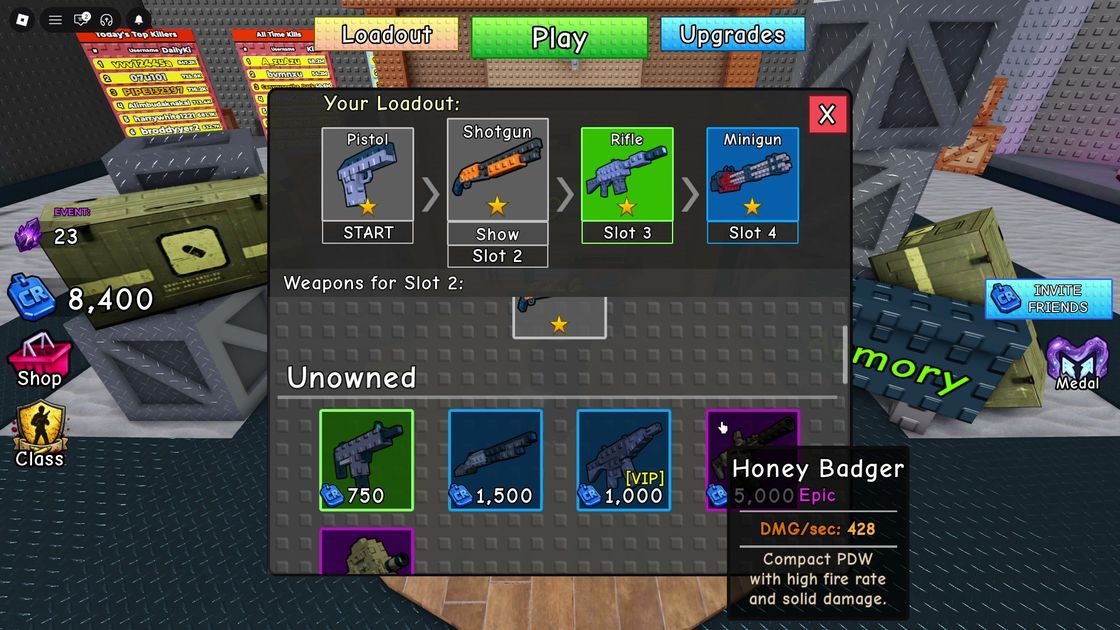
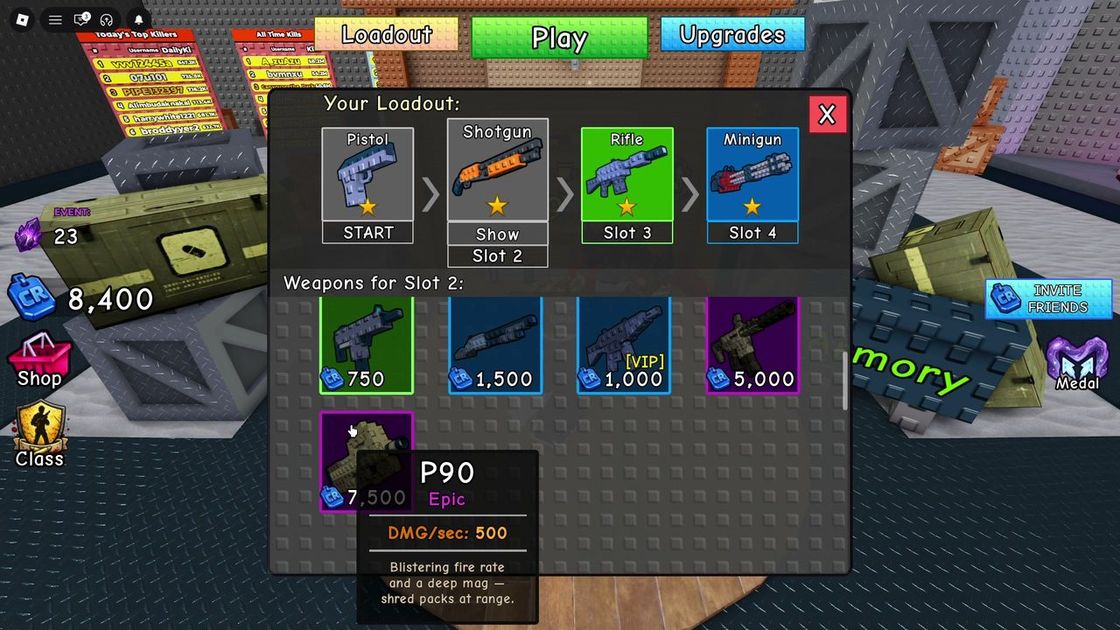
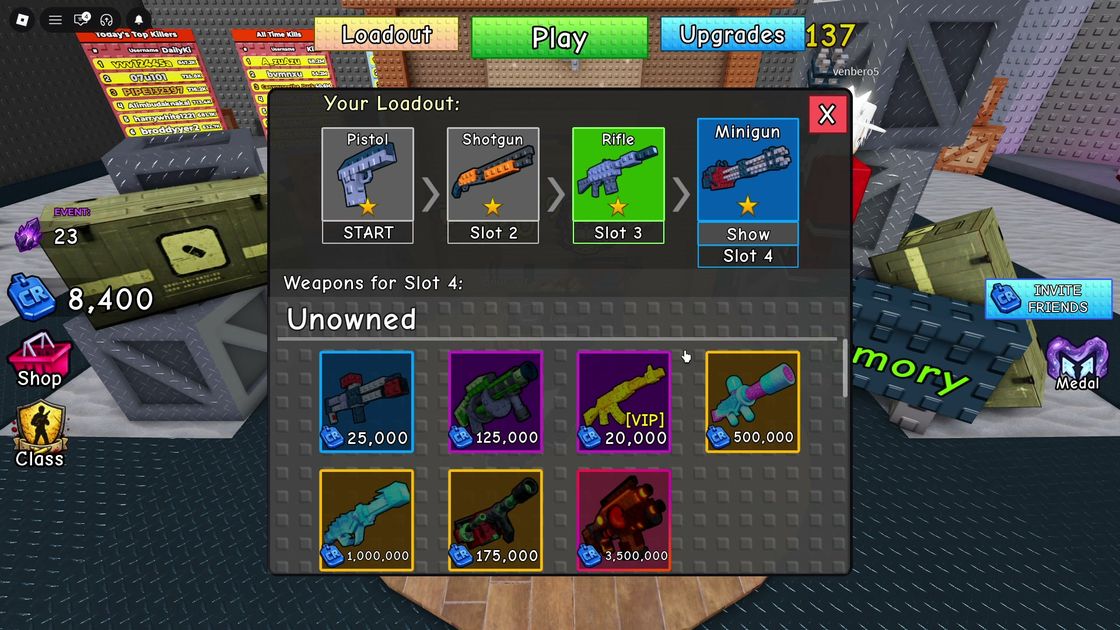
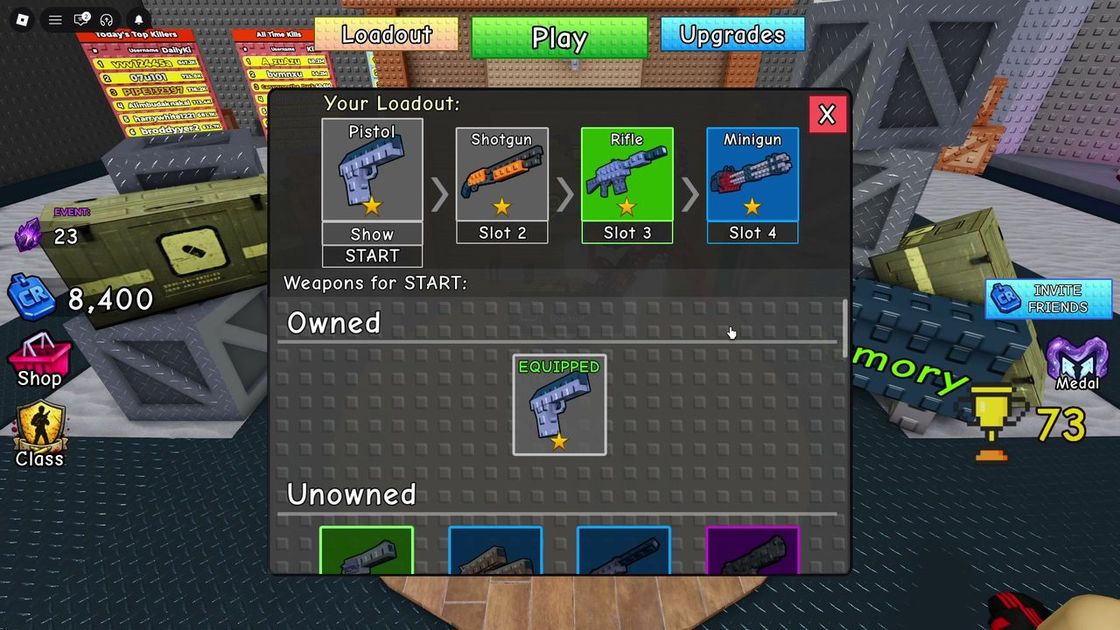
Weapons are laid out across 4 slots, the starters free. Within a slot you buy ever-stronger guns for Credits; buying replaces the current weapon (no dual-wield). All DMG/sec and prices are read straight off in-game cards.
| Weapon | DMG/sec | Rarity | Price, CR | From the card |
|---|---|---|---|---|
| Slot 1 · Pistols | ||||
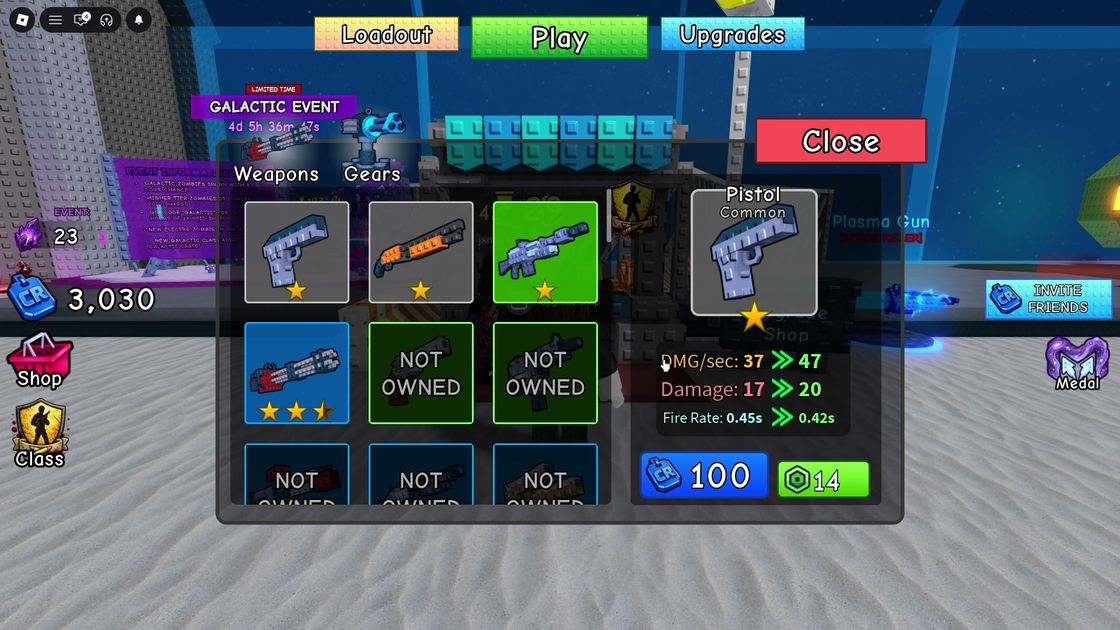
| Pistol | 37 | Common | start | "Reliable sidearm" |
| Revolver | 50 | Uncommon | 250 | stronger than a pistol but slower |
| USP-S [VIP] | ~142 | VIP | 500 | VIP subscription only |
| Dual Pistols | 155 | Rare | 650 | "Double shoot zombies fast" |
| Deagle | 240 | Epic | 5,000 | "Heavy-caliber pistol. High damage per shot" |
| Slot 2 · Shotguns / SMG | ||||
| Shotgun | 133 | Common | start | "Powerful at close range" |
| MP5 [VIP] | 200 | VIP | ~1,000 | "Reliable and accurate submachine gun" |
| Combat Shotgun | 275 | Rare | 1,500 | "Shoots faster than a regular shotgun" |
| Honey Badger | 428 | Epic | 5,000 | "Compact PDW with high fire rate" |
| P90 | 500 | Epic | 7,500 | "Blistering fire rate and a deep mag" |
| Slot 3 · Rifles | ||||
| Rifle | 666 | Uncommon | start | "Balanced automatic rifle" |
| Burst Rifle | 800 | Rare | 2,500 | "Shoots in bursts of 3 bullets" |
| AK-47 | 900 | Rare | 3,500 | "You can't go wrong with this" |
| Sniper | 375/enemy | Epic | 10,000 | shoots through zombies in a straight line |
| Tommy Gun | 999 | Epic | 35,000 | "Hold the trigger and watch the horde drop" |
| Heavy Rifle | 1,722 | Epic | 75,000 | "Better than a minigun, great horde killer" |
| Scar-H | 2,105 | Legendary | 125,000 | "Heavy per-shot punch at long range" |
| Slot 4 · Heavy | ||||
| Minigun | 3,033 | S-start | free | no reload; free power fantasy |
| Flamethrower | 2,600/enemy | Rare | 25,000 | "Burns zombies, great AoE" |
| Santito's Golden AK-47 [VIP] | 4,500 | Epic | 20,000 | "Santito's precious gun. Golden bullets" |
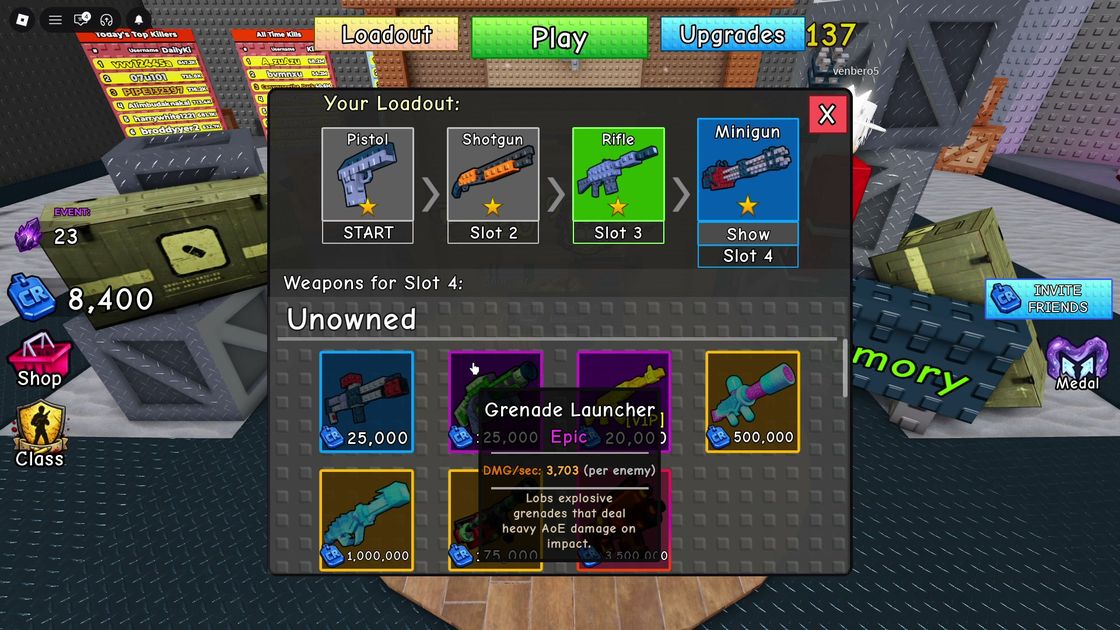
| Grenade Launcher | 3,703/enemy | Epic | 125,000 | "Heavy AoE damage on impact" |
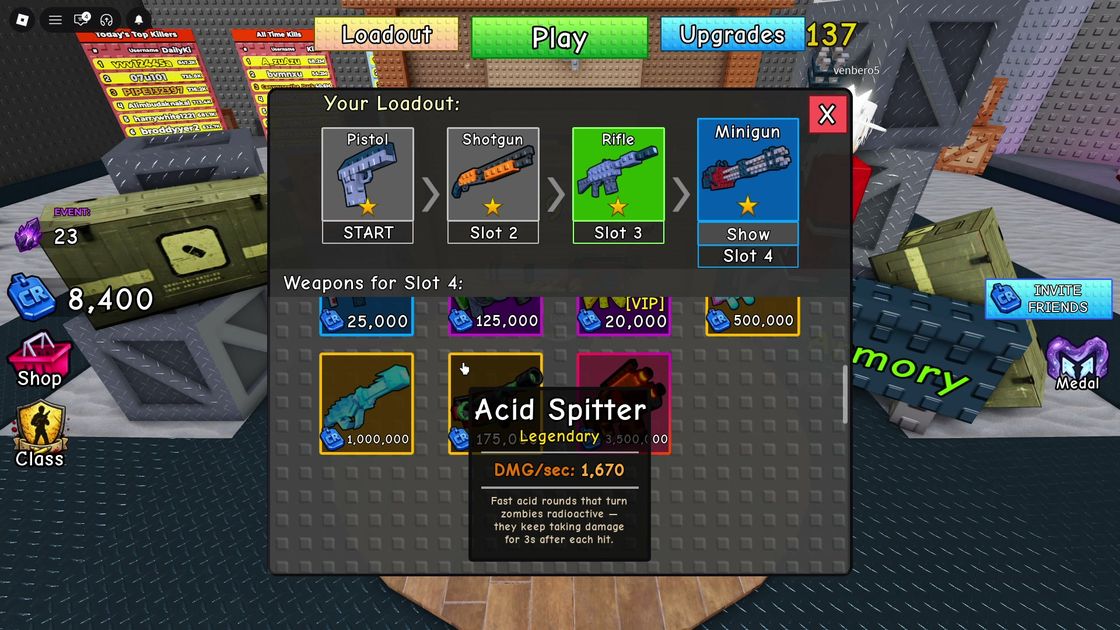
| Acid Spitter | 1,670 | Legendary | 175,000 | acid makes zombies radioactive — damage for 3s more |
| Gumdrop Blaster | ~4,687 | S | 500,000 | endgame gun (value is fan-wiki) |
| Arctic Striker (freeze) | ~6,000 | S | 1,000,000 | best-in-slot; freezes enemies (value is fan-wiki) |
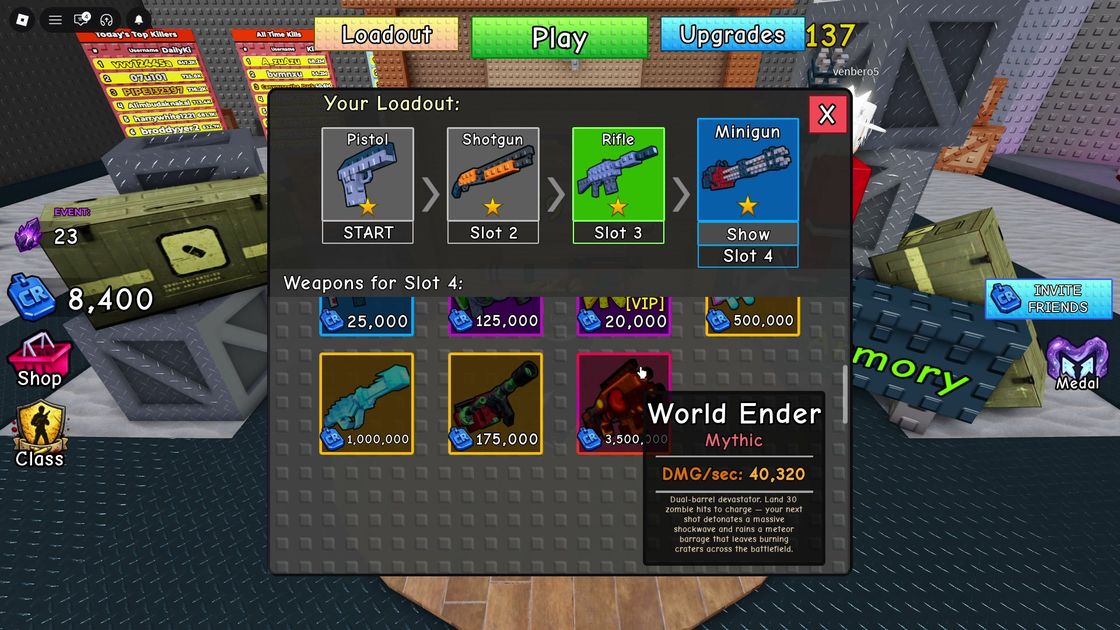
| World Ender | 40,320 | Mythic | 3,500,000 | charges over 30 hits → shockwave + meteor barrage |
Guns marked "/enemy" hit along a line / AoE, so their total DPS against a crowd exceeds the nominal figure. Values for Gumdrop Blaster and Arctic Striker are taken from a fan wiki (no captured tooltip for them) and are marked unverified. World Ender, Grenade Launcher and Tommy Gun were added as F2P weapons in the 05/08/2026 patch.
Weapon catalog — cards with in-game values
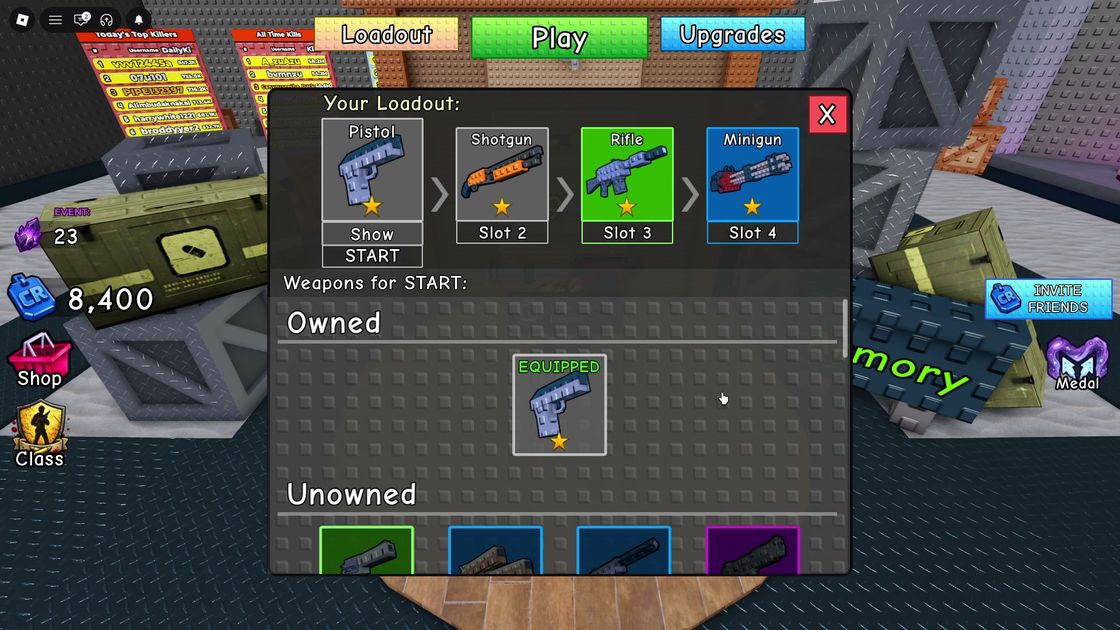
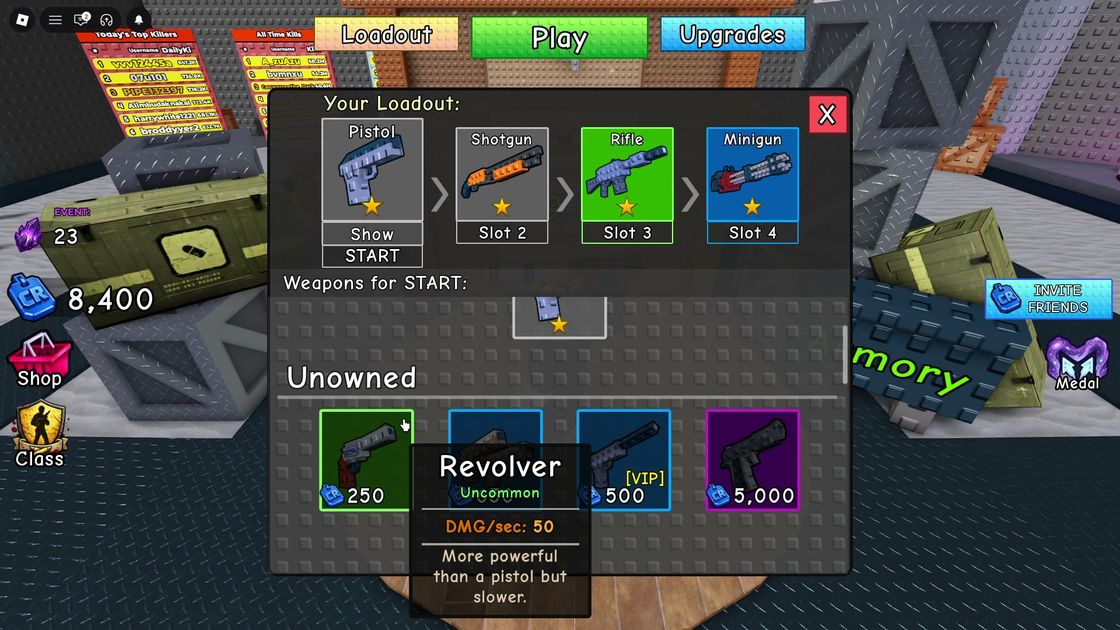
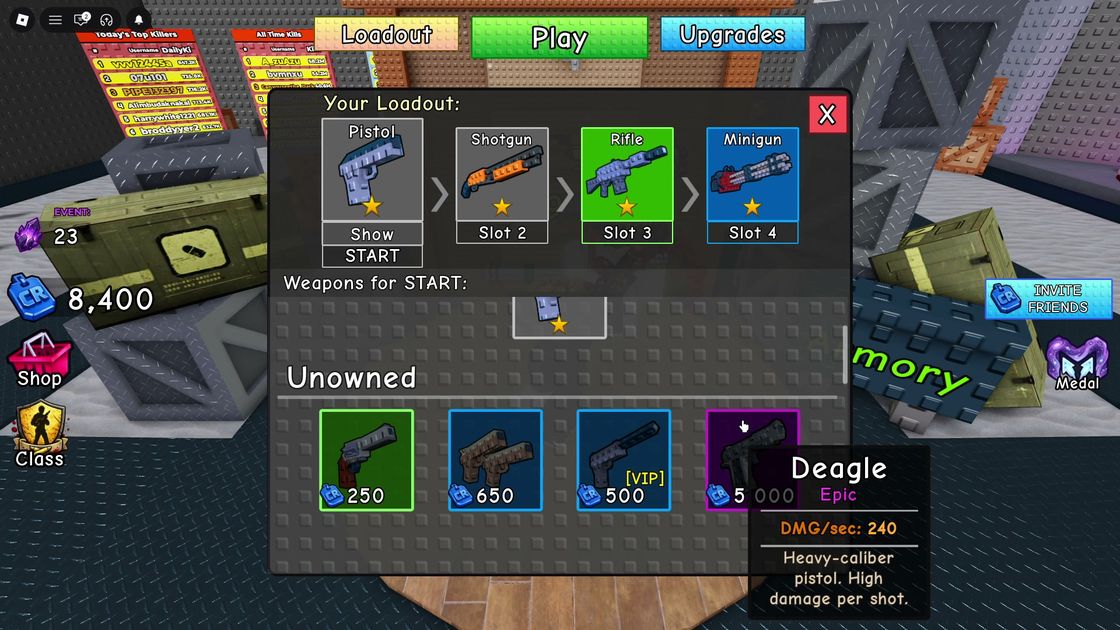
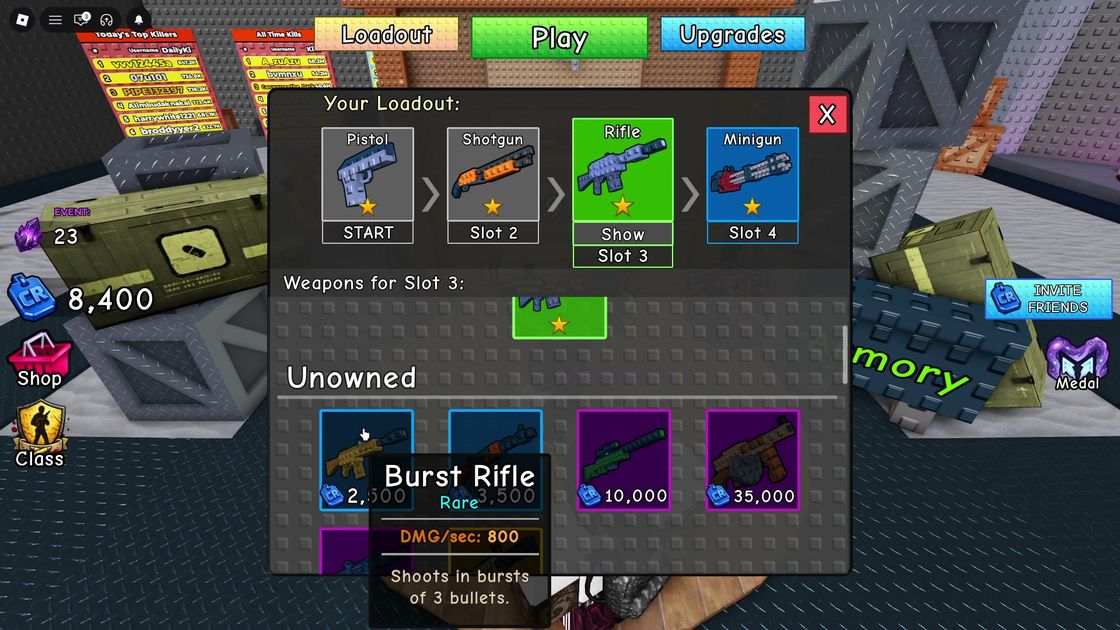
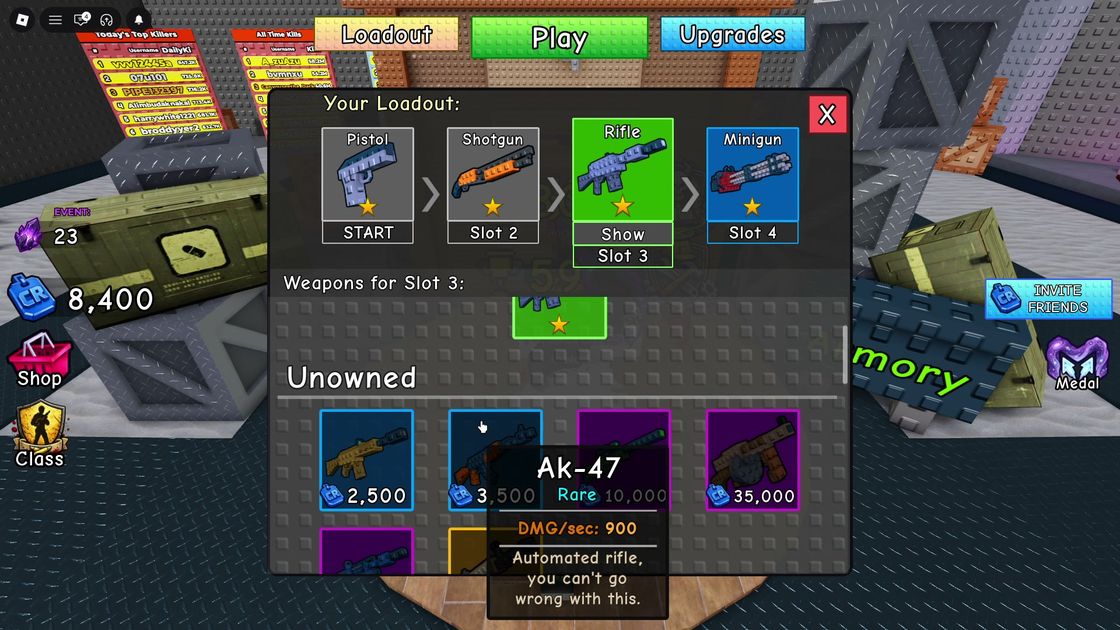
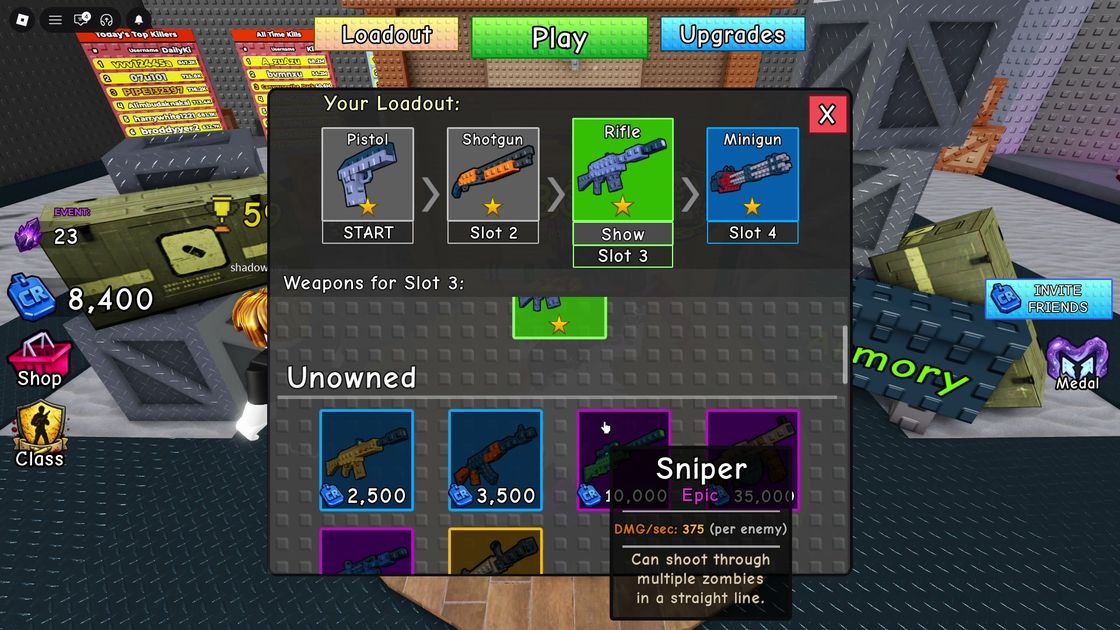
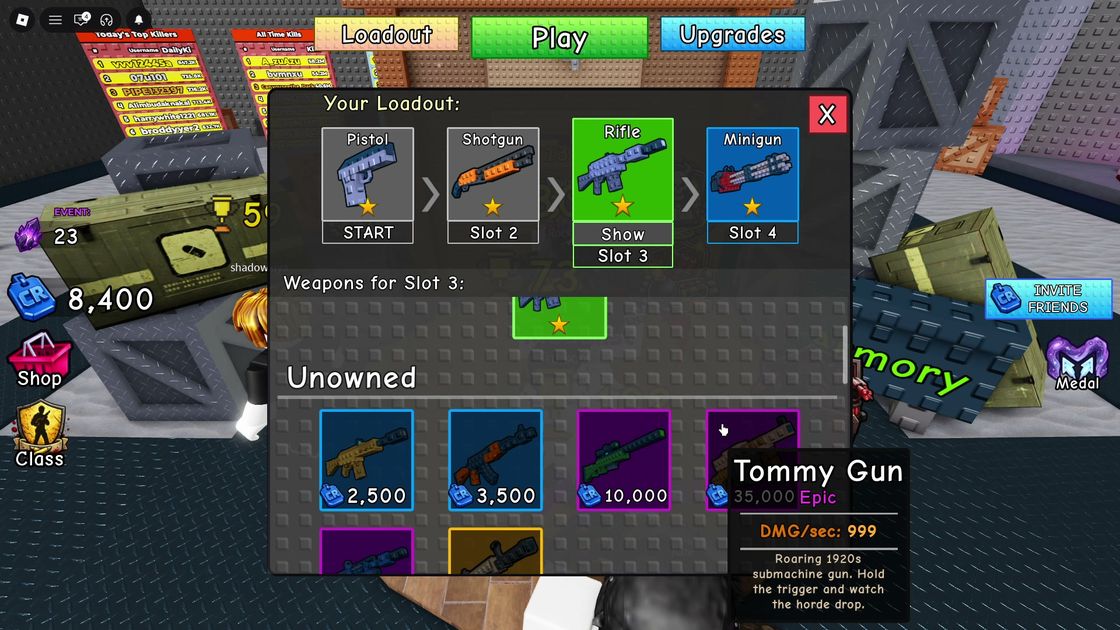
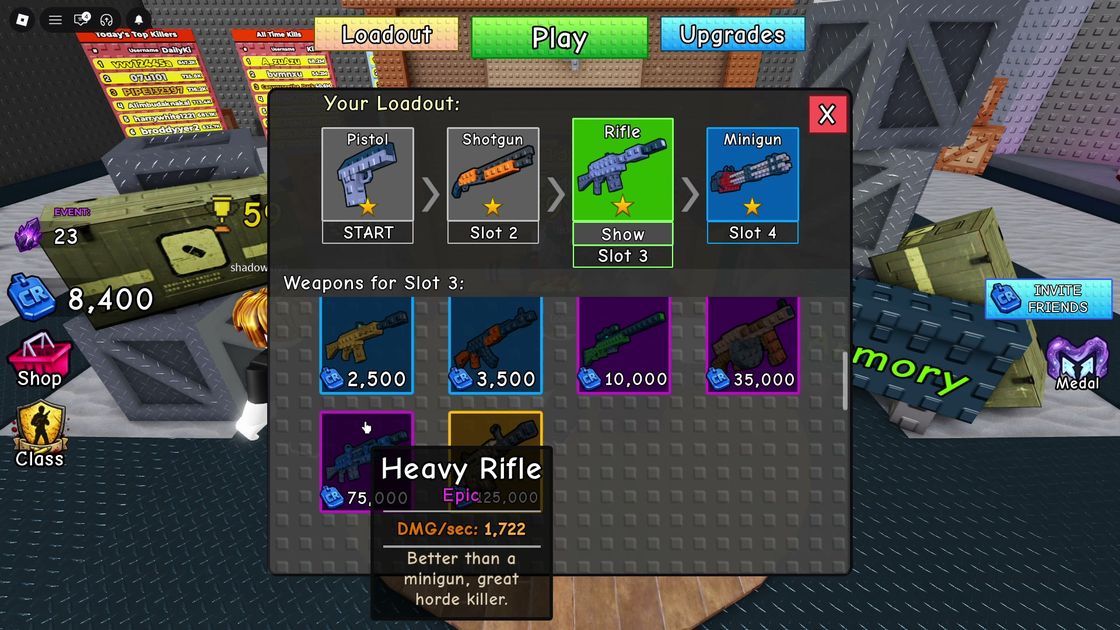
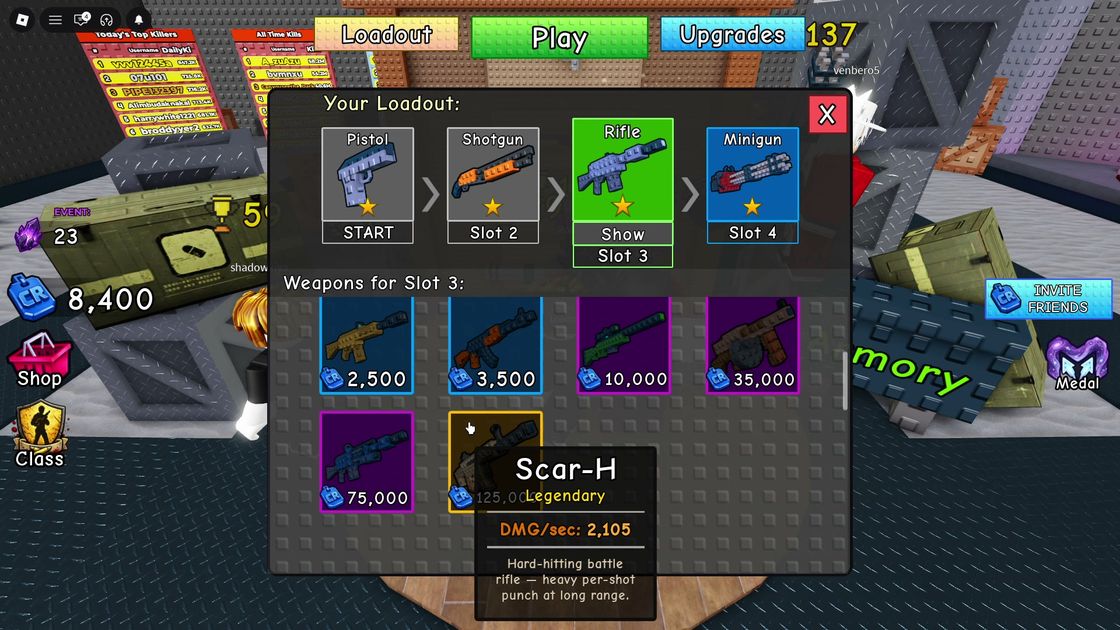
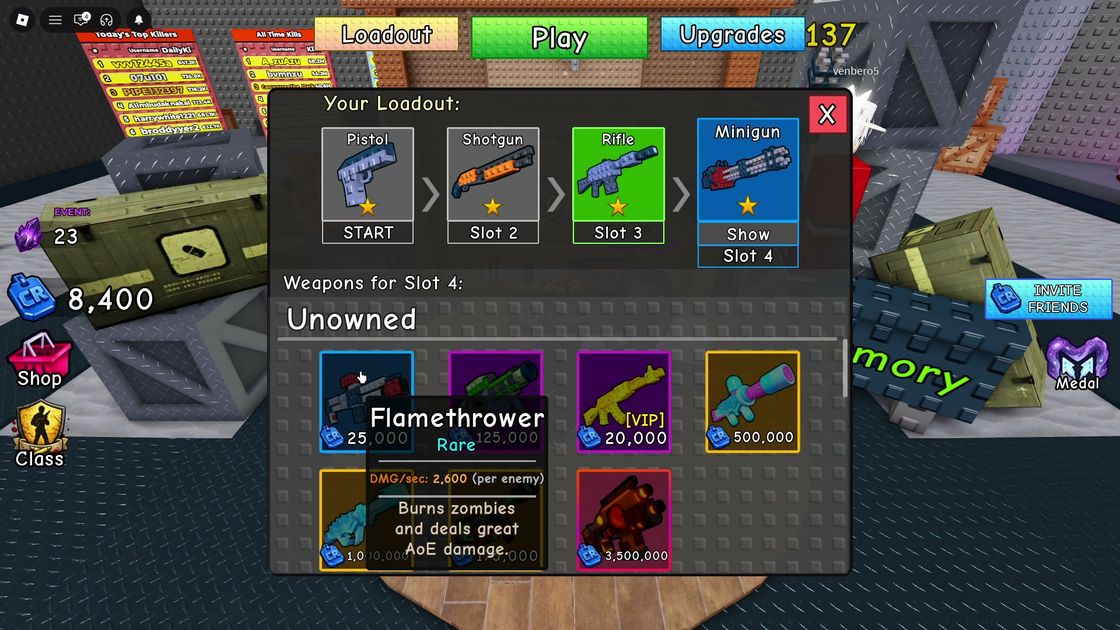
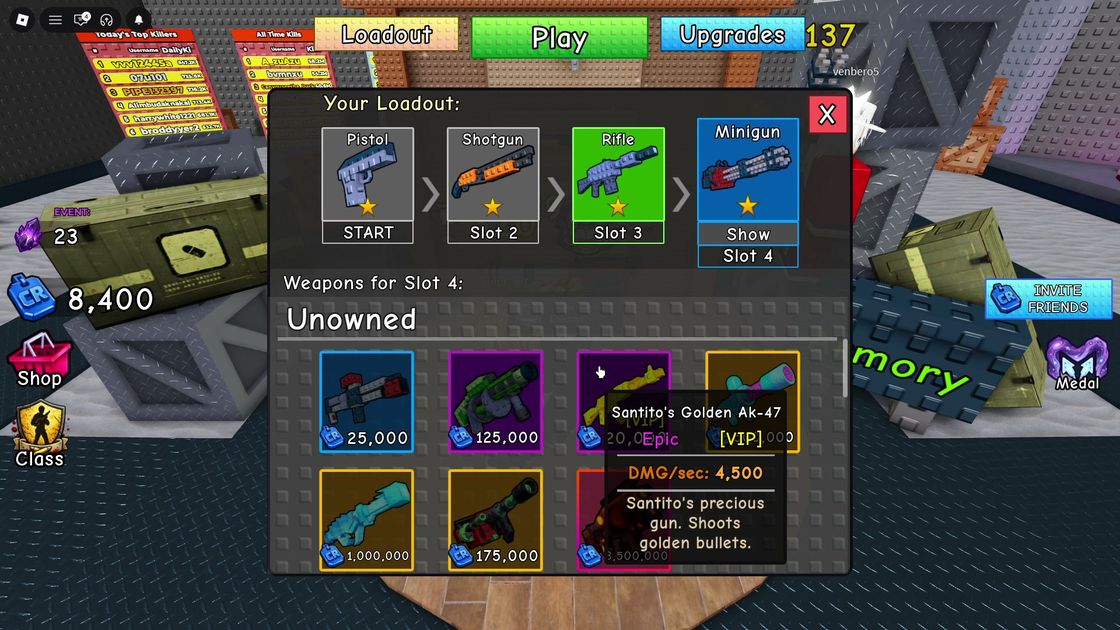
Every gun levels up by stars
On top of buying there is a second progression layer: in a separate Upgrades tab any owned weapon improves by stars — DMG/sec, per-shot damage and fire rate all rise. This extends each gun's value and gives crystals somewhere to sink.
10 classes: role, rarity, price, abilities
Classes are the persistent meta: bought with Credits, kept between runs, three abilities each. This is the axis players return to the hub for, and the main source of build variety (weapons scale linearly, the class defines the role).
| Class | Rarity | Role | Price, CR | Abilities |
|---|---|---|---|---|
| Survivor | Common | Balanced | free | Barricade · Auto Turret · Landmine |
| Medic | Uncommon | Support | 10,000 | Stim Shot · Mending Tower · Healing Station |
| Marksman | Uncommon | Offense | 15,000 | Frag Grenade · Deadeye · Sonar Ping |
| Engineer | Rare | Defense | 20,000 | Flame Turret · Auto Turret · Steel Barricade |
| Ninja | Rare | Offense | 25,000 | Cloak · Blade Fury · Shuriken |
| Demolitionist | Epic | Offense | 50,000 | Stim Shot · Shockwave Bomb · Molotov |
| Tactician | Epic | Defense | 75,000 | Vanguard Turret · Spikes · Steel Barricade |
| Bastion | Legendary | Defense | 200,000 | Shelter · Laser Turret · Drone |
| Necromancer | Legendary | Offense | 250,000 | Soul Harvester · Raise Undead · Death Nova |
| Overclocker | Legendary | Support | 250,000 | Beacon · Timewarp · Overcharge Pulse |
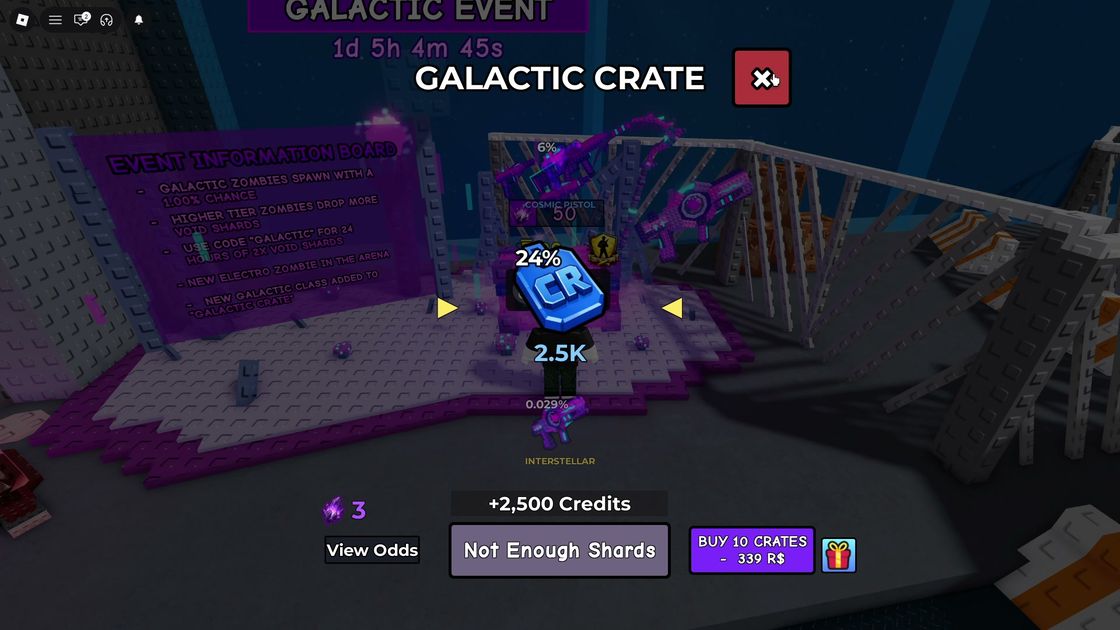
| Celestial (event) | Event | Cosmic AoE | Galactic Crate 0.25% | Starfall · Black Hole · Space Bomb |
All prices and abilities are read off Class Shop cards. Celestial is the only class not bought with Credits but pulled from a Galactic Crate (0.25% chance): the event's FOMO carrot.
Class catalog — Class Shop cards
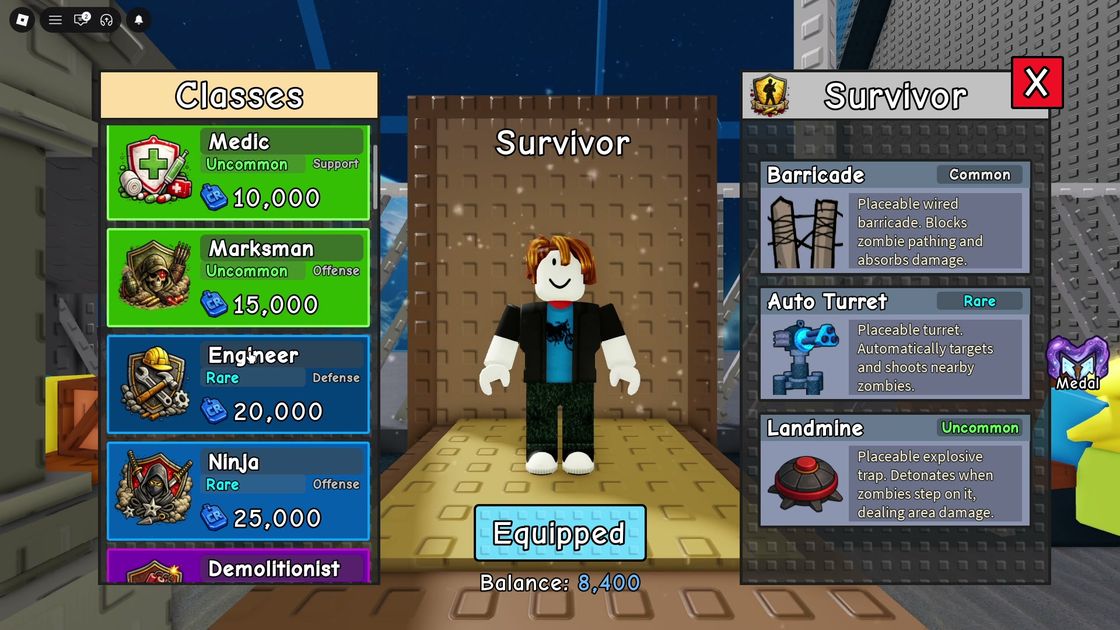
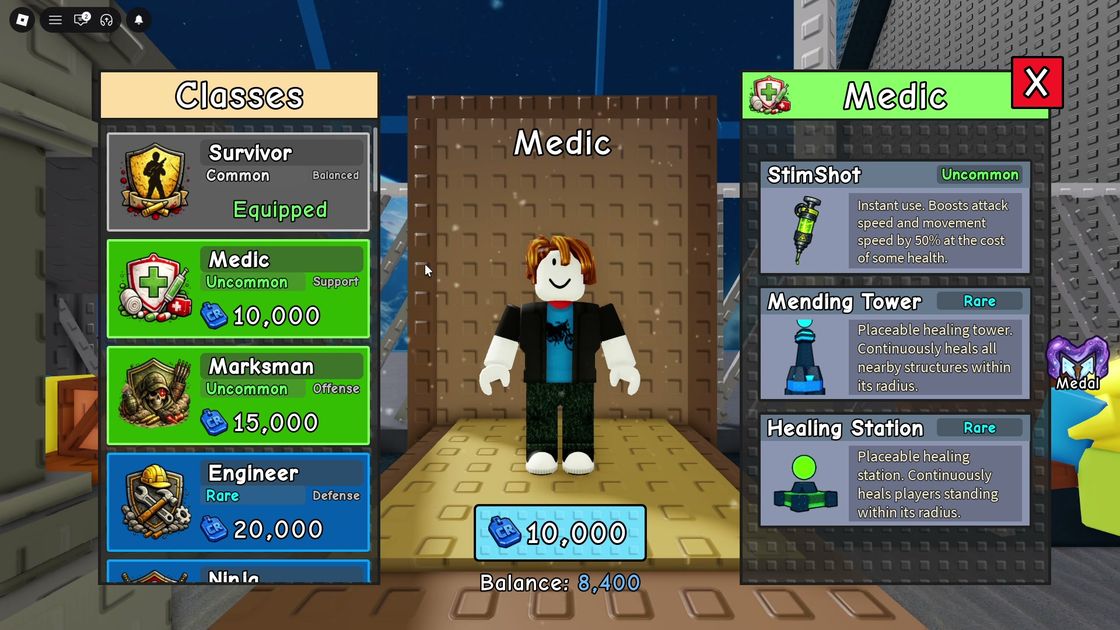
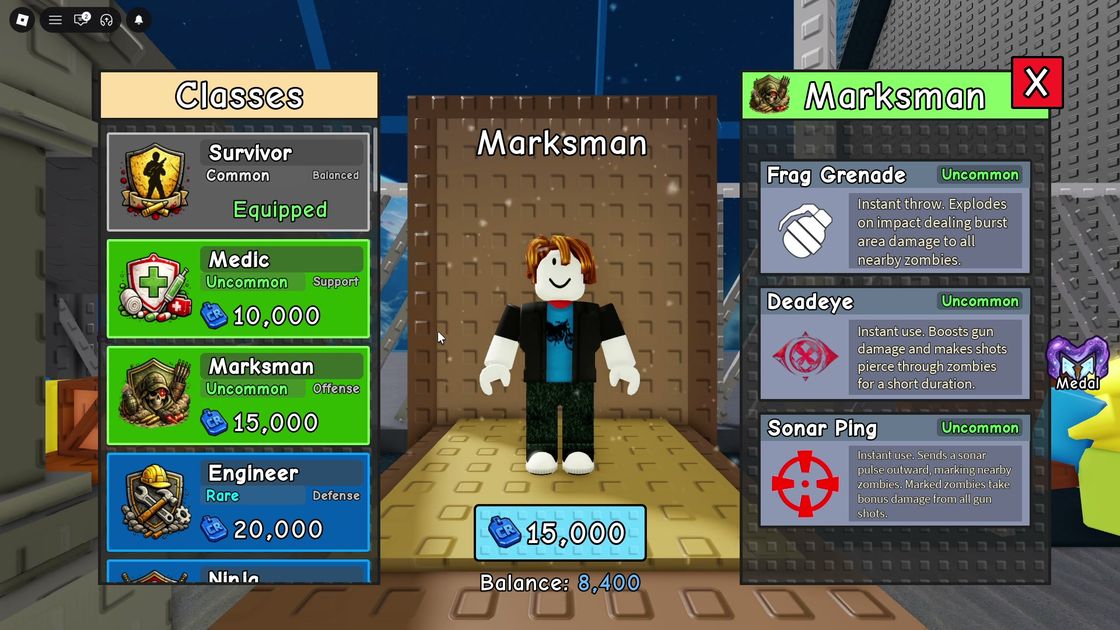
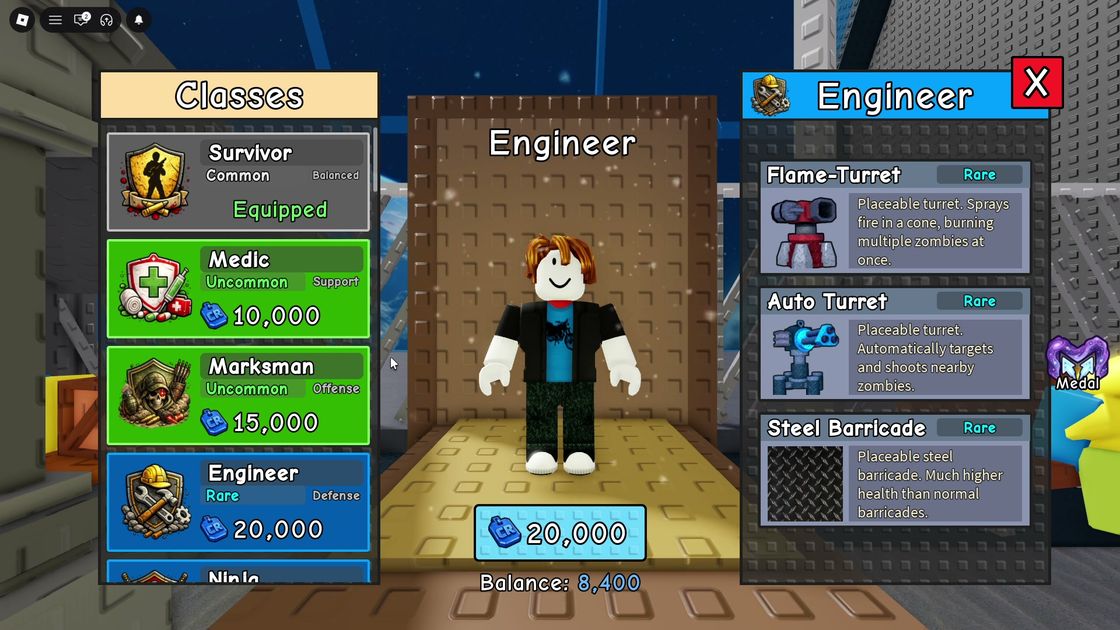
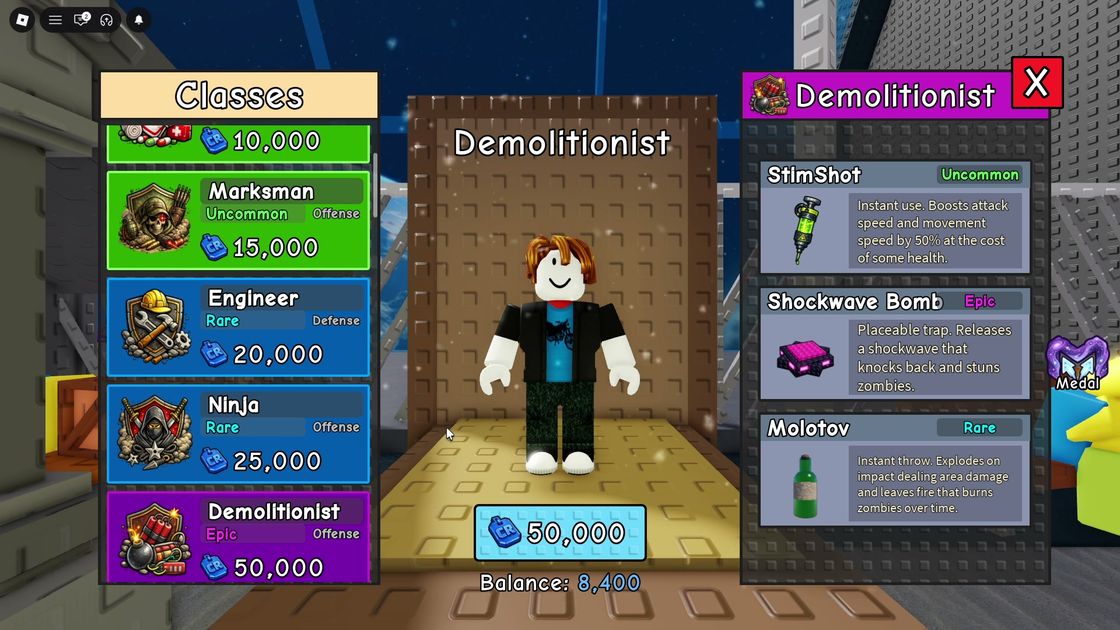
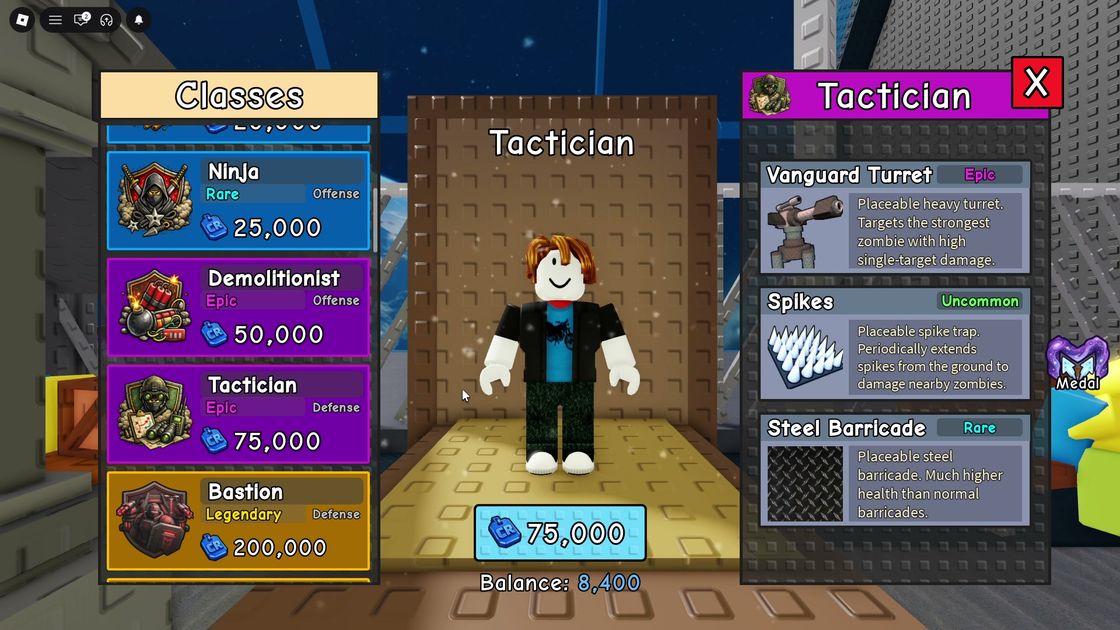
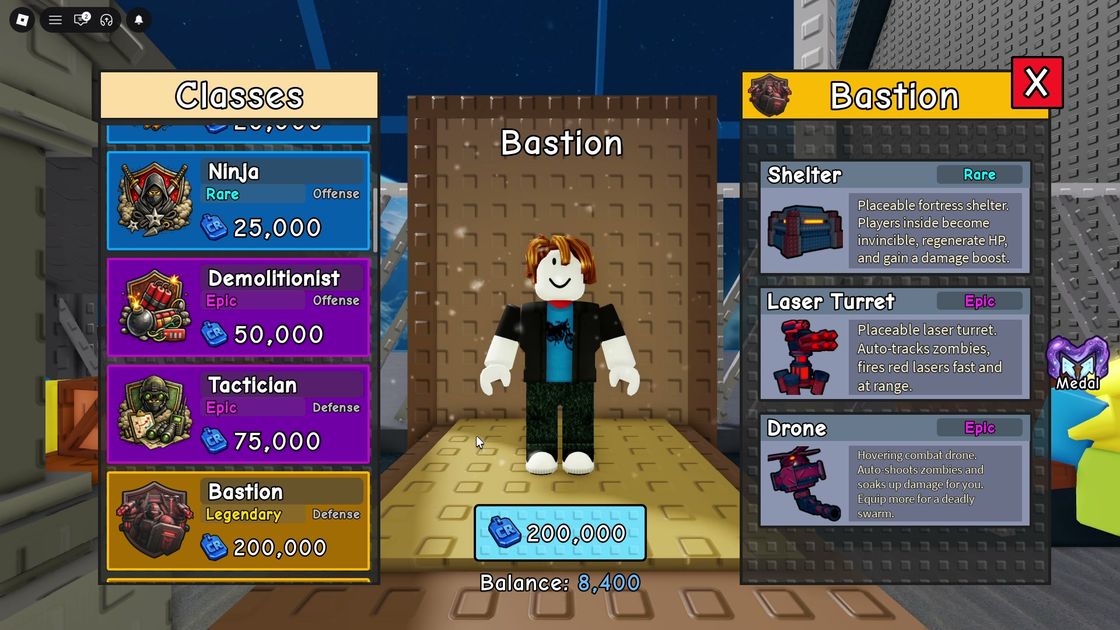
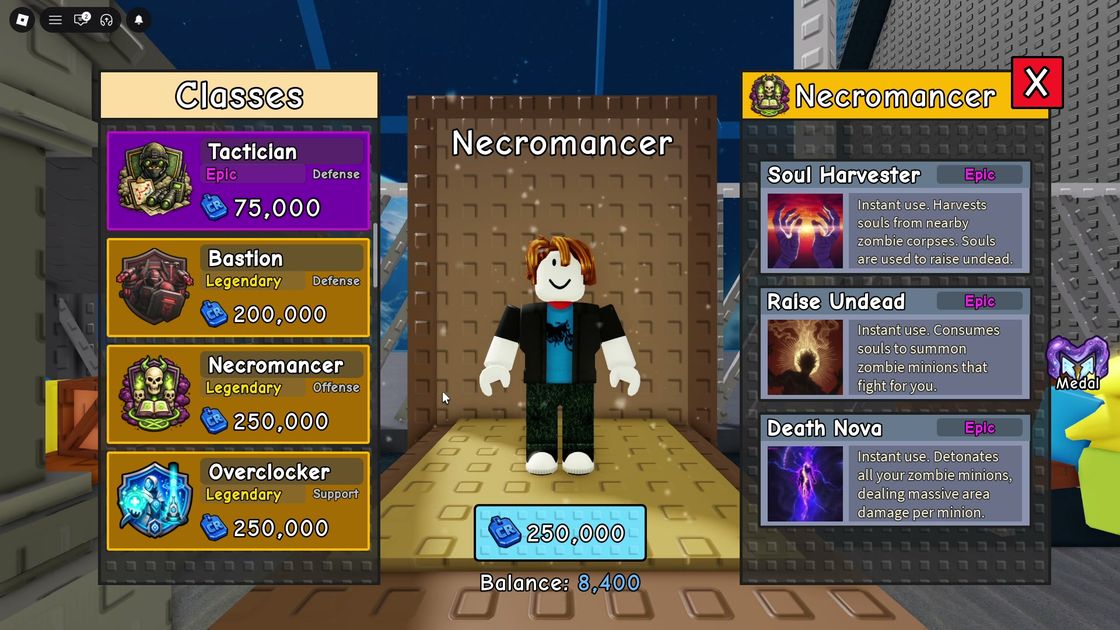
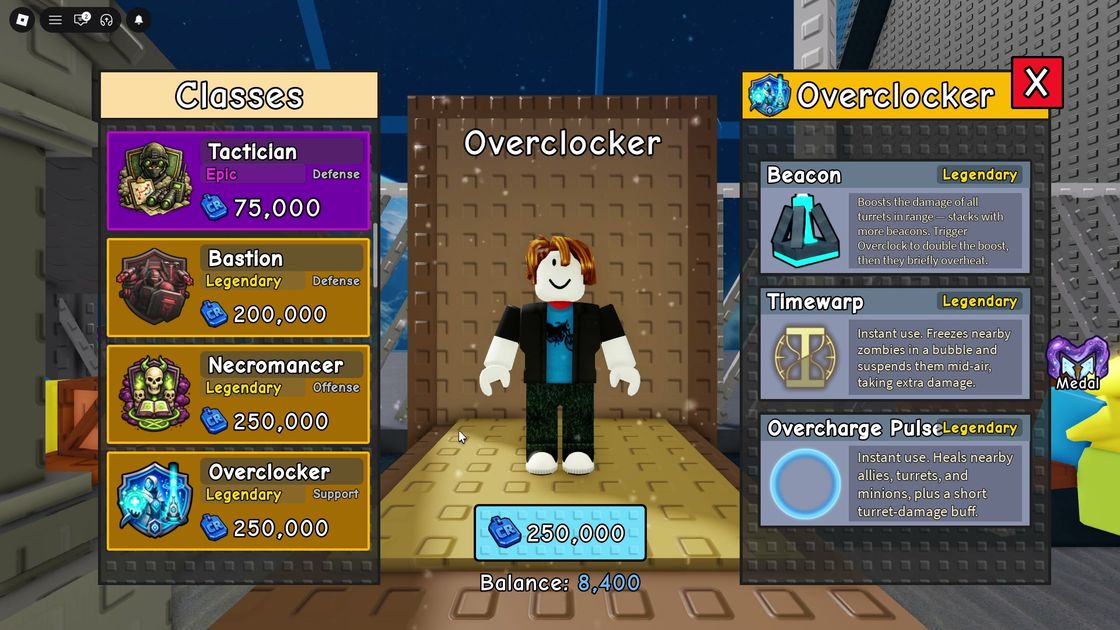
Ninja (Rare, 25,000, Offense) is in the roster, but no standalone card was captured — so the catalog shows the 9 classes with confirmed cards.
Economy, monetization and retention
How one currency does two jobs, why the shop doesn't dent the like-rate, and what brings the player back tomorrow.
One currency, two loops
A two-layer economy: what resets each run, and what accrues toward the meta. This structure is exactly what turns one run into a session — every wave both resets and advances a long-term goal.
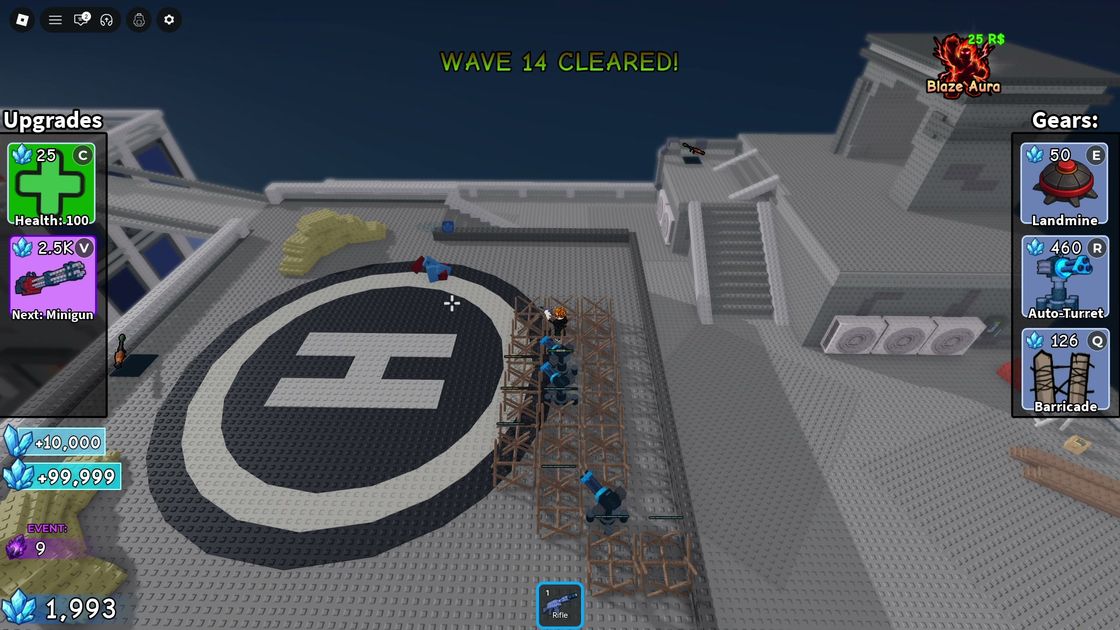
Drop from kills and survival. Spent in combat on weapon upgrades, turrets, barricades, mines, 100 HP for 25. Reset every run; gear price rises with each purchase. Key nuance: crystals can be topped up for Robux mid-combat (the +10,000 / +99,999 HUD buttons) — unlike Credits, which are only earned.
Awarded at the end of a run and accrue across sessions. Spent in the hub on classes (10k–250k) and weapon ownership (250 → 3.5M), plus permanent damage/DPS/fire-rate upgrades.
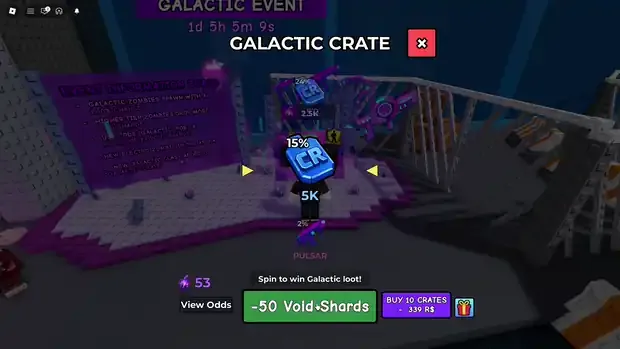
Drop from Galactic zombies (~1% spawn), persistent. The only use is the Galactic Crate (50 shards a spin). Earned, not bought with Robux.
Sells acceleration, convenience and chance — but never gates the fun
Monetization is layered but F2P-friendly: earn multipliers (gamepasses), a direct Robux top-up of the in-run currency, crate gacha, and cosmetics. No layer locks the core content — which is why the like-rate holds at 95.6% even with mass conversion (RPU 111.6 is broad monetization, not deep whaling).
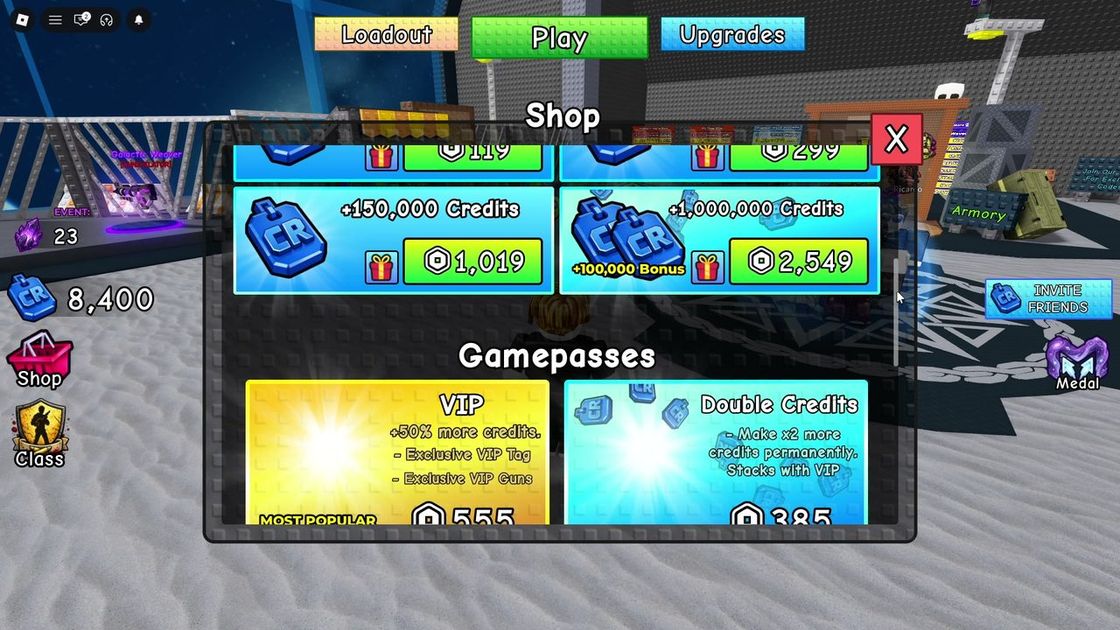
| Item | Type | Price, R$ |
|---|---|---|
| VIP (most popular) | gamepass | 555 |
| Double Credits | gamepass | 385 |
| Crystals +10,000 (in combat) | currency top-up | Robux* |
| Crystals +99,999 (in combat) | currency top-up | Robux* |
| +150,000 Credits | bundle | 1,019 |
| +1,000,000 Credits (+100k bonus) | bundle | 2,549 |
| Buy 10 Galactic Crates | dev product | 339 |
| Aura (cosmetic, e.g. Blaze) | cosmetic | ~25 |
| Plasma Gun / Galactic Weaver (weapon) | dev product | ~159 / ~479 |
- The crystal top-up price isn't printed on the button and isn't given in public sources (in-game only); the fact of a Robux purchase is confirmed from the combat HUD.
- VIP · 555 R$** — +50% Credits, a VIP tag, exclusive VIP weapons (USP-S, MP5). Marked "MOST POPULAR" — the primary conversion driver.
- Double Credits · 385 R$ — ×2 Credits permanently, stacks with VIP** → a whale path of ≈×3 meta earnings.
- Crystals for Robux · in combat — The +10,000 / +99,999 top-ups convert impatience directly: buy currency → an instant maxed build in the current run. The power is temporary** (crystals reset at run's end), so it's convenience, not permanent pay-to-win — which is exactly why it doesn't dent the like-rate.
Per-purchase verdict
| Purchase | Price | What it gives | Verdict |
|---|---|---|---|
| Double Credits | 385 R$ | ×2 earnings forever, stacks | buy best long-run ROI |
| VIP | 555 R$ | +50% + VIP weapons + tag | buy if you play regularly |
| Crystals +10,000 / +99,999 | Robux | an instant maxed build in the current run | optional convenience, power is temporary |
| +1M Credits bundle | 2,549 R$ | a one-off jump to expensive classes/weapons | optional a shortcut, not power |
| Buy 10 Crates | 339 R$ | 10 gacha spins (chance at event loot) | caution pure chance |
Price provenance. Gamepasses (555 / 385) and Credit bundles are read off the in-game Shop screen. Trackers (rolimons) listed the same gamepasses at 449 / 649 — prices were revised over the game's life, and the on-screen figure is authoritative. Crystal top-ups and cosmetic auras are confirmed from the combat HUD; their exact price is in-game only. Plasma Gun / Galactic Weaver are from the wiki (medium confidence).
Layers of return on top of the loop
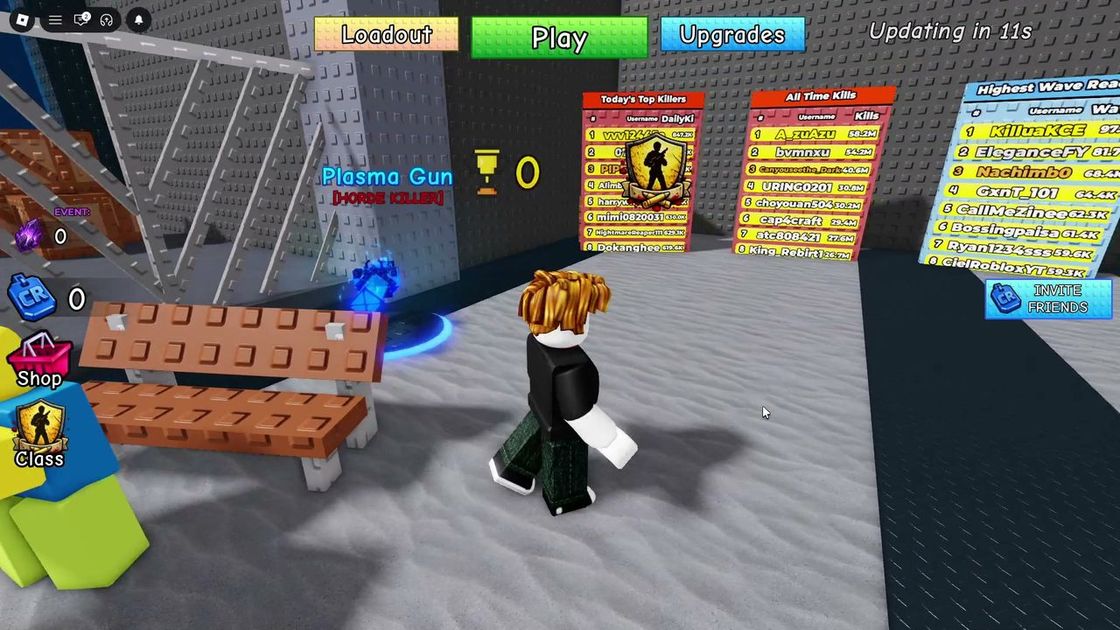
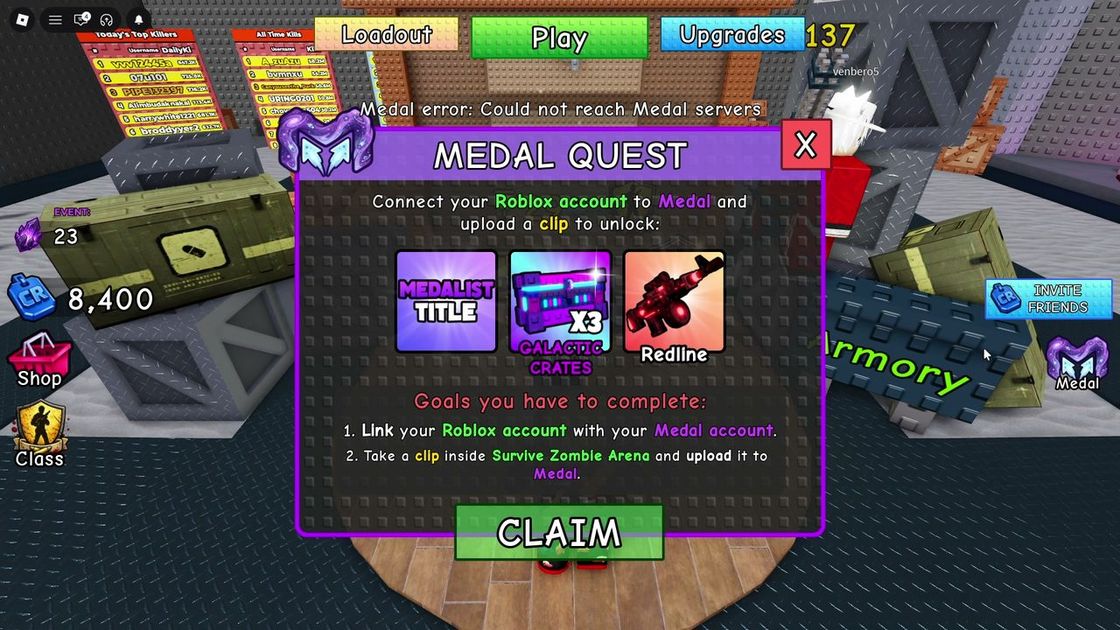
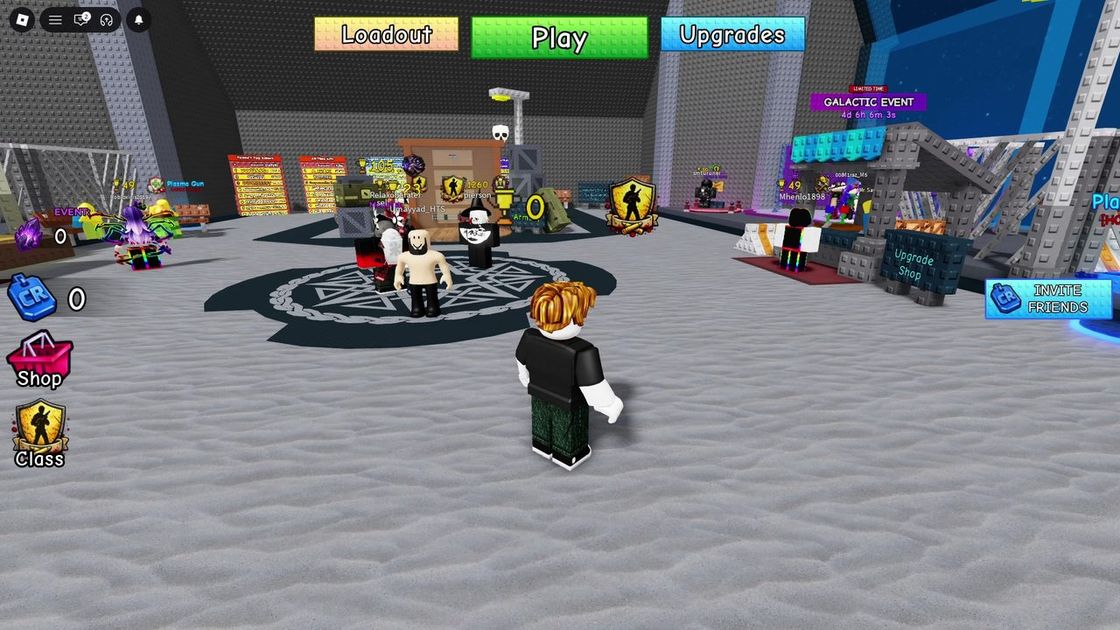
Retention is assembled across three horizons — minute, session and day — and backed by live-ops the old zombie archetypes lack: events with their own economy, codes, referral, and constant community votes on future content.
Wave pressure, buy-phase decisions, the Auto-Skip vote for tempo, the high-wave chase right now.
Leaderboards (Top Killers, All-Time Kills, Highest Wave), persistent classes and weapons, boss beats (~30, "Yetis" in the 60s), referral and codes.
Themed events (Galactic → the Atlantis map, Void Shards, crate gacha, an exclusive class), votes on future maps, a ~128k-member Discord.
Live-ops timeline
Readability vs noise
The UX strength is instant readability of the idea and of threats; the weakness is the density of the buy menu and the visual noise of late waves, where enemy silhouettes risk drowning in effects.
A one-line idea, instant combat without a tutorial, color-coded threat tiers, HP auto-regen, fire-sound falloff as the camera pulls away, small parties without pile-ups, the space-pod start ritual.
Buy-menu density (weapons + gear + classes at once); late-wave visual noise vs elite/boss readability; pathfinding-bug ledges that enable AFK farming (an economy-integrity risk); awkward HP display; first-person hides the full horde.
What to transfer, what to build, and the final call
The practical layer: a pattern-transfer matrix, prototype direction, a scorecard by dimension and the final verdict.
Which patterns to adapt
Mechanics broken into decisions: what to take as is (USE), what to adapt to your context (ADAPT), what to study before adopting (STUDY), and what to avoid (AVOID).
| Pattern | Call | Why | Fit |
|---|---|---|---|
| In-run buy phase between waves (kill-earned crystals → weapons + gear) | USE | the compounding loop's core; repeatable decisions and a felt power spike | prototype spine |
| Dual economy: in-run reset + same currency funds permanent unlocks | USE | each run stays fresh yet always advances a meta goal | high |
| Free power weapon + steep ladder to a best-in-slot | ADAPT | instant fun for newcomers, a long chase for veterans | high |
| Stacking earn-multiplier monetization (VIP + Double), never gate fun | USE | lifts RPU while protecting the like-rate | high |
| Direct Robux top-up of the in-run currency (convenience, not a gate) | STUDY | converts impatience into revenue without locking content; power is temporary — the currency resets each run | medium |
| Class roster as persistent meta (10 roles) | ADAPT | role variety + a long unlock chase; scope the count | phase 2 |
| Themed event with its own map/currency/crate/class | ADAPT | manufactured freshness + FOMO | phase 2 |
| 25-player co-op + referral | USE | forgiving and viral; an edge over 6-player archetypes | high |
| Color-coded threat tiers + standout elite silhouettes | USE | readability under chaos; cheap and effective | high |
| Reload as a vulnerability window | STUDY | adds skill texture to a casual loop; tune so it doesn't frustrate | medium |
| Mid-run wave sameness | AVOID | the content-depth ceiling — "becomes repetitive over time" | anti-pattern |
| Pathing-bug ledges for AFK farming | AVOID | breaks economy integrity | anti-pattern |
| Perf drops in dense mobs | AVOID | breaks late gameplay — needs pooling / different logic | anti-pattern |
What to build first
A minimal vertical slice that tests the game's central hypothesis — whether a power spike is felt in one short run and whether you want to start a second.
A co-op arena of 3–5 waves with a kill → Credits → buy-phase loop and one visible power spike (a free strong weapon + a 3-tier ladder + star upgrades). 2–3 class deployables (turret, barricade, heal), one persistent hook (a class unlock), color-coded enemy tiers (standard / fast / tank + one elite).
Events, crate gacha, the full 10-class roster, Nightmare mode, leaderboards. These are layers on top of a proven core, not the core itself.
Is a power spike felt within ~10 minutes? Do testers start a second run voluntarily? Is the buy phase legible in combat? Do enemy tiers read at a glance in a dense wave?
By key dimension
A summary score of the game's systems on a ten-point scale. Strongest of all — the hook and core loop; weakest — content depth, which is precisely what to close in your own project.
The co-op wave-survival benchmark to copy
The bottom line: this is the mass-hit archetype worth studying as a reference — and its main risk (content depth and performance) points to exactly where your own project can win.
Survive Zombie Arena is a co-op arena readable in one line that delivers a genuine power spike inside a single ~13-minute run and monetizes acceleration, not fun, wrapped in modern live-ops the old archetypes lack. The bundle — buy-phase loop + dual economy + free power weapon with a ladder and star upgrades + stacking multipliers + 25-player co-op — is worth copying as the foundation of a new project.
The game's ceiling is drawn objectively by its own structure: wave content repeats in mid-run and dense hordes cause performance drops. Those are exactly the points where a clone can beat the original — through wave variety and performance.
- Buy-phase loop between waves (crystals → weapons + gear)
- Dual economy: in-run reset + meta on the same currency
- Free power weapon + a steep ladder + star upgrades
- Stacking multiplier gamepasses that don't gate the core
- 25-player co-op + referral
- Color-coded threats and standout elite silhouettes
- Adapt: the class roster as meta and a FOMO event with its own currency/crate/class
- Avoid: gating core fun behind Robux
- Avoid: wave sameness and perf freezes in a dense horde
Sources and data confidence
Methodology transparency: what comes from where and how reliably. Numbers from in-game screens are authoritative; where the source is a tracker, a fan wiki or the community, it is marked, and the unconfirmed is named unconfirmed.
Core loop, economy, gamepass and weapon prices, the class roster and abilities, cadence and patch history — read off in-game screens and/or cross-confirmed by multiple sources (rolimons, op.gg, the official update-log).
Revenue ~R$2.5M/day is a single-tracker model, not independently confirmed. Enemy HP is published nowhere (in-game only). Gumdrop Blaster / Arctic Striker DPS, exact Nightmare scaling, boss nicknames and the "wave 127" record are fan-wiki/community and marked unverified. The VOLATILE enemy is announced but not live.
Sources & credits
Survive Zombie Arena · design teardown & reference for your own project · 2026