Zombie Rush Survival
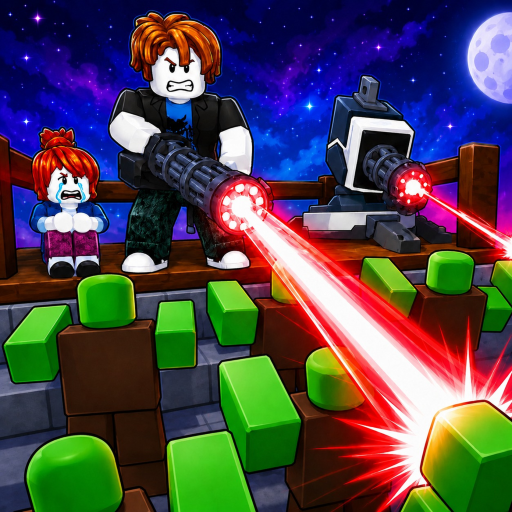
A co-op PvE wave-survival game for servers of up to 30 players with a full base-defense layer: on top of buying weapons, the team places turrets, barricades and traps, holding one shared arena against an endlessly escalating horde. The escalation never ends — the score is the number of waves you survive. A hybrid of co-op shooter and tower-defense on top of the classic "hold off the wave."
A complete design teardown of Zombie Rush Survival as a reference for a clone: core loop, economy, weapons, classes, defensive deployables, monetization and retention. Every number is pulled from in-game screens, and each system is broken down into decisions that can be ported into your own project. Identity metrics (likes, visits, peak concurrent, game-pass prices) are from Roblox's public pages.
Why this game is a polished niche breakout
Three takeaways that shape the teardown, and the promise the game sells itself with in a single line.
What makes this game interesting
Three design observations set the tone for the whole teardown: the turret-defense meta as the real core, light and fair monetization, and a level of polish rare for a fresh breakout.
Defense wins the fight, not the weapon. In a single 47-wave run, turrets and deployables scored 2,946 of 3,216 kills — versus just 3 gun kills and 267 melee kills. The core meta is to build out the position with turrets and finish off with a bat/club, not to upgrade the gun.
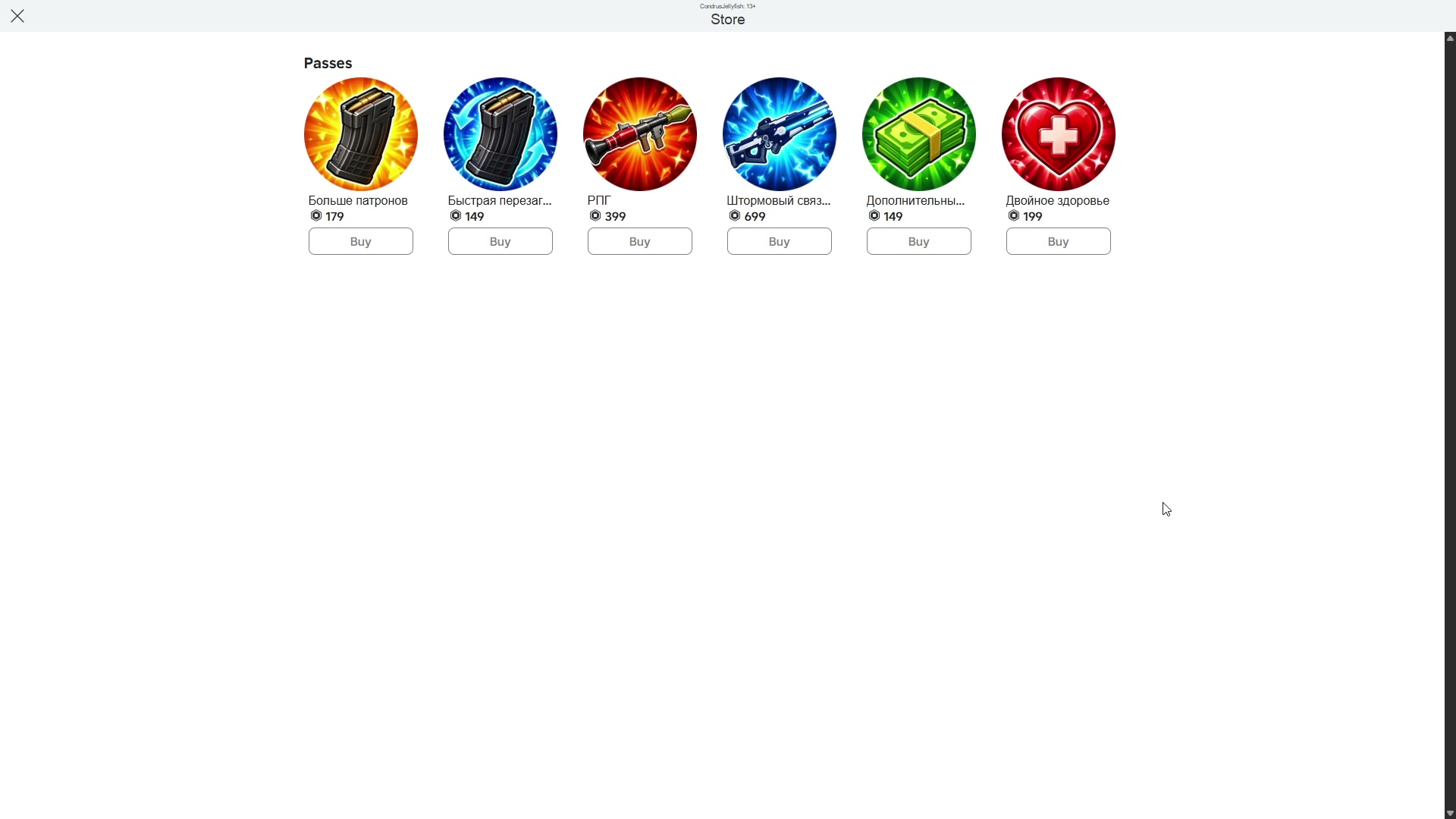
6 game passes priced 149–699 R$ (a 1,774 R$ catalog): convenience, survivability and two exclusive guns — with no core-loop gate. Shooting, building defense and pushing past wave 40 are all free. That coexists with 96.95% positive.
6 classes, 6 weapon tiers, its own sound and tracers on every gun. Menu buttons are 3D weapon models, not flat icons. Undead Dev. landed a second hit on a familiar genre: 96.95% likes, peak 16 570 in ~2 months.
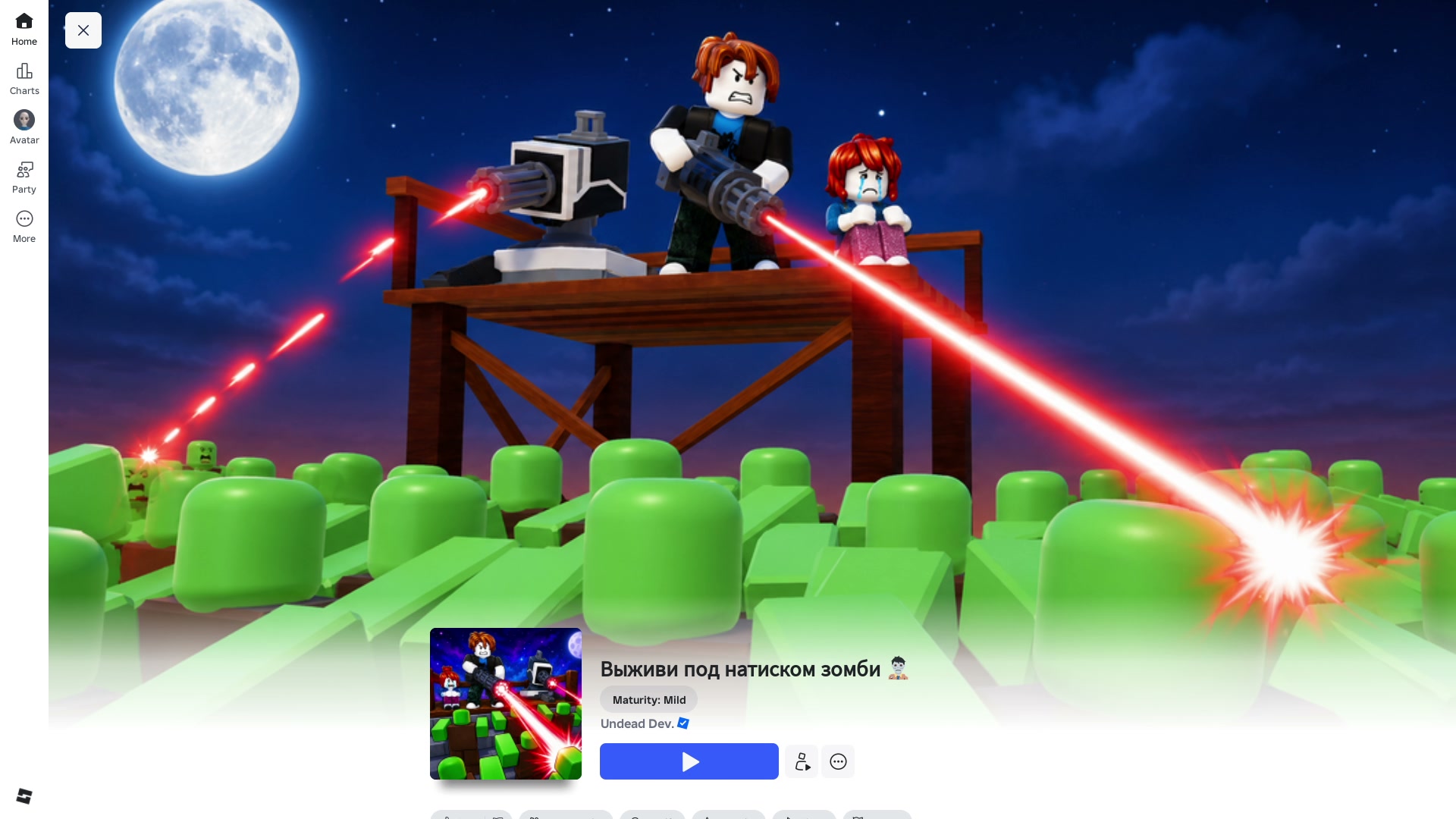
"Fight endless waves… build defenses to survive with your team"
The store promise is the whole pitch, and it reads in a second: endless waves, upgrades, building defenses, co-op with your team. Genre, scale and mode all register instantly. Below are the vitals from Roblox's public pages.
Dossier
The loop, the first session, the arena and the feel of combat
The mechanical heart: a tight compounding loop, an instant entry, one shared arena, and gunplay that stays readable under chaos.
Wave → $ per kill → buy weapons and defense with $ → wave gets harder
A compounding loop: the team holds off the wave, every kill drips a flat payout of in-raid $ (~$10, not a growing multiplier), and between waves that money goes toward the next gun in the loadout and toward building defense — turrets, barricades, barrels. The key is the build phase: it is the placement of deployables that turns shooting into a game about resource allocation and position layout. This $ lives only inside the raid (in co-op, a shared wallet); the Zombux earned over a run are a separate meta-currency for upgrading in the lobby (see "Economy").
Core loop:
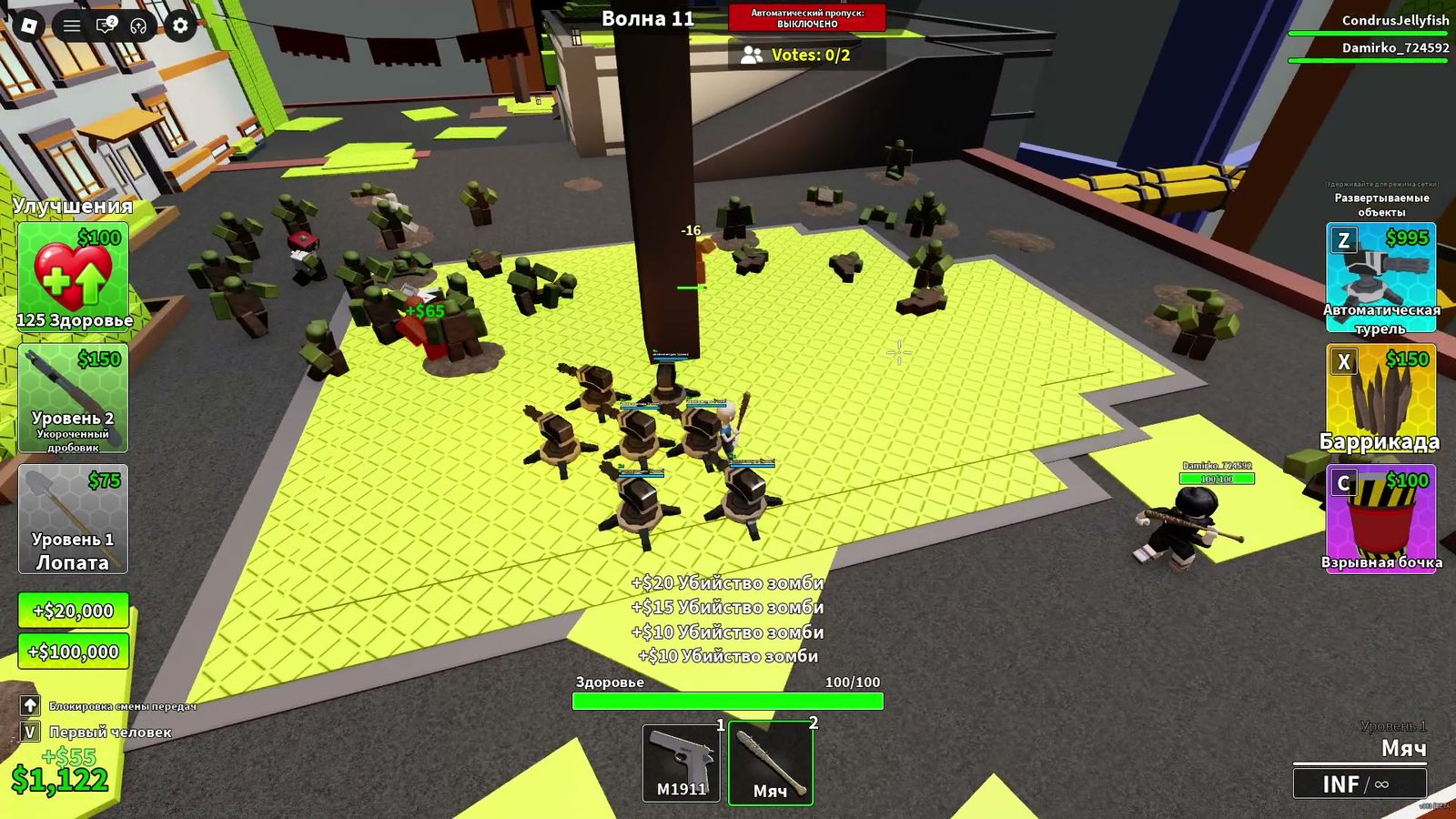
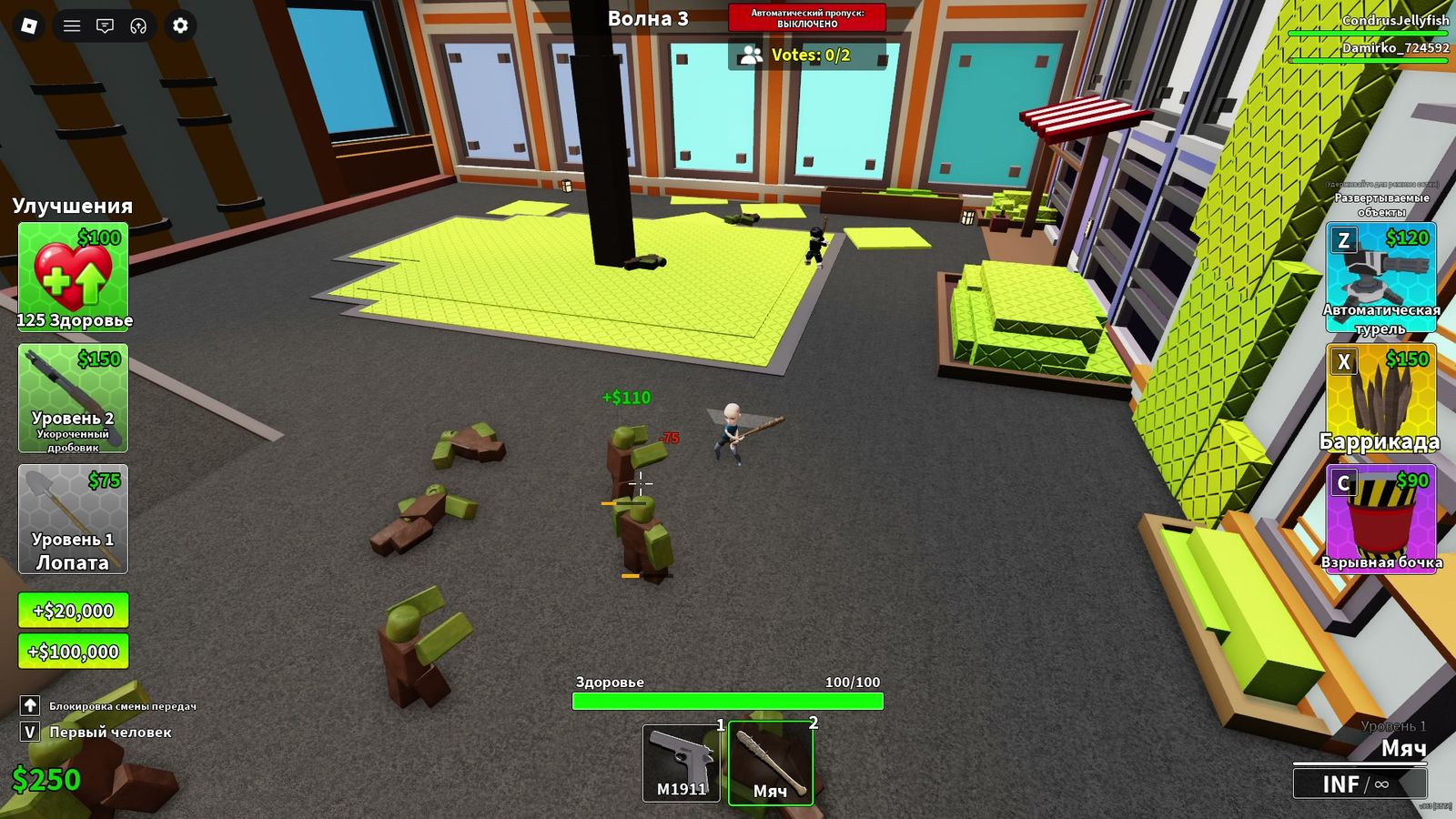
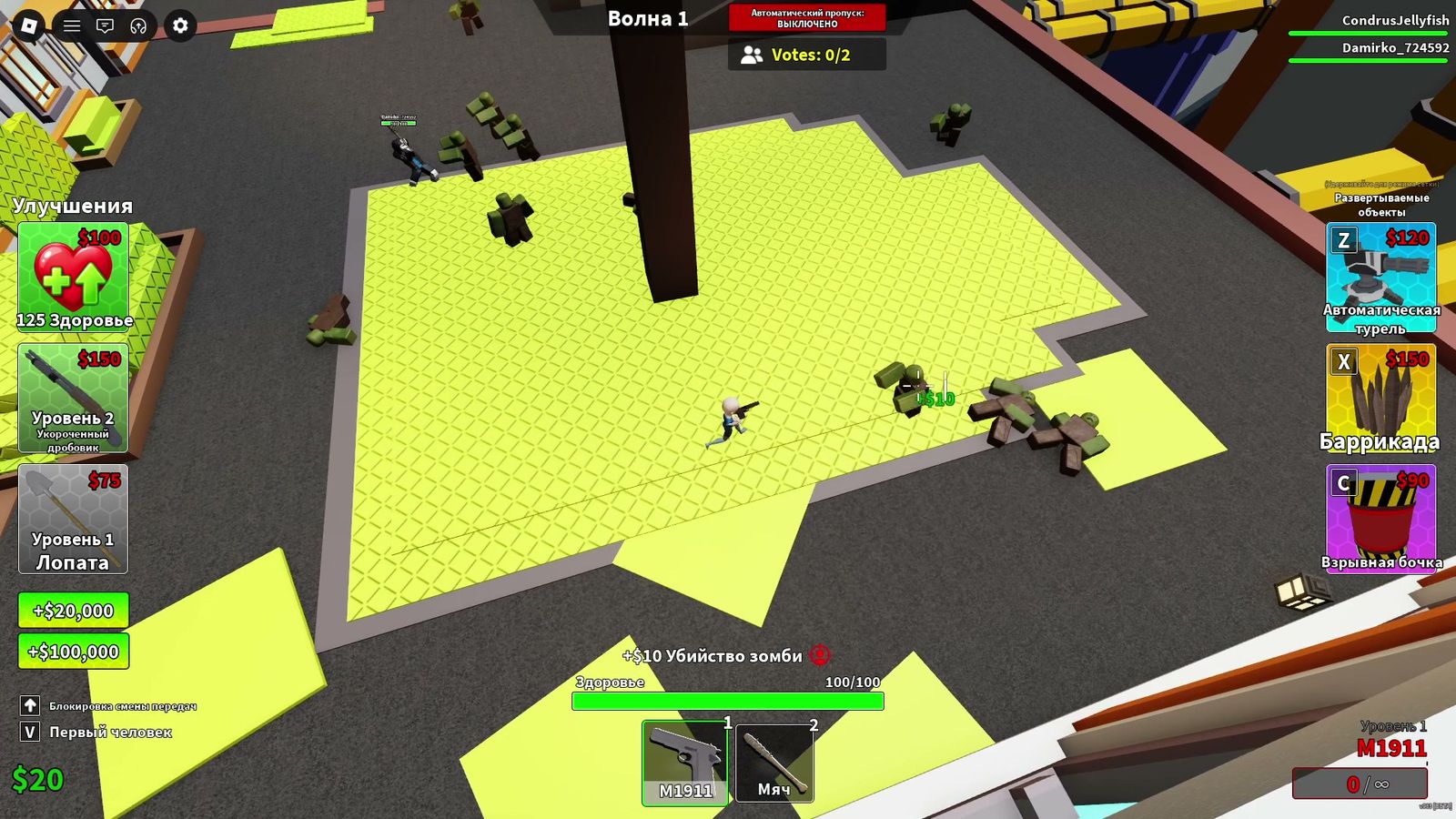
Number-go-up on every kill, visible growth of the defense within the run, an endless wave counter as a built-in goal. Co-op for up to 30 makes failure forgiving and planning a team affair.
The base-defense layer is a second kind of between-wave decision: not just "what to buy," but "where to place a turret, what to block an approach with." It is what sets the game apart from pure kite-and-shoot — and, as the kill-economy breakdown shows, it is defense that really wins the fight.
In co-op the in-raid $ is shared across the team: any kill tops up the shared raid wallet. This pushes toward role-splitting — someone farms kills, someone builds up defense on the shared money. Meta Zombux and star upgrades happen back in the lobby.
Zero tutorial, combat from the first second
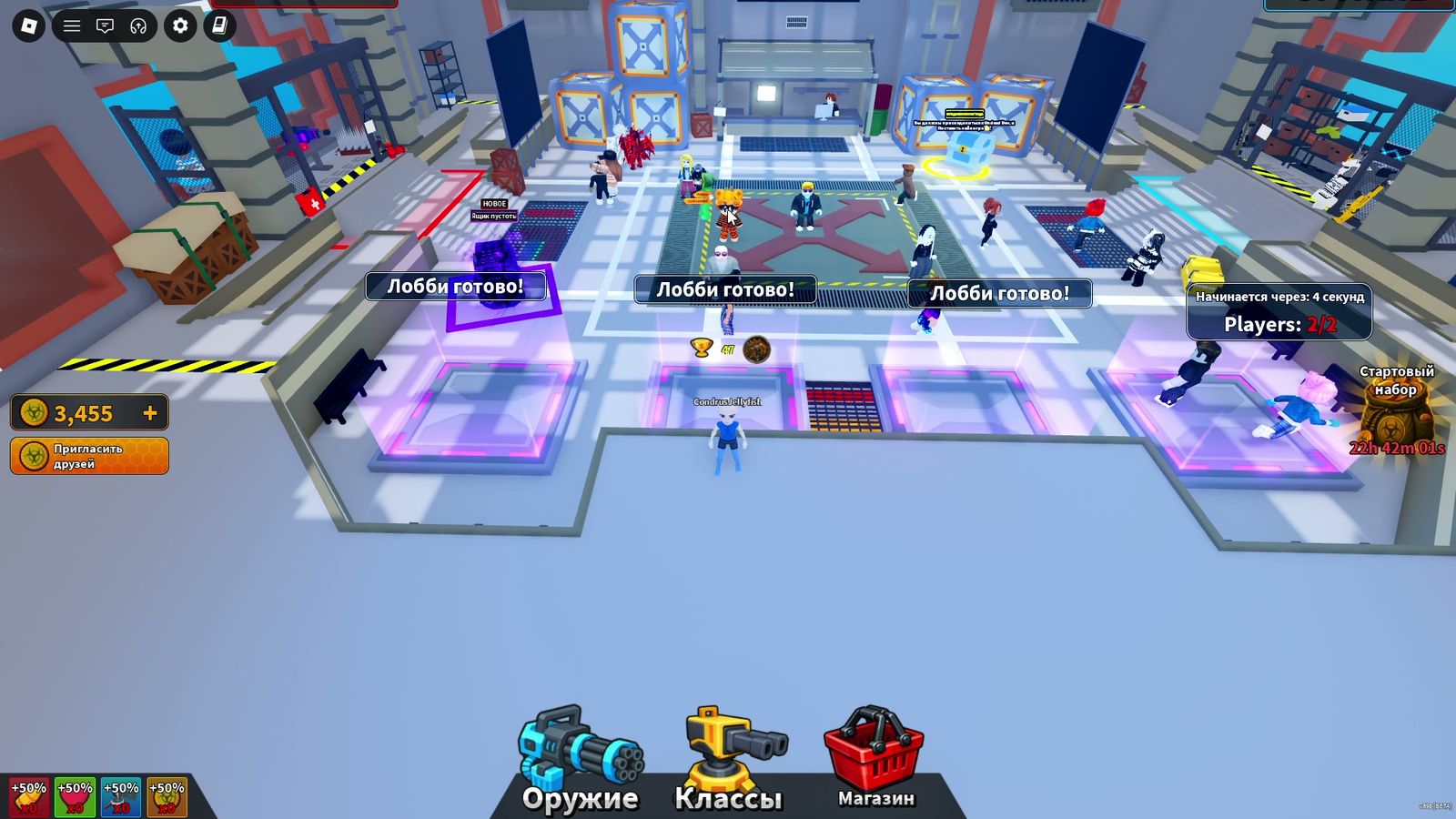
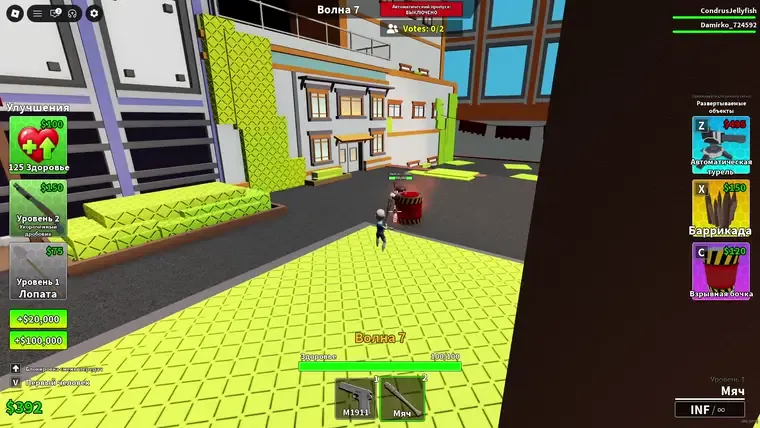
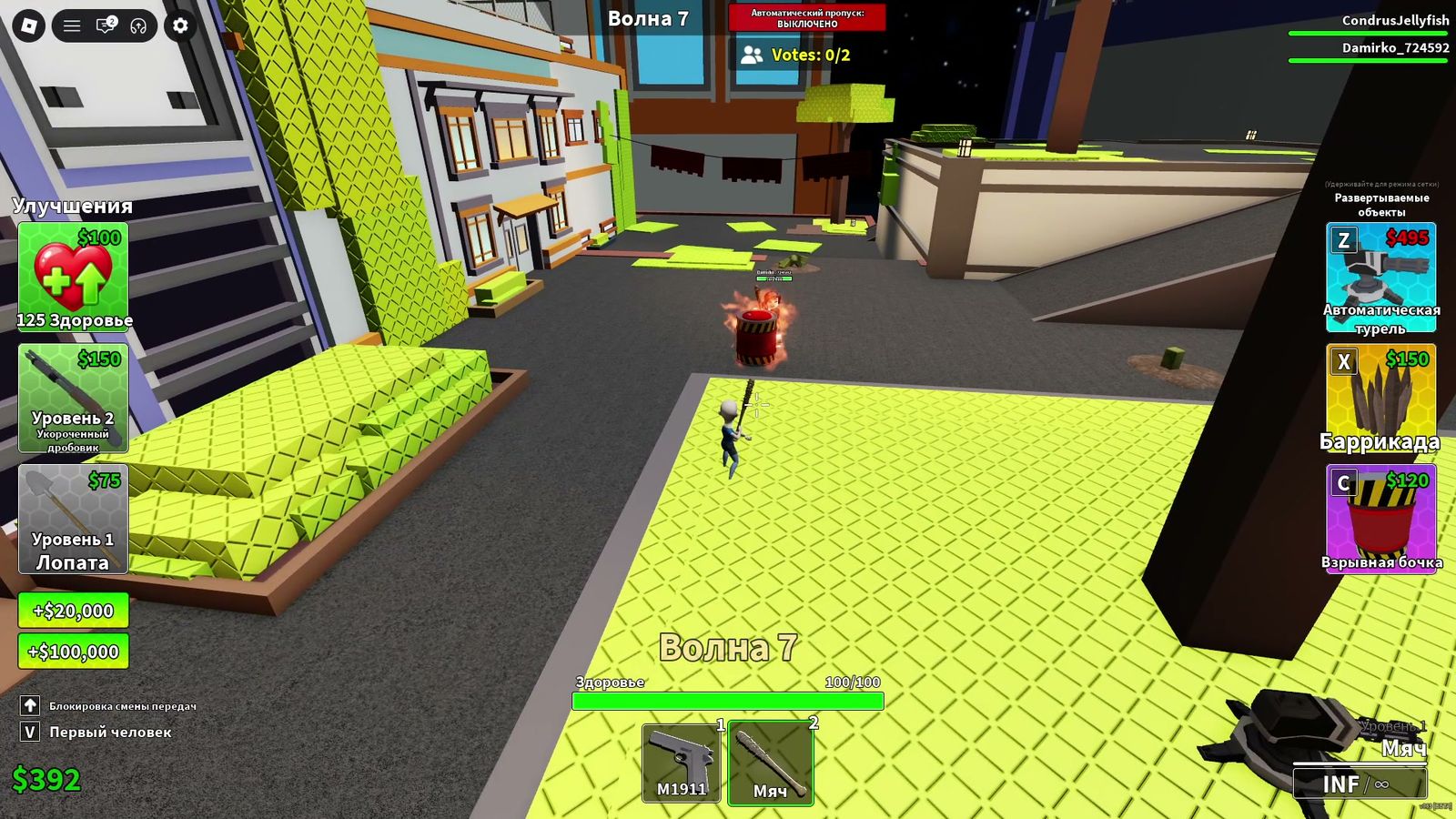
The game is free, and there is no formal tutorial: a new player lands straight in a lobby with pad zones and starts fighting with an M1911 and a bat, $20 in pocket. You learn the economy, buying and defense over the course of the first few waves. The barrier to entry is zero, and the promise matches the very first action.
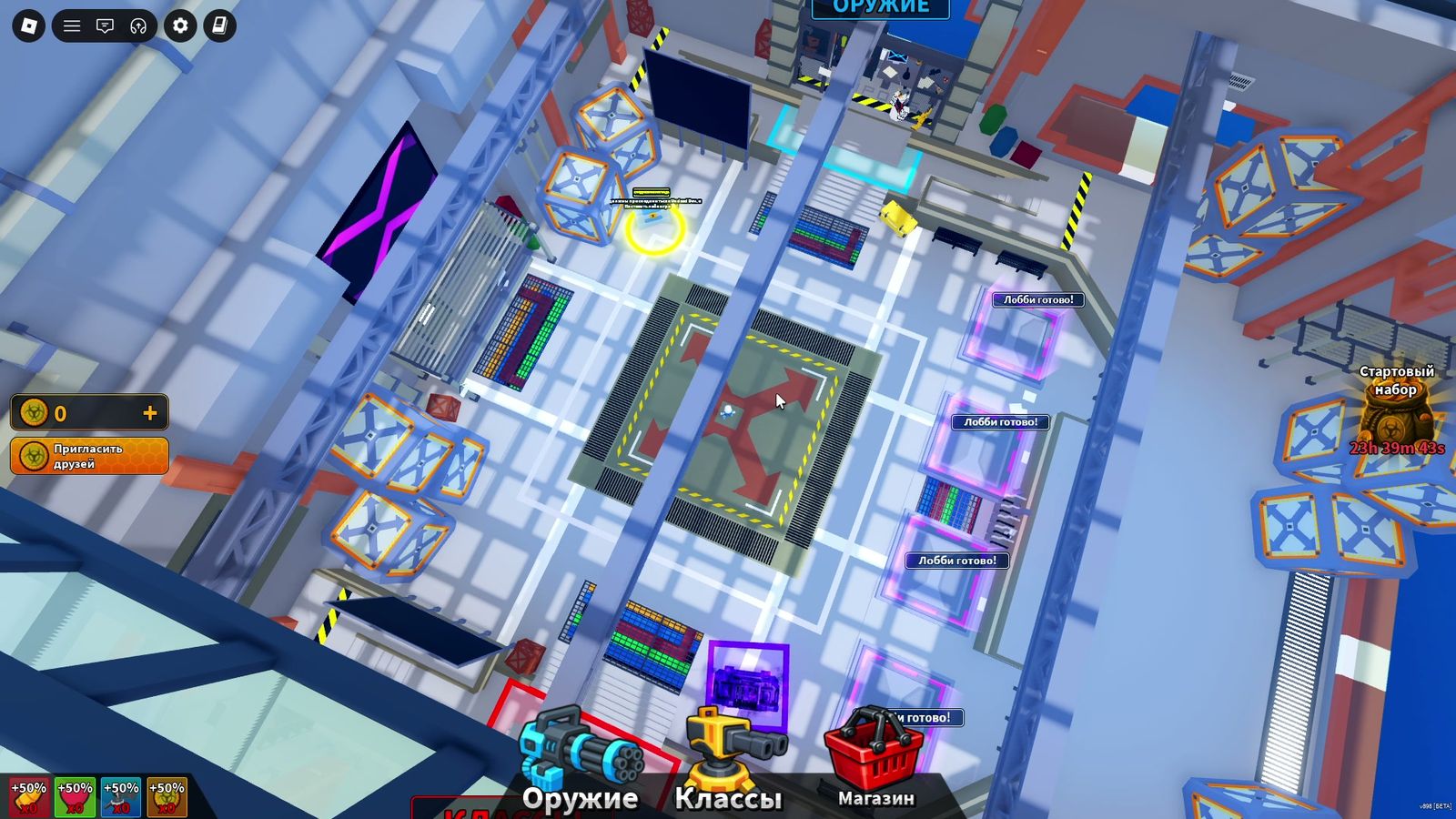
Zero price barrier, instant readability of the idea, immediate combat, and co-op for up to 30 that makes a newcomer's failure forgiving. The first reward — Zombux — comes as early as the opening wave.
The loop's logic — shoot → get Zombux → spend between waves — is grasped within a single wave. The lobby's pad zones replace a tutorial: the player discovers the systems by stepping onto them.
The density of between-wave decisions (what to buy + where to place defense) and the visual noise of big hordes. For a newcomer on a phone this is a pain point — a lot has to be figured out alone, without prompts.
One shared top-down arena around a central column
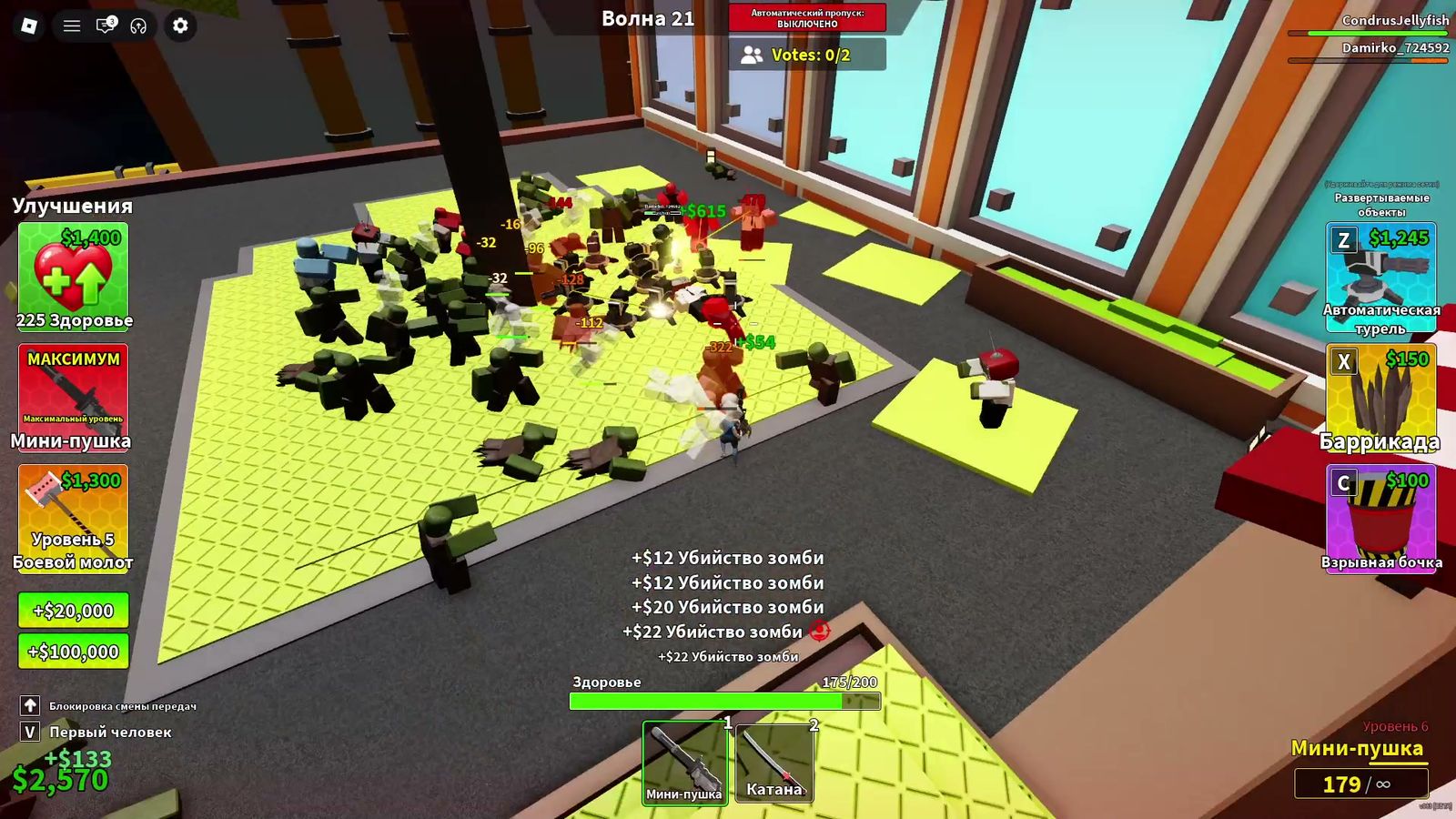
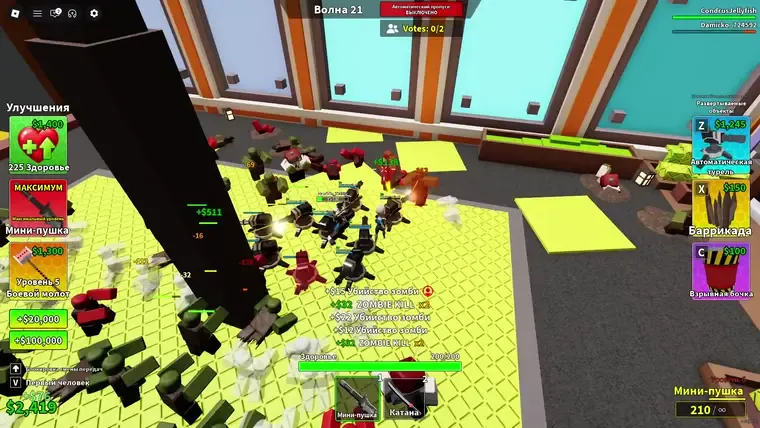
The game plays out on one shared arena seen from above: an open space around a central column/structure, with the horde spawning from all sides and closing on the team. The whole 30-player session unfolds here — the horde's scale grows with the number of players, not by swapping maps.
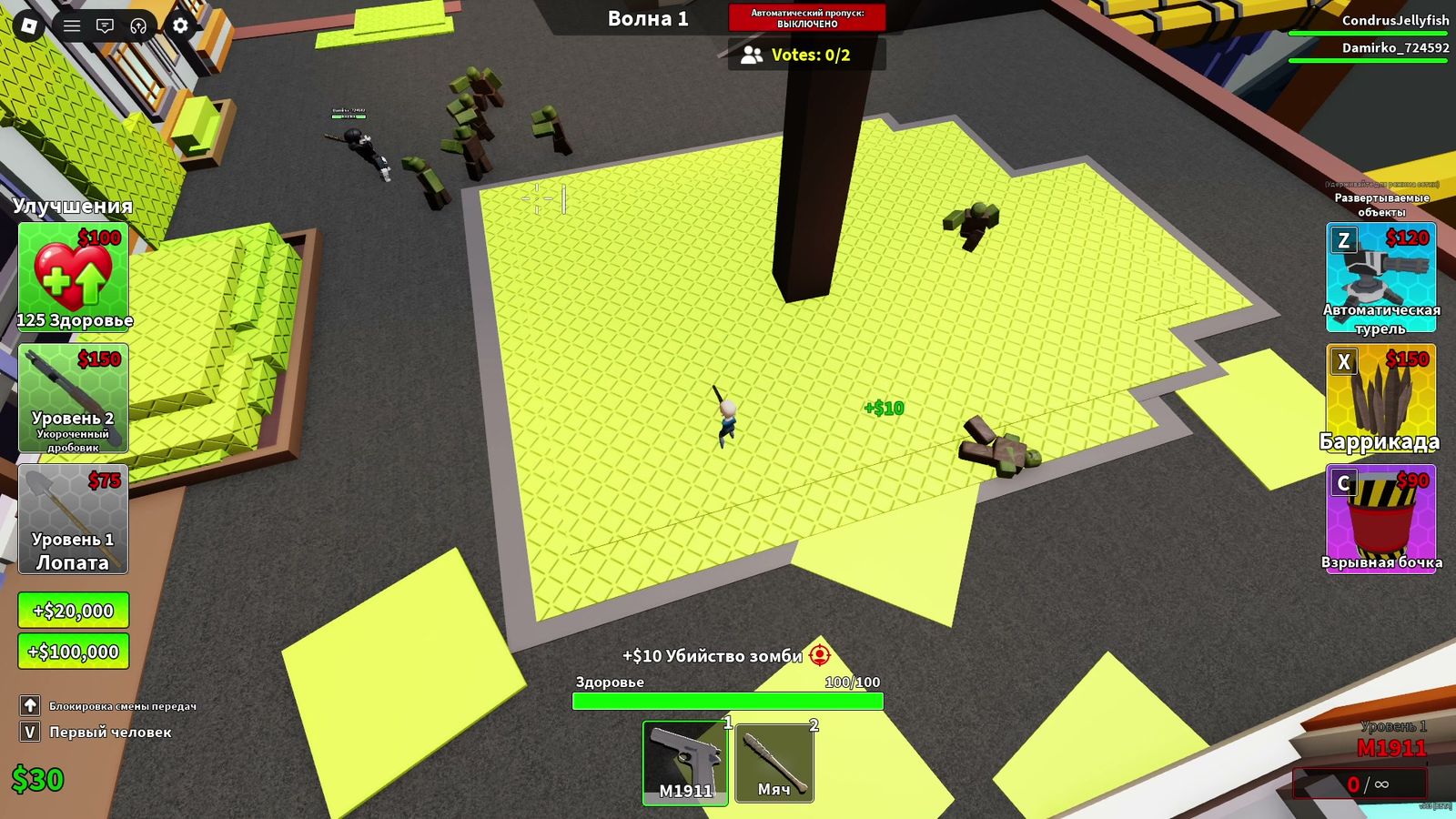
One enclosed arena around a central column. The horde spawns around the whole perimeter, so defense is built as a ring: turrets and barricades cover every approach, not a single chokepoint.
Horde density scales with the number of players in the raid: a solo run is noticeably easier, while launching in a duo/trio/quad presses many times harder. Difficulty is tied to the team composition, not just the wave number.
One map = all the polish and balance concentrated in a single space. No dilution across a dozen arenas — instead the spawn patterns, top-down readability and ring defense are all finely tuned.
Every gun has its own sound, zero background music
Gunplay stays readable under chaos thanks to tracers and separated audio: each weapon has its own firing and hit sound, while there is no background music in combat at all — only gun and horde SFX. Headshots deal more damage, damage ramps up under sustained fire, and the minigun has a spray with a light auto-lock onto the nearest target.
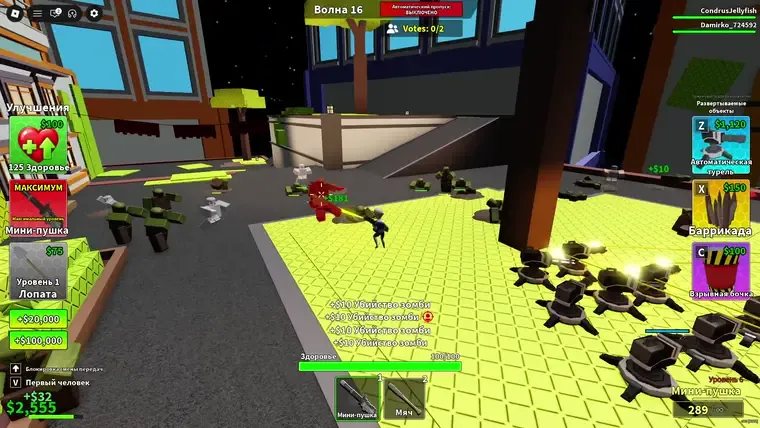
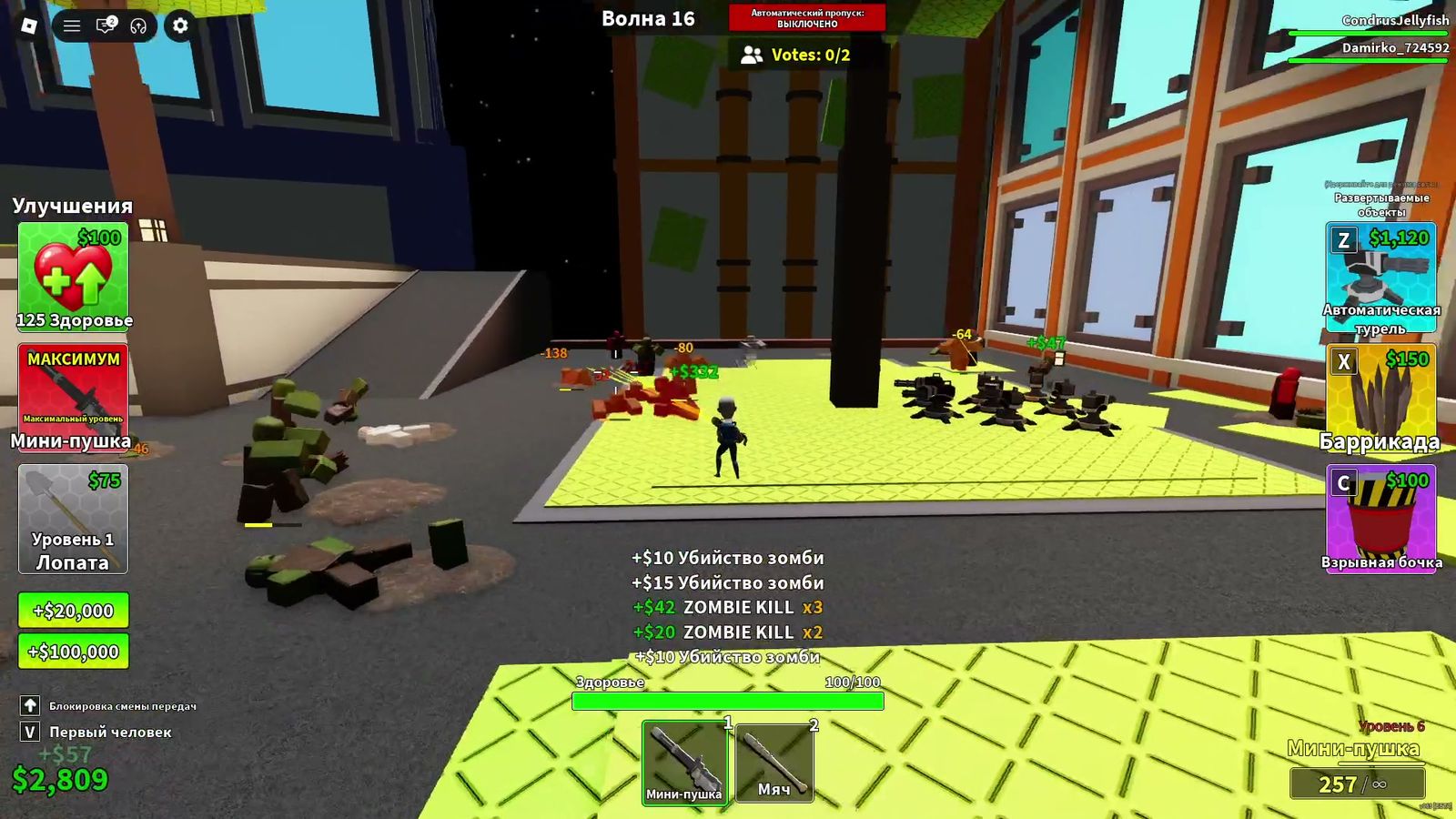
Separate audio per gun + tracers keep gunplay readable in a crowd. Headshots (more damage) and ramping damage under sustained fire reward accuracy and holding the target. The minigun has a spray with auto-lock. There is a "First person" toggle (V) even with the top-down camera.
The complete absence of combat music leaves long runs (23–28 min) without audio drama: no build, no musical marker for dangerous waves. With a repetitive mid-game, this amplifies the sense of a monotone audio backdrop.
Strong hook, long escalation, a re-hook near wave 40
The shape of a run: an instant hook into combat on entry, then continuous escalation with no clear finale. A typical run lasts ~23–28 minutes and reaches wave 39–47. The risk is a repetitive mid-game; a partial re-hook comes from new zombie types, including the black one around wave 38.
Instant combat from the first second: no tutorial, the horde presses right away, the first Zombux drip in as early as the opening wave. The entry is consistently gripping.
"Each wave gets tougher" — a continuous rising ladder of horde density and strength. Not an arc with an ending, but an endless build-up of pressure.
A run of ~23–28 minutes to wave 39–47 (across the two sessions analyzed). Long enough for a session, but it needs events to hold attention through the middle.
A repetitive mid-game: between the early and late zombie types stretches a "same thing but denser" section. The black zombie appearing around wave 40 works as a re-hook.
Enemies, weapons, classes and defensive deployables
The game's balance backbone: a bestiary by wave, a catalog of 6 weapon tiers, 6 classes and their deployables — with real stats from in-game screens.
From the green grunt to the black zombie of wave 38
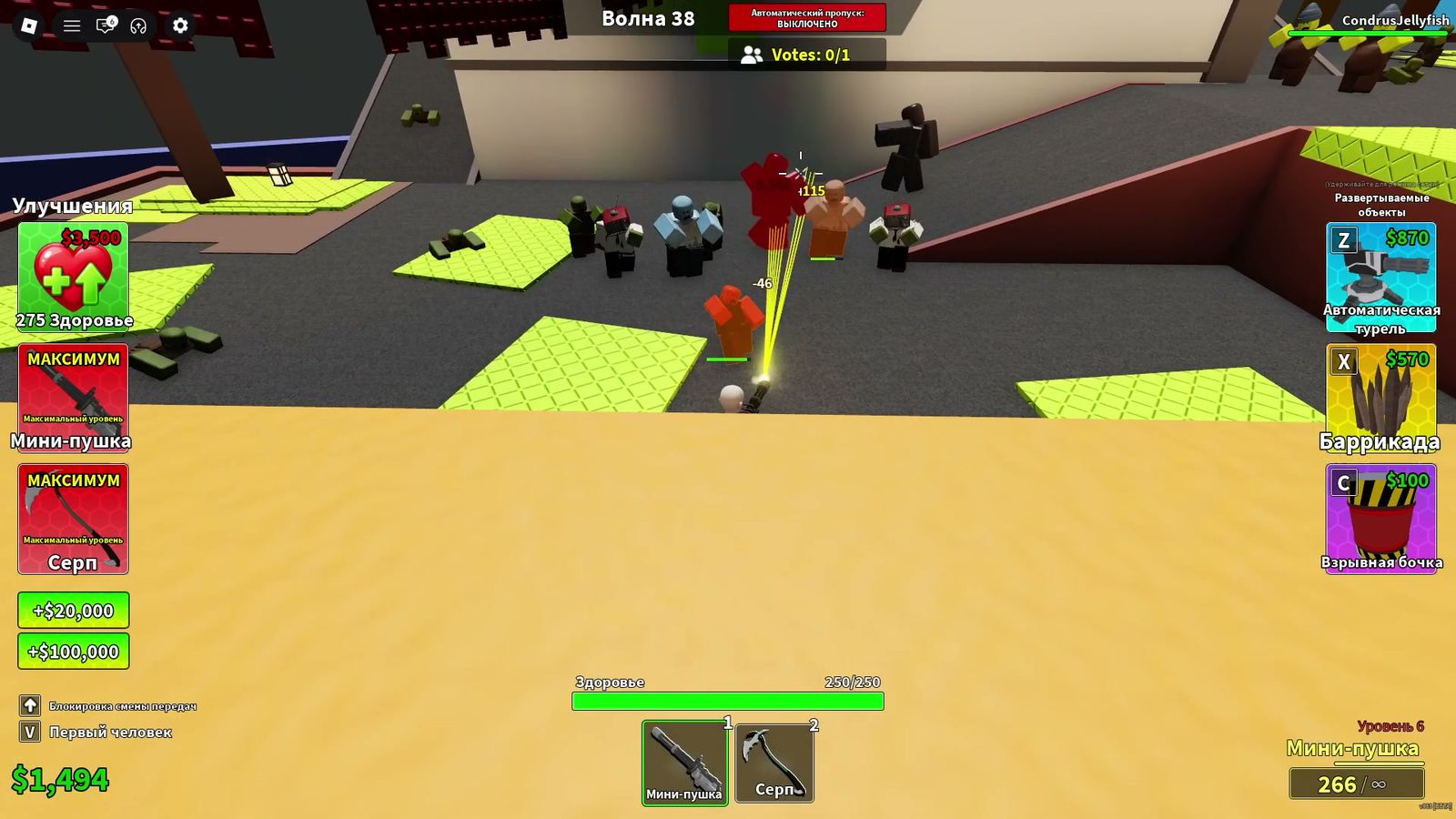
The baseline is the classic green blocky zombie from wave 1. Over the run, variations are added: a fast red one (early waves), low crouching ones, a transparent one, an exploding one that leaves a poison cloud on death, and a black one around wave 38. The horde's count and density scale with the number of players.
| Zombie type | Appears | Trait |
|---|---|---|
| Ordinary green | Wave 1 | the basic enemy, walks straight to your position; makes up the bulk of the horde |
| Fast red | early waves | noticeably faster than the grunt — forces you not to let the horde build momentum, a priority target |
| Low / crouching | early waves | a low silhouette, harder to track top-down; slips under the line of fire more easily |
| Transparent | early-mid | a semi-transparent silhouette — harder to read in a dense horde |
| Exploding | mid waves | on death it leaves a poisonous green cloud — a denial zone that forces you to fall back from the spot |
| Black | ~wave 38 | a late, reinforced type; works as a re-hook in the dragging mid-run |
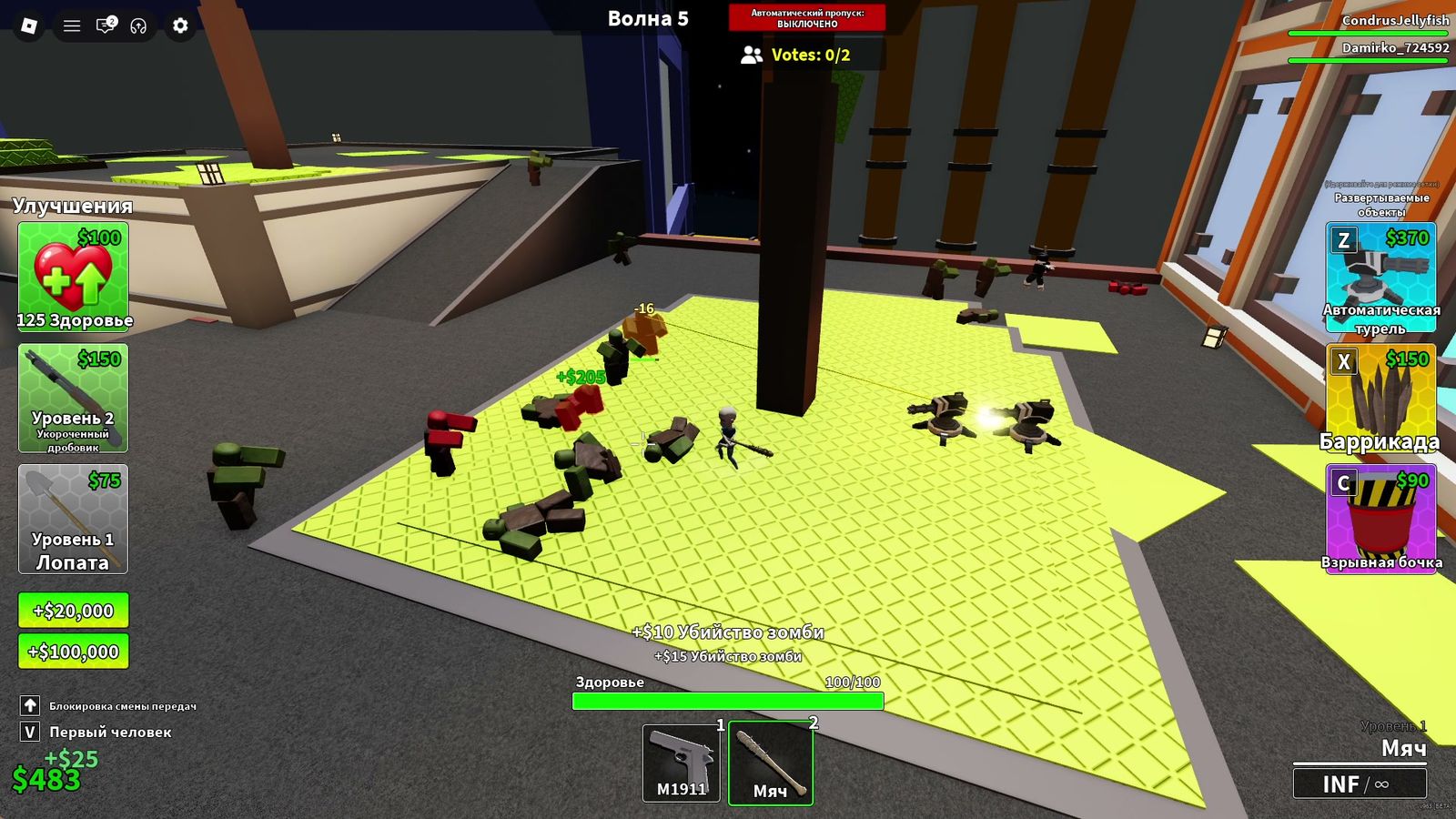
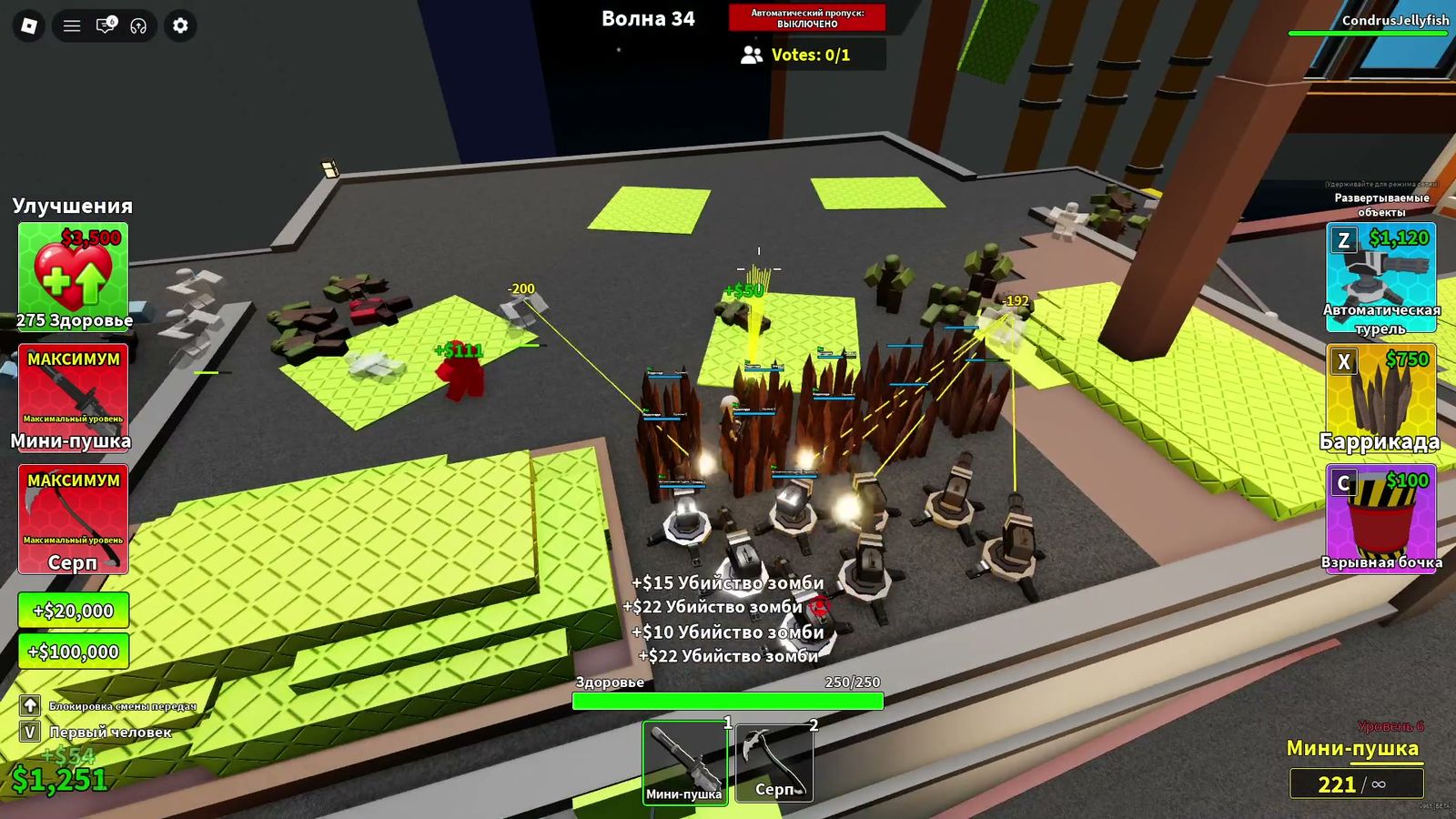
Six tiers, a tier default + a Zombux ladder + two Robux exclusives
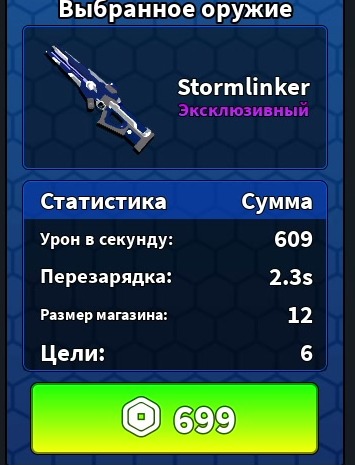
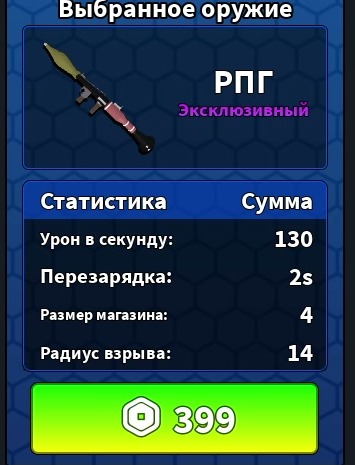
Weapons are structured as 6 rarity tiers: each tier has a default gun (granted) and a shop ladder in Zombux with rising prices. Two Robux exclusives are pinned to every tier's shop — Stormlinker (699 R$) and RPG (399 R$), scaling to the tier. Unlocking and star-upgrading weapons happen in the lobby for Zombux; inside the raid itself you advance along your loadout to the next gun for $.
| Tier | Default | Rarity | DPS (cur.>upg.) | Reload | Mag | Upgrade |
|---|---|---|---|---|---|---|
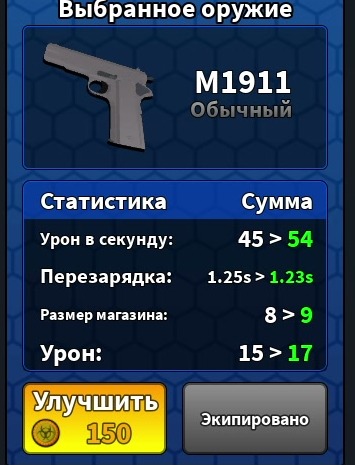
| L1 | M1911 | Common | 45>54 | 1.25>1.23s | 8>9 | 150 Z |
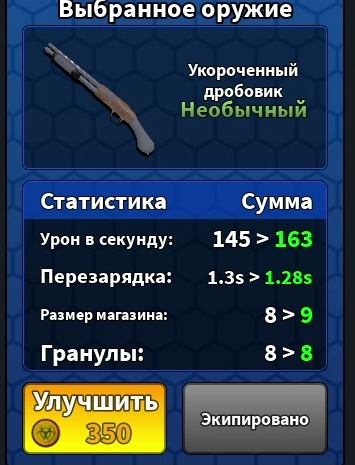
| L2 | Sawed-off Shotgun | Uncommon | — | — | — | — |
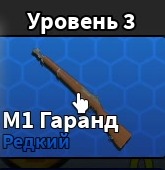
| L3 | M1 Garand | Rare | — | — | — | — |
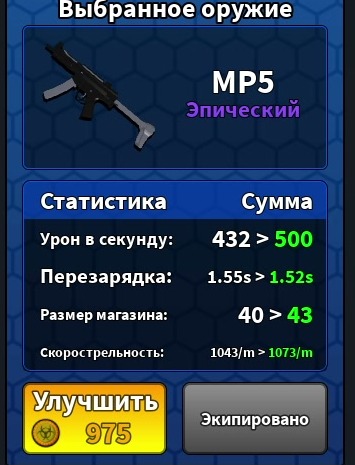
| L4 | MP5 | Epic | 432>500 | 1.55>1.52s | 40>43 | 975 Z |
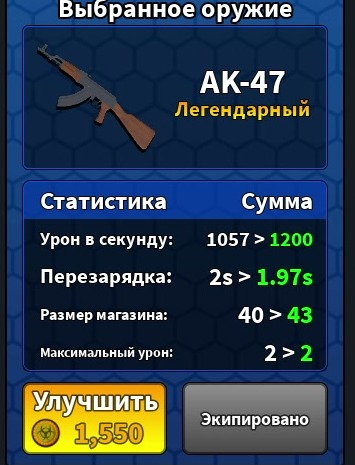
| L5 | AK-47 | Legendary | 1057>1200 | 2>1.97s | 40>43 | 1 550 Z |
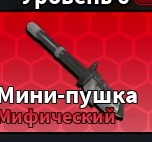
| L6 | Minigun | Mythical | 3440>3836 | 3>2.95s | 400>422 | 1 925 Z |
Summary table: prices and stats of every gun
| Weapon | Price | DPS / stats (where measured) |
|---|---|---|
| Tier L1 · Common | ||
| M1911 default | upgrade 150 Z | DPS 45>54, mag 8>9, damage 15>17 |
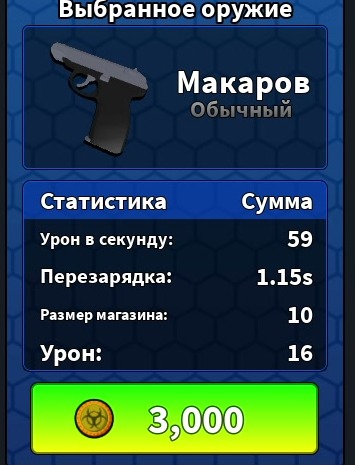
| Makarov | 3 000 Z | DPS 59, reload 1.15s, mag 10, damage 16 |
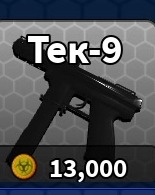
| Tec-9 | 13 000 Z | — |
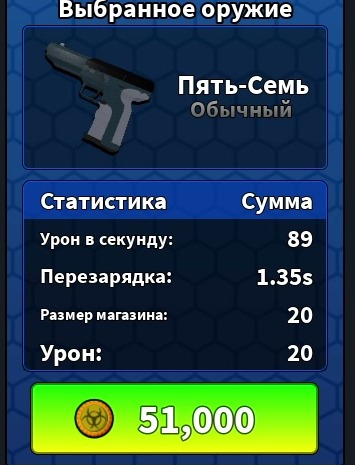
| Five-seveN | 51 000 Z | DPS 89, reload 1.35s, mag 20, damage 20 |
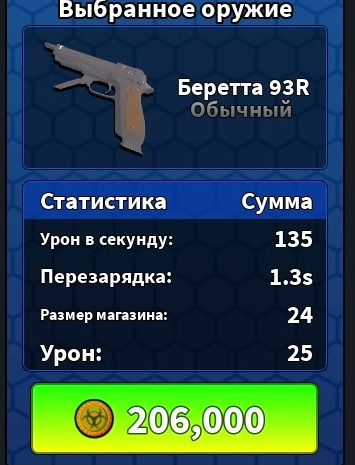
| Beretta 93R | 206 000 Z | DPS 135, reload 1.3s, mag 24, damage 25 |
| Tier L2 · Uncommon | ||
| Sawed-off Shotgun default | — | — |
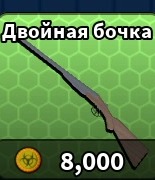
| Double-barrel | 8 000 Z | — |
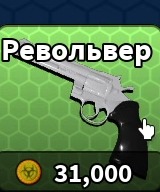
| Revolver | 31 000 Z | — |
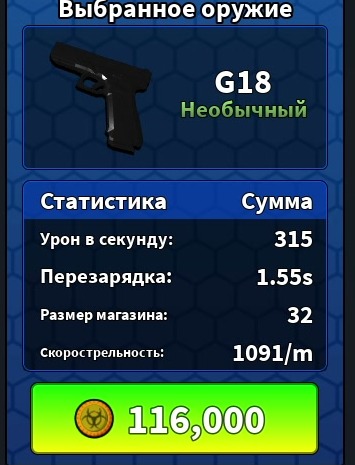
| G18 | 116 000 Z | DPS 315, reload 1.55s, mag 32 |
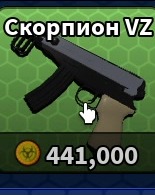
| Scorpion VZ | 441 000 Z | — |
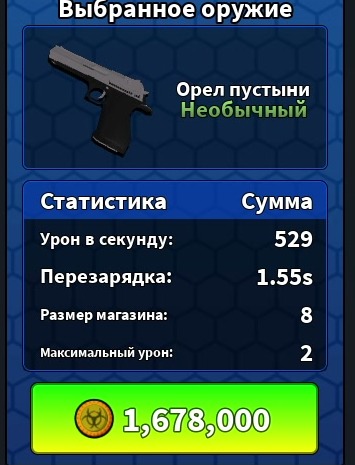
| Desert Eagle | 1 678 000 Z | DPS 529, reload 1.55s, mag 8 |
| Tier L3 · Rare | ||
| M1 Garand default | — | — |
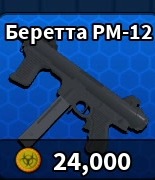
| Beretta PM-12 | 24 000 Z | — |
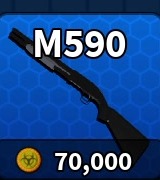
| M590 | 70 000 Z | — |
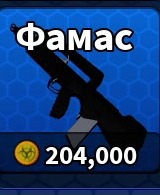
| FAMAS | 204 000 Z | — |
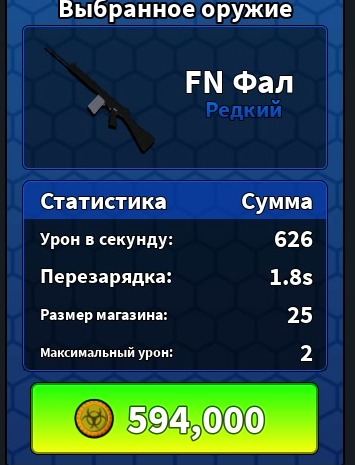
| FN FAL | 594 000 Z | DPS 626, reload 1.8s, mag 25 |
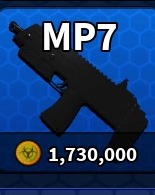
| MP7 | 1 730 000 Z | — |
| Tier L4 · Epic | ||
| MP5 default | upgrade 975 Z | DPS 432>500, mag 40>43, fire rate 1043>1073/min |
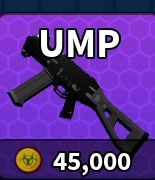
| UMP | 45 000 Z | — |
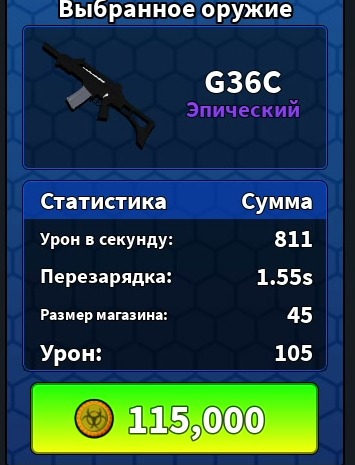
| G36C | 115 000 Z | DPS 811, reload 1.55s, mag 45, damage 105 |
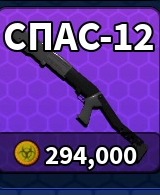
| SPAS-12 | 294 000 Z | — |
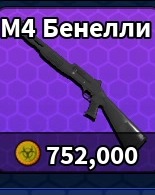
| M4 Benelli | 752 000 Z | — |
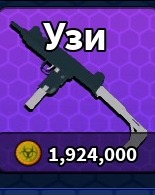
| Uzi | 1 924 000 Z | — |
| Tier L5 · Legendary | ||
| AK-47 default | upgrade 1 550 Z | DPS 1057>1200, mag 40>43 |
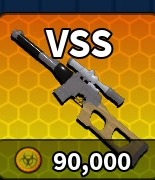
| VSS | 90 000 Z | — |
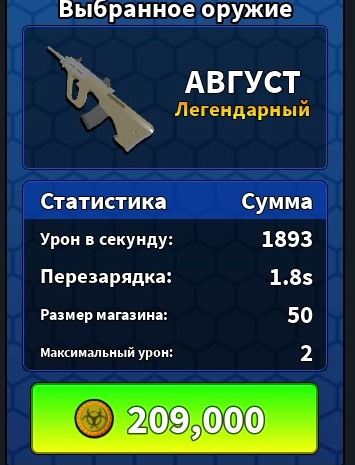
| AUG | 209 000 Z | DPS 1893, reload 1.8s, mag 50 |
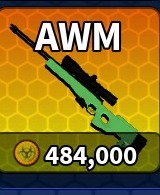
| AWM | 484 000 Z | — |
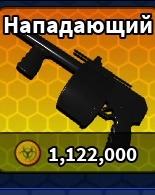
| Assaulter | 1 122 000 Z | — |
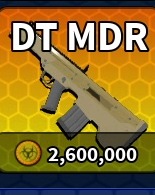
| DT MDR | 2 600 000 Z | — |
| Tier L6 · Mythical | ||
| Minigun default | upgrade 1 925 Z | DPS 3440>3836, mag 400>422 |
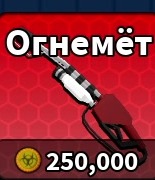
| Flamethrower | 250 000 Z | — |
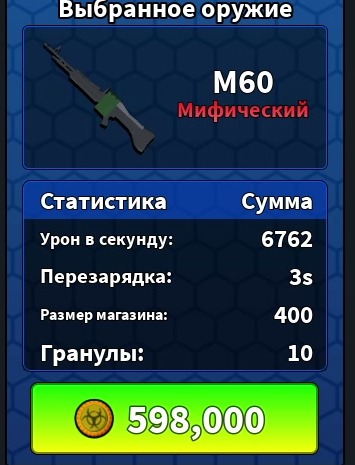
| M60 | 598 000 Z | DPS 6762, reload 3s, mag 400 |
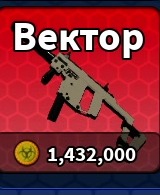
| Vector | 1 432 000 Z | — |
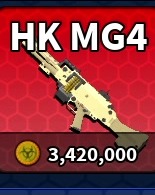
| HK MG4 | 3 420 000 Z | — |
| Robux exclusives · across all tiers | ||
| Stormlinker | 699 R$ | DPS 609, reload 2.3s, mag 12, targets 6 |
| RPG | 399 R$ | DPS 130, reload 2s, mag 4–5, blast radius 14 |
Catalog: screenshot and card for every gun
All 36 guns in the game — by tier. The defaults and some purchasable ones are captured from the "Selected weapon" panel (with stats), the rest from shop cards. The Zombux price is the lobby unlock; the two Robux exclusives are broken out separately.
Tier L1 · Common
Tier L2 · Uncommon
Tier L3 · Rare
Tier L4 · Epic
Tier L5 · Legendary
Tier L6 · Mythical
Robux exclusives · work across all tiers
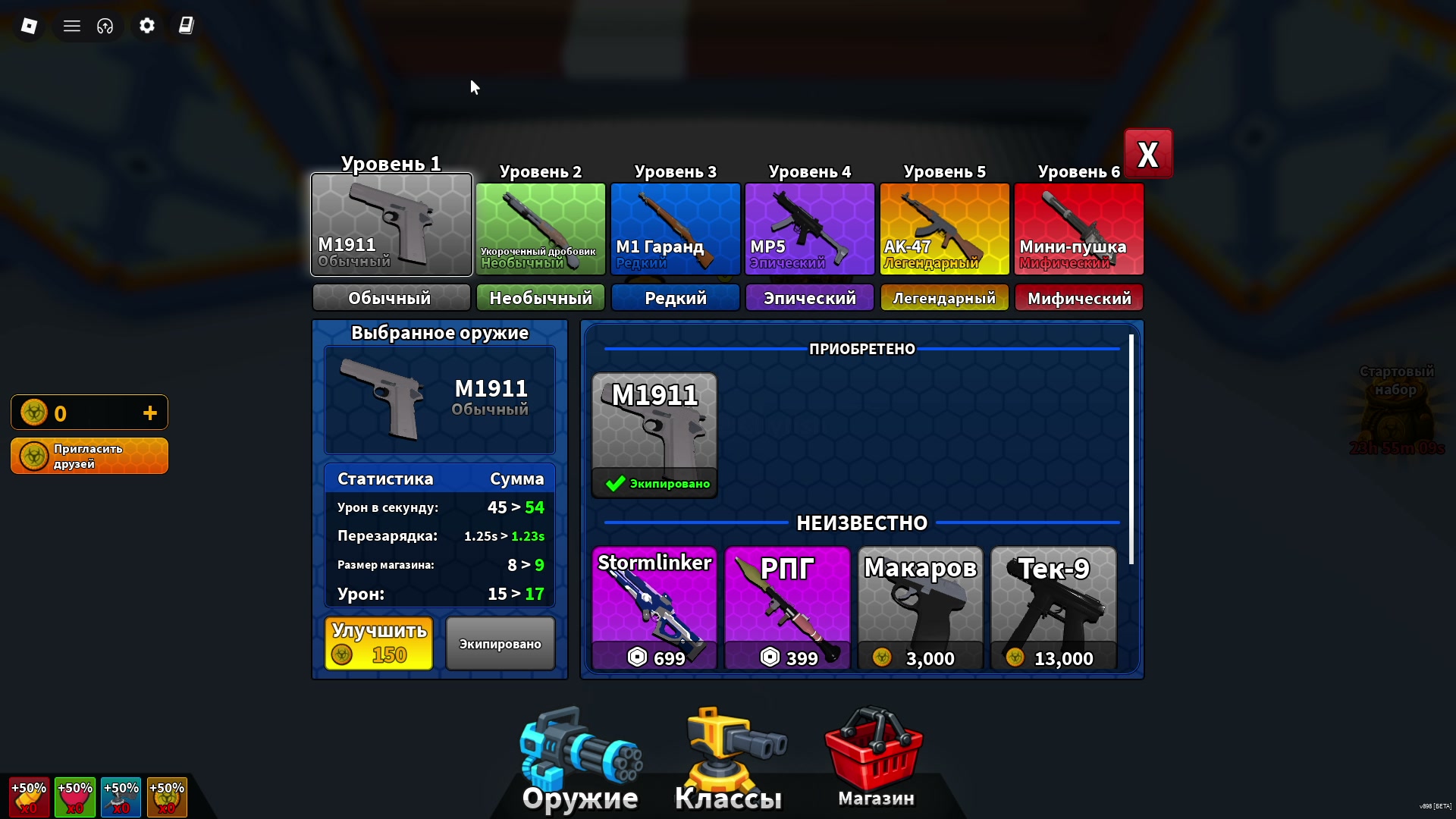
Star-based upgrading of weapons and deployables — in the lobby for Zombux
Upgrading runs on stars in the lobby for Zombux — for weapons, for deployables, and it is permanent progress: it carries over between runs. Each step raises specific stats: DPS, mag, reload speed on guns; DPS, range and HP on turrets. Inside the raid itself, stars are not leveled — there you only take equipped upgrades and place deployables for $.
| Weapon | DPS | Key stat |
|---|---|---|
| M1911 (L1) | 45 > 54 | damage 15>17, mag 8>9 |
| MP5 (L4) | 432 > 500 | fire rate 1043>1073/min, mag 40>43 |
| AK-47 (L5) | 1057 > 1200 | mag 40>43 |
| Minigun (L6) | 3440 > 3836 | mag 400>422 |
Buildings are upgraded in the same place — in the lobby for Zombux. The Recruit's automatic turret, upgraded to 3.5★, reaches DPS 343, range 56>58, HP 279>307. It is this turret curve — not the weapon one — that decides the outcome of the late waves.
Permanent (in the lobby for Zombux): weapon and class unlocks + star upgrades of weapons and deployables — they carry over between runs. Resets every raid: the in-raid $, the guns taken along the loadout and the placed deployables — you accumulate them from scratch every run.
Six classes, each with three defensive deployables
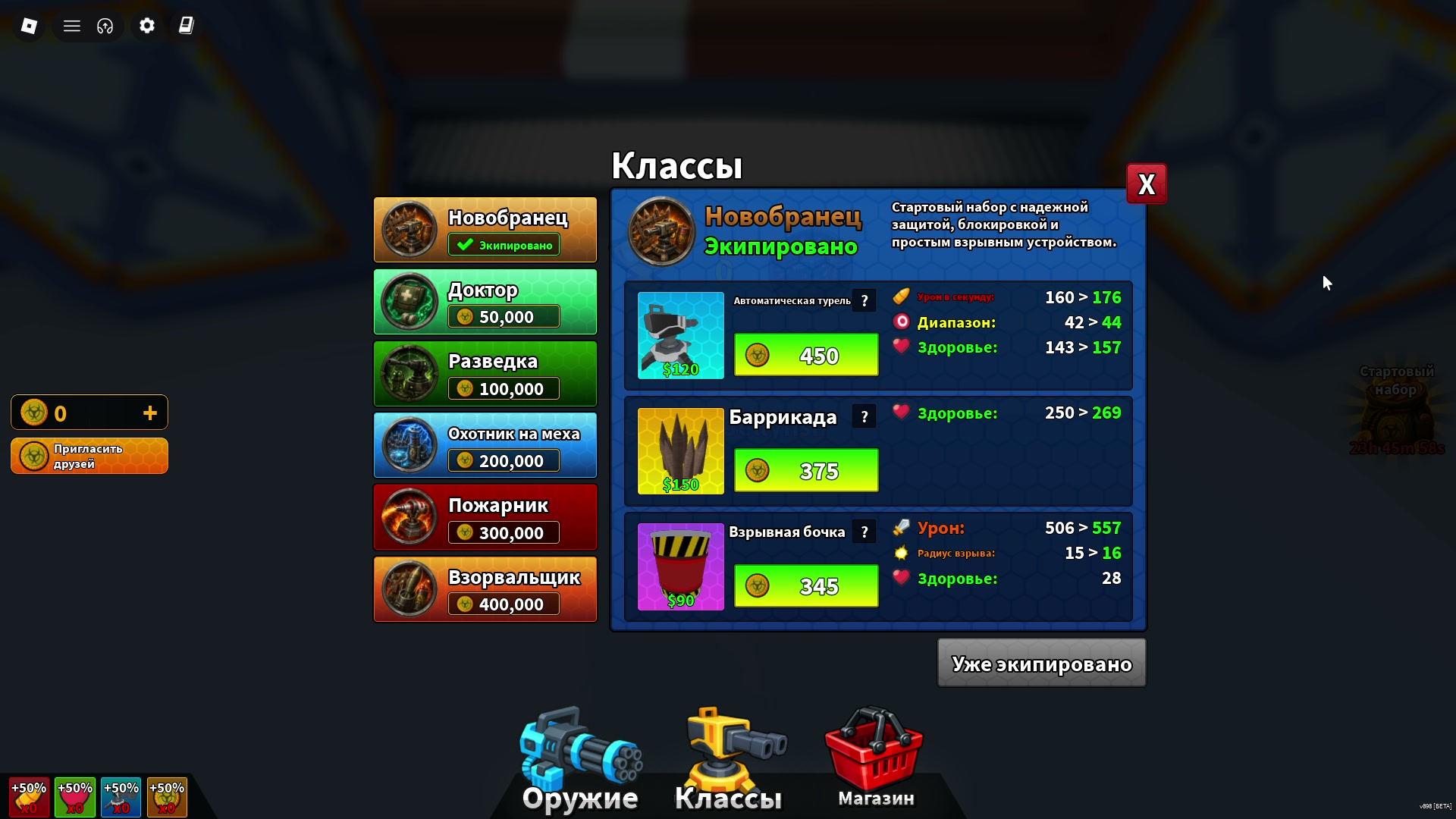
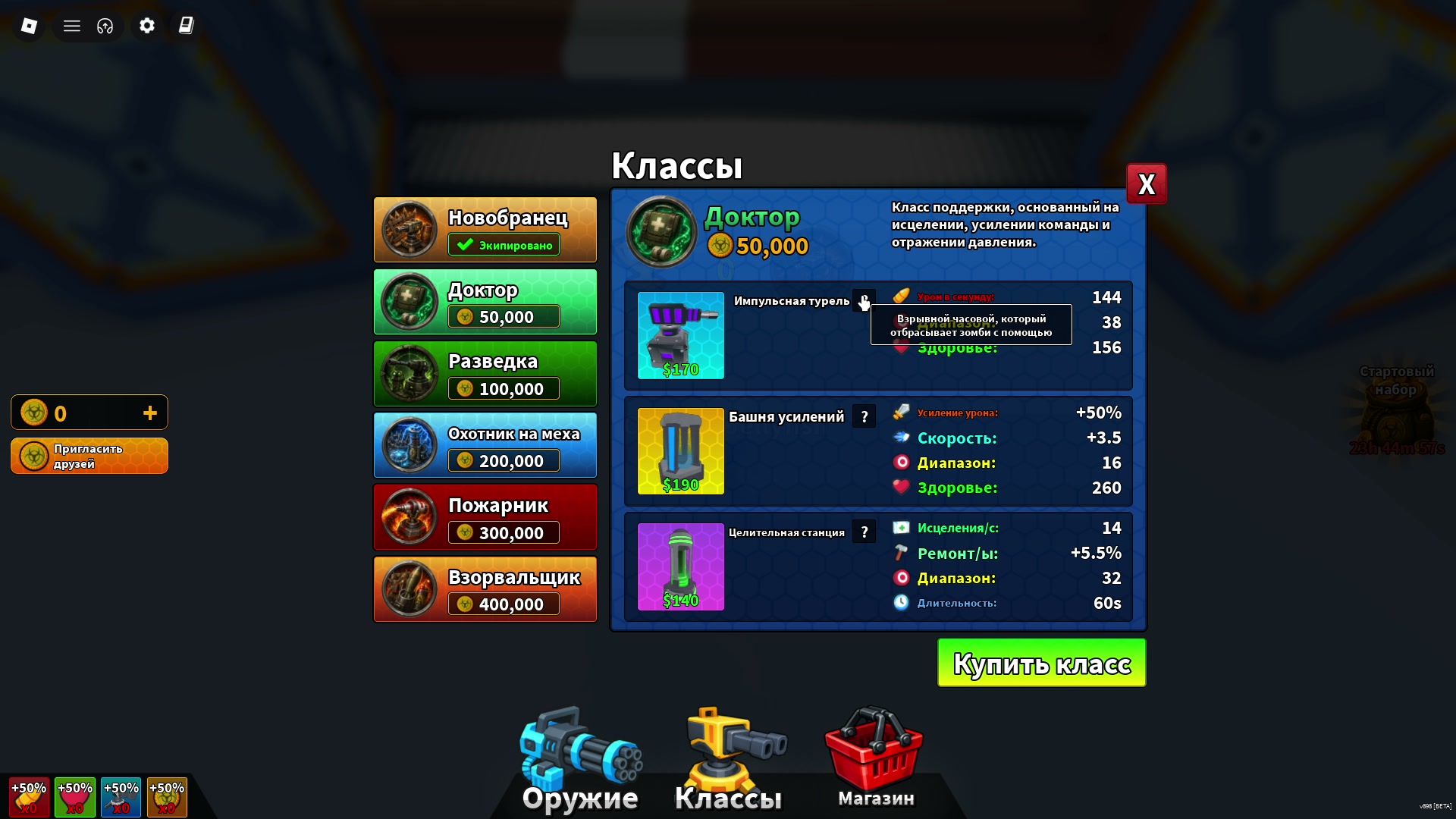
All the role variety comes from 6 classes, unlocked for Zombux. Each carries its own trio of deployables — a turret, a barrier and a special device — with its own stats. The Recruit is free; the rest unlock for 50,000 – 400,000 Zombux. This is the core of the meta variety: a set of defensive tools is picked to suit the team composition.
| Class | Price | Role | Deployables |
|---|---|---|---|
| Recruit | free | starter defense | Automatic turret · Barricade · Explosive barrel |
| Doctor | 50 000 Z | support: heal, buff, deflect pressure | Pulse turret · Buff tower · Healing station |
| Scout | 100 000 Z | targeting, marking, allied cover | Sniper turret · Recon tower · Ghost |
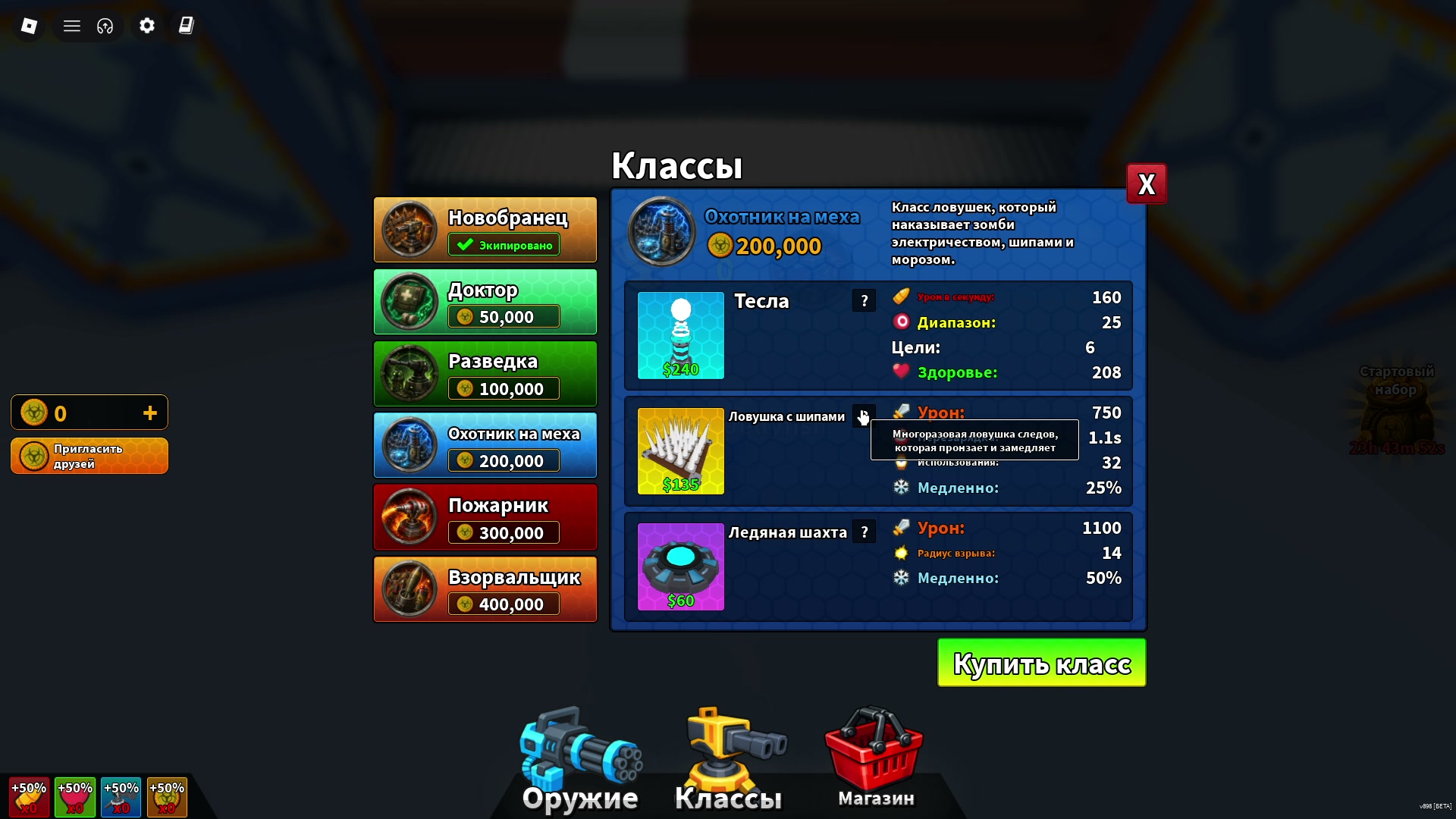
| Mech Hunter | 200 000 Z | traps: electricity, spikes, frost | Tesla · Spike trap · Ice mine |
| Firefighter | 300 000 Z | area damage at chokepoints | Fire turret · Fire barricade · Molotov barrel |
| Bomber | 400 000 Z | explosive: mortars, magnets, blast walls | Mortar turret · Explosive barricade · Lure bomb |
Deployable stats (build $ Zombux in-match)
Recruit free — free · starter set
| Deployable | Build | Stats (cur.>upg.) |
|---|---|---|
| Automatic turret | $120 | DPS 160>176, range 42>44, HP 143>157 |
| Barricade | $150 | HP 250>269 — blocks zombies |
| Explosive barrel | $90 | damage 506>557, radius 15>16, HP 28 |
Doctor 50 000 Z — 50 000 Z · support
| Deployable | Build | Stats |
|---|---|---|
| Pulse turret | $170 | DPS 144, range 38, HP 156 |
| Buff tower | $190 | +50% damage, +3.5 speed, range 16, HP 260 |
| Healing station | $140 | 14 heal/s, +5.5% repair, range 32, 60s |
Scout 100 000 Z — 100 000 Z · control
| Deployable | Build | Stats |
|---|---|---|
| Sniper turret | $120 | DPS 269, range 63, HP 143 |
| Recon tower | $150 | +25% damage taken by targets, range 16, ping 5s, HP 260 |
| Ghost | $80 | range 24, 6s |
Mech Hunter 200 000 Z — 200 000 Z · traps
| Deployable | Build | Stats |
|---|---|---|
| Tesla | $240 | DPS 160, range 25, 6 targets, HP 208 |
| Spike trap | $135 | damage 750, slow 25% |
| Ice mine | $60 | damage 1100, radius 14, slow 50% |
Firefighter 300 000 Z — 300 000 Z · area damage
| Deployable | Build | Stats |
|---|---|---|
| Fire turret | $150 | DPS 220, range 27, HP 156 |
| Fire barricade | $170 | HP 300 |
| Molotov barrel | $120 | damage 1300, radius 15, DPS 110, 4.5s |
Build detail: the in-game "Firefighter" class description is untranslated — the card is in English ("Burn groups and punish zombies at chokepoints"), whereas the other classes are localized.
Bomber 400 000 Z — 400 000 Z · explosive
| Deployable | Build | Stats |
|---|---|---|
| Mortar turret | $240 | DPS 201, range 50, radius 14, HP 208 |
| Explosive barricade | $200 | HP 360, damage 1300, radius 14 |
| Lure bomb | $150 | damage 1800, radius 17, lure 48, 4s |
Economy, monetization and retention
How the Zombux earning works, what the light monetization is built from, and what keeps the player around — with real screens and prices analyzed.
Two currencies: $ inside the raid, Zombux — lobby upgrading
The game has two currencies. $ is in-raid cash: it drips from kills (flat ~$10, stacking +$20 / +15 / +10 — not a growing multiplier) and is spent only in the current raid on loadout weapons, upgrades and placing deployables, resetting to zero at the end of the run; in co-op the $ wallet is shared across the team. Zombux is the meta-currency: it is awarded per run (visible in the results) and spent only in the lobby on permanent weapon/class unlocks and star upgrading. The run's summary shows both lines: "Zombux earned" and "Total money earned $."
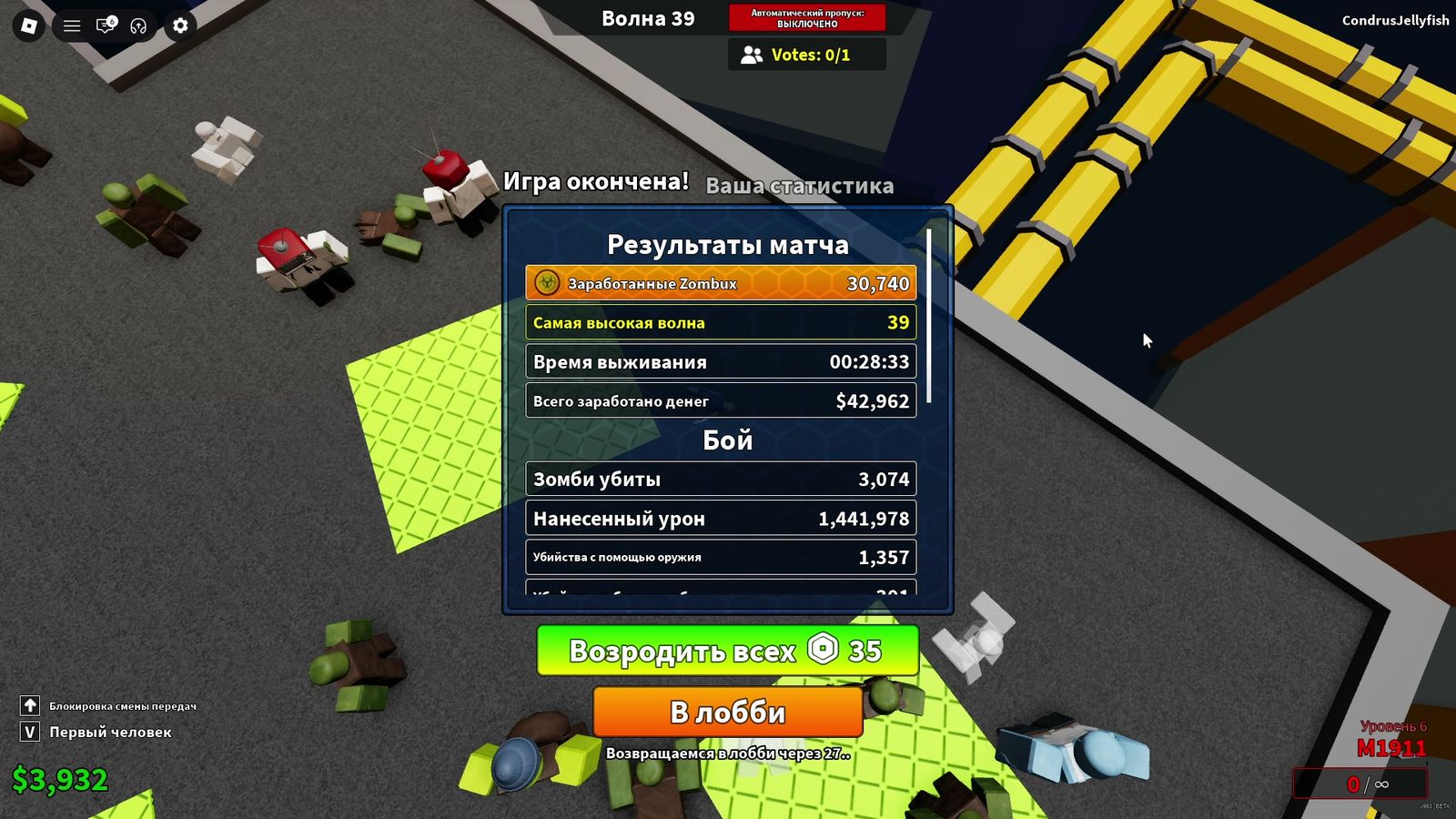
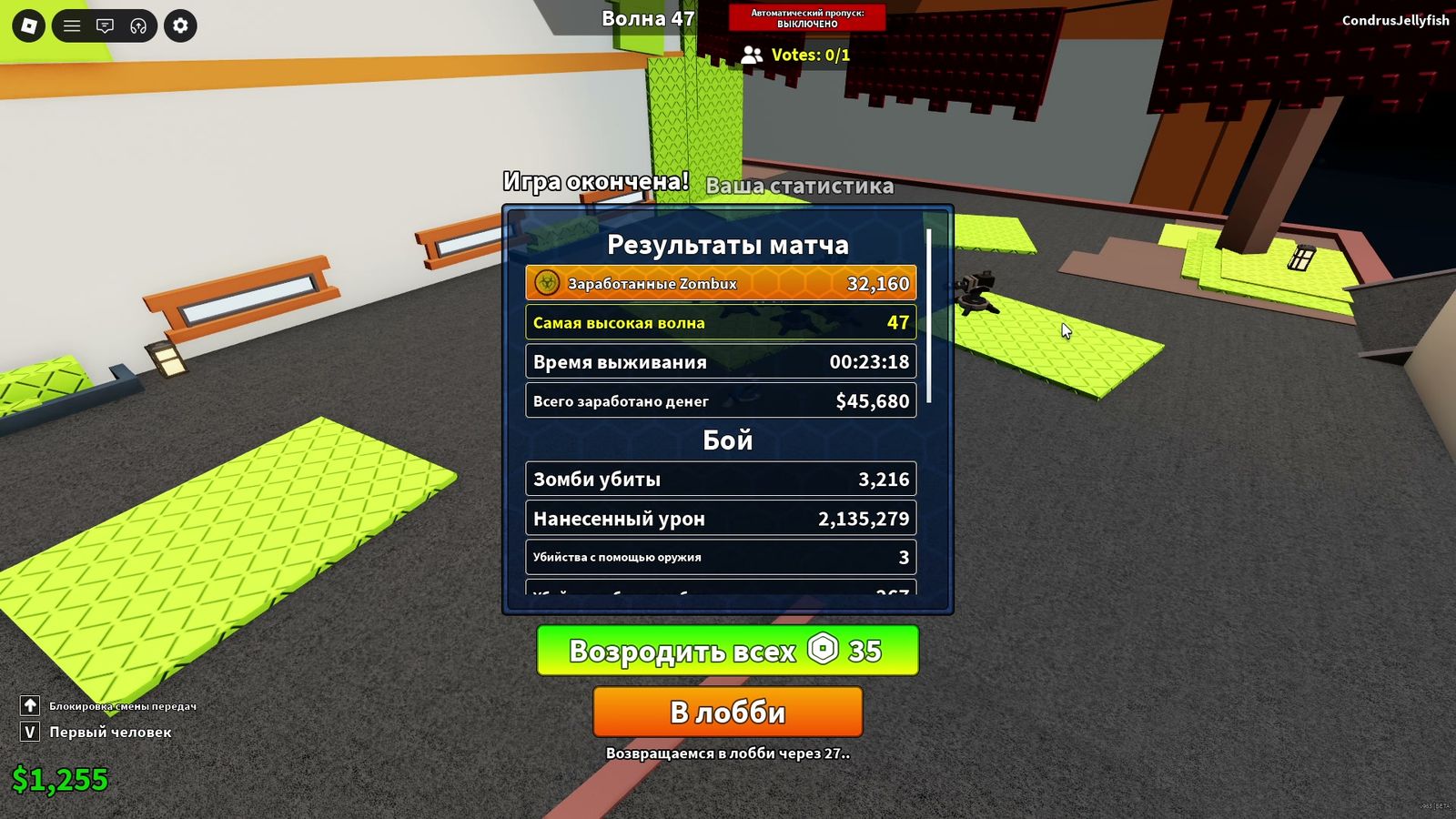
Run 1: 30 740 Zombux, wave 39, 28:33, total $42 962, 3 074 zombies killed. Run 2: 32 160 Zombux, wave 47, 23:18, total $45 680, 3 216 zombies killed. Per-session earnings — tens of thousands of Zombux.
Inside a raid, each successive placement of the same deployable costs more while the earlier ones live: the auto-turret starts at $120 and by the late waves reaches $2 000+. Destroyed turrets bring the price back down — this is how the game curbs endless defense spam and forces you to protect what you have already placed.
Flat payout + a shared $ wallet = a predictable, team-based in-raid economy. There is no farm-cheesing via a combo multiplier; the amount is honestly tied to the number killed. The shared $ wallet pushes toward role-splitting: some farm, others build up defense on the shared money.
Light pay-for-power: 6 game passes, cases, Zombux packs
The monetization is unobtrusive: 6 game passes at 1,774 R$ (149–699), multi-game "buff" boosts, a limited "Void Crate" case, a first-24h starter pack, Zombux packs and in-match cash. The core loop is locked nowhere — hence the 96.95% positive. Below are all the real prices.
Game passes (6 · 1 774 R$)
| Game pass | Price, R$ | Effect |
|---|---|---|
| Extra starting cash | 149 | +$2 000 cash at match start |
| Fast reload | 149 | faster reload |
| 50% more ammo | 179 | +50% ammo |
| x2 Health | 199 | double player HP |
| RPG | 399 | unlocks the RPG across all weapon tiers |
| Stormlinker | 699 | unlocks the Stormlinker across all tiers |
"Buff" boosts (once/game · sold in bundles)
| Boost | +1 game | +3 games | +5 games |
|---|---|---|---|
| +50% weapon damage | 20 | 50 | 75 |
| +50% Health | 20 | 50 | 75 |
| +50% Deployable power | 45 | 100 | 150 |
| +50% Zombux | 55 | 120 | 175 |
The "Void Crate" case and the starter pack
Opening 1 = 129 R$ · 3 = 299 R$ · 10 = 799 R$. Odds: Common 37% · Uncommon 25% · Rare 15% · Epic 9% · Legendary 7% · Mythical 6.5% · Secret 0.5%.
Starter pack — 49 R$ (+50 000 Zombux + 4 boosts ×2 games, ~24h limit). Zombux packs: 25k=79 · 75k=199 · 200k=499 · 600k=1 199 · 1.5M=1 799. In-match cash: +$20 000 = 79 R$, +$100 000 = 299 R$. Revive all = 35 R$, self-revive = 25 R$.
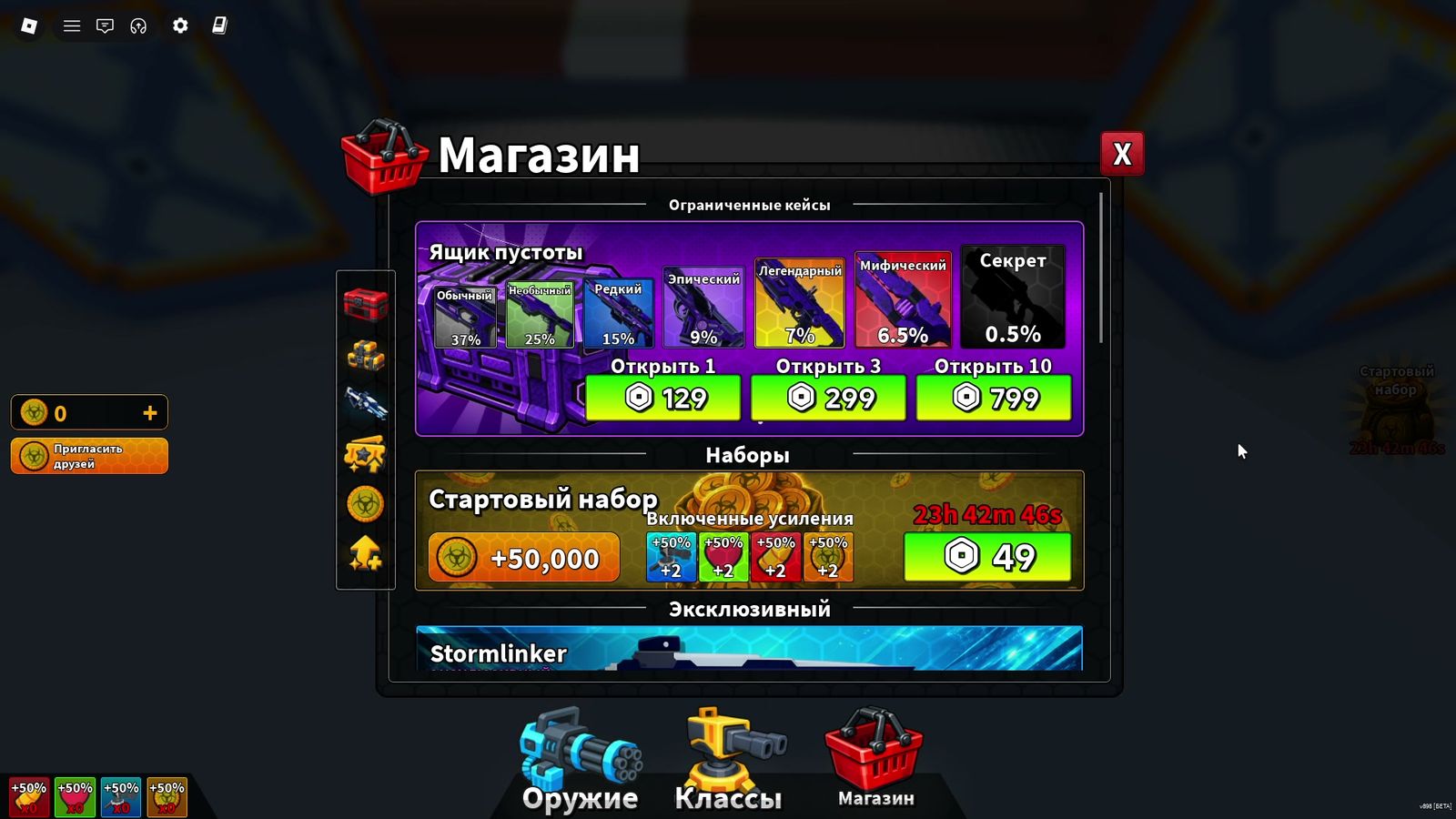
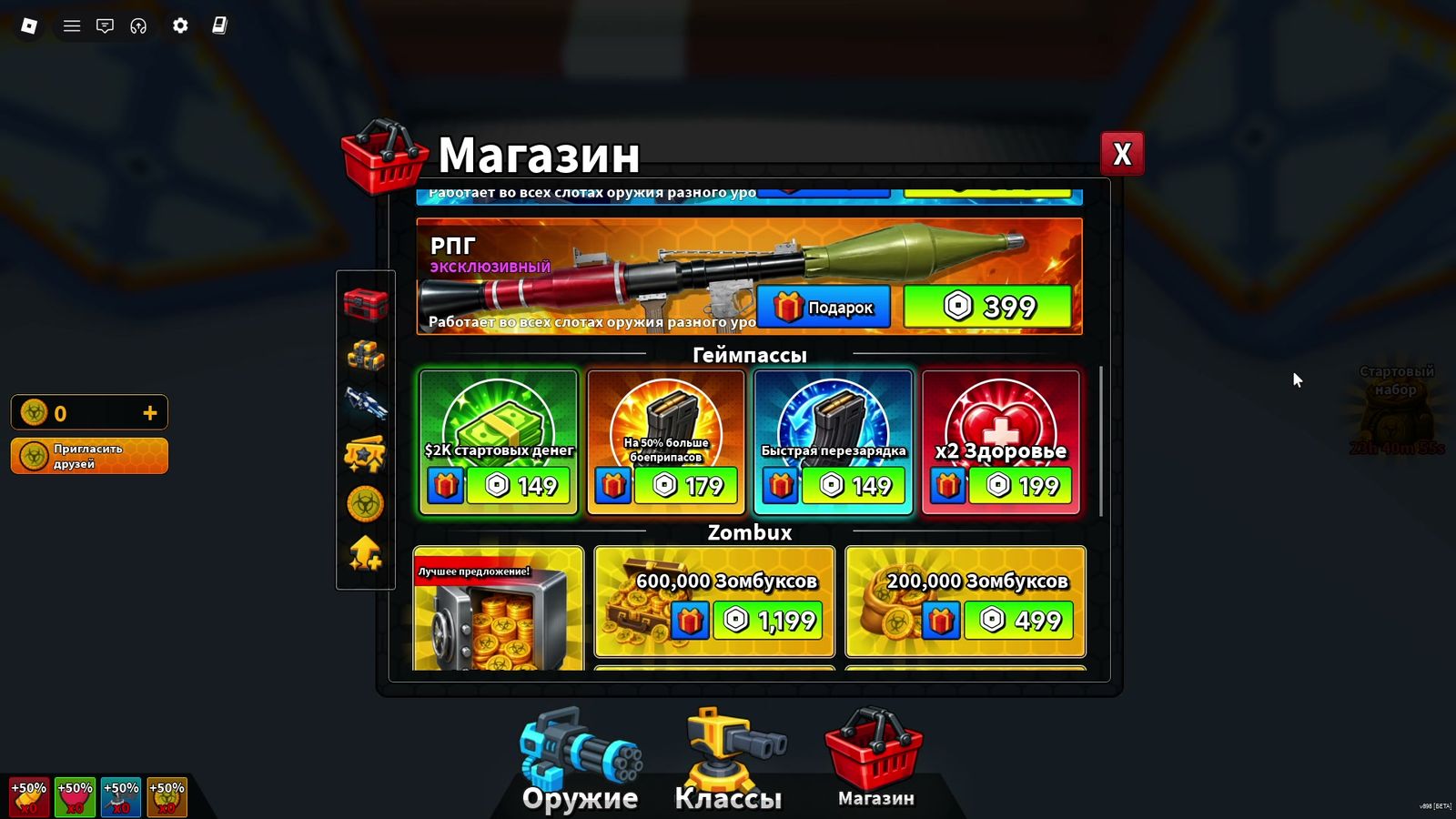
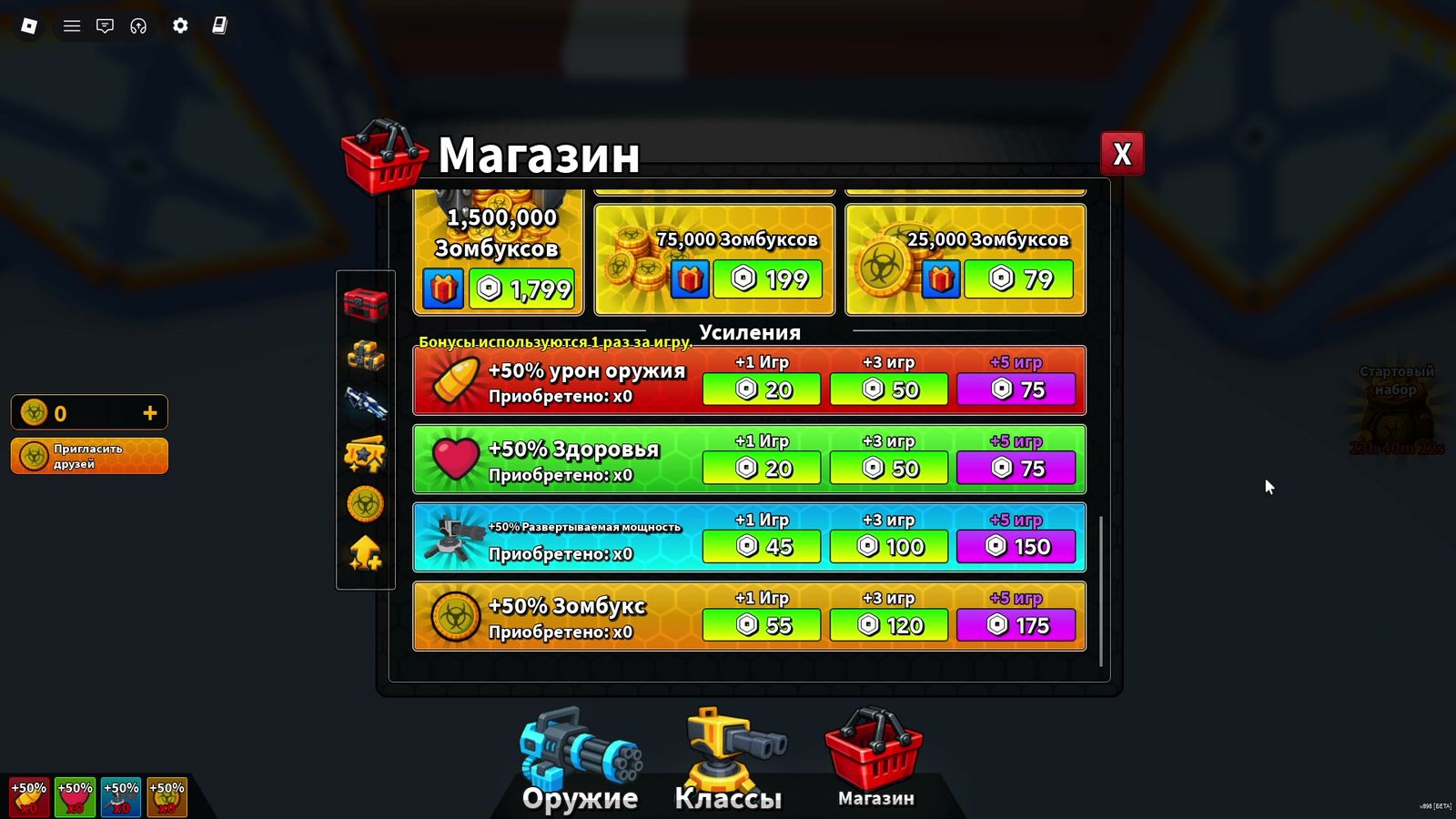
Cheap entry thresholds (two passes at 149) + one premium top-end at 699 cover the full price fan. No pass gates the core loop: shooting, building defense and pushing past wave 40 are all free. What is sold is acceleration and a safety margin, not access to the fun — hence the 96.95% positive.
The "open 10" button at 799 R$ shows no discount relative to ten single openings (10×129 = 1,290). An explicit "−491 R$" price tag would lift the bundle's conversion — a missed value anchor.
Dailies, record trophies, the case and the starter pack
Retention leans on a core loop with a built-in goal (beat your own wave) and a few hooks: a daily reward for joining the group and liking, trophies over the player = the max wave reached, a limited Void Crate and a first-24-hours starter pack.
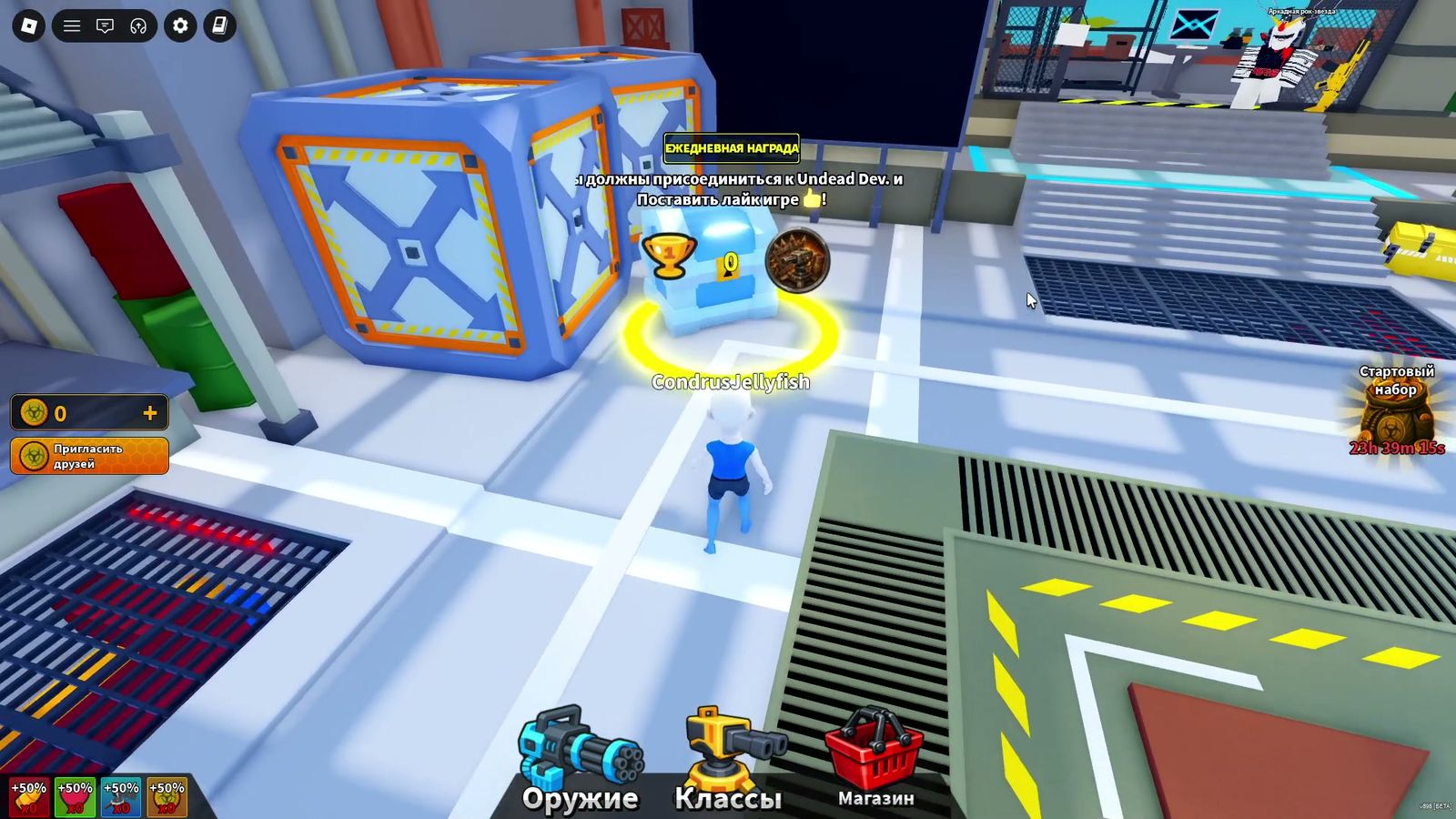
A reward for joining the Undead Dev. group + liking the game. A single hook converts straight into group growth and into the like rate — part of that very 96.95%.
Trophies hover over the player, equal to the max wave reached. A public flex counter extends the tail of a session: beat your own wave record.
The limited Void Crate and the first-24-hours starter pack create an early impulse to buy and a reason to come back while the offer is live.
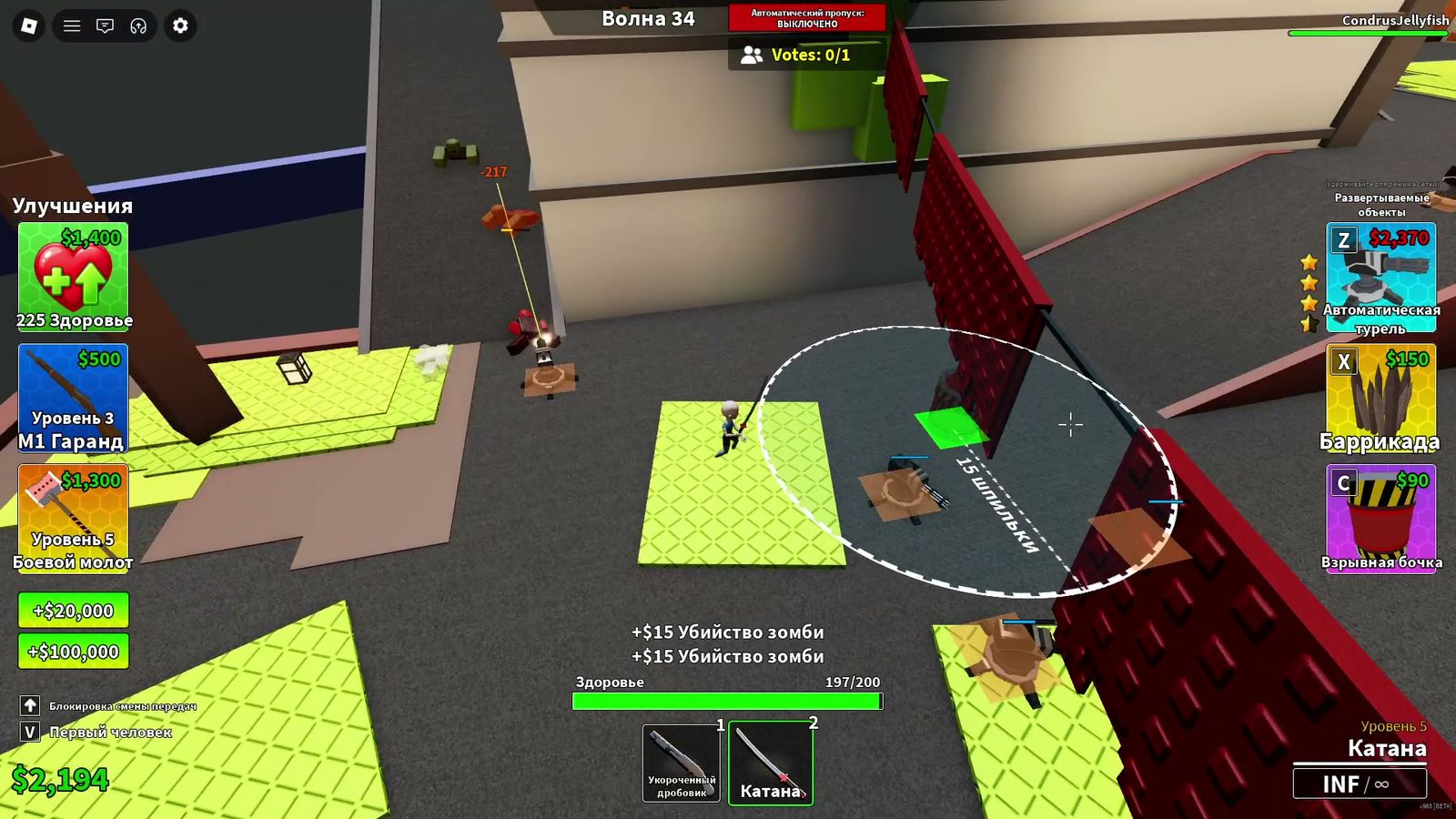
A dense but readable HUD for top-down combat
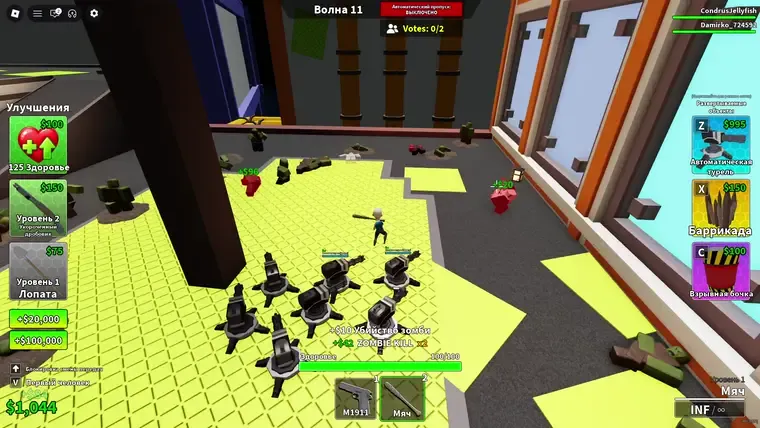
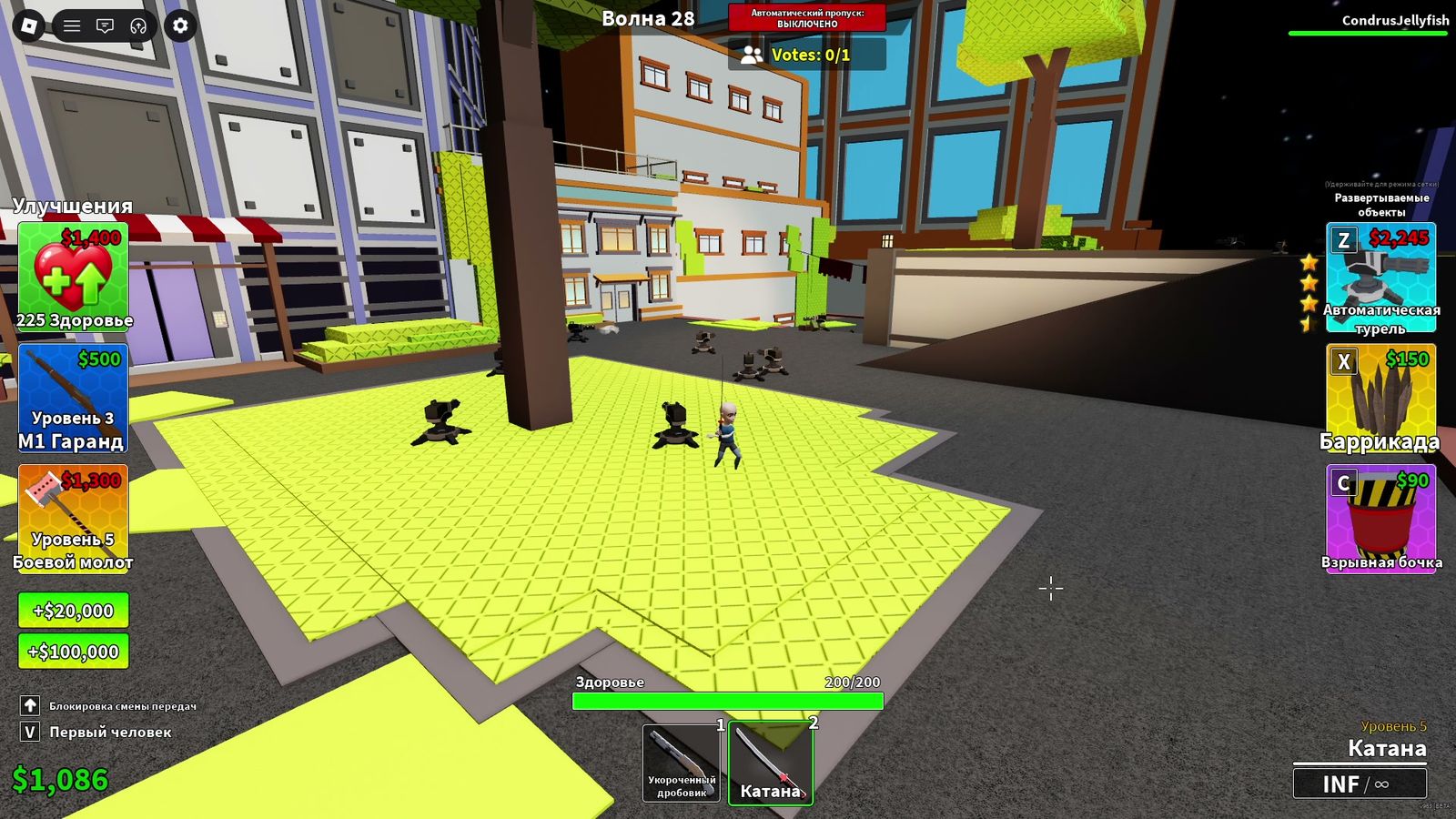
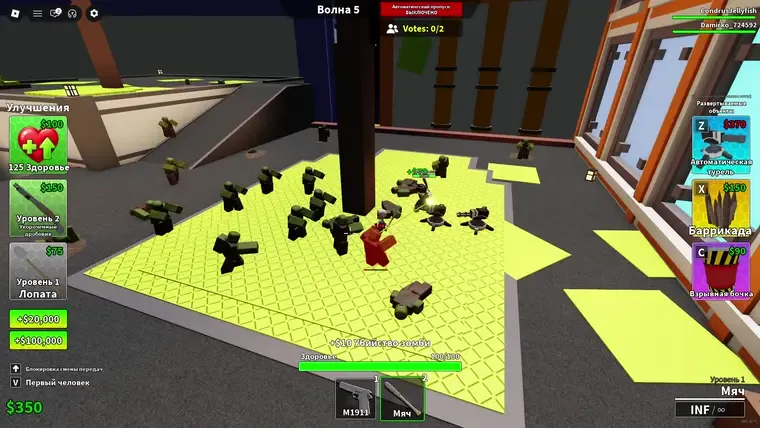
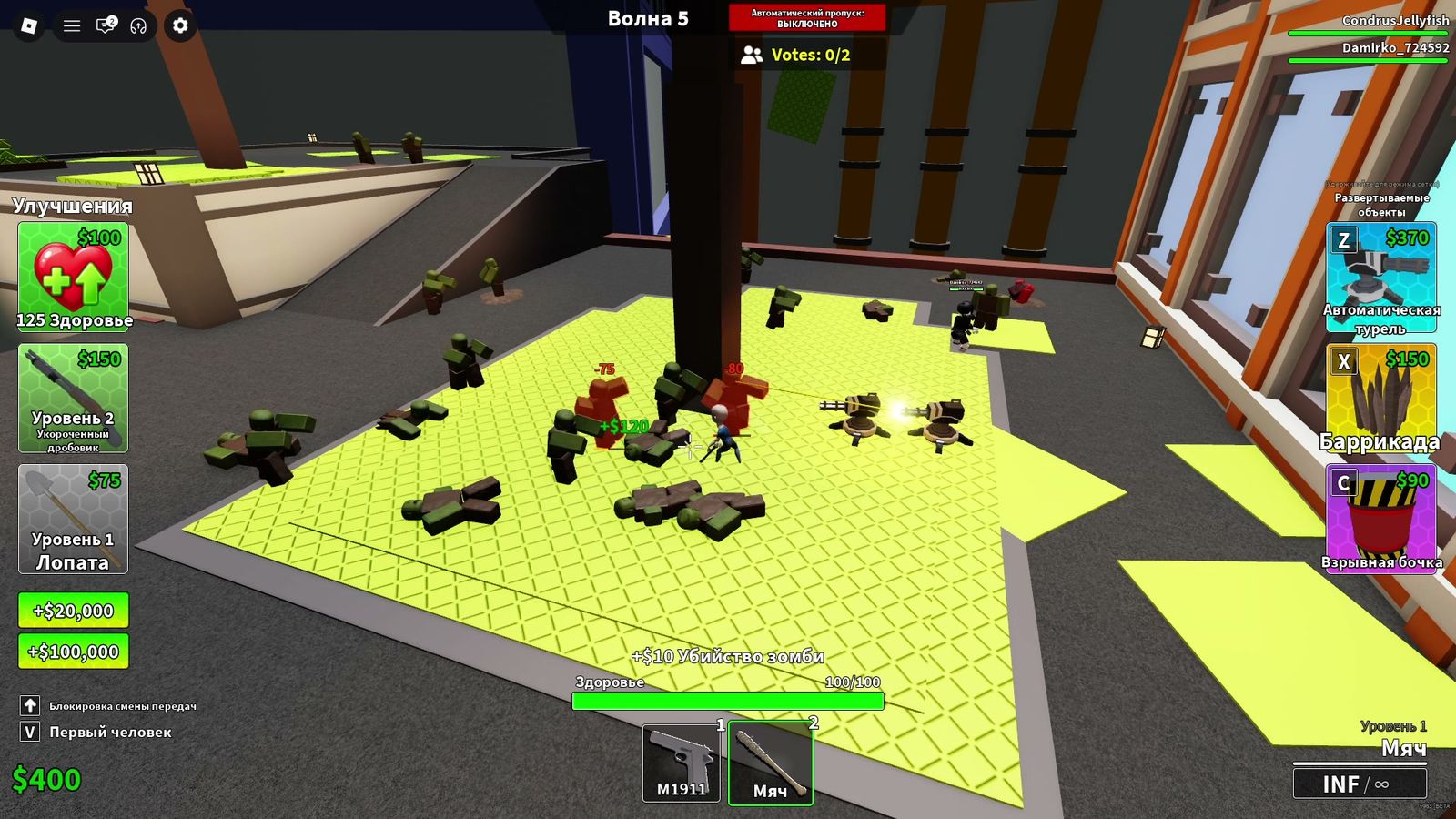
The HUD is gathered along the edges so it does not clog the top-down scene: at the top — wave status and the team, on the left — upgrades and toggles, at the bottom — health and weapon slots, on the right — defensive deployables. Building placement runs in a grid mode with a range preview.
| Zone | What it holds |
|---|---|
| Top | wave number · auto-skip · downed counter · player names with their HP |
| Left | HP / ranged / melee weapon upgrades · Zombux purchase (Robux) · gear-shift block · "First person" toggle |
| Bottom | own HP (X/Y) · melee and ranged weapon slots |
| Right | defensive deployables · "hold for grid mode" |
What to port, what to build and the final rating
The practical layer: a pattern-transfer matrix, the prototype direction, a rating by dimension and the final verdict.
Pattern-transfer matrix
Five confirmed patterns of the game broken down into decisions for your own project: why it works, how on-trend it is for the niche, how to port it, what it costs and the final verdict.
| Pattern | Why it works | Trend | Transfer | Cost | Verdict |
|---|---|---|---|---|---|
| Co-op wave-survival loop (kill → Zombux → weapon+defense → harder wave) | a compounding core with number-go-up and a "how many waves can you survive" goal; co-op for up to 30 makes failure forgiving | mature, stable demand | USE — the prototype's backbone | medium | take it as the foundation |
| A turret-defense layer as a second kind of decision | defense really wins the fight (2,946 of 3,216 kills — turrets); "where to place" gives tactical depth and a differentiator | rising, rare in the niche | ADAPT — the key twist | above medium | the main differentiator |
| Flat economy with a shared wallet in co-op | predictable, team-based; no combo-cheesing, money honestly tied to the number killed; the shared wallet — role-splitting | a proven co-op-game device | USE — the economy model | low | copy it directly |
| Weapon tier ladder (default + Zombux shop + Robux exclusives) | top DPS available via cheap defaults, expensive guns = prestige; buying is low-stakes, but the variety fan is wide | standard progression | ADAPT — rebalance the stakes | medium | take the structure, fix the balance |
| Light monetization (6 game passes 149–699, core not locked) | cheap thresholds + a premium top-end lift conversion without gating the fun; coexists with 96.95% likes | a proven F2P standard | USE — the monetization model | low | copy the structure |
What to build first
The minimal vertical slice of a clone: it should test both main hypotheses — whether the endless wave loop holds, and whether turret defense adds real tactics rather than decoration.
A co-op arena (one shared, top-down) with the loop kill → Zombux → weapon + turrets → harder wave. Flat payout per kill, a shared wallet. One class with 3 deployables (turret, barricade, barrel) as the second kind of decision. 2–3 zombie types (grunt + fast + exploding) and rising density wave over wave.
The other 5 classes, the full catalog of 6 weapon tiers, cases, cosmetics, late special zombies. First prove the core of the "shooting + defense" hybrid, then layer on top.
Does the defense layer change the player's decisions (where to hold the line) rather than just decorate? Is the "buy + place" phase readable under pressure? Do they launch a second run for the sake of "further along the waves"?
Final rating by dimension
A summary rating on a ten-point scale based on the teardown of all the game's systems: hook, core loop, economy, monetization, retention, the defense twist, polish and prototype potential.
Strongest of all — the defense twist (9): turret defense really wins the fight rather than decorating it. Polish (8) rests on 6 classes, 6 tiers, its own sounds/tracers and a 3D menu. Retention is lower (6): beyond dailies and record trophies, there are no deep live-ops mechanics. Economy (7) loses a point on the devalued weapon purchase.
A polished breakout with a turret-defense meta
Zombie Rush Survival is a polished co-op survival game where defense really wins the fight and light, fair monetization does not lock the fun. Its strengths — polish, sound and tracers, class variety. Its weaknesses — devalued weapon balance, a repetitive mid-game and the case UX.
A fresh (release 05/08/2026) co-op survival game from Undead Dev., which gathered 96.95% positive and a peak of 16 570 in ~2 months. It is defined by three things: the turret-defense meta (defense scored 2,946 of 3,216 kills in the analyzed run), light pay-for-power monetization (6 game passes 149–699 R$ with no core-content gate) and a high level of polish — 6 classes, 6 weapon tiers, its own sound and tracers on every gun, a 3D menu. For your own project the greatest interest is the pairing of the endless wave loop with a turret-defense layer and a flat economy on a shared wallet.
Weaknesses. The weapon purchase is devalued: top DPS is available via cheap defaults, expensive guns fall outside the stakes. The mid-run is repetitive until the late zombie types appear. The case UX does not show the "open 10" bundle discount. None of this breaks the core, but these are points worth fixing in a clone.
- Co-op wave-survival loop: kill → Zombux → weapon+defense → harder wave
- Turret defense as a second kind of decision — defense really wins the fight
- Flat economy ~$10/kill with a shared wallet in co-op
- 6 classes with trios of deployables — the core of the meta variety
- Light pay-for-power: 6 game passes 149–699 R$, core not locked
- Adapt: the weapon tier ladder — rebalance the purchase stakes
- Adapt: show the bundle discount in the case (a missed anchor)
- Avoid: a repetitive mid-game — add events between waves 20–35
Sources and confidence in the data
Methodological transparency: where every value in the teardown comes from.
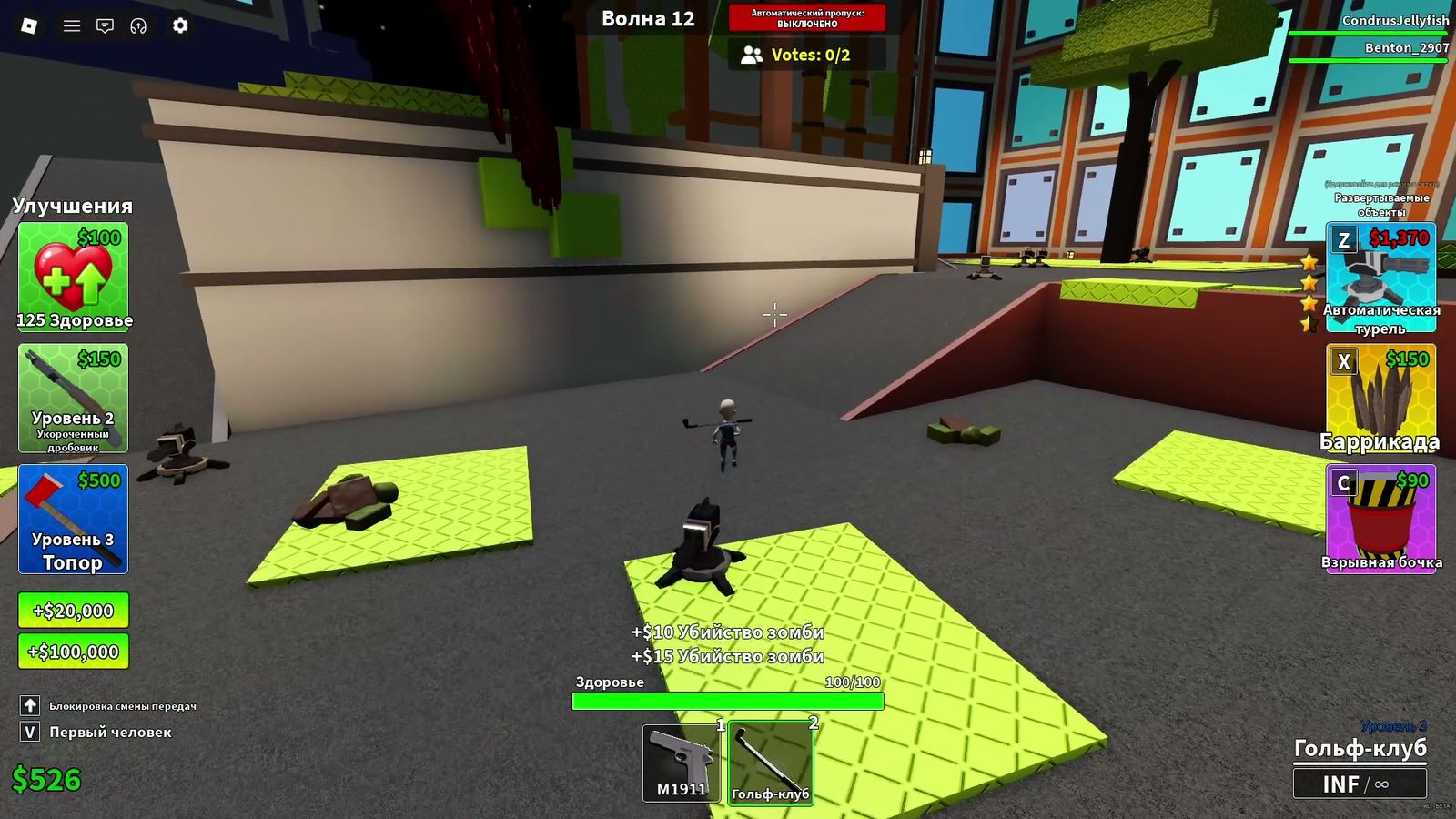
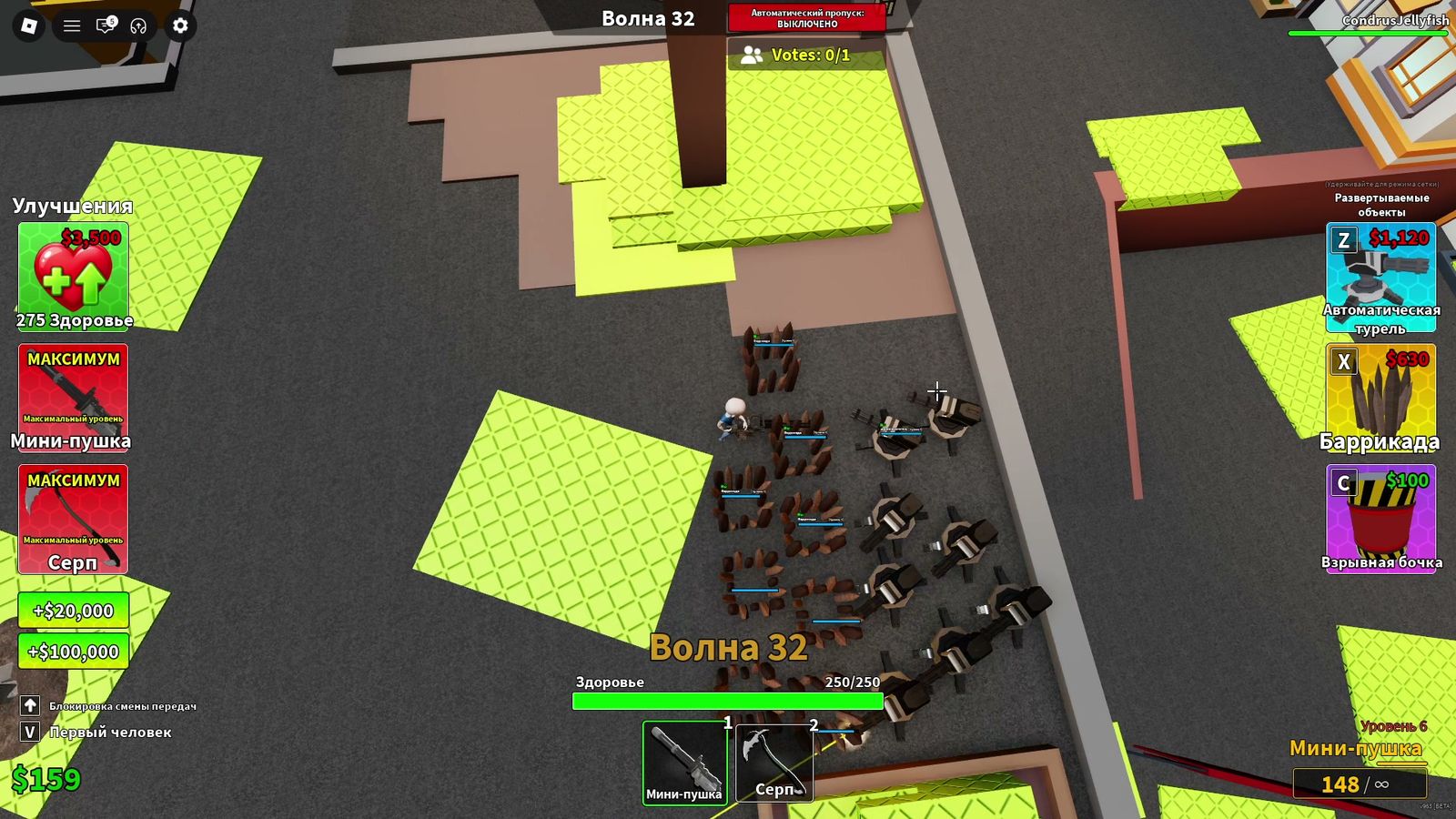
All values on combat, economy, weapons, classes, deployables and monetization are pulled from in-game playthrough screens: weapon and deployable stats, class and purchase prices, game-pass/case/boost price tags, case odds, run summaries (30 740 Zombux / wave 39 and 32 160 Zombux / wave 47) and the kill breakdown by source.
The title, developer (Undead Dev.), dates (release 05/08/2026, update 06/16/2026), server size (30), likes (96.95%), visits (~34M), peak concurrent (16 570) and the prices of the 6 game passes — from Roblox's public pages.
Sources & credits
Zombie Rush Survival · design teardown and clone reference · 2026